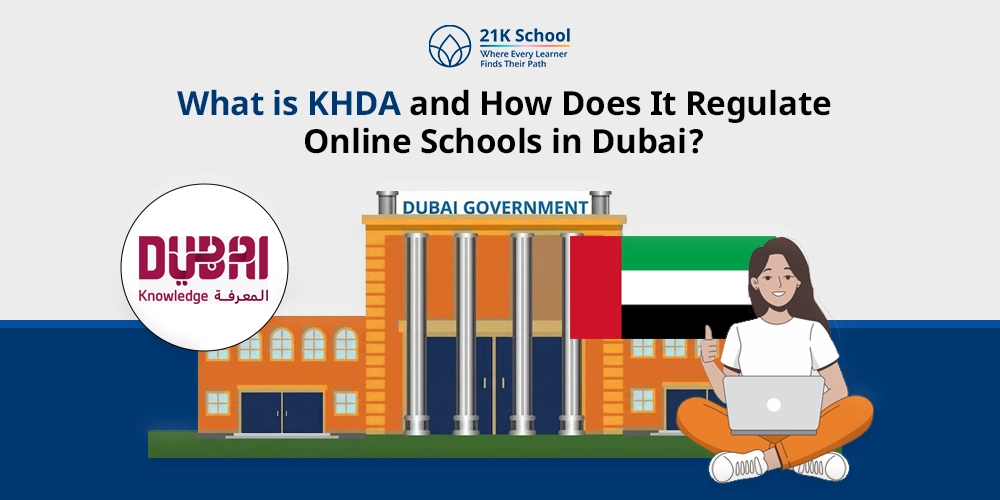
What Is KHDA and How Does It Regulate Online Schools in Dubai?
 Written byAnshu KumariContent Specialist
Last modified: Jul 31, 2026 14 min read
Dubai has emerged as a global centre for excellent learning, development , and families have become more insistent on flexible learning methods. That allows them to stay in accordance with international education standards.
During the past few years, online learning has become extremely popular and has enabled children to proceed with their schooling from the comfort of their homes with better accessibility and continuity.
As online learning keeps on increasing, there are significant concerns regarding the quality of education , the security of the learners and the use of academic qualifications. In this regard, the Knowledge and Human Development Authority (KHDA) can play a critical role.
KHDA is the government agency that controls and regulates the private education industry in Dubai and ensures that the schools and other institutions which educate students meet the high standards of teaching, learning, and well-being.
To simply state, KHDA helps to make sure that the schooling process in the city of Dubai (both online and private) is credible and high-quality and ensures that it can be trusted by the families.
The article will explain what KHDA is, why it oversees online schools in Dubai, why its authorisation is valuable, and the advantages that it brings to learners and parents.
What is KHDA?
The Knowledge and Human Development Authority (KHDA) is the official government body that regulates the Dubai private education industry and training centres.
It is largely directed towards upholding high standards of internationalisation in the learning institutions and providing the students with quality education opportunities in a safe and favourable environment.
Sheikh Mohammed bin Rashid al-Maktoum, the Prime Minister and Vice President of the UAE, was the founder of KHDA, which was established in 2006.
The authority collaborates with the learning institutions, which issue licenses, inspect teaching and assessment, and publish performance reports in such a manner that ensures accountability and transparency.
Amid the increased popularity of online education, KHDA has a major role to play in ensuring that the online schools and distance learning programmes are controlled. This is to ensure that the online learners have access to quality education, the safety of learners and the academic qualification is recognised and accepted.
KHDA also manages a large number of educational providers, which include private schools, nurseries, training centres, higher education institutions, vocational education institutes, and corporate training organisations in Dubai.
How does it regulate online schools in Dubai: 4 major KHDA's roles
In order to achieve high standards of education, KHDA has set minimum standards regarding the quality of curriculum , the qualification of teachers, student protection and licensing and supervision of online education providers.
1. Licensing and approval
Licensing and permitting of the educational institutions, including the online schools is among the most important duties of KHDA. Any providers planning to do online education in Dubai must comply with the KHDA regulations.
In the course of the approval, KHDA assesses the curriculum, teaching methods , technology, school management and learning support systems. Schools will feel compelled to demonstrate that the online platform is secure and reliable and can deliver an effective online learning experience.
Such a licensing system shields the families of unidentified or poor-quality schools and places the legitimised schools in a professional education environment, and keeps them responsible in the Dubai education system.
The initial review may commence within two weeks, while the whole process of licensing and approval requires approximately 7-8 weeks.
2. Ensuring curriculum standards
KHDA also makes sure that online schools are teaching on identified academic curricula that are of local and international standards. As Dubai is a multicultural city, schools ought to make their curriculum as diverse as possible, i.e. the British, American, Indian CBSE and the International Baccalaureate curriculum.
The authority carefully reviews these academic programs to be in a position to provide a balanced and quality education to the students. In the case of online schools, it also evaluates the effectiveness with which the curriculum is presented utilising online technologies.
KHDA assists in ensuring the qualifications obtained by the students that are locally as well as internationally recognised using the curriculum standards.
3. Monitoring educational quality
The other essential task that should be carried out by KHDA is to ensure the quality of education. The schools are constantly checked as to whether they continue to meet the standards as far as both the academic and the operational standards are involved.
When it comes to online schools, KHDA quantifies the engagement of students , the efficacy of instruction, digital classrooms , and educational successes.
The authority has also encouraged schools to conduct the relevant training to teachers on online pedagogy to enable them to become proficient in providing effective virtual instructions.
This ongoing check keeps the schools on their toes, it assists them to come up with improved means of instruction and in the process the students are guaranteed good and continuous learning.
4. Tuition & fees
KHDA also regulates the policies of tuition fees in the private schools in Dubai and online learning providers. The authority promotes transparency by giving guidelines, such as a school fee fact sheet on school fees, by making sure that schools do not levy unrealistic fees on their learning services.
The KHDA approval in raising the tuition fee may be required in the schools in order to cushion the parents against irrational financial practices. KHDA also checks on the policy of refunds and the payment system to make sure that families are fairly treated.
With online schools, the regulation of fees is especially crucial due to the possibility of different systems of tuition based on the digital services and support they offer. Supervision by KHDA assists in maintaining reasonable educational costs in line with the type of learning students receive.
Why KHDA matters in Dubai's education system
KHDA is the central body that manages private educational institutions in Dubai. It aims at making education of high quality, so that learners get proper assistance in their academic journey.
KHDA sets a standard that every private school or training centre in Dubai has to conform to. For this, it checks the school standards against PISA and OECD level frameworks.
Educational officials of Dubai understand that due to lack of such standards, the quality of education might be compromised across institutions, and learners and their parents might feel dissatisfied with the institutional facilities.
Parents feel relieved when they know that their investments are not going in vain. The DSIB organises regular inspections that check the quality of learning, teachers, resources, and fees of these schools.
These institutions also get ratings like good, very good, outstanding, etc. as per their reports and educational quality.
The KHDA also offers the option for remote learning during adverse situations, so that learners can learn at their homes while ensuring their own safety.
KHDA guidelines and distance learning policies
KHDA guidelines state that distance learning programs and courses will be continued in schools for the already continuing sessions.
It also clarifies that parents will be obliged to pay full tuition fees until the learners are provided with the quality educational resources and training, even if through virtual learning apps and platforms.
For learners and parents who find it difficult to operate technological gadgets must be given quality assistance and alternative learning options during the classes. Teachers can act as a pillar while learners learn through online learning.
It ensures continuous learning among learners while maintaining digital safety, assessment efficacy, engagement, and teacher readiness.
For teachers, professional training should be given to guide learners through varied learning platforms and digital processes. But, in all of this, schools are expected to regulate screen time for kids that induces a balance between a healthy mind and learning schedule.
4 benefits of KHDA regulations
The following are the main benefits of KHDA regulations in Dubai-based schools:
1. Transparency
One of the central advantages that learners and their parents experience because of KHDA regulations is transparency, which gives them the clarity to choose the best school in Dubai.
Parents also can access all details about the fee structure of each school while also confirming if the particular school is KHDA-approved.
KHDA gives assurance that a school abides by minimum quality standards and is credible for delivering education and certificates.
2. Quality assurance
Quality is another aspect that learners want to ensure before admissions in a certain school. If the school is approved by KHDA, you can be relieved of the fact that it passes basic quality standards.
For virtual learning set-ups , this quality assurance can be confirmed with efficient academic training, engagement in online classes, teachers' support, and assessment processes.
It also gives parents the assurance that the certifications from these schools will be recognized by employers and higher institutes.
The Dubai Schools Inspection Bureau (DSIB) works in close association with KHDA to regularly monitor and inspect schools.
Not just at the beginning, but even after that, the inspections are done to score the school's performance and quality checks. This encourages them to keep improving.
3. Student protection
Another key benefit of KHDA is that it prioritizes learners' safety and protection. Learners should feel comfortable and motivated to ask questions in a safe learning environment.
KHDA-approved schools keep your children's data safe and run on ethical principles. Even teachers have to maintain professional decorum in the classes, which might be either online or offline.
If there is any problem, parents, learners, and teachers are free to communicate and reach a possible solution that induces motivation in learners and keeps them mentally healthy.
4. Confidence in qualifications
KHDA-unapproved schools and institutions hamper the confidence of learners regarding their credibility of qualifications.
Schools that are KHDA-approved provide credentials and certificates that are hugely accepted by multiple universities and employers in Dubai. This applies for online schools as well.
Parents are often concerned about these certifications and their value in the real world. KHDA approval comes into play to help with these concerns as it guarantees the implementation of accepted curricula and recognised academic standards.
KHDA approval process: Step-by-step for 2026
Go through the following steps to understand the KHDA approval process in detail:
1. Step 1: Trade name and pre-approval
If you are planning to start a school start with the trade name and pre-approval by connecting with relevant Dubai authorities.
There are several types of educational activities including online school, vocational educational centre etc. Select your educational type and submit the details to get an Initial Approval Certificate.
KHDA reviews each section clearly and checks whether the mentioned information is meeting Dubai's education standards and regulations.
2. Step 2: Business and legal documentation review
In the next step, the Institute needs to submit business and legal documentation. The authorities review everything in depth.
This step is to make sure that the institution is established legally and financially to run a business in Dubai. Governance and management of the school must also be seen as transparent.
Some key areas include:
- Trade license details
- Ownership information
- Management structure
- Financial documents
However, there are several documents online schools need to share such as online platforms, cybersecurity systems, data protection systems etc.
3. Step 3: Curriculum evaluation
In the third step, the organisation evaluates the curriculum. The main aim is to check whether the curriculum meets the international educational standards.
For approval, schools need to pass the criteria like effective curriculum, meaningful teaching methods, and assessment systems for children's academic growth.
For online schools, KHDA also checks how virtual classes are managed and organised to make learning impactful for each learner. The goal is quality education.
4. Step 4: Facilitators and staff qualification assessment
Teacher and staff qualification assessment plays a major role in quality education. That's why KHDA analyses facilitators qualification, experience and assessment technique.
They also give special attention to online schools by demonstrating:
- Virtual classrooms
- Use of digital learning tools
- Conducting remote assessments
As per the KHDA, qualified facilitators support learners both academically and emotionally.
5. Step 5: Technology and infrastructure inspection
Technology-driven education is today's need. That's why schools that are applying need to share information related to:
- Learning Management Systems (LMS)
- Video conferencing platforms
- Student attendance tracking systems
- Cybersecurity measures
- Data privacy systems
As per the KHDA, schools need to include technology in education for quality education. It not only safeguards the environment but also motivates for future growth and success.
6. Step 6: Compliance and quality assurance review
In the next step, KHDA focuses on compliance and quality assurance before approving any Institute.
The aim of this step is to review whether the Institute meets all educational and operational requirements.
This review generally includes:
- Interviews with people involved in leading the school
- Policy evaluations
- Proper review of learning systems
The authority may also consider checking the student support systems, communications with parents and the practice of monitoring pupils' progress at online schools.
Any institution that does not meet the standards can be requested to make a change before the end of approval.
7. Step 7: Final KHDA approval and licensing
After all evaluations have been successfully passed, the institution receives KHDA official approval and the licence.
The approved schools are then legally allowed to run schools in Dubai and include themselves in their advertising as KHDA-approved schools.
Schools are expected to continue to abide by the KHDA regulations after securing approval.
The authority may, at any time in the future, perform inspections and evaluations of schools' performance to ensure that the quality of education in schools continues over time to meet standards.
Timeline for KHDA approval in 2026: Week-by-week
The KHDA approval procedure generally takes 7 to 8 weeks. However, it depends on the institution's readiness and documentation quality.
Go through a quick table to understand the timeline in detail:
| S.No. | Week | Activity | Possible reasons for delay |
|---|---|---|---|
| 1. | Week 1 and 2 | In the initial step parents submit:Application formImportant documents | Key reasons to delay are:Missing documentsincorrect detailsincomplete information |
| 2. | Weeks 3 and 4 | Document verification procedure | Key reasons to delay are:Delayed financial recordsOwnership issuesMissing approvals |
| 3. | Weeks 5 and 6 | Review facilitators qualifications and technology inspection | Key reasons to delay are:Weak digital systemsLess qualified facilitators |
| 4. | Weeks 7 and 8 | Final compliance review and licensing | Key reasons to delay are:Policy issuesOperational gapsPending corrections |
Conclusion
KHDA is a recognised organisation in Dubai popular for regulating the education system for learners.
The body is responsible for the licensing and methodological review of institutions that want to provide education to children. It works with private organisations, universities, training centres, vocational schools, and many more.
Whichever organisation wants to set up in Dubai and cater for their audience from there will have to go through the licensing and approval procedure of KHDA.
KHDA is also strict regarding parental concerns and issues. Therefore, school owners will have to ensure transparency in their academic and legal documentation.
Frequently asked questions
6 questions
What is KHDA?
KHDA is the Knowledge and Human Development Authority, a Dubai government entity. KHDA is responsible for direction, quality, and growth of private learning and education in Dubai. It regulates the training institutes, universities, early childhood centers, and private schools to ensure high standards of learning and student well-being.
Is KHDA approval mandatory for online schools in Dubai?
Yes, KHDA approval is mandatory for online schools in Dubai offering K-12 education. Hence, learners must enrol in the institutions which are officially accredited by the KHDA.
How does KHDA regulate online schools?
KHDA regulates the online schools in Dubai by a dedicated distance learning quality expectations framework and strict licensing regulations.
What curriculum is accepted by KHDA for online schools?
KHDA primarily accepts the American curriculum and the British curriculum for formal online schools. Further, the curriculum for online schools must meet the local standards of KHDA- mandatory instruction in English and integration of Islamic Education and Arabic.
How can parents check if an online school is KHDA-approved?
Parents can check if an online school is KHDA-approved by searching the official KHDA School Directory.
Does my child's online school need to be KHDA-approved in Dubai?
Yes, your child's online school needs to be KHDA-approved in Dubai if you want your child's online schooling to be counted under the mandatory education requirements in Dubai.
About the author
Anshu Kumari
Content Specialist
Anshu Kumari is an Education Content Specialist at 21K School- a fully accredited institute- Cambridge International (IA702) and Pearson Edexcel (94883). She focuses on the in-depth research and creation of the well-drafted guides on NIOS admission, Indian Education Policy, and competitive exam preparation. With around 2 years of experience at 21K School, her psychology background informs her approach to the education content and hence focuses on creating guides to address the real anxieties of the guardians. She writes well-researched articles on competitive exam timelines, stream selection, and board choices by referring to the official resources. All Anshu’s content pieces are fact-checked against the board and primary government official resources and is dedicatedly reviewed by the school’s academic team.
Every 21K School guide is written by our education team and reviewed by a subject facilitator before publishing.
Exploring a CBSE-pathway online school?
Talk to an advisor about 2026–27 admissions — no obligation.
Talk to an advisorComments
No comments yet — be the first to share your thoughts or ask a question.