

Are you aware of what the types of scholarships are and what one would be appropriate for you?
Education is among the best means of individual and national growth, but due to financial limitations, there are many deserving children who may not realise their educational potential. In order to eliminate this divide, a myriad of scholarships in India exist which are provided by the state, non-governmental organisations and respective institutions.
Such scholarships are intended to assist students who may be of various backgrounds based on merit, financial need, category, talent and discipline and motivate them to take higher education without the financial strain of covering their fees.
The knowledge of the various kinds of scholarships available in India assists the students in selecting the appropriate opportunities, which are in tandem with their academic interests, their socioeconomic background and their career dream.
Contents
Types of Scholarship in India: Category-wise
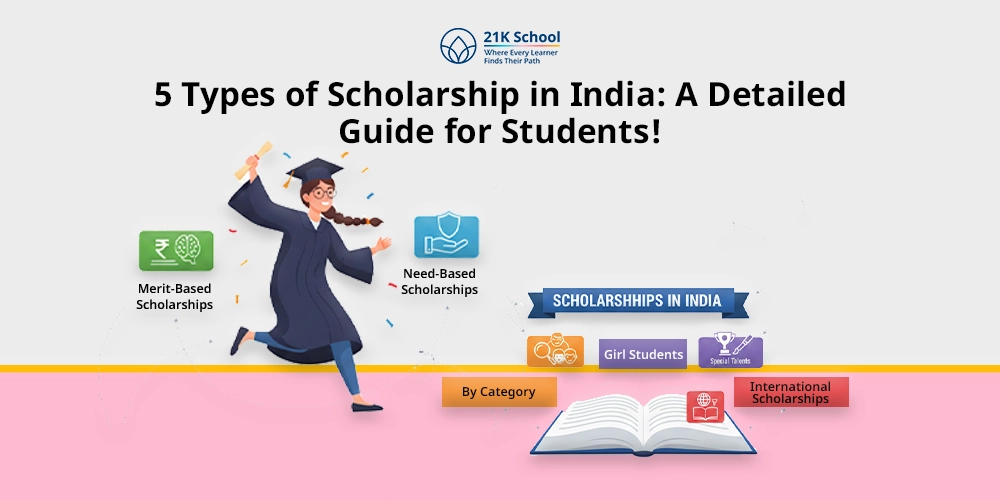
In India, there are various types of scholarships which are offered to meet the needs and potential of individuals and provide them with education.
Scholarship has various categories, which include school-level scholarships, higher education scholarships, merit-based scholarships and need-based scholarships, among others. This is a place where you are going to do research on the types of scholarships in India.
1. By Study Level
The scholarships are made available at various levels of study, including school (K-12), undergraduate, postgraduate, doctoral and postdoctoral. Study opportunities are also available in India and overseas; they are offered by government agencies, non-profit organisations and even individual organisations.
1.1. School Level Scholarships
A school-level scholarship is to be offered to students pursuing their studies in high school, usually up to the 12th grade. These scholarships are aimed at encouraging young learners to continue their education and prevent cases of school drop-outs due to poverty.
They also reward and recognise academic excellence at a tender age. The most prominent are the National Means-cum-Merit Scholarship (NMMS) given to Class 8 students who pass the NMMS test, and the scholarship remains till Class 9-12. The CBSE Merit Scholarship Scheme for Single Girl Child for students studying in classes 11 and 12.
1.2. Scholarships in Higher Education
Higher Education Scholarships are targeted to persons who are pursuing undergraduate, postgraduate courses or doctoral courses in various disciplines. These scholarships are aimed at reducing the burden of tuition fees, housing fees, as well as research costs and motivate students to get additional education.
The UGC and AICTE schemes would be among the big scholarships under this category; the Indira Gandhi PG Scholarship Single Girl Child, Pragati and Saksham Scholarships, and the Post-Matric Scheme of SC/ST/OBC.
1.3. Field-Specific Scholarships
Field-specific scholarships are provided to students who desire to major in particular areas of academic or professional such as engineering, medicine, law, management, science or arts.
The scholarships are the driving force to perform well in specific fields, and they breed talent which can be exploited to build the nation. They are the INSPIRE Scholarship among science students and the Aditya Birla Scholarship for engineering, law and management students.
2. By Eligibility Level
They may be further sub-categorised by the level of eligibility of the scholarships, with post-matric, school-level, and even each of the subsets that may then be further divided into girls and students with disabilities.
2.1. Merit-Based Scholarships
Merit-based scholarship is awarded based on the achievements or the outstanding performance of a student in academic subjects like sports, arts, or leadership. They should also reward good performance and motivate the performing students to put in more effort.
The common awards that are based on merit include the National Talent Search Examination (NTSE), the Aditya Birla Scholarship and the state-based merit awards.
2.2. Need-Based Scholarships
Students whose financial background does not able to afford them good education are awarded need-based scholarships. The scholarships are determined by the family’s economic background, and not only grades and therefore, no desirable student is denied an opportunity to receive any education without a financial reason.
These are the Reliance Foundation Scholarship, the Tata Trusts Scholarship and the other need-based schemes which are granted under the National Scholarship Portal (NSP).
2.3. Merit-Cum-Need-Based Scholarships
Those that are combined with the performance in academics and financial need are the Merit-Cum-Need-Based Scholarships. They are also targeted at bright students who require financial assistance. These scholarships establish a balance between need and merit, i.e. the capacity of poor students who cannot afford themselves is assisted in terms of finances.
The usual ones are the Indian Oil Academic Scholarship, the Swami Vivekananda Merit-cum-Means Scholarship and the FAEA Scholarship.
3. By Category
The list of categories, in which scholarships exist, is rather wide and can be roughly grouped into the following categories: eligibility, based on financial need, demographics, area of study, and location.
3.1. Minority Scholarships
Minority Scholarships are given to students who are of minority groups like Muslims, Christians, Sikhs, Buddhists, Parsis and Jains.
Such scholarships help to popularise educational prospects among the minorities and even enhance the representation of minorities in tertiary education. These are the Maulana Azad National Fellowship and the Post-Matric Scholarship of Minorities by the Ministry of Minority Affairs.
3.2. Wards of Special Personnel
Special Personnel Scholarships are also awarded to children of persons in the defence service, paramilitary, police, and other government servants. They recognise such staff members and their service to the communities by sponsoring their children’s education.
The Prime Minister Scholarship Scheme (PMSS) among the wards of the Central Armed Police Forces (CAPF) and the Armed Forces is one of them.
3.3. Students with Disabilities
The Scholarships with disabilities are supposed to offer inclusive education to physically, visually or mentally challenged students. Such scholarships not only contribute to the delivery of financial assistance but also increase access and equality in education .
Such cases include the AICTE Saksham Scholarship and the NHFDC Scholarships, which meet the requirements of the differently-abled students.
3.4. Girl Students
The Girl Student Scholarships are intended to ensure that the girls are encouraged to learn and reduce the difference between the genders in the learning process .
They help to increase female enrollment and make young women resolute to obtain higher education. Some of the outstanding ones include the AICTE Pragati Scholarship for Girls in technical education.
4. By Source of Funding
The funding sources to fund the scholarships are diverse, and this could be classified into four large groups, which are governmental bodies, education institutions, individual corporations and non-profit organisations.
4.1. International Scholarships
The international scholarships are provided by foreign governments, international organisations or Universities to help Indian students study in foreign countries. International learning and culture exchange is encouraged through these scholarships.
Others are the Fulbright-Nehru Fellowship, the Commonwealth Scholarship and the Chevening Scholarship.
4.2. Institutional Scholarships
The universities or colleges, and institutions, government and non-government, offer the Institutional Scholarships. These scholarships are mostly founded on merit or need and are directed towards attracting talented students into specific institutions.
Some of them are the Ashoka University Scholarships, Symbiosis International University Merit Scholarships and other fellowships provided by IITs and IIMs.
4.3. Private Scholarships
Corporations, NGOs or charitable foundations fund the Private Scholarships. They are mirrors of the social responsibility of the private organisations and are supposed to take care of deserving students in different streams. The most notable ones are the Reliance Foundation Scholarships, Aditya Birla Scholarship and Tata Trusts Scholarships.
4.4. Government Scholarships
Government Scholarships are centrally/state government subsidised, and the beneficiaries targeted by them are very wide, which includes SC/ST/OBC students, economically weak sections, minority and women. Such scholarships are offered through the National Scholarship Portal (NSP), and there are schemes like NMMS, INSPIRE and AICTE Pragati.
5. Miscellaneous Scholarships
Miscellaneous scholarships are an imprecise category of opportunities, which is not very well placed in a typical category like personal development, specific skills or talents.
5.1. Music Scholarship Programs
Music Scholarship Programmes specifically addressing the students who study or have studied music and the performing arts. They help the young artists to develop professionally . Some of the significant ones are the Inlaks Scholarship in Music and the ITC Sangeet Research Academy Scholarships.
5.2. Sports Scholarship Programmes.
The programme is the Sports Scholarship Programme, which is aimed at assisting students who are interested in sports either nationally or internationally. These scholarships are beneficial to athletes to continue with their education as they train to compete.
Such may be the Sports Authority of India (SAI) Scholarships, ONGC Sports Scholarship and Tata Trusts Sports Scholarships.
5.3. STEM Scholarships
The STEM Scholarships should support learning in the area of Science, Technology, Engineering and Mathematics. They enhance technical innovation and research.
The most popular are L’Oreal India For Young Women in Science Scholarship, Google India Women Techmakers Scholarship and the INSPIRE Scholarship by the Department of Science and Technology.
Conclusion
Scholarships in India are significant towards accessibility and inclusiveness of education to all. They sponsor deserving students to ensure they are not stressed economically so as to achieve their academic objectives.
These scholarships, offered by the government, private organisations and institutions, encourage merit, provide needed help and equality in opportunities in different fields.
Scholarships can not only help individuals to grow personally, but also bring national development and provide a skilled, educated and progressive society by empowering students of diverse backgrounds.

You may also want to read