

Let me ask a question first. How would you know if a particular teaching method is working efficiently?
There must be some indicators to know if you are having quality education. Right?
Similarly, it is crucial for educational institutions, policymakers, and teachers to assess the quality of education through some strategies or aspects.
We will look at these indicators of quality education one by one, and see how they evaluate the status of education. But, before that we need to understand what quality education is.
Contents
- What is Quality Education?
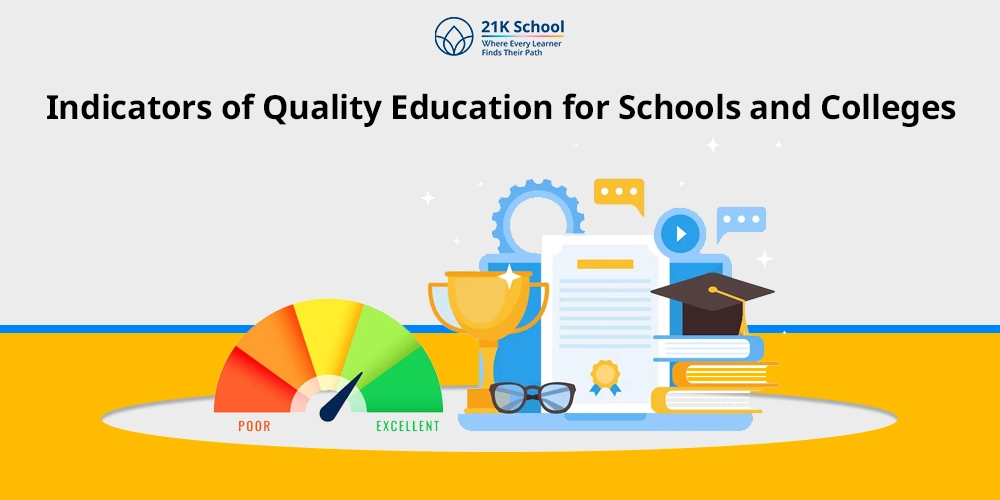
- 13 Key List of Indicators of Quality Education
- 1. Qualified and competent teachers
- 2. Learner-centered teaching approach
- 3. Safe and supportive learning environment
- 4. Relevant and updated curriculum
- 5. Effective assessment and evaluation practices
- 6. Student learning outcomes
- 7. Inclusivity and equity
- 8. Availability and proper use of learning resources
- 9. Community and parental involvement
- 10. School Governance and Leadership
- 11. Monitoring and accountability systems
- 12. Lifelong Learning Opportunities
- 13. Student Retention and Completion Rates
- Final Thoughts
What is Quality Education?
Quality education can be defined as a learner-centered system of learning that goes beyond traditional classrooms. Here students are taught in an inclusive and safe setting to enable their holistic development.
It encompasses life skills like critical thinking and personality development, fostering their emotional well-being, homeschooling and career growth.
The main aim of quality education is to maintain educational equity among learners.
It prepares the students to face the real-world challenges, so that they play a positive role in their society.
It is also measured through the educational outcomes and benefits that students receive from education systems, rather than just looking for the processes and techniques utilized.
13 Key List of Indicators of Quality Education
The following list consists of the indicators of quality education in schools, colleges, universities, and other institutions:
1. Qualified and competent teachers
Educators play a key role in every modern education system.
Quality teaching requires teachers who are well-trained, knowledgeable, motivated, and have a good command of the subject and pedagogical skills.
Constant professional development, decent pay, and favorable working environment can help teachers to be effective and innovative.
Teachers who actively cater to varied learning needs of students and motivate them to study are considered as efficient teachers.
2. Learner-centered teaching approach
Education turns out to be of the best quality when learners are the center of education and participate actively in learning, instead of being passive learners.
Students who learn in a learner-centred learning environment indulge in hands-on activities like group discussions and field trips.
This allows them to learn self-dependency and creates understanding about personal styles of learning.
Quality education implies active learning, inquisitive learning process, and meaningful teacher-student relationship.
3. Safe and supportive learning environment
Effective education requires a supportive and inclusive learning environment.
In recent times, parents are concerned because of poor school bullying statistics. This is why students need to feel more secure and confident in their learning environment.
When students do not feel discriminated against or bullied, they have better chances to focus on their education.
The learning outcomes of students are improved as they feel belonged and resilient when faced with challenges.
4. Relevant and updated curriculum
Quality education can be ensured by effective and relevant curriculum.
A quality curriculum is the one which is in trend with current societal and educational standards.
It fosters inclusivity and establishes a balance between academic and non-academic training.
This might vary from having digital literacy to incorporate moral values and a sense of responsibility through classroom learning.
One of the major approaches followed in quality curriculum is experiential learning due to which students learn real life skills and build competence.
5. Effective assessment and evaluation practices
Evaluation has to be efficient to determine if the education provided is effective. Assessments are mostly taken in two ways, which are formative and summative.
Formative assessments revolve around tests, quizzes, and discussions to get immediate feedback of student performance. On the other hand, summative assessments analyze the final results of students.
One thing that should be considered during these assessments is that they should be able to assess the learning objectives properly.
Quality assessment facilitates learning, highlights areas of improvement, and enables taking informed decisions for upgrading teaching methods.
6. Student learning outcomes
Learning outcomes represent what the students know and understand at the end of a course.
Quality education leads to a good academic performance, critical thinking, creativity, and social skills.
The results must be quantifiable, significant, and consistent on national and global levels.
Other important indicators are long-term outcomes which are employability, empathy, and civic-engagement.
7. Inclusivity and equity
Quality education is non-discriminatory and comprehensive. It means that all learners regardless of gender, learning disabilities, socio economic status, and cultural background are given equal chances to succeed.
With inclusive education systems, students with special needs receive specific support and adaptive instruction to accommodate different learning abilities.
Because of educational equity students are welcomed who are deprived of resources.
8. Availability and proper use of learning resources
The availability and accessibility of optimum learning resources is a good indicator that learners are getting quality education.
These materials might include online learning sources, digital textbooks, visual aids, labs, etc.
It is necessary that all learning resources are made available and well-incorporated with the learning sessions in schools and universities.
An effective application of these technologies in education improves student-engagement in the long run.
9. Community and parental involvement
Education might not achieve its best potential without the active engagement of parents and the community in general.
It is their support and intervention due to which learning outcomes become stronger and assist in ensuring overall well-being of students.
When families and communities partner with schools they reinforce the values of learning and offer more resources, which maximizes the quality of education.
10. School Governance and Leadership
Quality education needs transparent and participatory governance.
Responsible school authorities and policymakers can ensure equitable resource allotment and long-term planning for growth of institution and students’ future.
This would result in effective decision-making on behalf of students and implementation of policies.
11. Monitoring and accountability systems
It is crucial to have monitoring systems to maintain the quality of education.
The basic role of these systems is to regulate the effectiveness of teaching activities and student outcomes.
It finds the weaknesses and strengths of an institution through evidence-based analysis to decide how it can function better.
12. Lifelong Learning Opportunities
Quality education builds a lifelong learning culture that helps to develop curiosity, flexibility, and constant enhancement of skills.
Adult education, professional training, and informal learning opportunities make a person become relevant in the evolving world.
Lifelong learning helps in individual, long-term development.
13. Student Retention and Completion Rates
When an institution is able to retain students and motivate enough to complete their education, it signifies delivery of high quality education.
The quality education systems work on various aspects like academic support, financial help, family support, and students welfare.
These are to minimize the rate of dropping out and successful completion of the programs.
Final Thoughts
We need a large number of indicators of quality education to assess the availability of resources and teaching practices in an education system.
This is because ensuring quality education is a comprehensive and detailed process. These indicators give a base to improve the learning methods for students so that learning objectives are fulfilled.
The aim of providing quality education is to ensure that students become capable enough to face their life’s challenges, be empathetic, and responsible for societal changes.

You may also want to read