

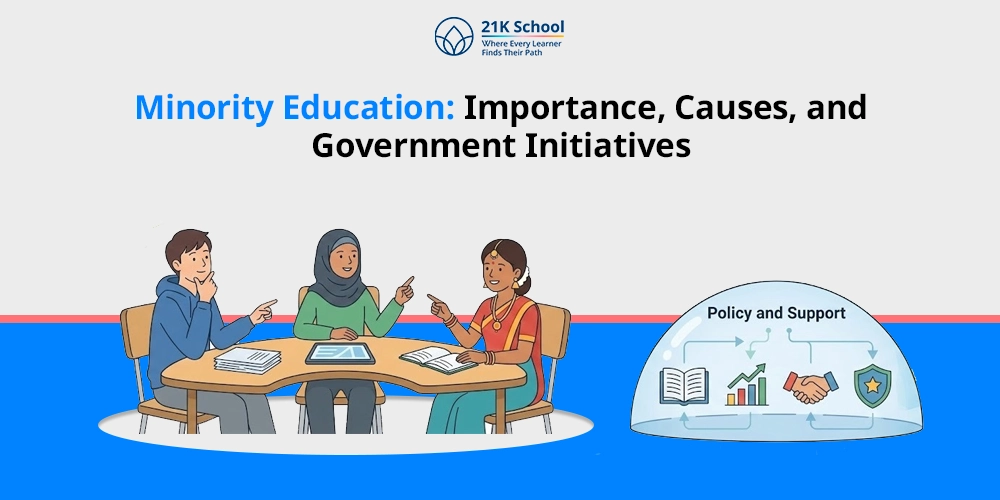
Education is a powerful tool for transforming individuals, communities, and nations. The objective is to provide access to education to every community.
A diverse country like India consisting of various minority communities including Muslims, Christians, Sikhs, Buddhists, Parsis (Zoroastrians), and Jains has faced various challenges, especially in the education sector.
That’s why minority education is one of the crucial terms to understand and need discussion in detail. This blog is all about a deep analysis of minority education.
Contents
What is Minority Education in India?
Minority education refers to education policies designed for minority communities in India. The main aim of minority education is to support the learning needs of individuals from minority communities.
It is supported by bodies like the National Commission for Minority Educational Institutions (NCMEI).
In India, minority education comes under Article 29 and 30 of the Constitution and includes religious groups like:
- Muslims
- Christians
- Sikhs
- Buddhists
- Jains
- Parsis
Article 29 protects the interests of minorities regarding conservation of their language, script, and culture. On the other hand, Article 30 gives minorities the right to establish and administer educational institutions.
Importance of Minority Education
Education is a fundamental right of every individual from majority to minority groups. To provide equal opportunity minority education in India is introduced.
Let’s understand the importance of minority education is:
1. Promotes educational equality
Many students often deal with various challenges related to minority groups facing social, economic, and regional disadvantages etc.
Through minority education, individuals can promote educational equality in the society between minority and majority.
2. Preserves cultural and linguistic heritage
To preserve cultural and linguistic heritage, education is one of the powerful tools especially for minorities.
Minority educational institutions promote mother-tongue instruction and cultural studies to ensure future generations respect and appreciate their differences.
Minority education promotes social inclusion through which students can participate actively in society.
Students interact with people to understand different cultures and communities. It helps them to reduce social exclusion and strengthens social cohesion.
4. Empowers economically weaker sections
Minority education empowers economically weaker sections by providing knowledge, skills, and employment opportunities, helping them become successful.
In this way, poverty and unemployment can be reduced.
5. Encourages national unity with diversity
Minority education encourages national unity with diversity by promoting collaboration between different cultures and communities.
In this way, people explore different mindsets, skills, and traditions.
Causes of Minority Education in India
There are various reasons due to which minorities face challenges to learn effectively. From social discrimination to limited access to resources let’s go through a detailed understanding on the causes of minority education in India:
1. Low quality of education
Minority communities are often marginalised due to poor quality education and knowledge. This is because schools lack proper infrastructure, trained teachers, and modern teaching methods.
2. Lack of Awareness and Institutional Support
Awareness about opportunities and institutional support is important to make education meaningful in the 21st century.
Minority groups are often unaware of various educational rights, government schemes, scholarships, and reservation policies designed to support education.
3. Gender-Specific Challenges
Gender-specific challenges impact females or girls where they face educational challenges and cultural barriers. Females are expected to marry, have children, and work at home instead of receiving basic education.
This creates an imbalance in growth, increases school drop rates, and decreases literacy rate.
4. Social Discrimination
Social discrimination is one of the major reasons for minority education. This discrimination is often done based on religion, language, or cultural identity etc.
It can negatively impact individual thoughts, self-esteem, confidence, and overall development.
5. Lack of access to higher education
Minority students are unable to access higher education due to various challenges such as financial burden, lack of awareness, language barriers, lack of support, etc.
The absence of quality education and institutions is also one of the reasons they are unable to pursue higher education and good employment opportunities.
Government Initiatives of Minority Education in India
The Government initiatives for minority education in India are one of the effective ways through which students can access quality education, reduce school dropout rates, provide financial help, and strengthen educational infrastructure.
Some popular initiatives are:
1. Scheme for Providing Quality Education in Madrasas (SPQEM)
The Scheme for Providing Quality Education in Madrasas (SPQEM) is implemented by the Department of School Education & Literacy (Ministry of Education).
The scheme was transferred to the Ministry of Minority Affairs from 01 April 2021. It aims to encourage traditional institutions such as Madrasas and Maktabs to introduce modern subjects.
Subjects in the curriculum like Science, Mathematics, Social Studies, Hindi, and English.
2. Scheme for Infrastructure Development of Private Aided/Unaided Minority Institutions (IDMI)
The Scheme for Infrastructure Development of Private Aided/Unaided Minority Institutions (IDMI) helps to upgrade educational infrastructure in minority elementary/secondary/senior secondary schools.
Infrastructure directly enhances educational quality and accessibility for learners.
In this way, the government helps to improve infrastructure quality by funding classrooms, labs, libraries, toilets, and girls’ hostels.
3. Sarva Shiksha Abhiyan (SSA)
Sarva Shiksha Abhiyan (SSA) was subsumed under the Samagra Shiksha Abhiyan in 2018, along with Rashtriya Madhyamik Shiksha Abhiyan (RMSA) and Teacher Education (TE).
It helps in achieving Universalisation of Elementary Education (UEE) for children aged 6 to 14. SSA has been subsumed under Samagra Shiksh since 2018.
In this way, every student can access education including minority communities.
Sarva Shiksha Abhiyan (SSA) works as a powerful base for improving the Indian school education system.
4. Pre-Matric Scholarship Scheme
The pre-matric scholarship scheme is a central government income-based scheme that offers financial assistance.
The Ministry of Minority Affairs runs the scheme specifically for minorities. While separate schemes exist for SC/ST/OBC under the Ministry of Social Justice.
The program is designed for classes 1 to 10 students to reduce dropout rates and continue learning for minority students. It is an ideal way through which a child can complete basic education.
5. Post-Matric Scholarship Scheme
The post-matric scholarship scheme offers financial assistance to minority students of class 11th and above.
It includes undergraduate and postgraduate courses. The scheme is ideal to reduce financial burden by covering admission fees, tuition fees, and maintenance allowances.
In this way, students can pursue higher education with confidence.
6. Merit-cum-Means Scholarship
Merit-cum-means scholarship is a program that helps financially to economically weaker backgrounds. The criteria to avail of the scheme are both high academic performance and low family income.
It covers tuition fees and provides maintenance allowances to students.
Key Minority Educational Institutions and Universities
The Minority Educational Institutions (MEIs) in India offer modern, holistic, and transformative education to children.
The MEIs come under Article 30 of the Constitution. Key religious/linguistic minority institutions include:
Muslim Minority Institutions
- Aligarh Muslim University (Aligarh)
- Jamia Millia Islamia (New Delhi)
- Jamia Hamdard (New Delhi)
- Shia PG College (Lucknow)
Christian Minority Institutions
- St. Stephen’s College (Delhi)
- Loyola College (Chennai)
- St. Xavier’s College (Mumbai/Kolkata)
- Madras Christian College (Chennai)
Sikh Minority Institutions
- Khalsa College (Amritsar)
- Sri Guru Tegh Bahadur Khalsa College (Delhi)
Other Minority Institutions
- Various Jain, Buddhist, and Parsi Institutions
Minority Education and NEP 2020
The National Education Policy (NEP) 2020 aims to ensure equitable, quality education for all no matter if an individual is from a minority or majority group.
Key aspects of NEP 2020 regarding minority education are:
- It aims to protect constitutional rights for minority educational institutions.
- The policy is designed to ensure the educational rights of minorities.
- It promotes access to basic education.
- It helps in reducing dropout rates through targeted interventions and regional language instruction.
Conclusion
Minority education is a powerful way to promote growth and development of each individual in the society. In this way, students can fulfill minorities’ educational needs.
Through various schemes and scholarships the government of India aims to improve access to quality education.
Implementation of government schemes and policies help students to fulfill their educational needs.

You may also want to read