

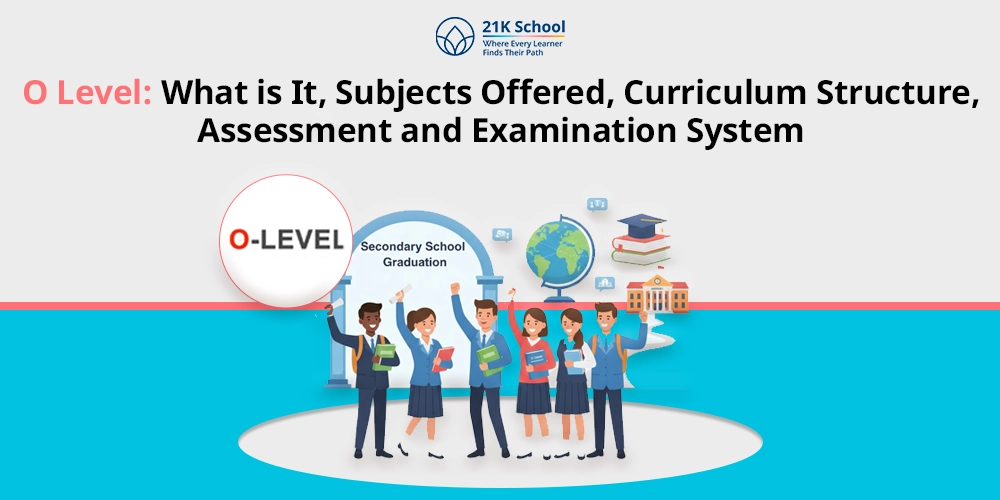
O level is a Cambridge IGCSE level of education or say the UK GCSE level.
It forms the base for the further A level education or any job opportunities that align with this qualification.
In this article, we would be looking at the detailed picture of O level, its history, prerequisites to attend this qualification, where it is recognized and why.
We will also see some challenges that lie in implementing O level, its curriculum structure, and then compare it with the other education systems.
Contents
- What is O Level?
- Historical Background of O Level Education
- O-level: Age Group and Duration
- Subjects Offered in O Level Education
- O-level: Curriculum Structure
- O-level: Assessment and Examination System
- 4 Importance of O Level Education
- 5 Advantages of O Level Education
- 4 Challenges of O Level Education
- O Level Education and Future Opportunities
- Comparison of O level with Other Education Systems
- Concluding Comments
What is O Level?
Ordinary Level also known as O level, is a secondary school level that started in the United Kingdom and is presently introduced in other numerous parts of the world.
Students usually take it at the completion of their secondary years and this can be used as a baseline to their further studies.
Cambridge Assessment International Education (CAIE) is also a typical examination board to award O Level qualifications.
O level education is aimed at the formation of profound knowledge on subjects and fosters critical thinking , practical skills, problem-solving , and self-study.
The evaluation of students is carried out using standardized tests, which prove impartiality and uniformity within regions.
Universities, colleges, and employers worldwide are largely concerned with the qualification.
Contrary to some educational systems that have put a lot of emphasis on continuous assessment , O levels focus on final assessments.
These tests determine both knowledge and comprehension of the students.
This renders O level as a very demanding and an honored qualification that makes students ready to face academic challenges in the future.
Historical Background of O Level Education
The O level education system has been applied in the United Kingdom since 1951 in an attempt to systematize the school education at secondary level.
Prior to its introduction, secondary education had no common assessment system, and thus, it was not easy to compare academic performance of students.
The O level was made to take the place of the School Certificate Examination and to offer a more structured method of secondary education which was inclusive.
It enabled students of various schools and actions to be evaluated on the same grounds.
This O level grew popular over time and was embraced by most countries. These were the countries which were mostly connected historically with the British education system.
O Levels were officially replaced in 1988, not 1986. The GCSE was introduced/phased in starting 1986, but the complete replacement occurred in 1988 with the last O Level exams sat in 1987.
But O levels were still taught internationally with Cambridge International Examinations.
O level qualifications are still a standard in international education. It is known today to be academically rigorous and globally relevant.
O-level: Age Group and Duration
The O level education is aimed mostly at the students between the age range of 14-16.
It normally lasts for two years, but might vary depending on the countries, their education systems, and the subjects studied.
O level education usually follows the lower secondary education.
At this age, learners are motivated to pursue various subjects in academics and acquire the culture of studying on their own.
The time can be helpful in terms of enough time to do in-depth studies, drilling, and practice before actual examinations.
Most schools are flexible with the subject choices that they learn, and thus the student can customize his education based on their interests and future objectives.
O level education is important due to the age group which it targets, as it is an important period of intellectual and personal growth in the life of a student.
At this age, the students start making critical choices regarding their academic and career careers. So, this O level education gives them the direction and base to make such choices.
Subjects Offered in O Level Education
O level education has a variety of subjects (more than 40) in various academic disciplines.
Such topics are made to suit all kinds of interests and career goals.
Common categories of subject matters are:
1. Core Subjects
They tend to be mandatory and develop necessary capabilities.
- English Language
- Mathematics
- Science (Physics, Chemistry, Biology or Combined Science)
- Second or National Language (e.g. Urdu, Bangali)
- Regional Studies (e.g. Pakistan Studies, Islamiyat)
2. Science Electives
Students who are studying STEM tend to choose the following:
- Physics
- Chemistry
- Biology
- Computer Science
- Additional Mathematics
3. Commerce and Humanities
These would be necessary for studying:
- Accounting or Principles of Accounts
- Economics
- Business Studies
- History and Geography
- English Literature
4. Other Electives
These include:
- Art & Design and Performing Arts
- Global Perspectives and Environmental Management
- Agriculture, Nutrition, or ICT.
The number of subjects chosen by the students would be approximately 7-10. The examinations are followed by certificates to continue the studies.
O-level: Curriculum Structure
O level curriculum is skillfully set to provide academic profundity and comprehensibility.
It is designed in a manner that makes it apt in localised context, even for learners who do not have a background speaking English as their first language.
The syllabus of every subject has detailed learning objectives, key topics, and assessment requirements.
The curriculum targets theoretical and practical knowledge.
The main characteristics of O level curriculum are:
- Practical and not just rote learning .
- Knowledge applied to practical settings.
- Analytical and critical thinking skills .
- Subject specific learning outcomes.
Hands-on learning is provided by practical elements, e.g., laboratory in science courses and coursework in creative courses.
Independent research, time-management , and good study practices are also promoted in the curriculum.
All in all, the O level curriculum is intended to equip students for examinations fosters lifelong learning and success in their academics.
O-level: Assessment and Examination System
O level education is mostly administered through assessment which involves exams.
The students will be assessed using written tests, oral vivas, and practical tests.
At the end of the course, examinations are made, which occur usually in June or November. The results are out by the month of August and January.
A* to E are the six internationally recognized grades that can assess achievement of students at various levels.
The assessment system is standardized, which makes it consistent and fair in all examination centers in the world.
The areas of assessment included in the examination system are communication knowledge, understanding, problem-solving abilities, critical and judgmental abilities, and applied competence (where necessary).
This strict evaluation procedure guides in ensuring the credibility as well as international association of the O level qualifications.
4 Importance of O Level Education
O level is important due to the following reasons:
1. Academic Foundation
O level education has offered a good academic background preparing the student to further academic levels like A Levels, IB or university courses.
This profound subject knowledge and focus on the concepts enable the students to migrate into higher education with ease.
2. Skill Development
Other than academic knowledge, O level education acquires crucial skills that include critical thinking, problem-solving skills , communication, and time-management skills .
The skills can benefit an individual in education and also in general life (employment in particular).
3. Global Recognition
O level is an internationally accepted level of education that is respected in most learning institutions and the employment sector globally.
This international acceptance will allow students to study or work in a foreign country and compete at the global stage.
4. Career Preparation
O level education is beneficial because it provides students with a broad range of subjects that focuses on practical skills.
It allows students to find out more about the career opportunities and make an informed choice concerning their future.
It prepares a ground of professional development and lifetime achievements.
5 Advantages of O Level Education
O level education provide the following benefits to the students who has taken it:
1. International Standard
O level education primarily has one of the best merits that it is internationally standardized.
International examination boards which have a reputed curriculum and examinations, design and monitor the examinations.
This will provide consistency, fairness, and high academic quality in various countries.
O level learners find it easy to apply in the institutions across the world because the qualification is commonly recognized in many countries.
2. Subject Flexibility
O level education gives a student room to select subjects based on their own interest, strength and career objective.
There is no definite stream and students have the option of taking science, arts, or commerce subjects.
This flexibility enables the learners to experience various areas and build a balanced academic profile.
3. Strong Academic Discipline
The O level system focuses on discipline, studying on a regular basis, and getting an in-depth knowledge on subjects.
The students are expected to manage their time efficiently, fulfill the syllabus standard, and give standardized exams.
This academic discipline teaches the students to be responsible and mature academically.
4. Preparation for Higher Education
O level education is a stepping stone towards the higher education programs including the A levels, International Baccalaureate, and the university studies.
The basic emphasis on analytical thinking, written expression, and problem solving prepares the students with the ability to achieve success in advanced academic conditions.
5. Development of Independent Learning
Students in O level classes are also suggested to learn on their own and conduct research by themselves.
This builds self-confidence and critical thinking ability.
The habits of independent learning developed at the time of O level education are good throughout life and in higher level academic studies.
4 Challenges of O Level Education
Some of the drawbacks that learners should consider before choosing O level education are:
1. Academic Pressure
The O level system is academically vast which exerts a lot of pressure on students to make good results in examinations.
This competitive grading and high expectations lead to study-stress at times particularly to students who perform poorly in exams.
2. High Workload
The comprehensive structure and content structure under study are extraordinary which demand a steady dedication and prolonged study hours.
To have a balance in study-routine and to manage multiple things might become a worrying issue, especially when one is weak at time-management.
3. Limited Practical Exposure
O level education is mostly theoretical even though in some subjects, there are practically oriented parts.
This can inhibit practical learning and exposure in some subjects particularly relative to skill-based/vocational education systems.
4. Access and Cost
The O level education is costly because of higher tuition fee, examination fee, text books, and others.
The accessibility of good O level schools and trained teachers in some areas might be difficult too, and hence can not be accessible to all students.
O Level Education and Future Opportunities
If you are a student qualified from O level education you can have a bright future ahead. This might open up the following opportunities for you:
1. Higher Education
Students who have done O levels may continue with A levels, foundation courses or some other post-secondary qualifications similar to pre-university qualifications.
Colleges and universities across the globe accept O level results, and therefore, students have the opportunity to study both locally and internationally.
Good O Level results enhance the chances of getting admission in prestigious institutions.
2. Career Pathways
The O level education enables the student to determine their personal interests and strengths, which could direct them to appropriate future jobs in the 21st century .
O levels help students develop skills and choose the subject they will continue in their career at higher education or professional training levels.
These might be the fields of science, business, humanities, technology, and more.
Comparison of O level with Other Education Systems
You will have a better understanding of O level education once you compare it to the other education systems like:
1. O level vs A level
O level and A level are both British education paths which have different purposes.
O level is a secondary level qualification normally completed by students, whose age is between 14-16. Its aim is to build a strong academic foundation and a vast array of subjects.
A level is a higher, pre-university qualification, a follow-up to O level, and is normally pursued by individuals at the age of 16-18.
O level is more focused on general and simple ideas.
A level involves in-depth learning about the subject and specialization, making the students fit directly for university education.
2. O level vs IGCSE
The level and international acclaim shared by O level and IGCSE differ in minor aspects like structuring and teaching methods .
O level is more traditional and exam-based. IGCSE is more flexible with some form of coursework and practical examination in certain subjects.
O level has academic rigorous and respected subjects, particularly in those countries where it has existed over a long period of time.
3. O level vs Local Systems
O level is a global qualification as compared to the local education systems like Matric, SSC, or other national boards.
Generally, O level concentrates on conceptual analysis and the application of knowledge. Mostly, the local education system tends to concentrate on memorization and textbook learning.
O level exams are externally marked and assessed under international standards.
Local assessment relies on national exams and percentage grading based on a national-level assessment system.
4. O level vs American Systems
The O level system is very dissimilar to the American education system with respect to structure and assessment.
O level is mostly examination-based, and the end-level grades of the students are assessed through external exams at the end of the course.
Comparatively, the American system uses ongoing testing which comprises classwork, projects, quizzes, and tests. All these assessments sum up into a student’s Grade Point Average (GPA).
The O level is based on a set syllabus and standardized exam.
Whereas the American system is more flexible on the choice of subjects taught. Students are evaluated after a long period and not by one set of final exams.
Concluding Comments
O level education is similar to class 9th-10th class in our education systems, but with more specificity and advanced subject choices.
Though it’s a Cambridge based system, it is still renowned in many other countries with an emphasis on British history and their education.
The O levels promote students to acquire practical and theoretical knowledge that is required for stepping up to the A levels or any other higher education routes.
You can understand that besides its high cost and work load, it has gained its popularity among various parents and children.

You may also want to read