

Education can be the only light that can brighten the future of any social region.
And this becomes truer in case of rural areas, which haven’t seen development in ages.
We often see that these sections of our society remain ignored due to lack of upliftment and general awareness, and hence result in keeping the development of the nation at stack.
This is why the government of India should pay large attention to the delivery of education in all areas of each state.
In this article, we will understand the importance of education in rural areas, and how it can affect the lives of rural people for their growth.
Contents
- What is Education in Rural Areas?
- Importance of Education in Rural Areas
- 1. Bridging the Urban-Rural Divide
- 2. Enhancing Agricultural Productivity
- 3. Promoting Entrepreneurship
- 4. Reducing Migration
- 5. Empowering Women Economically
- 6. Reducing Poverty and Inequality
- 7. Improving Health and Hygiene
- 8. Empowering Women and Girls
- 9. Encouraging Civic Participation
- 10. Preserving Cultural Heritage
- To Sum It Up
What is Education in Rural Areas?
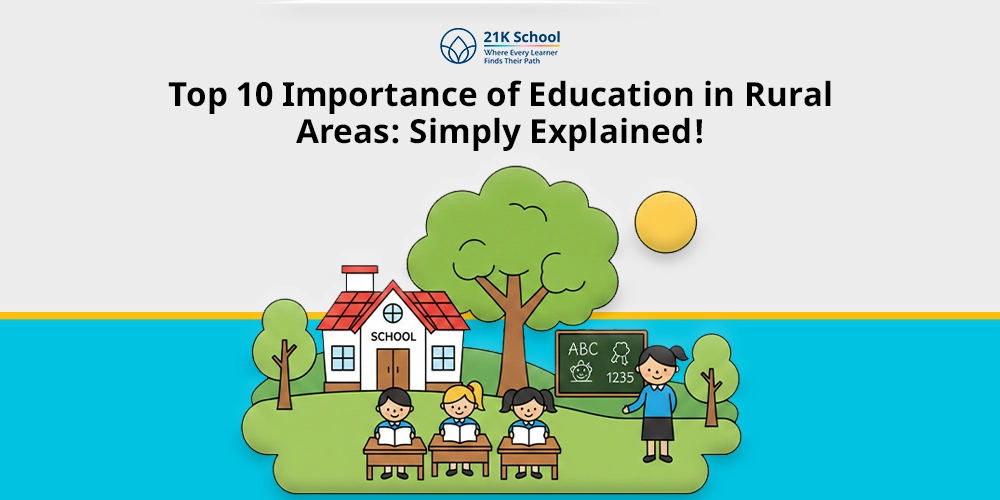
Education in rural areas means the delivery of education and educational facilities to citizens living in villages, small towns or remote areas.
It encompasses formal, non-formal, and vocational education to address the needs of a rural population.
Rural education involves access to learning which is relevant and practical.
It discusses the special concerns of the rural population including dependency on the agricultural sector, gender inequality and lack of job opportunities.
The kind of education provided to rural people is effective in terms of combining an aspect of tradition with life skills .
This could look like farm training along with technological advancements, so that villagers become capable enough to support their families financially and morally.
Importance of Education in Rural Areas
The importance of education in rural areas targets inclusive growth and social transformation of a nation.
Some more of these significance are:
1. Bridging the Urban-Rural Divide
Education is instrumental in decreasing the disparity that exists between urban and rural societies.
The rural students are usually disadvantaged in relation to their resources and employment opportunities.
An example of this bridge is good education that prepares the rural youth with skills that would enable them to compete with others.
The availability of online technologies and online education at rural schools facilitates the fact that children living in villages have an equal chance to study.
This gap in education needs to be filled to have balanced national growth.
2. Enhancing Agricultural Productivity
Most of the rural economies depend on agriculture which can be advanced by education.
An educated farmer could know better how to manage his soil, his crops, modern irrigation methods as well as sustainable farming, compared to an uneducated farmer.
Education can also assist the farmers to decode the market trends, finances and utilize the government schemes.
Literacy programs and agricultural training programs enable farmers to embrace innovation that enhances productivity and profitability.
3. Promoting Entrepreneurship
Education fosters creativity, problem solving and innovation which are also important qualities of being an entrepreneur.
Rurals or villagers see more opportunities than others in setting up small companies and self-employment opportunities.
And these can be simple poultry farming, handicrafts, dairy, or pottery businesses.
Entrepreneurship will decrease the reliance on agriculture only and diversify the sources of rural family income.
4. Reducing Migration
One thing that has been faced in the rural areas is the migration into urban areas to seek jobs and education.
The result of this migration is the overpopulation of the cities and the rural lands underdeveloped.
This trend can be countered with quality education in the villages.
With the potential to acquire the rural youth with employable skills and vocational training. They can easily be able to seek or develop opportunities in their respective communities.
The rural communities can afford to stay home locally because education offers them career opportunities locally, like teaching, health care, or agro-industries.
5. Empowering Women Economically
Women education can be one of the best methods of empowering rural communities.
Once they are educated, women become financially independent, are later integrated in the work force and make sound decisions on behalf of their families.
Women who are educated have a higher probability of investing in the education of their children, better nutrition, and efficient utilization of family resources.
Programs aimed at rural education focusing on education of girls contribute to gender equality, and postponement of early marriages.
Explore the importance of girls education .
6. Reducing Poverty and Inequality
The most effective tool of ending the cycle of poverty can only be education.
Education gives a person the opportunity to find a better job, earn more, and raise the standards of living in a rural environment.
It alleviates equality because it makes the marginalized groups more empowered to engage in social and economic activities.
Through its encouragement, literacy and professional training have assisted village families to ensure backward mobility and decrease division of wealthy and poor.
This would eventually result in a fairer society.
7. Improving Health and Hygiene
Through education, people are encouraged to be conscious of their health and hygiene.
Literate people are more knowledgeable regarding preventive measures of diseases, family planning and sanitation methods.
Health education can be life-saving in rural settings where the disease might get severe due to lack of health care and awareness.
Educated mothers have higher chances of immunizing the children properly and upholding hygienic environment at home.
8. Empowering Women and Girls
The education of girls is one of the pillars of sustainable education and an investment in the younger generation. Education is a pathway to equality .
Most communities in rural areas follow historic conditions of isolating women, depriving them of opportunities to build careers because of their gender.
Learned girls are bolder, independent, and can bring positive change in the society where they live.
Other than that, female education results in fewer family members, healthier children, and social awareness.
9. Encouraging Civic Participation
Education raises civic responsibility and political awareness.
The educated citizens living in the rural regions tend to be more aware of their voting rights, and keep the local government in check.
Civic education also helps in improving transparency and depleting corruption, besides enhancing democratic governance at the grass-root level.
The educated are also better placed in terms of facilitating community development projects locally.
They are more active in participating in community organizations, as well as making contributions to community welfare programs.
10. Preserving Cultural Heritage
Education provides modernization, but on the other hand, it helps in the maintenance of the fine culture in the rural set up.
Educated people are able to record, glorify, propagate local art, language, folklore and customs.
Through the introduction of cultural studies in rural education, the schools will have the ability to inculcate pride and the sense of heritage in children.
This balance between continuation and change makes sure that nothing is sacrificed to modernization and cultural identity is promoted.
To Sum It Up
Many villagers think that education can harm their nativeness and cultural upbringing.
But that is a really outdated thought and view of education.
Now, education is a necessity, and we as a society are still unable to provide basic and advanced levels of education in these corners of our villages.
We are really messing up something big.
The importance of education in rural areas is for overall development of a nation, and the participation of these sections are crucial in the same.

You may also want to read