

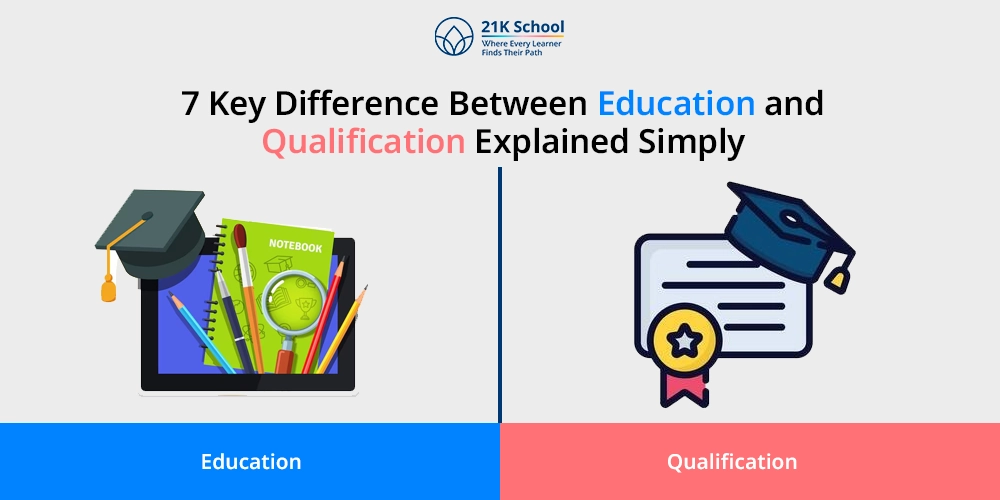
Have you ever wondered why education and qualifications do not go hand and hand?
Some of the words that are used interchangeably in the contemporary competitive world are education and qualification, yet these two are not the same. Education refers to the general process of learning, the ability to think critically, and intellectual growth.
It defines the personality, thinking, and perception of the world to a person. Qualification, however, is an official acknowledgement of skills or Knowledge in the form of certificates, degrees or that which can be used to demonstrate academic or professional ability.
Education will expand the mind and soul, whereas a qualification certifies particular learning success. It is important to know the difference between the two because the only way to be a true success is not only to comprehend what is on paper, but also to put the knowledge to use in real life.
Contents
What is Education?
Education is a process by which one learns, acquires, appreciates and comprehends things that aid people to grow intellectually, socially and emotionally. It is not just limited to learning in the classroom setting; it is all about experience, which leads to the formation of character and the development of the individual.
Education teaches individuals how to reason and problem-solving to make the correct decision that is going to make society and their lives better. It also instils innovativeness, interest and ethical values; hence, people can embrace change and play a significant role in their societies.
Besides, social understanding, empathy and tolerance toward other people may be established through education and make a society more tolerant and progressive. Education, in essence, is not merely the act of attaining academic knowledge only but it is a life process that shapes the entire person and prepares the students to live a successful life.
What is Qualification?
The official expression of what one knows, what abilities one has, as well as the skills, is a qualification which is usually acquired by formal training, education or by any practical knowledge.
It is the physical evidence of the competence of the person and can usually be depicted by certificates, diplomas, or degrees that are granted by educational institutions or professional associations.
Qualifications indicate that one has passed through certain academic or professional stipulations that are required in a specific job or profession.
Compared to education, which is larger and more general, in personal and intellectual development, qualification is narrower and more professional, i.e. it is more dedicated to mastering certain subjects or skills.
Key Difference Between Education and Qualification
Education is the general process of learning, and qualification is the more specific process of being issued with a degree or a certificate that you have passed a set of standards in a certain field or occupation. This is the difference between education and qualification mentioned below.
| Aspects | Education | Qualification |
| Meaning | The general process of gaining knowledge, skills and judgement is education. | The specific and formal credentials that demonstrate that you finished a programme and that you are worthy of a specific field are qualifications. |
| Nature | Education is a fast-moving lifelong process of learning, developing skills and values in order to attain personal and social development. | Qualifications are official documents that validate the successful graduation of a given educational course. |
| Purpose | Education is meant to make a better person or a better professional and equip them to be productive and contributing members of the society. | Qualification is meant to authenticate the knowledge and skills acquired in the course of education, which means that career opportunities and promotion become available. |
| Objective | The primary goal of the educational process is to lead to the overall development of the person and help them to realise their potential and become a productive member of society. | The qualification goal is as a credential to certify the acquired skills and knowledge to be used in a career and for social acceptance. |
| Outcome | The result of learning is the general growth in the intelligence, character, and personality of an individual. | The result of qualification is physical evidence of success, e.g. certificate, a diploma or a degree. |
| Types | There are primarily three forms of education, namely, formal, informal and non-formal education | There are three types of qualification: academic qualifications (degrees), professional qualifications (professional certifications), and vocational qualifications (practical, trade-based credentials like BTECs and NVQs). |
| Example | A case in point of education is the study of history, science, culture, or ethics not to pass the exams but to know the world and the art of critical thinking. | Examples of qualifications include formal education like a bachelor’s degree or a master’s degree, and professional qualifications like certifications. |
1. Definition
Education: Education is an ongoing and lifelong process through which individuals acquire new knowledge, skills, attitudes, as well as values that make up their personalities. It does not just concern its formal schooling but all learning methods acquired during life, in the classroom, at home or in society.
Qualification: Qualification, however, is the official acknowledgement or certification that an individual has acquired some form of learning or mastery in a given field. It is typically given upon successful completion of a course, successful exams or meeting the demands of an educational or professional organisation.
2. Nature
Education: Education is holistic, extensive and lifelong in nature. It includes mental, emotional and social development and makes people cognise the world and their place in it. Education does not begin and end with textbooks or classrooms, but it is about life lessons, experiences, and personal growth. It emphasises on critical thinking skills.
Qualification: Qualification is specific, formal and result-oriented. It is set on attaining quantifiable academic or professional results. Qualification is organised in a prescribed curriculum, examination and grading system. It is practical in nature and specific in terms of preparing people for a certain career or occupation.
3. Purpose
Education: Education is required in order to result in a well-rounded person capable of making a positive impact in society. It is geared towards the developing intellectual ability, morals, emotional intelligence and social responsibility.
Qualification: Conversely, the purpose of qualification is simply to certify that one possesses the knowledge and skills which are relevant in a particular job, trade or study. It is possible to define qualifications as a way of being validated, so that a person has passed some standards or criteria.
4. Objective
Education: The overall aim of education is to foster lifelong education and whole-person development. It aims at developing mental curiosity, creativity, discipline, as well as moral values of students. The purpose of education The homeschooling is to create independent thinkers and be able to analyse the situation critically, effectively resolve problems and be able to adjust to the changing environment.
Qualification: The intent of the qualification is more realistic and measurable. It is intended to demonstrate that one has completed a certain course of study or training programme. Qualifications portray that an individual is able to perform some tasks or roles.
5. Outcome
Education: Education refers to the general process of cultivating the mind, character and personality of a given individual. It causes an individual who is capable of thinking critically and acting ethically, and he or she is beneficial to society.
Qualification: The outcome of qualification is a concrete indication of achievement such as a certificate, diploma or degree. It refers to the fact that a person has successfully passed the academic or professional exam of a specific discipline. It is common to use qualifications in order to secure a job, promotion or even to further their studies.
6. Types
Education: Education has three broad categories, which are formal, informal and non-formal. Formal education is institutionalised in the sense that it is done within schools and universities, whereas informal education is spontaneous and it does not take place within institutions, including learning in the family. There are also informal education, which will be more casual and automatic and may not lead to a certificate, like training or workshops.
Qualification: There are different levels of qualification, such as academic degrees, bachelor’s and master’s, vocational and professional qualifications, such as certifications and diplomas and other forms of qualifications, such as certificates of higher learning or professional qualifications.
7. Example
Education: An example of education is the learning of history, science, culture or ethics, not only to pass an examination but to know the world and think critically. A student who is taught about teamwork, communication, and leadership both in the classroom and in the extra-curricular activities is receiving an education in a general sense.
Qualification: one of the qualifications could be having a Bachelor of Degree in Computer Science, a Diploma in Mechanical Engineering or a Nursing Licence. With the help of these documents, it is officially confirmed that a particular person has passed a certain programme and can demonstrate all the knowledge and skills needed in that sphere.
Conclusion
Education and qualification are similar terms, but they are used in different contexts in the life of a person. Studying is a lifelong process which builds the knowledge, values, and understanding which influences the character and attitude of the person towards life.
Qualification, on the other hand, is official confirmation of a certain ability or education, which can be a gateway to a career in most instances. It may be true that qualification will be the gate to a job, but education will bring in the wisdom, the ability to make use of the opportunities.
The secret to success is to balance between being competent and being educated enough to be in a position to utilise that knowledge in real life.

You may also want to read