

Education is not limited to learning textbooks. Students also need various physical activities from early childhood to improve physical and mental fitness.
Physical development is equally important for students’ personal and professional growth. Various physical activities like walking, swimming, writing, drawing etc improve 21st century skills .
They are essential for performing day-to-day tasks like participation in sports, writing competition, playground activities etc.
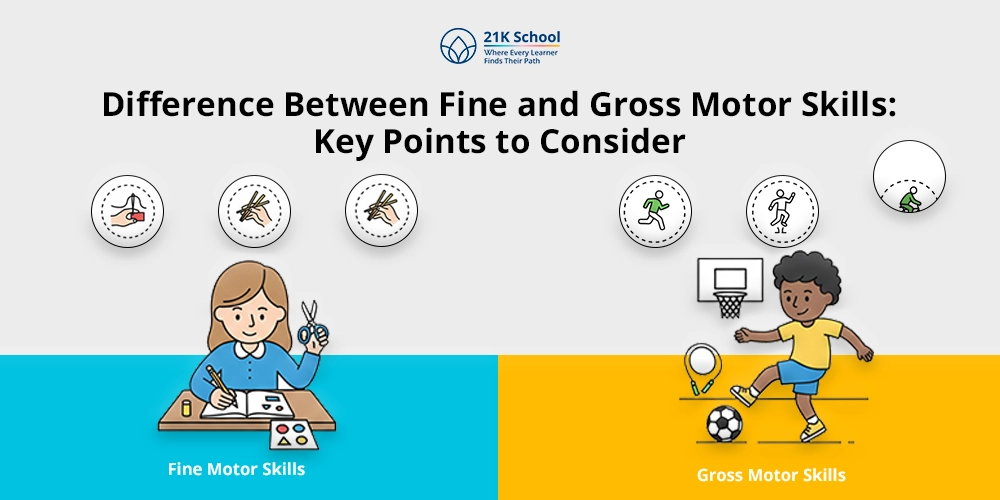
In early childhood development, motor skills are the foundational stone of any child growth which includes two types: “Fine Motor Skills ” and “Gross Motor Skills ”.
Let’s understand the difference between fine and gross motor skills to implement each one effectively.
Contents
What are Fine Motor Skills?

Fine motor skills include various fun learning activities that help in coordination of small muscles, especially those in the hands, fingers, wrists, and toes.
Fine motor skills are crucial because:
- It supports academic learning.
- develop independence in daily activities.
- Improve hand-eye coordination.
- Foundation for occupational skills.
- Improve focus while learning .
What are Gross Motor Skills?

Gross motor skills include various physical activities that help learners to use large muscle groups. It is an ideal way to control body movements.
Some common examples like walking, jumping, running, climbing, and balancing enhance students’ strength, stability, and overall body control.
Gross motor skills are crucial because it:
- Support body balance and posture.
- Ensure strength, and coordination.
- Gross motor skills are the foundation for fine motor skill.
10 Key Difference Between Fine and Gross Motor Skills

Given below are the 10 key differences that distinguish between fine and gross motor skills:
| S No. | Particulars | Fine Motor Skills | Gross Motor Skills |
| 1. | Meaning | Fine motor skills include small, precise movements using the hands and fingers of individuals. | Gross motor skills involve large, coordinated body movements using arms, legs, and torso. |
| 2. | Muscles Involved | Muscles involved in fine motor skills are small muscles like hands, fingers, wrists. | Muscles involved in gross motor skills are large muscles such as arms, legs, back, shoulders. |
| 3. | Type of Movement | Type of movement in fine motor includes controlled, delicate, and accurate. | Type of movement in gross motor includes broad, powerful, and dynamic. |
| 4. | Area of Development | In fine motor skills, major areas of development are hand-eye coordination and finger control. | In gross motor skills, major areas of development are balance, strength, and overall body coordination. |
| 5. | Age of Development | Fine motor skills develop after gross motor skills. It is usually in preschool years. | Gross motor skills develop earlier. It starts in infancy. For example, rolling, sitting, walking. |
| 6. | Role in Learning | The role of fine motor skills in learning is it supports academic and creative skills like writing, art. | The role of gross motor skills in learning is it supports physical play and overall body awareness. |
| 7. | Skills Involved | Skills involved are grasping, drawing, cutting, buttoning. | Skills involved are running, jumping, throwing, climbing. |
| 8. | Assessment Methods | Popular assessment methods include fine motor tests, tracing, or bead-threading tasks. | Popular assessment methods include physical coordination and balance assessments. |
| 9. | Impact on Daily Life | Fine motor skills affect self-care, handwriting, and detailed work. | Gross motor skills affect mobility, sports participation, and play. |
| 10. | Examples | Examples of fine motor skills include writing, using scissors, tying shoelaces. | Examples of gross motor skills include Walking, swimming, catching a ball. |
1. Meaning

Fine Motor Skills: It mainly focuses on individuals specific body movement such as typing in keywords. Fine motor skills focus on accuracy.
Gross Motor Skills: It includes large-scale movements in which use of the whole body in particular work. Gross motor skills focus on strength and coordination.
2. Muscles Involved

Fine Motor Skills: Hands, fingers, and sometimes the face muscles are used in fine motor skills.
Gross Motor Skills: Large muscles in the legs, arms, and torso are used in gross motor skills.
3. Type of Movement

Fine Motor Skills: Fine motor movements are controlled, delicate, accurate, slow, precise, and controlled.
Gross Motor Skills: Gross motor movements are broad, powerful, energetic, and dynamic.
4. Area of Development

Fine Motor Skills: These skills are helpful in the development of hand-eye coordination, finger dexterity, and control.
Gross Motor Skills: These skills are effective in the development of balance, body coordination, muscle strengthening, and overall body coordination.
5. Age of Development

Fine Motor Skills: It typically develops during the preschool years of learners. It can be started through learning how to draw or write.
Gross Motor Skills: It develops in an early stage. An infant can start gross motor skills activities like crawling, standing, and walking.
6. Role in Learning

Fine Motor Skills: The role of fine motor skills in learning academic growth and achievement like drawing, and craft activities.
Gross Motor Skills: The role of gross motor skills in learning is to support physical learning which is equally important as brain & social development.
7. Skills Involved

Fine Motor Skills: Various skills involved in fine motor skills are grasping, drawing, cutting, buttoning.
Gross Motor Skills: Some skills involved in gross motor skills are running, jumping, throwing, climbing.
8. Assessment Methods

Fine Motor Skills: Implementation of various fine motor skills activities as an assessment in daily life improves strength.
Gross Motor Skills: Physical coordination and balance assessments are mainly included in gross motor skills.
9. Impact on Daily Life

Fine Motor Skills: Fine motor skills promote students academic performance and independence .
Gross Motor Skills: Gross motor skills reduce clumsiness, build confidence , or increase participation in group play.
10. Examples

Fine Motor Skills: Writing, buttoning clothes, threading beads, opening jars, drawing, coloring, or using utensils are some common examples of fine motor skills.
Gross Motor Skills: Jumping rope, swimming, climbing stairs, throwing a ball, running, or skipping are some common examples of gross motor skills.
Conclusion
Both fine and gross motor skills play a crucial role in students’ lives. It is not only beneficial for physical development but also for mental growth.
Through fine and gross motor skills activities kids learn about concentration, confidence , and participate in different activities.
Discovering the difference between fine and gross motor skills which help students, teachers, and parents to understand its use. One can also use online learning strategies to develop motor skills .
Implementation of these skills from childhood offers success academically , socially, and physically. For lifelong growth and independence, effectively reinforce fine and gross motor skills in students’ lives.

You may also want to read