

Have you ever thought that equal learning is still not a reality. One of the common reasons is education inequality.
Students in the 21st century are dealing with various challenges to learn effectively. Challenges such as poverty, lack of resources, financial crisis, and many more.
These challenges create inequality in education. Inequality is a complex issue affecting millions of people on a personal and professional level.
Let’s get a detailed outlook on education inequality. its causes, impact, challenges, and solutions to overcome.
Contents
- What is Education Inequality?
- Inequality in Education in India
- History of Gender Inequality in Education
- 8 Types of Education Inequality
- 6 Main Causes of Education Inequality
- Education Inequality by the Numbers
- 6 Impact of Education Inequality
- 4 Key Solutions to Reduce Education Inequality
- 3 Role of Education in Removing Gender Inequality
- Education Inequality in India and Government Policies
- Conclusion
What is Education Inequality?
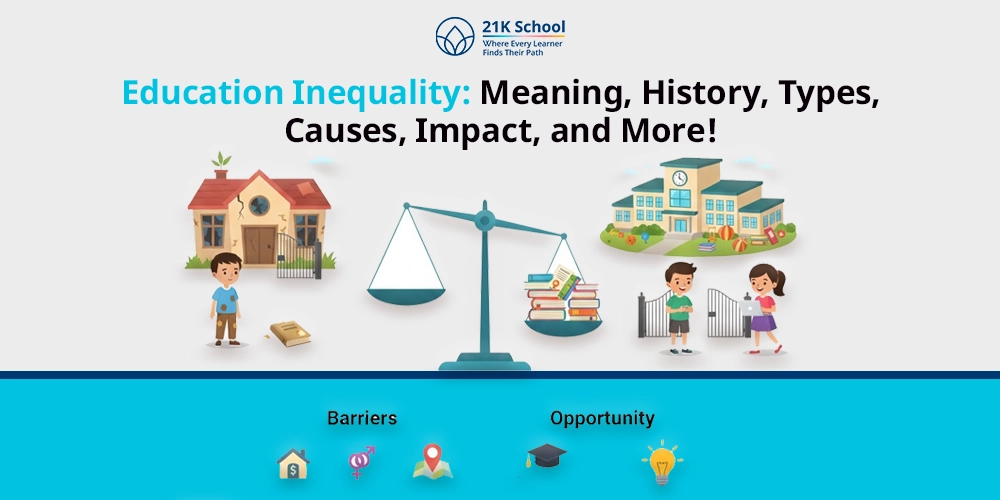
Unequal distribution of resources, opportunity, and outcomes in different individuals is known as educational inequality.
The major factors of education inequality are income, gender, location, language, learning disability etc. Education inequality is not about going to school, but the equal right as an opportunity to make a difference.
Inequality in Education in India
As per World Inequality Report 2026, inequality remains among the highest in the world and has shown little movement in recent years. The key points of the current situation are:
- The top 10% of earners capture about 58% of India’s national income.
- The bottom 50% receive only 15% of total national income.
- Wealth inequality is more severe than income inequality.
- The richest 10% hold around 65% of total wealth in India.
- The top 1% alone own about 40% of total wealth.
- The income gap between the top 10% and bottom 50% has remained largely unchanged between 2014 and 2024.
- Average annual income per capita is approximately €6,200 (PPP).
- Average per capita wealth stands at about €28,000 (PPP).
- Recent data (2022-2023) suggests it’s higher, around 23 to 37% depending on the definition used.
- No significant improvement in women’s workforce participation.
The overall report signifies the economic inequality in India remains deeply entrenched. Some common factors impacting are income, wealth, and gender, and reflect persistent structural divides.
While talking inequality in India it’s important to understand the past literacy rates:
- According to the Periodic Labour Force Survey (PLFS) 2023-24 (July–June), India’s overall literacy rate for persons aged 7 and above is 80.9%.
History of Gender Inequality in Education
Gender inequality in education simply means unequal access, treatment, and instead of learning at home and school girls and women have less
Education is often considered a privilege. That’s why girls and women instead of schooling manage households. But, it is not right.
Some of the main reasons for avoiding schooling for girls are early marriage, domestic responsibilities, cultural and religious beliefs etc.
However, with time people understand the importance of education for everyone and to reduce gender inequality various initiatives are introduced.
Gender Inequality in Education in India
To understand the history of gender inequality in education in India, check out below details:
- Ancient and Vedic Period
In Vedic times there is some equality in education for both genders. Some upper-caste women had educational access, but this wasn’t universal.
Later, Vedic and Post-Vedic ages women are denied to learn. Instead they spend time in household work.
- Medieval Period
The status in medieval period is education was almost non-existent due to reasons like child marriage and sati increased.
- Colonial Era
In the colonial era, British rule brought modern education which initially excluded female education.
But, later women education in India was promoted and establishing girls’ schools like Bethune School in 1849 took place.
- Post-Independence
Post-Independence 1947 onwards the Indian Constitution guaranteed equal educational rights for all. After that various government initiatives are introduced to reduce gender education inequality.
8 Types of Education Inequality
To understand education inequality effectively, one need to go through all the types:
1. Socioeconomic Inequality
Socioeconomic inequality is a most common and viable form of education inequality. Students often feel discrimination in schools, resources, learning tools etc.
Socioeconomic inequality is mainly between upper and lower, rich and poor. For example, a student from lower-income background may struggle with:
- Poor infrastructure
- Overcrowded classrooms
- Pressure to work instead of study
- Lack of basic learning materials
2. Gender Inequality
Educational inequality based on gender means male and female get unequal access to education, opportunities, and outcomes.
Gender inequality increases with their level of education in school. As compared to male, females are leaving school, and discontinue learning.
This is due to various factors like financial issues, culture beliefs, child marriage etc. This kind of discrimination impacts negatively on girl child life.
3. Racial and Ethnic Inequality
Another type of inequality in education is racial and ethnic inequality in which students are treated unequally based on race.
These kinds of discrimination are often done in the classroom based on color. This leads to feelings of exclusion which reduce confidence and higher dropout rates.
4. Geographic Inequality
As the name suggests, geographic inequality is based on the areas an individual belongs or lives.
Rural and remote areas suffer from fewer schools, resources, and trained teachers while urban schools often face funding crises.
Here, geography decides the level of education an individual gets.
5. Disability and Special Needs Inequality
In disability and special needs inequality, students are unable to learn with adequate support, trained staff, and accessible facilities for students with disabilities.
These students are unable to compete with regular learning curriculum and syllabus. This impacts their learning negatively.
6. Language Inequality
Language plays a major role but language barrier is a cause of inequality.
Students who don’t speak a dominating language often struggle to communicate effectively, learn lessons, understand concepts and so on.
Multilingual education and mother-tongue play major roles to avoid language inequality.
7. Structural and Systemic Inequality
Structural and systemic inequality are those which are built directly into the system for example, biased curriculum design or inappropriate testing.
8. Institutional Inequality
Not all institutions promote equality which leads to institutional inequality such as differences in school standards, teacher qualifications, and availability of basic resources.
6 Main Causes of Education Inequality
Explore some of the main causes of education inequality that create unequal learning opportunities:
1. Poverty and Economic Barriers
Causes like poverty and economic barriers often limit students from strengthening their lifestyle.
Parents unable to fulfill day-to-day requirements of children often neglect basic education in school. That’s the reason many children drop out before completing their secondary education.
2. Unequal Distribution of Resources
Unequal distribution of resources is one of the major causes of education inequality. This is generally due to people stereotyping and believing that girls should know about household work.
3. Government Policies and Funding Gaps
Government policy and funding play a major role to reduce education inequality. But, due to various factors like lack of funding and geographical limitations, reaching needful families and students becomes difficult.
4. Language and Cultural Barriers
Language and cultural barriers are one of the causes due to increasing educational inequality. Students who are unable to speak most spoken language struggle to connect, understand, and express feelings.
5. Family Background and Parental Education
One of the main causes of education inequality is family background and parental education. Parents with limited education or unable to help their children with homework or assessments .
6. Disability and Special Educational Needs
Due to inequality, disability and special needs students deal with various problems. Problems such as limiting access to quality education , employment, full social participation etc.
Education Inequality by the Numbers
- Current Statistics (2024-2026 data):
According to the World Inequality Report 2026 which is published in December 2025 by the World Inequality Lab. The key highlights released:
- The global inequality, with the top 10% owning 75% of wealth and responsible for 77% of capital-linked emissions.
- As per World Inequality Report 2026 the top 10% income share is equal to 58% in 2024. Income is measured after the operation of pensions and unemployment insurance systems and before income tax.
- Comparative Data Across Regions:
States of India with higher inequality/deprivation (often Central/Eastern/Northeast):
- Bihar, Jharkhand, Uttar Pradesh, Odisha, Chhattisgarh, Madhya Pradesh, West Bengal, Meghalaya, Assam, Tripura, Rajasthan.
States of India with Lower Inequality/Better Performance (Often Southern/Western):
- Kerala, Tamil Nadu, Goa, Maharashtra, Gujarat, Andhra Pradesh.
- Trend Analysis:
- The inequality showcases global decline, but slowing progress after 2015.
- Due to COVID-19 pandemic some gains are reversed especially in the education sector.
- The global conversation in 2024 and 2026 focuses on the need for increased and equitable financing, quality-oriented reforms, and addressing issues to achieve SDG4 by 2030.
6 Impact of Education Inequality
Education inequality affects both individuals and society. Some common points to understand:
1. Limited Career Opportunities
Career is a stepping stone for any student to become independent and get desired job opportunities.
Education inequality limits students’ career opportunities by reducing options, forced for low pay jobs, trapped in poverty, and many more.
2. Social Inequality and Injustice
Education inequality affects not only individual lives but also the society. It deepens the gap between rich and poor, privileged and non-privileged people in the society.
3. Innovation and Productivity Loss
In student life, innovation motivates them to become productive throughout the journey.
But, education inequality can reduce students’ interest which leads to loss of abilities, innovation and productivity.
4. Increased Crime and Unemployment
Lack of proper education often takes individuals in wrong pathways. This increases crime, social unrest, and unemployment.
Reducing inequality can help people to understand the right and wrong to make decisions.
5. Intergenerational Poverty
With time, education inequality takes a difficult turn by passing from one generation to the next. Parents and children both struggle to fulfill their basic needs.
4 Key Solutions to Reduce Education Inequality
To reduce education inequality, it’s important to step out and take the right action to bring about change in society and individuals’ lives.
1. Funding and Resources
Equal and adequate funding for both the genders can impact positively. For example, providing equal access to books, learning tools, internet etc.
Remember, investing in early education is more important for students from low-income families.
2. Teachers and Support
Highly qualified teachers to make learning effective and promote awareness can be helpful to reduce educational inequality.
Teachers help construct a needful curriculum to fulfil the needs of every student.
3. Curriculum and Technology
Each student and their needs are different from each other. Each student learns at their own pace.
To support their unique learning style, teachers need to customise curriculum and implement effective strategies like integration of technology to make the environment adaptable.
4. Systemic and Policy Changes
By addressing the problem and major factors of inequality, one can plan systematic and policy changes in education.
Through technology access, addressing socio-economic barriers and dismantling the school-to-prison pipeline, inequality can be reduced with time.
3 Role of Education in Removing Gender Inequality
Education in students’ lives plays a major role especially when it comes to equality.
1. Improved Health Outcomes
Educating girls and women is important for the development of society. It directly improves the quality of life by taking the right decisions, accessing healthcare and family needs.
2. Challenging Stereotypes and Norms
Education helps in avoiding wrong challenges and norms set by society for girls/women. Individuals can think critically and spread awareness about equal rights.
In this way, people of society together stop the practices of outdated stereotypes.
3. Economic Empowerment
Educating girls/women encourages economic empowerment. In this way, girls can learn various skills and gain knowledge to become confident to earn, lead, and decide.
Education Inequality in India and Government Policies
To reduce education inequality in India, the government has taken various steps.
Introduction of policies help in creating a positive learning environment. For detailed information check out mentioned policies:
1. Education Initiatives by Government in India
Some common India’s initiatives to reduce inequality includes:
2. Scholarship Programs
To reduce education inequality, scholarship programs are effective.
It aims to bridge inequality by offering financial guidance to students. Some of the key government scholarship programs include:
- PM-USP (Central Sector Scheme)
- National Means-cum-Merit Scholarship (NMMS)
- Scholarship for Top Class Education for SCs/SSTs
- Pragati Scholarship (AICTE)
- Kasturba Gandhi Balika Vidyalayas (KGBVs)
3. CSR in Education
One of the ways to tackle education inequality is corporate social responsibility or CSR.
By funding infrastructure, scholarships, and digital literacy for underprivileged students inequality can be reduced with time.
CSR in education helps in the upliftment of students’ learning by fostering infrastructure development, providing scholarships, and promoting digital literacy.
4. Mid-day Meal Scheme
The Mid-day meal scheme also known as PM-POSHAN.
The scheme promotes social equity in which learners from different castes, religions, and backgrounds sit together to share food.
They learn about equality, togetherness, teamwork , collaboration, and build a positive personality.
Conclusion
Education inequality is not just a problem in a particular region or country, it is a worldwide issue which impacts an individual’s future.
Education is a powerful way to bring equality in individual life in society together. With the support of school, parents, and teachers educational inequality can be reduced.
Through key solutions such as fulfilling funding gaps, enforcing inclusive education
policies, providing required resources etc education inequality easily scales down.

You may also want to read