

Nursery class is the beginning of preschool education, and parents wonder what the right age is to admit their children in nursery school.
The Nursery age criteria of the CBSE admission will be of importance to the parents who wish to enrol their children in school at an early age.
When small learners start to get education at the right age, they also develop intellectually and socially in the right manner.
This write-up will tell us the CBSE age criteria for nursery learners and some basic tips for parents before they put their kids in schools.
Contents
- What is the CBSE Age Criteria for Nursery?
- What is the Importance of Age in Early School Years?
- Age Criteria for Nursery Admission in CBSE Schools
- CBSE Age Criteria Table by Class
- CBSE Age Limit Calculator
- Documents Required for Nursery Admission in CBSE Schools
- NEP 2020 Criteria for CBSE
- Age Relaxation in CBSE Nursery Admissions
- 6 Tips for Parents Applying for CBSE Nursery Admission
- Conclusion
What is the CBSE Age Criteria for Nursery?
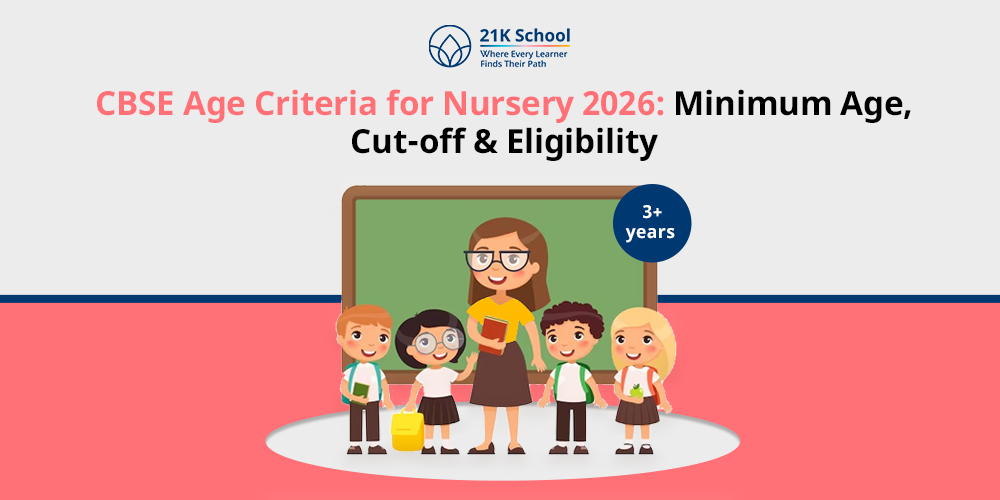
The CBSE age criteria for nursery as per CBSE guidelines is 3+ years old as of March 31 of the academic year based on the National Education Policy (NEP) 2020. So, a child should be born between April 1, 2021, and March 31, 2022, for the 2025–26 session.
The CBSE age eligibility for Nursery admission assists in providing the children with an opportunity to start early childhood education at the right age, for their development. Age-wise, most of the schools that are based on the CBSE are similar, but, as previously stated, schools might differ a little with regard to the school or state-wide education policies.
1. Minimum Age
Nursery in most of the CBSE-affiliated schools is taken by children as early as 3 years old. The child must have reached the age of three years before the actual cut-off date of the school, which is normally on 31st March during the year of admission.
This principle will ensure that the children are developmentally ready to participate in fun learning activities , socialising with others in the classroom and other rudimentary social skills likely to be found in a nursery.
2. Maximum Age
The age of the latest Nursery admission in most CBSE schools is approximately 4 years old. This limitation will guarantee that there is the right age development of early education classes.
Through the age limit, schools would ensure that children attend Pre-Nursery, Nursery and other classes in a systematic manner depending on their ages and development level.
What is the Importance of Age in Early School Years?
The early school years of a child are an important period in life where the child learns, socialises, and grows emotionally, and thus is developmentally prepared to learn and adjust easily in a school setting.
1. Builds Confidence
When children are put in classes that are at their age, they are able to feel comfortable and competent.
They will be more involved in doing things, raise their voices in the classroom and take responsibilities without having to feel overwhelmed, thus developing a feeling of self-confidence and having a positive attitude towards learning .
2. Emotional Development
Association with peers who share a similar age helps in emotional development. The children are taught how to deal with emotional states such as frustration, excitement, and anxiety within a positive learning environment .
They also learn to be empathetic, patient and resilient as they go through the social interactions, and this makes them able to cope with challenges in school and in their day-to-day lives.
3. Develop Social Skills
Peer interaction in relation to age helps in communication, collaboration skills and teamwork. Children are taught to share, take turns and solve conflicts at the natural level.
This social interaction also enables them to establish good friendships, appreciate other points of view and enhance their general interpersonal skills needed in academic and personal lives.
4. Prepares Them for School
The right-aged children are better prepared to cope with school study schedules and instructions, thus participating in learning processes.
Placement through age means that they are able to concentrate on academics and have the chance to engage in classroom discussions, which facilitates the process of transitioning to home or pre-school into a productive transition.
5. Better Adaptation
When children are put in the right age, they become easily adjusted to school life. The age-based classes lessen the feeling of being excluded or being overwhelmed.
It enables them to move at a comfortable pace, learn at a pace that fits them well, and they can take up academic challenges in the future with confidence .
Age Criteria for Nursery Admission in CBSE Schools
Different CBSE schools have a basic age criteria for children getting admission in nursery class, but their cut-off dates vary sometimes.
1. Common Requirement for Minimum Age
Most commonly, CBSE schools require children to be of at least 3 years of age during their admission in nursery school .
This age should be as per the mentioned cut-off dates by varied schools. This is a guideline that would allow the children to be developmentally ready.
Learners should be capable of attending classes and participating in classroom activities to foster basic learning as well as socialisation with the teachers and others.
2. How Schools Determine Learners’ Age Eligibility
Whoever wants to get admission in nursery class has to be eligible agewise. Schools calculate this age by counting the child’s age through their birth certificate.
If according to the birth certificate, the kid’s age is 3 years or more till the reference date presented by the respective school, they will get admission.
3. Reference Date for Age Calculation
The date by which the age of the child should be 3 years in the same academic year is called the cut-off or reference date.
The usual cut-off date in CBSE schools is 31st March of the year of admission, but other states or schools can have a slightly different date.
CBSE Age Criteria Table by Class
The CBSE age requirements in each class enable the parents to enrol their children in the correct level of early education. The age sequence followed by most CBSE schools between Pre-Nursery and Class 1 is to allow children to learn based on their level of development.
| Class | Typical Age |
| Pre-Nursery (Playgroup) | 2 to 3 Years |
| Nursery | 3 to 4 Years |
| LKG (Lower Kindergarten) | 4 to 5 Years |
| UKG (Upper Kindergarten) | 5 to 6 Years |
| Class 1 | 6 to 7 Years |
| Class 2 | 7 to 8 Years |
| Class 3 | 8 to9 Years |
| Class 4 | 9 to10 Years |
| Class 5 | 10 to11 Years |
| Class 6 | 11 to12 Years |
| Class 7 | 12 to13 Years |
| Class 8 | 13 to14 Years |
| Class 9 | 14 to15 Years |
| Class 10 | 15 to16 Years |
| Class 11 | 16 to17 Years |
| Class 12 | 17 to 18 Years |
CBSE Age Limit Calculator
The CBSE age limit calculator will also allow the parents to determine whether their child is within the necessary age to be accepted into the classes, such as Nursery, LKG, UKG, or Class 1.
It computes the age of the child according to his or her date of birth and the cut-off date of the school (usually 31 March of the year of admission).
You can use a CBSE age limit calculator by first entering the child’s date of birth and then selecting the admission year of the child.
Use the standard cut-off date (31 March) or the one specified by the school and the calculator will show the child’s right age to join school.
You can calculate accordingly the right age for your kid to get admission in nursery.
Documents Required for Nursery Admission in CBSE Schools
In the case of a parent desiring to have his/her children admitted to the Nursery in the CBSE schools, he/she is expected to submit some important documents to get the process done.
Proper documents will ensure that there will be a trouble-free admission, and the schools will be in a good position to maintain appropriate records on students and will also take care of the fact that the child does not fall short of the required eligibility criteria.
These are the documents which help the schools in deciding on the age, identity, and home of the child.
- Birth certificate
- Address proof
- Passport-size photographs
- Aadhar Card (If Required)
- Parent identity proof
- Pass Certificate (if Applicable)
NEP 2020 Criteria for CBSE
The NEP 2020 requirements of CBSE bring about significant alterations in the education system that are related to the new structure of schools, learning stages by age, acquisition of skills, and more appropriate methods of assessment of students to enable a holistic growth of the student.
1. Introduced New Structure (5+3+3+4)
The National Education Policy 2020 has introduced a new set of school systems, 5+3+3+4 , as compared to the old system, 10+2. This is a model that consists of five years of the foundational stage, three years of the preparatory stage, three years of the middle stage and four years of the secondary stage.
The schooling is correlated with the developmental stages of children, and the emphasis is placed on the establishment of sound ground-level learning skills at a tender age.
2. Age-Based Schooling System
NEP 2020 plans schooling according to the age groups and not solely according to the classes. The initial phase is the age of 3-8, the secondary phase is the age of 8-11, the preparatory phase is the age of 11-14, and the middle stage is the age of 14-18.
This system creates a system in which the teaching practises are in tandem with the child in accordance with the cognitive development of children and their learning capabilities at each stage.
3. Focus on Early Childhood Education
The policy attaches a lot of significance to Early Childhood Care and Education (ECCE) among children between the ages of 3 and 6 years. This level covers pre- school, nursery, LKG, and UKG.
It is aimed at the acquisition of simple literacy, numeracy, creativity, and social skills at a tender age to make the children more skilled to join school.
4. Focus on Skill-Based Learning
NEP 2020 facilitates practical and skill-based learning over rote learning . Students are also to be taught to be critical thinkers, creative, communicative, and able to solve problems .
The policy also introduces vocational education , coding, and real-life learning activities in the middle school to provide the students with real-life challenges and career life.
5, Change in Assessment
Depending on the policy, it proposes major changes in student assessment practises. Schools will put more emphasis on the evaluation and competency-based education instead of putting emphasis on end-of-year exams alone.
The board exams will be made more friendly and will be more concept-oriented and practical application of the concepts as opposed to memorisation. This will help ease the examination stress and learning.
Age Relaxation in CBSE Nursery Admissions
In some cases, there can be some age relaxation in admission to CBSE nursery, based on the school policy or regulations in the state education department.
Even though most of the schools will adhere to the rigid age restriction, there may be a slight variation of this rule in the situation where the child will be out of date by a few months.
Parents are usually required to submit the required documents and a request for consideration. The school administration will, however, not guarantee the relaxation of the age limit, but will depend on it.
6 Tips for Parents Applying for CBSE Nursery Admission
The competition for the application to the CBSE Nursery may be quite serious, and parents must follow the primary tips. The process of admission becomes successful and easy when the person prepares the documents early, understands the rules of the school, and plans all the actions correctly.
1. Check School-specific Guidelines
The age requirement and admission processes of any school under CBSE might change; a parent is expected to follow the verdicts.
Among the certainties are visiting the official school webpage, or school prospectus, to understand that they have the right and the privileges qualifications before they apply, and that they have to scramble to meet the deadline of the admissions.
2. Keep Documents Ready
Before applying for admission in your child’s nursery class, you should ensure that you have all the necessary documents including their birth certificate and identity proofs.
It would make the application process hassle-free.
3. During the Admission Cycle, Apply Early
There are multiple applicants for nursery, so parents should make sure that they apply early as soon as the application window opens in their targeted schools.
If parents miss the deadline, their children might have to wait for another year to get into school.
4. Confirm the Age Limit Date
The parents should verify the official cut-off date during the commencement of school admissions.
This would enable them to choose schools that align with the age of their children and save their time and effort while putting in applications.
5. Shortlist Several Schools
Parents should also shortlist multiple schools for nursery admissions of their kids.
When they will have multiple options for schools, they can choose wisely from them based on their reputation, cut-off date, and curriculum specificity.
6. Prepare for Parent Interaction
Others have a very brief meeting with the parents to know more about the background and the readiness of the child. The parents will be advised to be ready to negotiate on the child’s habits, development and expectations of the school in a polite but confident way.
Conclusion
Parents should be aware of the CBSE age requirements for Nursery admission in order to ensure that his/her child embarks on their schooling at the developmental stage.
To avoid the problems with admission, the parents must be aware of the minimum and maximum age requirements, have the necessary paperwork, and observe the school-related rules.
Knowledge of deadlines, preparation and parent interaction preparation contributes to the high chance of easily and successfully acquiring a Nursery seat.

You may also want to read