

Every learner has a different level of understanding, pace, and capabilities to learn things, and in the present world we understand this.
That is why, unlike traditional education, newer methods of learning are being tested and accepted. One such learning method is adaptive learning.
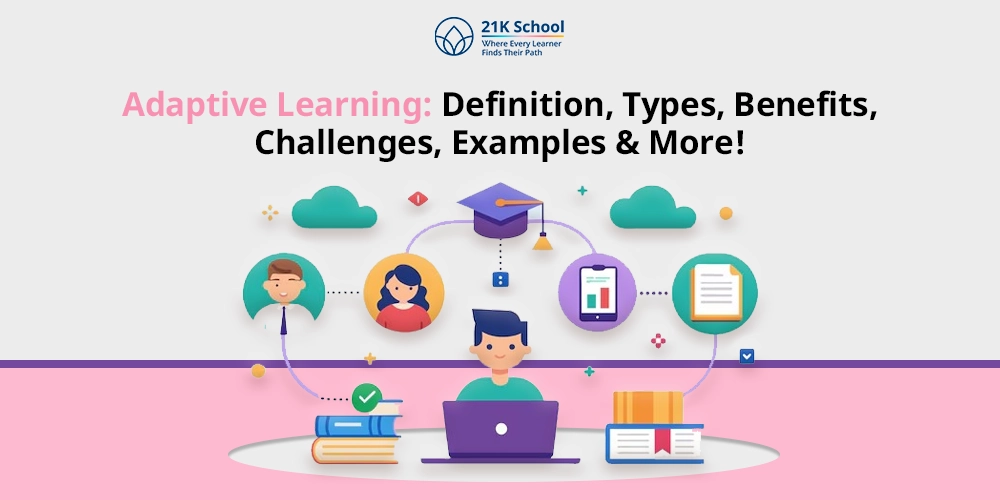
Adaptive learning adjusts to learners’ ways of learning and designs a personalized approach of learning.
It is based on the various computer programs and applications that are programmed to engage learners and result in strong academic outcomes.
To learn more about adaptive learning, you can read the below article. After reading this you will also know about its history, roles, advantages, disadvantages, types, and examples.
Contents
- What is Adaptive Learning?
- Evolution of Adaptive Learning
- Adaptive Learning in Artificial Intelligence
- How Adaptive Learning Works
- Types of Adaptive Learning
- 4 Key Technologies Behind Adaptive Learning
- 6 Benefits of Adaptive Learning
- Adaptive Learning in K-12 Education
- Adaptive Learning in Higher Education
- Adaptive Learning vs Traditional Learning
- 5 Challenges in Adaptive Learning
- Role of Educators in Adaptive Learning
- Adaptive Learning Platforms
- Adaptive Learning Examples
- Future of Adaptive Learning
- Concluding Comments
What is Adaptive Learning?
Adaptive learning is a method of learning that utilizes technologies and data-driven algorithms to customize learning for individual students.
This approach is commonly known as personalized adaptive learning. It is the mode of learning where the content, difficulty levels, and presentation strategies are dynamically adjusted with respect to real-time performance of learners.
In contrast to the conventional forms of teaching in which all students take the same course at the same time, personalized adaptive learning establishes an individual learning course.
For instance, when a student is good at solving mathematical operations, they will be offered more complex problems, thus enhancing their proficiencies.
On the other hand, if a student is a slow learner, they are given exercises that match and can improve their level of understanding.
Responsiveness is the feature of adaptive learning. The system constantly collects information and modifies the experience in response, so that learners do not get bored by easy or overstimulated by hard content, respectively.
The main characteristics of adaptive learning are real-time content customization, personalized feedback, progress tracking data, mastery-based promotion, automated assessment, and remediation.
Adaptive learning is more engaging, motivating, and achieves more success because it keeps learners at the centre of the experience.
Evolution of Adaptive Learning
Adaptive learning was not a phenomenon that came out of the blue. It is closely related to progress in educational psychology, computer science, and artificial intelligence development.
Adaptive learning can be traced to behaviorist learning theories in the mid 20th century.
Psychologist B. F. Skinner developed his own teaching machines in the 1950s, inspired from the teaching machines developed by Sydney Pressy (in 1920s).
These machines were based on the principle of behavioural learning theory that consisted of reinforcements and offered immediate feedback to plan future sequential steps.
This was a major contribution in adaptive learning systems way before its popularity.
Similarly, in the 1960s and 1980s, evolution of computers gave origin to personal computers, which led to the emergence of “computer-assisted instruction”.
In earlier programs there were many branching scenarios in which learners were taken on various paths depending on the way they answered. Such systems, however, were constrained to simple programming logic and did not analyze real-time data.
With the development of artificial intelligence in the 1990s and 2000s, intelligent tutoring systems developed.
These platforms mimicked personal tutoring through the analysis of the responses of learners and provided them with individual feedback. In spite of its commitment, early systems were expensive and difficult to scale.
The current adaptive learning systems have been operated using big data, complex machine learning algorithms, and cloud computing.
This is the reason that these machines can handle huge amounts of data and offer exceptionally adapted content for effective learning of learners.
Various adaptive systems are currently common in K-12 education, colleges, professional certification courses, corporate workplaces, upskilling programs, and online platforms.
The development of adaptive learning is the result of an increased change towards learner-centered education enabled by technological advancement.
Adaptive Learning in Artificial Intelligence
The driving force of the modern adaptive learning systems is artificial intelligence.
In the absence of AI, it would be impossible to scale real-time personalisation.
Without human intervention, AI helps systems to examine published student performance data in real-time, forecast performance, and identify trends.
It also suggests specific tools to those who are under-performing and personalizes learning early in real-time.
With the help of AI, intelligent learning platforms are applied as intelligent tutors. Not only do they judge whether or not an answer is correct, but also the method that a learner used to arrive at an answer.
To illustrate the point, AI may identify misconceptions depending on general error patterns and offer remedial advice to resolve that particular misconception.
Predictive analytics is also improved through AI. Through historical data, systems can predict areas where the student might struggle with and take necessary measures before they start to underperform by a large margin.
With adaptive learning, AI improves competency-based education where students can focus on mastery without setting a time limit on a subject in higher academic institutions or in business organizations.
The growing use of AI is making education more intuitive, engaging, and more adaptive to complex cognitive needs rather than relying on rote learning.
How Adaptive Learning Works
Adaptive learning works on the following four areas to advance learning and cater to individual needs of all learners:
1. Diagnostic Assessment
The adaptive learning process starts with some diagnostic evaluation that identifies the current knowledge, level of skills, and weaknesses of the learner.
This baseline testing can include a pre-test, skill mapping quizzes, behavioral tests, or learning preferences surveys.
Depending on the findings, the system develops an individualised learning process. Due to this, learners start from a level where they are capable of better comprehending the lessons.
Diagnostic assessments avoid repetition and frustration, since students do not spend time revising things they have already learnt.
2. Continuous Data Monitoring
As soon as learning starts, the system keeps track of the performance data.
These include accuracy of responses, time taken, frequency of attempts, engagement metrics, and even confidence ratings.
This constant stream of information enables the system to dynamically refine the profile of the learner.
Constant observation makes sure that instruction stays aligned with performance trends and learning rate.
3. Algorithmic Decision-Making
Algorithmic decision-making is the core of adaptive learning.
The algorithm decides the kind of instructional method that is to be utilized and the level of difficulty suitable for a student based on their repeated past performance.
It also figures out when a student needs remedial classes and if a new topic should be taught to them.
The complexity of these algorithms defines how effective the adaptive experience can become, and makes the personalization effective and data-based.
4. Feedback Loops
Adaptive learning provides feedback assistance for personalized learning. They make sure that the learners get instant practical feedback about their performance.
Feedback can consist of instant correction feedback, solution clarifications, progress dashboards, and milestones.
Notably, feedback is not limited to students. Analytics reports are also provided to educators and administrators to make improvements in instruction and curriculum based on the data.
Types of Adaptive Learning
Depending on the structure and the intelligence level, adaptive learning systems could be classified into the following:
- Rule-based adaptive learning is based on pre-determined rules and logical decisions. Although efficient, it is based on programmed routes as opposed to dynamic artificial intelligence.
- AI-driven adaptive learning involves personalisation of instruction on-the-fly using machine learning models. These systems keep improving their predictions as new data is received and the learning profile altered.
- Macro-adaptive learning modifies the general learning trajectories using periodic tests as opposed to real-time performance. It also tends to measure the progress at specified times.
- Micro-adaptive learning involves immediate modification of the content during the lessons in response to individual questions or actions of the learners.
- Content-based adaptive learning is a type of learning where the education materials are aligned to the demands and needs of students, like videos for visual learners.
4 Key Technologies Behind Adaptive Learning
The main technologies in education that support adaptive learning include the following:
1. Artificial Intelligence (AI)
Artificial intelligence allows systems to imitate the decision making process of human beings.
AI processes complicated patterns in data and creates unique suggestions, which takes learners on individual journeys.
Within adaptive learning, AI is used to provide advanced tutoring, predictive analytics, automated grading, and customized feedback.
It is also scalable as thousands of learners can be provided with a tailored instruction without affecting its quality.
2. Machine Learning (ML)
Machine learning is a form of artificial intelligence where the system gets better as time passes without being explicitly reprogrammed.
ML algorithms recognize patterns in the behavior of learners, anticipate the results of performance, narrow down the recommendations on content, and determine areas of knowledge gaps.
Machine learning models can be more precise as one gathers more data. This is the ongoing enhancement responsible for increasingly accurate and individualized adaptive learning experiences.
3. Learning Analytics
The process of collecting, analyzing, and interpreting student performance data can be called learning analytics.
Analytical dashboards enable educators and administrators to change instructional methods and allocate resources after referring to the data.
These data consists of students’ performance, dropout rates, curriculum effectiveness, and level of student engagement.
4. Natural Language Processing (NLP)
The adaptive learning systems are able to understand and react to a human language through natural language processing.
NLP is used to create talking computing devices, virtual coaches, computerized assessment systems, chatbots, and voice-based learning assistance.
NLP enhances access and engagement by fostering more natural interactions between technology and learners.
This ensures better, in-depth understanding of communications taking place between students and adaptive technologies.
6 Benefits of Adaptive Learning
Adaptive learning offers multiple benefits for learners, educators, and educational institutions that can be mentioned as:
1. Personalized Learning Experiences
One of the most primary advantages of adaptive learning systems is providing personalized learning experiences to all learners.
Instead of following a strict curriculum, it analyzes the understanding level, skills, and pace of students to design individualized teaching strategies.
It assesses their strengths and flaws well to help learners reach their best potential.
2. Increased Engagement
Adaptive learning ensures that students are never idle, since they are offered material that suits their abilities.
Learners have a greater chance of remaining motivated and focused when they are exposed to things that are not too difficult or too simple.
Interactive elements, instant feedback, progress tracking dashboards and other tools are also utilized to boost student engagement.
These tools can also observe how much the students grow because this motivates them and gives them confidence to continue.
3. Improved Learning Outcomes
Individualized adaptive learning enhances student performance.
Adaptive learning systems can detect the level of knowledge quickly, after which optimum remediations are offered to avoid further misconceptions.
Since the learners need to master the concepts before they move forward, they form more powerful conceptual foundations.
This mastery-driven framework enhances retention, increases depth of learning, and improves learning outcomes of subjects.
4. Efficient Use of Time
Repetition that is unnecessary is avoided through adaptive learning.
Students do not waste time in revising concepts that they have mastered; hence they are able to concentrate on the aspects where improvements are necessary.
In the case of educators, adaptive systems automatically grade, record performance information, and provide insights.
The saved time can then be utilized for personal assistance and mentoring of students.
5. Data-Driven Instruction for Educators
The data gathered by the adaptive learning systems are of great use for educators.
The educators can easily analyze students’ performance graphs and progress analytics to know if they need any extra assistance.
This enables educators to make informed decisions through data-driven instruction for learners without relying on outdated periodic assessments.
6. Scalability
Scalability is considered as one of the most crucial aspects of adaptive learning.
In the conventional context, it is not quite easy to provide individualised instruction to a large group.
Adaptive technology facilitates the provision of personalized experience to hundreds and thousands of learners at the same time.
Adaptive learning can be greatly useful for online learning, large courses at universities, or even corporate training programs, where it could be challenging to offer individualised support.
Adaptive Learning in K-12 Education
In K-12 education, adaptive learning is used to support the needs of different classroom settings.
This is because students differ significantly in their ability, speed of learning, and previous knowledge.
Adaptive learning systems are great for bridging the learning gaps among varied students with different developmental levels.
The learning programs used in adaptive platforms evaluate the understanding level in real-time and then adjust the learning exercises depending on these evaluations.
Learners with issues in basic knowledge are provided with additional practice and explanatory information, while advanced learners are shown more detailed information.
Differentiated learning is also based on adaptive learning and this method is widely promoted in primary and secondary education levels.
With the help of performance dashboards, teachers get the opportunity to categorize students groupwise over strategically selected tasks, and also track their progress.
Also, adaptive learning devices promote self-directed learning. Students who get lower grades, teachers allow them to learn at their own pace and then assess them through comprehensive analytics.
This interdependence and support enhances academic performance as well as learners’ self-confidence.
Adaptive Learning in Higher Education
Leading universities are moving towards adaptive learning to increase their retention levels and even their achievements.
Classrooms at a university may have learners of different educational levels and readiness. Adaptive systems allow these learners to study efficiently by removing gaps at the beginning of the semester.
In large classes, adaptive platforms offer additional support based on the needs of each student.
Customised practice materials and live feedback to students are provided beyond classroom hours, supporting classroom learning.
Adaptive learning is also useful to incorporate competency-based education in the universities. Students do not learn according to set time but according to their proficiency.
This works well especially in professional coursework, technical education, and online degree courses.
Moreover, adaptive learning promotes lifelong learning.
Since present education systems emphasize skill learning, adaptive learning systems offer personalized assistance for students with clear career aspirations at any age.
Adaptive Learning vs Traditional Learning
Traditional learning and adaptive learning have significant differences that are worth mentioning in the following table:
| Aspect | Traditional Learning | Adaptive Learning |
| Curriculum | Fixed and uniform for all students. | Dynamic and personalized based on learner’s progress. |
| Pacing | Same pace for everyone. | Flexibility in pace according to different learners. |
| Assessment | Periodic standardized tests. | Continuous real-time assessments with instant feedback. |
| Technology Use | Minimal use | High use of computer analytics and AI |
| Content Adaptation | Fixed content for all | Content adapts as per learners capability and skills. |
| Learner Engagement | Can be passive. | High, active engagement of learners. |
| Role of Teacher | Central figure directing all learning. | Facilitator/guide alongside adaptive learning systems. |
| Feedback Speed | Often delayed (after periodic tests or assignments). | Immediate and targeted feedback. |
| Best For | Large groups, foundational structure. | Individual learning paths, diverse skill levels. |
| Customization | Limited | High personalization for each learner. |
5 Challenges in Adaptive Learning
Adaptive learning has the following drawbacks in spite of having several pros:
1. Data Privacy and Security
The adaptive learning systems store a lot of information about learners through their performance statistics and behavioral trends.
It is very necessary to protect this data since it is the responsibility of institutions to abide by data protection laws and cybersecurity practices.
Fears of misuse of data may evoke doubts in parents, students, and educators. Practices and ethical management of data should be transparent and ensure trust.
2. Algorithmic Bias
Adaptive systems depend on the algorithms trained by the past data. However, these data can be misleading due to unintentional biases in adaptive algorithms.
If these systems further plan exercises for a certain group of learners, they can be wrong or inefficient while doing so.
Therefore, educators should continuously assess the algorithms and work towards maintaining educational equity in learning.
3. Implementation Costs
Adaptive learning technology is costly to implement. The costs may include software licensing, upgrades for infrastructure, integration with existing systems, and maintenance support.
Institutions lacking financial resources may have restricted access to advanced adaptive platforms.
4. Teacher Training
Adaptive learning needs to be supported by trained educators. Educators should know how to interpret analytics, utilize the adaptive tools for lesson planning, and maintain balance between technology and conventional education.
Institutions that lack the training may not be able to take advantage of adaptive systems. For competent implementation, professional development programs are necessary.
5. Over-Reliance on Technology
Although adaptive learning has numerous benefits, over-dependence on technology may be a problem.
Content delivery is only a part of education. Mentorship, social interaction, and emotional growth are also needed for holistic growth of an individual.
Over reliance on automated systems can limit collaboration in learning and human interaction.
It is best to have a moderate strategy where adaptive tools are coupled with instructor-directed teaching.
Role of Educators in Adaptive Learning
In spite of technological advancement, educators still play the primary role in the success of adaptive learning. Technology supplements teaching but it cannot eliminate the human aspect of teaching.
Adaptive systems provide data-driven insights, which the teachers perceive and then apply to classroom instruction.
They give emotional help, stimulate critical thinking, and organize group discussions, which are less effective with technology alone.
Teachers facilitate contextualization of learning as well. Although adaptive platforms can be used to provide personalized content, teachers can relate content to real world applications and promote deeper comprehension.
Furthermore, educators have a significant role in eliminating ethical issues, providing equal opportunities, and maintaining a healthy balance between technology and face-to-face communication.
Adaptive learning can best succeed with a combined effort of educators and technology.
Adaptive Learning Platforms
Digital systems created to provide personalized instruction on an institutional scale are called adaptive learning platforms.
Such platforms combine artificial intelligence, machine learning, analytics, and interactive input to establish individualized learning journeys.
These usually include diagnostic testing, real time performance monitoring, automatic feedback systems, and student dashboards.
Adaptive platforms are used for employee training and develop professional skills to close skill gaps identified for an individual employee.
Within academia, they improve online and classroom education.
With the rise of technology, adaptive learning platforms are becoming increasingly advanced, including conversational interfaces, predictive analytics, and immersive experiences.
They are still evolving as an indicator of increased attention to personalized adaptive learning as the basis of contemporary education.
Adaptive Learning Examples
Adaptive learning is also being applied in schools, universities, as well as in corporate training settings.
When used in different educational environments, personalized adaptive learning can enhance engagement and academic results.
For instance, adaptive platforms like Dreambox used in K-8 mathematics programs determine how well a student grasps the concept of arithmetic or algebra, and progressively change the difficulty of problems. It simultaneously ensures that the learners are challenged in a proper way.
Adaptive applications such as Duolingo work best for language learning. It measures retention of vocabulary, pronunciation accuracy, as well as grammatical understanding.
Adaptive tools are implemented in large lecture courses like biology, economics, and statistics in higher educational institutions. Learners complete online courses that change based on their performance.
Adaptive learning is also used in corporate training programs. The compliance training or skill-based development of employees includes evaluations which help in identifying the areas in which employees are weak.
These examples also emphasize that adaptive learning modifies content, learning speed, and instructional directions based on the needs of an individual learner.
Future of Adaptive Learning
The future of adaptive learning will be influenced by the following:
1. Integration with Generative AI
The adaptive learning systems will be improved tremendously by generative AI.
According to students’ abilities, it would produce tailored interpretations, practice questions, summaries, and simulations in real-time. Generative models can offer exceptionally personalized assistance.
Rather than depending on the ready-made content libraries, adaptive systems in the future could generate dynamic learning content directly dependent on the individual gaps of a student.
2. Immersive Learning Environments
Virtual reality and augmented reality are immersive technologies, and they could significantly improve adaptive learning in the future.
These environments have the ability to replicate a real-world scenario and have difficulty levels adjusted according to the learner’s performance.
3. Predictive Career Pathways
As adaptive systems gather longitudinal data, they might start making predictions on the academic and career paths.
Adaptive platforms could suggest career paths aligned with optimal abilities through analyzing strengths, interests, and performance patterns.
4. Lifelong Learning Ecosystems
Adaptive learning will probably move outside the academic realm to lifelong learning environments. Due to the ever-changing nature of industries, people need to reskill and upskill continuously.
The future adaptive systems can retain long-term learner profiles that can change over decades.
From school through university to career training, the system would be able to offer permanent, individualised advice on the basis of career objectives and professional trends.
Concluding Comments
Adaptive learning systems have aided student learning through technology that adapts to their capabilities and learning patterns.
Educators who are trained well and provided with enough resources promote adaptive learning for making further changes in learning goals.
Though adaptive learning is still going through evolution and upgrades, it is crucial for corporate training and higher education
planning.

You may also want to read