

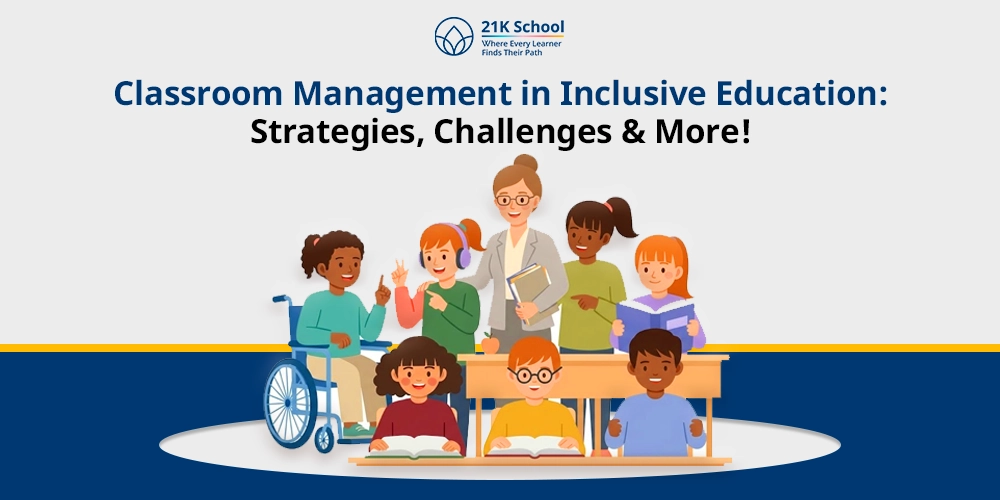
Managing a classroom that is composed of students whose learning needs are different is hard. Most educators are attempting to establish an inclusive environment, yet struggling to achieve the appropriate balance of maintaining discipline , attention and support to all children.
Inclusive education classroom management helps teachers to create an atmosphere where all the children are welcome, respected and feel like they belong. Students can learn to live together in the same environment with the proper approach.
So, here we will take a closer look at some of the helpful techniques that can guide us in coping with inclusive education.
Contents
- What is Classroom Management Important in Inclusive Education?
- Key Strategies for Classroom Management in Inclusive Education
- Key Components for Classroom Management in Inclusive Education
- Why is Classroom Management Important in Inclusive Education?
- How Can Teachers Help in Building Classroom Management in Inclusive Education?
- Daily Practices to Improve Classroom Management in Inclusive Education
- 1. Establish Consistent Routines
- 2. Set and Review Clear Expectations
- 3. Implement Differentiated Instruction on a Regular Basis
- 4. Offer Choices in Seating Arrangements
- 5. Use Positive Behaviour Support
- 6. Develop Positive Relationships with Students
- 7. Handle Behaviour Calmly and Consistently
- 8. Provide Various means for Demonstrating Achievement
- Benefits of Effective Classroom Management in Inclusive Education
- 1. Creates a Safe and Supportive Learning Environment
- 2. Improves Focus and Student Engagement
- 3. Fosters Social and Emotional Development
- 4. Provides Equal Opportunity for all Students
- 5. Develops Essential Life Skills
- 6. Helps Minimise Behavioural Problems
- 7. Strengthens Collaboration and Classroom community
- What Challenges do Teachers Face in an Inclusive Classroom Setting?
- Barriers and Facilitators of Inclusive Education
- Conclusion
What is Classroom Management Important in Inclusive Education?
Classroom management involves creating a positive learning environment for all students of varying abilities to study in a mainstream classroom.
It is geared towards the development of a structured, flexible and adaptive space in which students are able to develop academically and socially.
Key Strategies for Classroom Management in Inclusive Education
Classroom management provides inclusive education that is safe and geared towards the needs of diverse school learning . It would be handy in developing a proper teacher-student relationship.
Teachers may venture into the application of the above-mentioned strategies in an effort to enhance student interest as well as in a bid to provide a good learning environment.
The most important tips for classroom management implementation:
1. Creating a Safe Space
Classroom management will create well-defined and steady classroom routines and simple expectations to create a safe and secure, inclusive classroom environment.
2. Universal Design for Learning (UDL)
Inclusive classroom management based on Universal Design of Learning (UDL) does away with the exclusionary learning barriers by making engagement, representation and expression by the student affordable.
3. Differentiated Instruction
The support of various visual and differentiated materials and technologies helps the classroom management to adapt the materials and the methods of teaching to various needs of the students.
4. Build strong teacher-student relationships
Collaborate with teachers to make sure that there exists a working relationship between teacher and student , promoting open communication, personal-level teaching and classroom participation.
5. Positive Behaviour Support
Concentrate on reinforcement, proactive guidance, and social-emotional learning as a way of controlling behaviour and minimising disruptions.
6. Encourage flexible seating and collaborative grouping
Modify the classroom setting to peer learn together, and a flexible seating arrangement to promote interactive learning and collaborative learning .
7. Foster Positive Relationships
Create a support system on the side of all the students by creating a nurturing and emotionally comfortable atmosphere and creating a room to improve oneself and do his/her best.
Key Components for Classroom Management in Inclusive Education
Components of classroom management in inclusive education bring a favourable and positive ambience to the students. These are the blocks that will render the management of inclusive classrooms work.
Key components include:
1. Supportive Classroom Environment
It helps to create an adaptable teacher and student relationship through the creation of a caring atmosphere, where all the students would feel valued and loved. The interesting classroom setting promotes participation and self-confidence .
2. Proactive Structure and Clear Routines
Establish clear expectations of behaviour and rules to have a smooth transition and minimise confusion. Keeping classes under an inclusive environment that has clear study routines will contribute towards classroom management.
3. Differentiated Instruction and UDL
Differentiate instruction, and UDL should be offered to students so they can receive content, meaningfully engage, and demonstrate what they know.
4. Flexible Classroom Setting
Neighbour the seats in the learning area in a manner that all can access the same area. Design special places such as quiet spaces, visual aids and adaptive places to accommodate the needs of different students.
5. Encourage Collaborative Teaching Practices
Encourage general and special education teachers to co-teach and collaborate to develop inclusion strategies to offer individualised support.
6. Assistive Technology & Resources
With the assistive technology tools, there is independence and involvement of students.
Why is Classroom Management Important in Inclusive Education?
The notion of classroom management plays a significant role in inclusive education to establish a dependable and unbiased setting for students with various abilities and backgrounds.
Inclusive classroom management is maximised by a systematic structure to maximise the time used in the instruction and to ensure clarity in routines. Other than that, it is also beneficial in promoting positive behaviour support amongst educationists.
Inclusively managed classrooms will assist in building trust, respect and good relationships between the students and the teachers. By applying positive behaviour support, teachers have a chance to fix behaviour issues in their children at an extremely young age and also be able to empathise and respect their children.
How Can Teachers Help in Building Classroom Management in Inclusive Education?
The involvement of teachers in empowering classroom management in inclusive education plays a significant role in inclusive education, as it helps to create a positive and well-structured setting to help them deliver a personalised experience to the students.
An inclusive teaching method like differentiated instruction can be used to enable a teacher to meet the needs of the various learners without isolating any learner.
Hearing the children and making them feel respected through sympathetic teacher procedures and liberating communication procedures are also instrumental in providing them with impetus and inspiration to participate more in education.
The positive behaviour supports the mentors, the students and minimises disturbances. The teachers form a loose group so that it can be more interesting.
As the teachers will be observers most of the time, they will be able to redefine themselves, providing the setting in which the entire group of pupils will begin to feel at home and prepared to learn.
Daily Practices to Improve Classroom Management in Inclusive Education
The management of the classroom in an inclusive learning has to become a day-to-day practice which has to allow establishing a predictable and flexible learning process.
The teachers can start with some predictable habits like issuing schedules every day and establishing a low-stress environment in which nothing is unexpected.
1. Establish Consistent Routines
Ensure that each day has an available schedule, together with the appropriate visual aids to make sure that the anxiety rates are reduced, and that the attention is more focused in an inclusive classroom setting.
2. Set and Review Clear Expectations
Create classroom rules that are easy and get the students to participate in and revisit them to ensure all the rules remain constant and motivate them to adhere.
3. Implement Differentiated Instruction on a Regular Basis
Use visual, auditory and tactile delivery of the lesson to suit the various learners.
Provide options in seating. Provide learners with an opportunity to choose the seats based on their personal comfort, such as very quiet and group seats.
4. Offer Choices in Seating Arrangements
Let students select seats according to their personal comfort including quiet spaces or collaborative areas.
5. Use Positive Behaviour Support
Restate and complement the positive behaviours to consider guiding the students towards the direction they desire and inspire them.
6. Develop Positive Relationships with Students
The building of trust is achieved in the most basic of ways such as being able to meet the students and admire their talents.
7. Handle Behaviour Calmly and Consistently
Rapidly solve the problems without being confrontational so as to enjoy a healthy classroom atmosphere.
8. Provide Various means for Demonstrating Achievement
Utilize diverse forms of assessments such as projects and presentations to accommodate all types of students.
Benefits of Effective Classroom Management in Inclusive Education
Good classroom management in an inclusive environment offers an enabling environment to support students to perform well in school. It also helps students to maintain themselves focused, and also participate in the classroom activities enthusiastically.
Key benefits of effective classroom management in inclusive education:
1. Creates a Safe and Supportive Learning Environment
Fosters the feeling of safety in students, decreases their anxiety and brings confidence into a learning setting.
2. Improves Focus and Student Engagement
The clear procedures, routines and time-frames ensure that the students are kept busy and promote the learning process.
3. Fosters Social and Emotional Development
Develops compassion and respect towards others and a reduction in the potential of social isolation and victimisation.
4. Provides Equal Opportunity for all Students
Provides support through inclusive practices to all learning needs and helps all students to learn similarly.
5. Develops Essential Life Skills
Ensures self-reliance, responsibility and problem-solving by practising it and through interpersonal relations.
6. Helps Minimise Behavioural Problems
Utilises positive behaviour support to handle problems proactively and ensure a peaceful learning atmosphere.
7. Strengthens Collaboration and Classroom community
Encourages teamwork, exchange and even closer association among the students and teachers.
What Challenges do Teachers Face in an Inclusive Classroom Setting?
Teachers involves multiple challenges. They need to be flexible to students of varying abilities and be in a position to address behavioural patterns at the same time.
The difference in ability amongst the students is one of the most difficult to handle in the inclusive classroom, as well as to ensure no students are left out.
1. Managing Varied Abilities
As a rule, the learning abilities of the students in an inclusive classroom are different. This complicates the part of teachers to provide lessons that accommodate all at the same time.
Differentiated instruction involves more planning in which the teacher must also be forced to make changes in the contents, instructions and exams so that the students will not be left behind since the rest will not be turned to be retarded.
2. Handling Behavioural Differences
Diverse behavioural and emotional needs may be exhibited by students in an inclusive environment. Others might need extra assistance, encouragement or promptness to keep on going.
Positive behaviour support is a method which teachers have applied to influence behaviours and prevent disruptive behaviours, and build respectful relationships among students.
3. Time And Resource Limitation
Inclusive classes require planning, individual treatment, and modifying teaching materials to be time-consuming. The teachers can also have limited access to some resources such as assistive tools or support staff.
Inclusive education creates more of a challenge in classroom management; this is because of the need to balance between the presentation of a lesson, behaviour management and the need to offer students with limited time personalised support.
Barriers and Facilitators of Inclusive Education
Inclusive education is influenced by both facilitating and discouraging factors that determine the level of success of students who learn with each other.
Other impediments to inclusive education might be insufficient resources, teacher training and high classroom population that might culminate in the failure of a teacher to meet the needs of an individual learner.
It may also be a challenge to implement inclusive methods due to poor amenities, inflexible curriculum and lack of facilities. The faculty of inclusive education enhances the effectiveness of learning and interaction in the classroom.
Provision of assistive technology, adequate teacher training and differentiated instruction can assist teachers to deal with the difficulties associated with managing diverse classrooms. Inclusive policies in schools, collaborative teaching process and an inclusive learning environment are also propelling inclusion.
Conclusion
The responsibility to handle an inclusive classroom is a big burden to teachers, but, with proper strategy, patience and care, teachers can get to know the needs of each student and make a difference.
As long as teachers would develop a setting that would be characterised by trust and understanding, the students would be able to learn and do it at their individual speed. Incorporating small changes in the inclusive environment and routine can make a difference.
The inclusive classrooms have been provided to provide the children with equal opportunity of learning and gaining good strategies and attitude

You may also want to read