

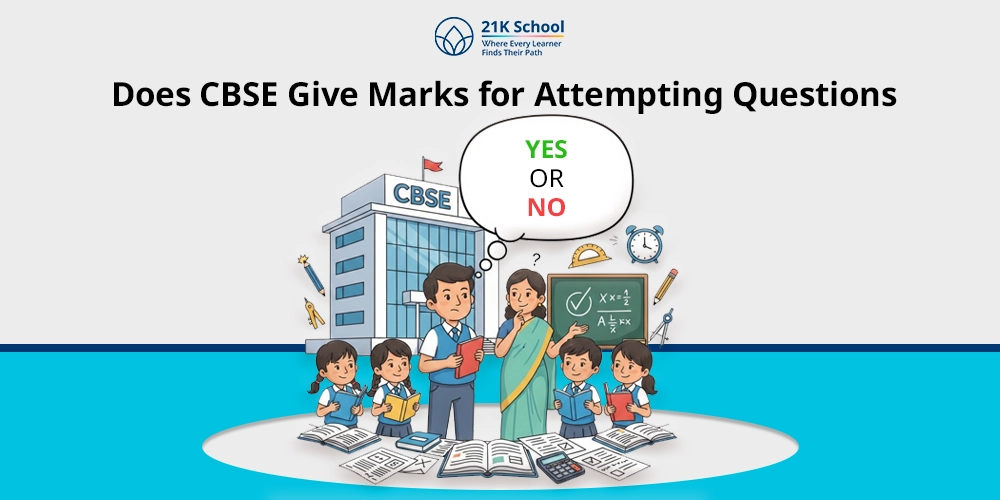
Are you one of those students who are confused about getting marks for attempting questions in CBSE exams?
Well, you are not alone for feeling so. So, does CBSE give marks just for attempting questions?
You can find that out after reading the following article as it will redefine the CBSE evaluation system for and criteria on which marks are provided.
This article will also let you know what things that evaluators look for in your answers and how you can score your best in these exams.
Contents
- What is the CBSE Evaluation System and How Does It Work?
- Does CBSE Give Marks Just for Attempting a Question?
- Concept of Step-Wise Marking in CBSE
- Internal Choices and Attempting All Questions
- Common Myths About Attempt Marks
- What Examiners Look For in an Answer
- Does CBSE Award Grace Marks?
- How Students Can Maximize Marks Even If Unsure
- Conclusion
What is the CBSE Evaluation System and How Does It Work?
Central Board of Secondary Education (CBSE) has a central-level and standardized system of evaluation.
CBSE provides examiners with the official marking schemes before answer checking begins.
This system ensures fair and consistent assessment for all students across all regions with the help of a 9-point relative grade scale (A-E2).
CBSE evaluation focuses on accuracy of content and conceptual understanding of taught syllabus.
The marks are given on what has actually been written and its relevance to the marking scheme instead of the effort.
The evaluation system is divided into two parts consituting the internal assessments and external assessments.
These internal assessments consists of assignments, tests, and practicals, while external assessments include the end-term theory exams or board exams.
It is also crucial to remember that students must obtain 33% in theory and practicals separately.
Failing one would mean failing the whole subject even if the combined score exceeds 33%.
On top of that, each grade includes top 1/8th of population, which reduces academic pressure among learners and evaluate them holistically.
Does CBSE Give Marks Just for Attempting a Question?
No, CBSE does not give marks just because one has attempted a question.
In case a student writes something wrong or irrelevant to the question, he or she does not get any marks even though the question has been attempted fully.
Examiners are instructed to give marks to those answers that have the right facts or reasonable explanations.
However, if any of the answers are partially correct, students can still be given marks for the correct parts.
Concept of Step-Wise Marking in CBSE
To increase the number of attempted questions and the chances to pass in CBSE exams, evaluators often use a step-wise marking scheme.
In this approach, students are rewarded with partial marks if they have written some steps correctly, instead of the overall answer in subjects like mathematics or physics.
Subject-Wise Explanation
These partial marks are applicable in those subjects only which include some steps.
For instance, students can earn marks in Mathematics for correct formulas, logical steps, and proper calculations. Although the final answer may be wrong, some points are awarded for correct steps.
In Science:
- Physics marks are given on the basis of using the right formulas and explanations.
- Chemistry, however, is marked on reasoned and balanced equations and calculations.
- Biology marks are based on the right points, diagrams, and explanations.
You may get partial marks in Social Science if you include important dates, names, clarity, and relevant concepts in the answers. Writing additional or irrelevant information on your own wouldn’t add to your scores.
Diagrams, right descriptions, and correct terms in the answer of economic subject questions can reward you with some marks even if your overall answer appears wrong.
Apart from these, marks in Accountancy are dependent on correct formulas, concepts, and calculations.
Language marks are based on the relevance of the content, grammar, expression and organization.
Some students think that writing anything and just filling pages can help them secure some marks at least in theory subjects, but that’s not true and they should remember this.
Internal Choices and Attempting All Questions
CBSE question papers usually offer internal options for a few questions. Here, two questions of the same weight are given to students to choose from.
While answering these questions the following should be kept in mind:
- There is no additional mark if you attempt both of them.
- The evaluators review the first answer only.
- There is no use in writing irrelevant answers as that would be a wastage of time.
The right choice would be the one that the student is more sure about, therefore he or she should answer it clearly.
Common Myths About Attempt Marks
There are some myths that are common among students about attempted questions in CBSE exams:
1. Myth 1: “CBSE gives marks for handwriting and effort”
Clear handwriting improves visibility of answers in answer sheets.
But, some students believe that their beautiful handwriting can save them from failing.
They should have clarity that good handwriting can only help them when they have written right answers in their answer-sheets or else it would be a waste.
2. Myth 2: “If I attempt every question, I’ll pass”
Many students try to attempt every question in the hope of at least getting passing marks.
This is a myth because if you don’t write the correct answers, no one can give you any marks. You must at least write answers that can secure you 33% so that you pass.
3. Myth 3: “Writing lengthy answers gives more marks”
Another myth is that if we write long answers, even without correct explanations or conceptual statements, we can score more marks.
In fact, these kinds of attempts can cause confusion among the invigilators, thus forcing them to score you much less.
What Examiners Look For in an Answer
The examiners in CBSE look for the following while evaluating an answer sheet:
- Correct concepts and facts
- Key value points as indicated in the marking scheme
- Logical flow and clarity
- Proper terminology
- Diagrams (where required)
- Step-wise solutions
Does CBSE Award Grace Marks?
CBSE has special criteria for offering grace marks . It does so only in case a student is lagging behind due to few marks from passing.
Grace marks are also given when a question paper turns out to be exceptionally challenging or if the question paper has inaccurate questions.
Though, individual examiners can not award grace marks, instead it is the CBSE board that decides if the whole population should be given those marks.
However, it is crucial to note that grace marks are not guaranteed. That is why students should not rely on them.
Besides that, they are also restricted to only 5% per subject with a maximum of 15 marks combined across all subjects.
How Students Can Maximize Marks Even If Unsure
Students can ensure maximum marks even if unsure of the answers written by following the given simple points:
- Writing correct spellings or formulas
- Mentioning accurate steps and reasoning
- Drawing labeled diagrams
- Answer in bullet points or use headings
- Avoid random or irrelevant context
- Attempt lengthy questions first and tough questions last
- Ensure effective time-management
It would be much better to write something that is significantly related to the question rather than nothing.
Conclusion
Now, you know that CBSE doesn’t give marks for just attempted questions if the context and theories presented are wrong.
But, if you have clarity of the questions given, and you attempt it with at least the right concepts, formulas, or step-by-step explanation, the invigilator will have to give some marks.
There are a few myths about CBSE giving marks for good handwriting, attempting all questions, and writing long answers. These are false and you should not be dependent on such strategies to pass your exams.
Instead, you can focus on clarifying your concepts, have a deeper understanding of them, attempt only the questions you are sure of, and write clearly. This will give you better results.

You may also want to read