


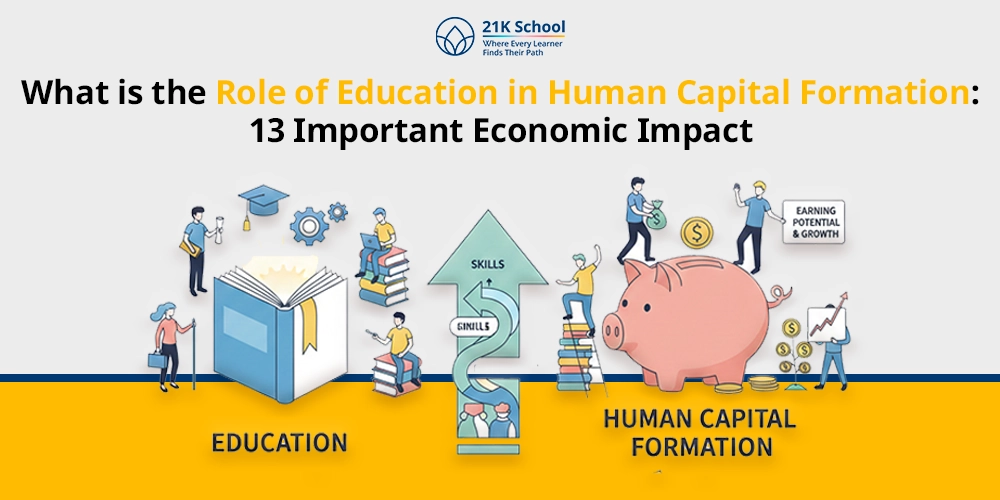
The human capital of a nation can be said to be one of the most crucial components of national development .
A country with a higher youth population can have a better potential to succeed and evolve, if it invests in education and generates employment opportunities.
The best way to train this population is through education . Without education, all the resources could be underutilized or misused.
This is why developed countries put emphasis on strong educational infrastructure and opportunities.
In this article, we shall discuss the role of education in human capital formation, but before that let’s first comprehend what human capital formation is.
Contents
- What is Human Capital Formation?
- What is the Role of Education in Human Capital Formation – 13 Important Roles
- 1. Skill Development
- 2. Improving Productivity and Efficiency
- 3. Focus on Research and Innovation
- 4. Economic Growth and Lifelong Learning
- 5. Reduction of Income Inequality
- 6. Employment Opportunities
- 7. Social Development
- 8. Women Empowerment
- 9. Health and Well-Being
- 10. Global Competitiveness
- 11. Responsible Citizenship
- 12. Cultural and Social Enrichment
- 13. Personal Empowerment
- Conclusion
What is Human Capital Formation?
Human capital formation is a process by which people attain more skills , knowledge, abilities, and values by investing in education, training, health, and development of their skills.
Human capital is represented in the form of people as opposed to physical capital like machines or buildings. Therefore, human capital enhances with learning and exposure.
An effective human capital formation can be possible with effective education as a crucial component. Though other resources like health and skill development would also be required.
This is because once people get good education and training, they become more productive and their income is higher.
This boosts their living standards and the economy of the country upgrades.
As the human capital theory says, education is an investment in humans that brings out productivity and enhanced skills. It is similar to the investment in machinery.
Social development is also promoted through human capital formation which lowers the level of poverty and unemployment.
What is the Role of Education in Human Capital Formation – 13 Important Roles
Education plays a significant role in human capital formation as it emphasizes the following:
1. Skill Development
Education provides people with necessary competencies that include literacy, numeracy, technical skills, problem-solving , and communication skills .
With the help of schools, colleges, and professional institutions, individuals learn some general and some specific skills needed in different jobs.
Education is one of the most important sources of human capital formation since skilled workers are more productive to be able to fulfill the shifting demands of the labor market.
2. Improving Productivity and Efficiency
Educated employees are more productive because they are more versed with their work. This enables them to utilize resources in an efficient manner.
Education enhances decision-making , minimizes errors, and promotes modern techniques and technologies.
The more the productivity, the more the firms and economies are able to generate output using the same resources, which results in a better economic growth.
3. Focus on Research and Innovation
Higher-level education encourages research and innovations in technology.
Research institutions and universities are the key players in creation of novel inventions and complex solutions.
Curiosity and critical thinking are the requirements of innovation, which are created through education.
4. Economic Growth and Lifelong Learning
Education is a direct contributor to economic growth since it enhances the standard of the human resources.
Having a well-educated workforce increases the production of goods and services of a country in an efficient manner.
Education also fosters lifelong learning where a person can keep on updating their skills. Such flexibility should be in a fast changing economy.
5. Reduction of Income Inequality
Education can also contribute to minimizing income inequality when quality education and educational equity are evident in all socio-economic backgrounds.
With a large number of individuals having access to quality education , individuals can enhance their talents and earning rates despite their background.
The result is a fairer distribution of income that reduces poverty, making social stability stronger.
6. Employment Opportunities
There can be enhanced employability due to education, whereby the skills of individuals are applied to the job market demands.
Those who are educated stand a higher chance of getting stable and well-paid jobs in today’s economy.
People are also prepared in technical and vocational education to take up self-employment and become entrepreneurs.
Education is beneficial in enhancing human capital formation and economic development by decreasing unemployment.
7. Social Development
Education is a social development factor that enhances tolerance, cooperation, equality, and social responsibility towards the people.
Educated people are more observant of societal problems and are in a better position to be involved in the development of the community.
Through education, social issues such as crime and social exclusion are minimized, hence forming a more united society.
8. Women Empowerment
One of the best tools of women empowerment is education.
Educated women can have a higher chance of engaging in the workforce by making informed choices as well as enhancing economic growth.
Gender equality, role in family and society, as well as health of women can also improve due to education.
Women-education can also empower them to leverage their economic capital that moves through generations.
9. Health and Well-Being
There is a close connection between education and health.
Educated people are aware of matters of health practices, nutrition, hygiene, and disease prevention. Health enhances productivity and minimizes absenteeism.
Healthy families and the reduced rates of mortality are also the outcomes of education.
10. Global Competitiveness
In a globalized world, nations are competing with one another based on the standard of their human capital.
Education increases the chances of a country to use modern technologies, attract foreign investments, and be involved in international trade.
Well-trained and talented employees can expand the level of global competitiveness of the country, as well as the future economic outlook.
11. Responsible Citizenship
Education creates educative and responsible citizens that know their rights and responsibilities.
Educated people have the higher chances to engage in democratic processes by obeying laws and acting beneficial for the society.
Civic education can promote morality, environmental awareness, and social responsibility, which are critical in sustainable development.
Before moving ahead, learn how to raise environmental awareness among young people .
12. Cultural and Social Enrichment
Education can also facilitate cultural awareness and heritage appreciation. It contributes to the maintenance of cultural values and fosters the openness to new ideas.
Literature, arts, history, and philosophy make an individual and society enriched.
With the help of education, cultural enrichment increases social peace and respect.
13. Personal Empowerment
Education also empowers the people through offering them self-confidence and independence.
It helps human beings to make wise decisions concerning their professions, health, and life.
Education empowers individuals, enhances motivation and ambitions, resulting in improved individual performance and human capital.
Conclusion
Education can be the best tool for human capital formation and advancement of any nation.
It can build necessary skills needed for employment and can serve as the mediator for social development of the country, thus reducing inequalities and favouring women empowerment.
As long as, educational base of a nation is strong, their human capital will always prove to be the best of all investments.
This is because it could gradually change the overall social, economical, physical, and moral picture of the country for the good.
