

In present times, everyone gets the importance of education in real life.
People from either villages or city areas are aware that education is the only means of growth .
The modern teaching approach involves learners from every background.
And this is the reason, the concepts of correspondence and distance education came forward.
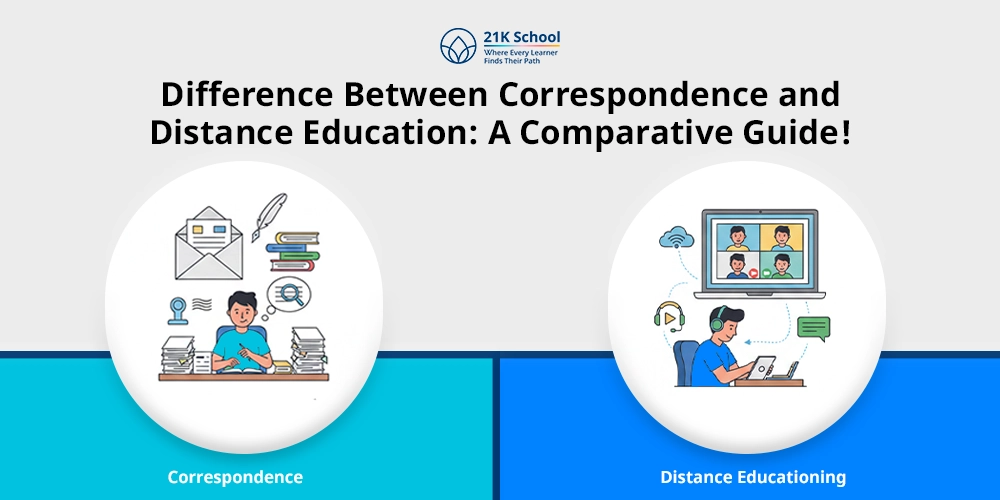
Both of them are advanced, but their ways of delivery, communication, costs, and other factors differ.
This article would brief you about these differences between correspondence and distance education, and find which suits who.
Contents
Key Differences Between Correspondence and Distance Education
Distinctions of correspondence and distance education will be talked about with a table and then bullet points.
So follow up with the table below:
| Aspect | Correspondence Education | Distance Education |
| Mode of Delivery | Hard copy textbooks sent via Post | Digital classrooms , videos, audiobooks, and online meetings. |
| Communication | One-way as educators not actively involved | Two-way as it includes online interactions and conferences |
| Technology Use | Least to no use, as learning with textbooks | Higher dependency of digital gadgets like phones, laptops, and computers. |
| Flexibility | Limited due to postal systems of feedback and assessments | High as learners can access resources anytime, anywhere |
| Feedback and Assessment | Slow feedback through mailed assignments | Instant or timely feedback through online assessments and forums |
| Learning Resources | Printed books, notes, assignments | Digital textbooks , interactive activities, and recorded lectures |
| Student-Teacher Interaction | Limited and delayed | Frequent, and real-time communication possible |
| Cost | Generally low | May vary depending on technology use and infrastructure |
| Example Institutions | University of Mumbai (Correspondence Courses), University of Delhi (School of Open Learning) | University of Phoenix, Indira Gandhi National Open University (IGNOU), Open University (UK) |
1. Mode of Delivery
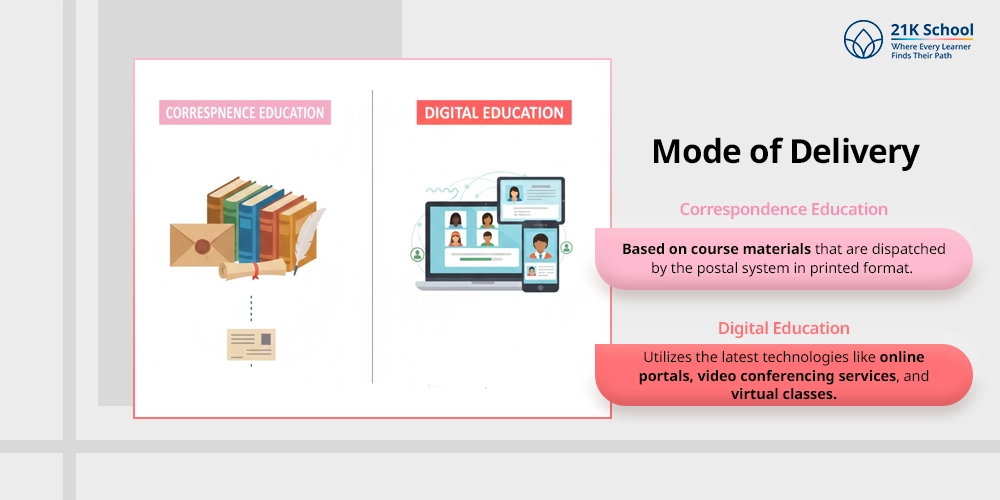
- Correspondence Education: Correspondence education is based on course materials that are dispatched by the postal system in printed format.
- Digital Education: Distance education utilizes the latest technologies like online portals, video conferencing services, and virtual classes that enable more dynamic, and interactive learning experiences.
2. Communication
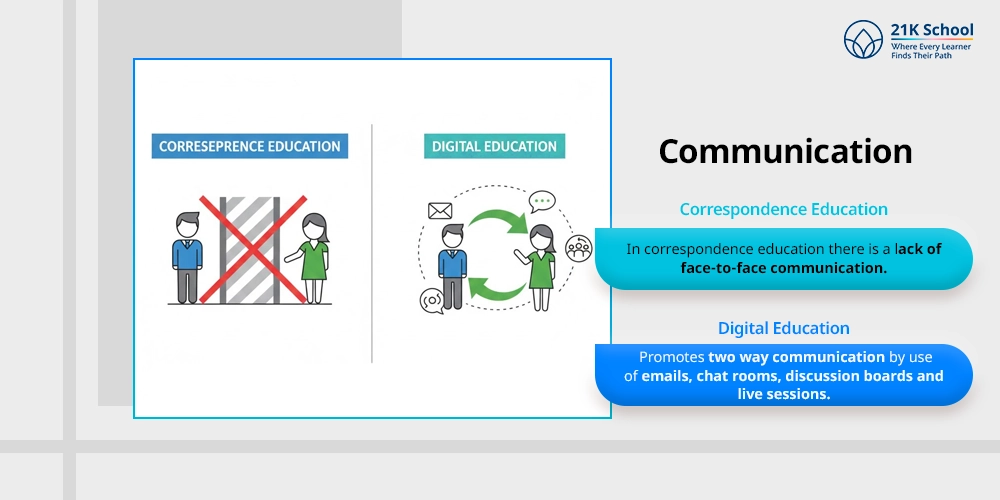
- Correspondence Education: In correspondence education there is a lack of face-to-face communication between teacher and student because it often is restricted to written feedback.
- Digital Education: Distance learning promotes two way communication by use of emails, chat rooms, discussion boards and live sessions, which promotes greater interaction.
3. Technology Use
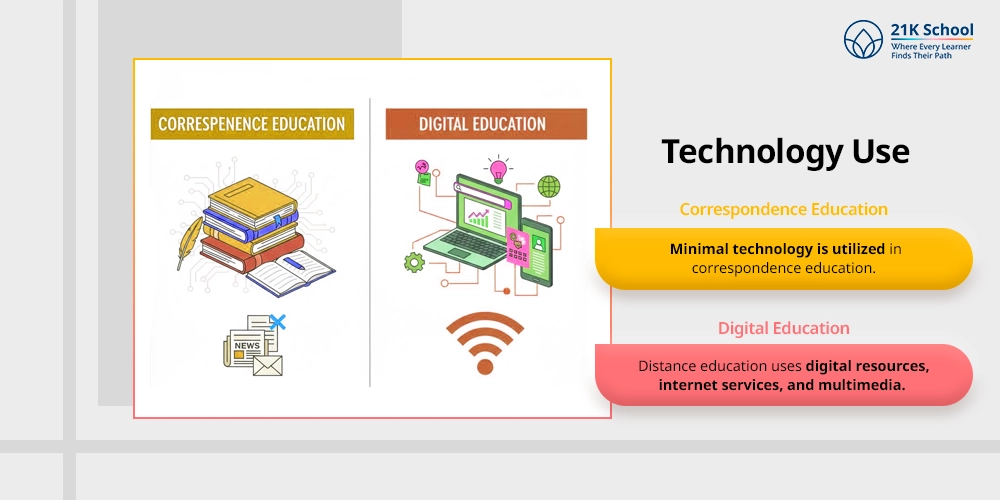
- Correspondence Education: Minimal technology is utilized in correspondence education, where printed text is used to a large extent.
- Digital Education: Distance education uses digital resources, internet services, and multimedia to promote knowledge , expertise and facilitate access.
4. Flexibility
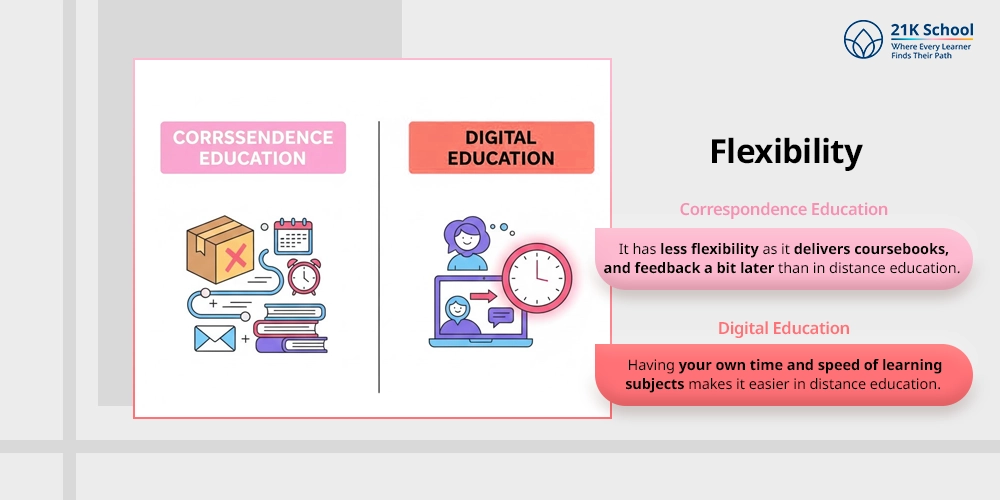
- Correspondence Education: Correspondence education has less flexibility as it delivers coursebooks, and feedback a bit later than in distance education. This is due to portal systems, and hard copy resources.
- Digital Education: Having your own time and speed of learning subjects makes it easier in distance education. Also the feedback can be given instantly through online meetings.
5. Feedback and Assessment
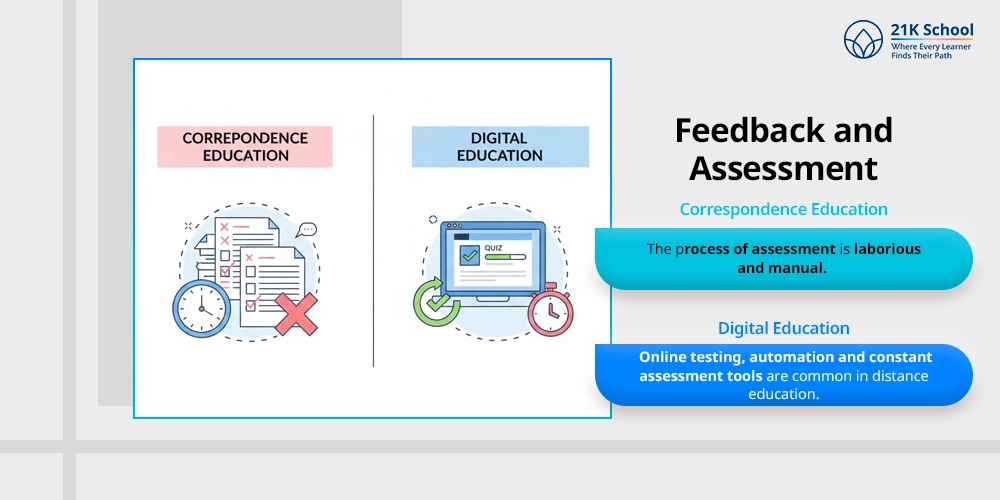
- Correspondence Education: In the case of correspondence education, the process of assessment is laborious and manual. Assignments are sent, marked and annotated back.
- Digital Education: Online testing, automation and constant assessment tools are common in distance education, making it a quicker or sometimes immediate evaluation.
6. Learning Resources
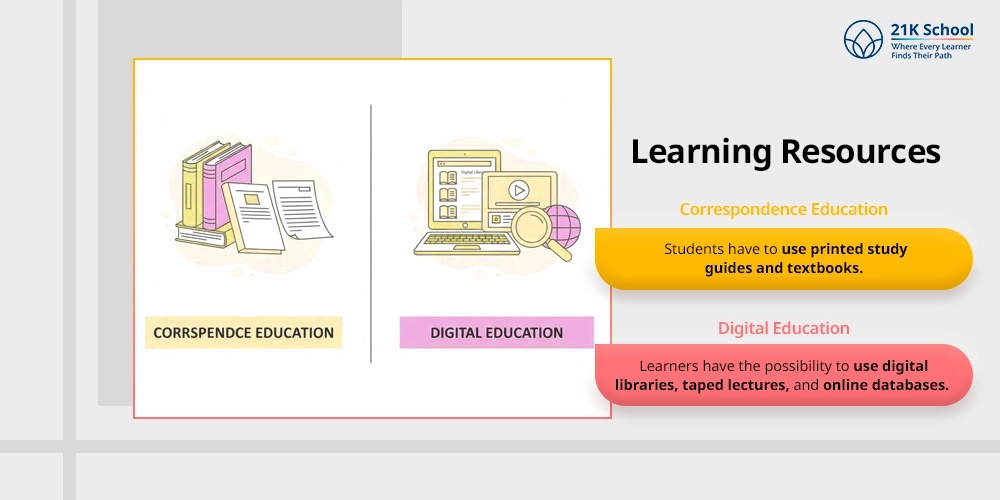
- Correspondence Education: Correspondence students have to use printed study guides and textbooks.
- Digital Education: Distance learners have the possibility to use digital libraries, taped lectures, and online databases, which provide them with a richer and more interactive experience.
7. Student-Teacher Interaction
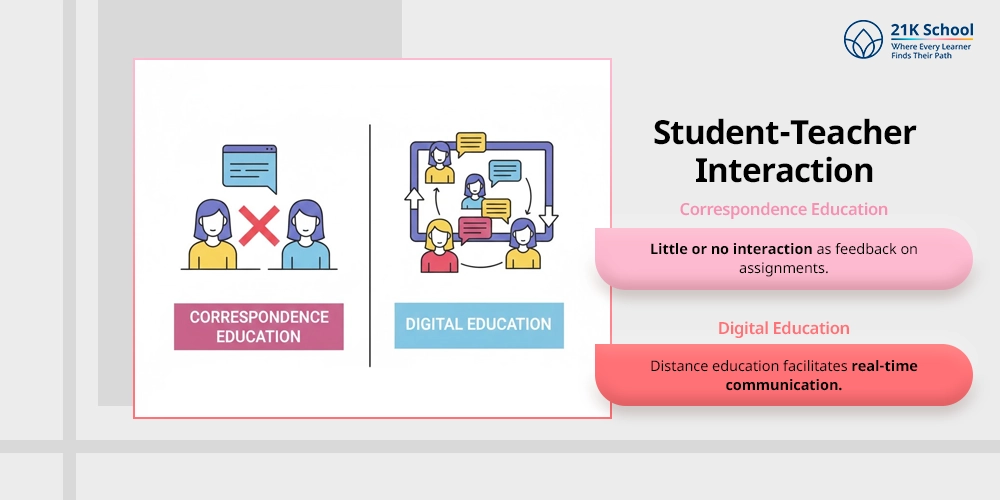
- Correspondence Education: Correspondence education has little or no interaction as feedback on assignments.
- Digital Education: Distance education facilitates real-time communication enabling students to have access to their instructors and peers via online meetings or discussion boards.
8. Cost
- Correspondence Education: The average cost of correspondence Education in India is around 30,000 INR for Undergraduate courses.
- Digital Education: The average cost of Digital Education in India is around 15,000 INR for Undergraduate courses like (BA, BCom.)
9. Example Institutions
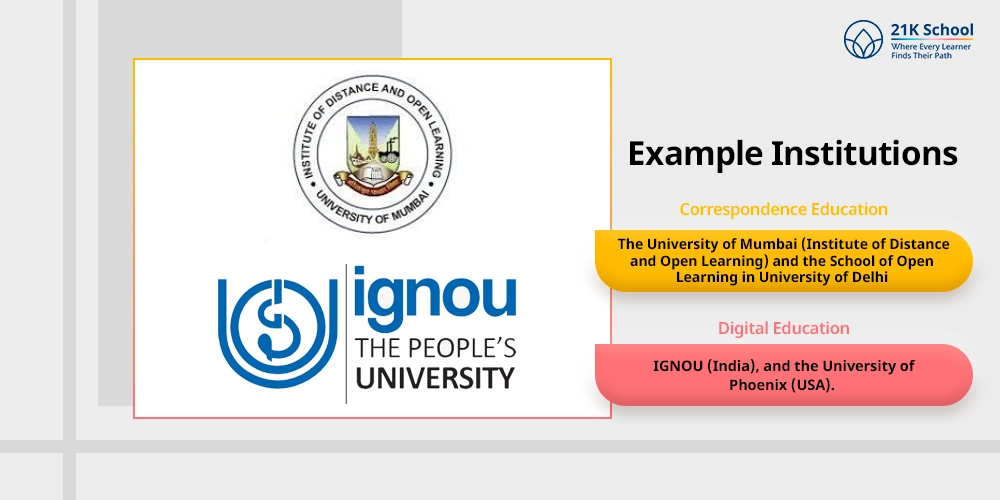
- Correspondence Education: The University of Mumbai (Institute of Distance and Open Learning) and the School of Open Learning in University of Delhi are notable institutions of correspondence education.
- Digital Education: Good examples in the case of distance education are IGNOU (India), and the University of Phoenix (USA) which use advanced online systems.
What is Correspondence Education?
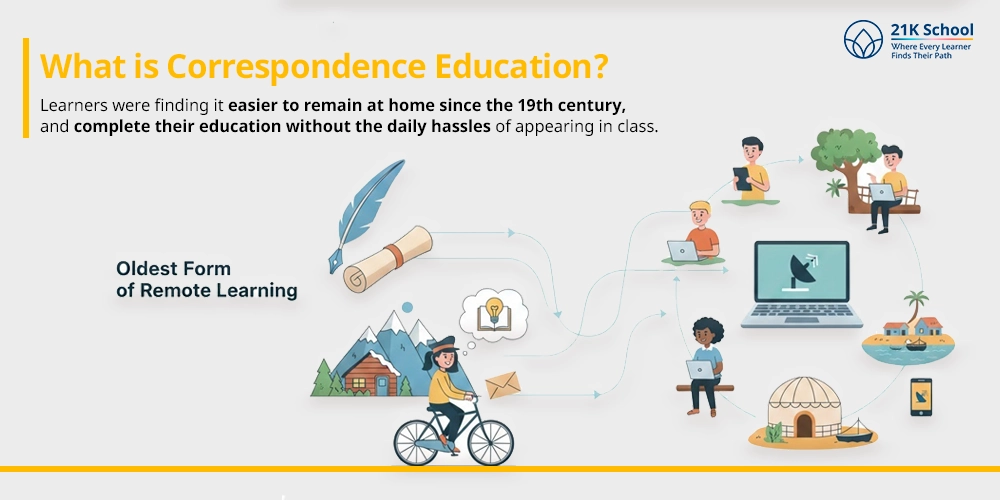
One of the oldest forms of remote learning is correspondence education.
Learners were finding it easier to remain at home since the 19th century, and complete their education without the daily hassles of appearing in class.
The correspondence courses came in very handy during the pre-digital period as they made education accessible to those living in remote regions.
Even now correspondence education can be taken as an option where there is low internet access.
Key Features of Correspondence Education
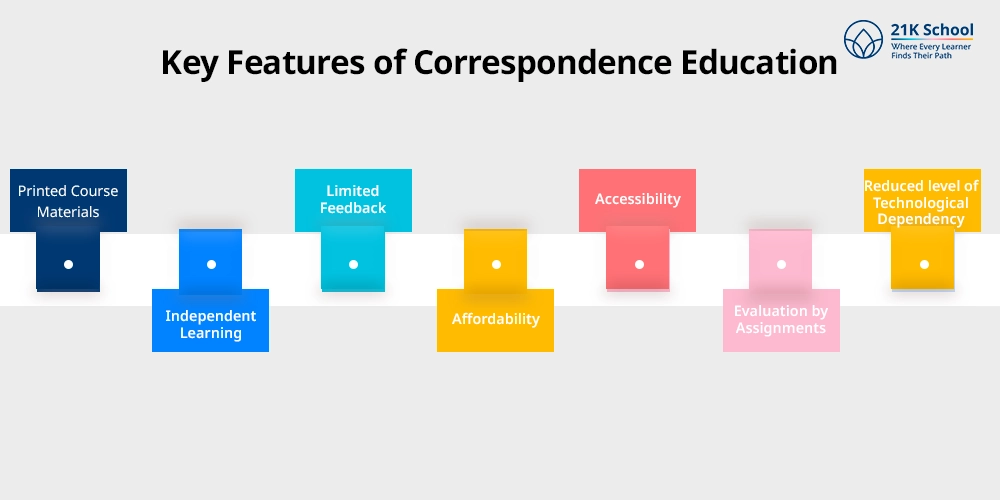
Main features of correspondence education includes:
- Printed Course Materials: The learner receives the study materials, textbooks and assignments through mailing to his or her address.
- Independent Learning: Students learn at their own time, which is usually in the absence of the instructors.
- Limited Feedback: Communication is done in the form of written correspondence; the feedback is delayed.
- Affordability: The cost is also reduced because one is free from dependence on digital infrastructure.
- Accessibility: Appropriate for young learners without internet access or devices.
- Evaluation by Assignments: The assignments are mailed by the students and exams are usually administered at the specified center.
- Reduced level of Technological Dependency: The system is completely offline, and thus, can be used by those who live in underdeveloped regions.
What is Distance Education?
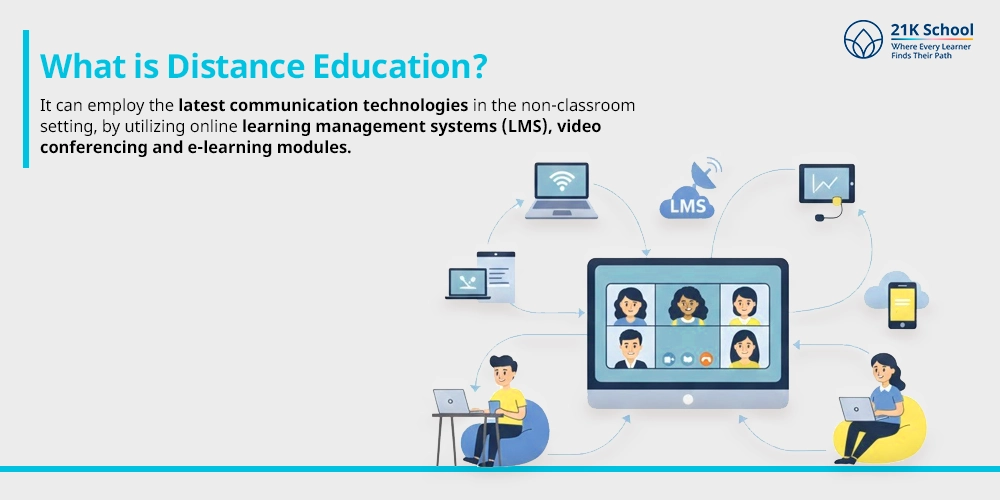
Distance education is one that uses more sophisticated technologies.
It can employ the latest communication technologies in the non-classroom setting, by utilizing online learning management systems (LMS), video conferencing and e-learning modules.
It enables learning by means of immediate communication between students and instructors along with other learners.
The focus is on providing access to digital learning resources, and consistent feedback for developing comprehension in students.
Key Features of Distance Education
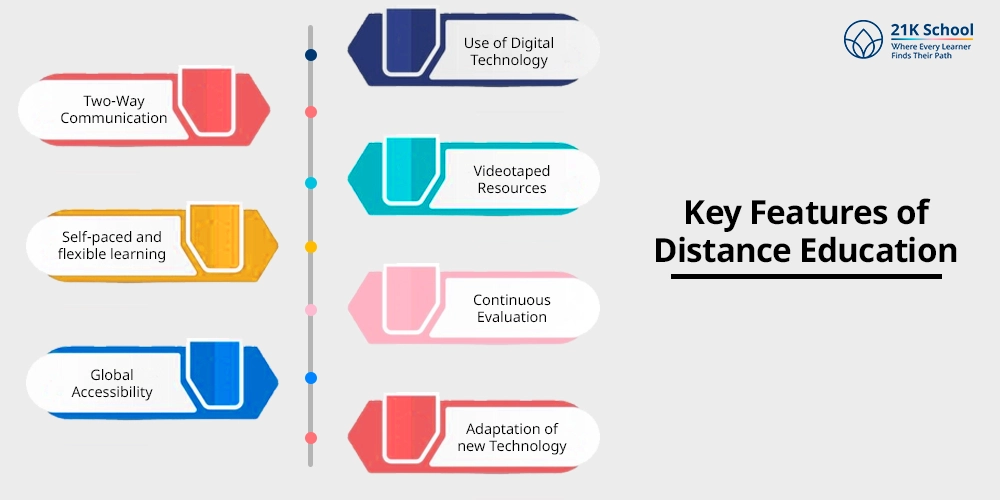
Distance education becomes distinctive due to its features. Let’s have a look at them one by one:
- Use of Digital Technology: Utilizing digital resources is quite common in distance education for conducting meetings and classes in Zoom or Google classrooms.
- Two-Way Communication: Unlike correspondence education, educators and children interact on a daily basis through Google meetings and online classes.
- Videotaped Resources: Educators plan their lessons in meetings with videos found online or curated by themselves and played later.
- Self-paced and flexible learning : Students are able to learn and refer to the study materials whenever they want and get time.
- Continuous Evaluation: Peer reviews, assignments and online quizzing offer a continuous and immediate evaluation.
- Global Accessibility: Distance education allows students all over the world to enroll in programs without necessarily moving.
- Adaptation of new Technology: The use of virtual labs, AI-based tutoring and adaptive learning systems are emerging as a characteristic feature.
Concluding Thoughts
Correspondence and distance education have a similar objective of offering knowledge to people through accessible means.
But the way they conduct education and their tools vary a lot.
A correspondence education is independent, and self-paced for students who like to study independently with minimum use of digital technologies.
Distance learning on the contrary is an interactive technology driven model, which gives flexibility, collaboration, and immediate feedback.
With the ongoing technological growth, traditional correspondence models would be integrated with the contemporary digital framework.
Hence learning will be made more inclusive and efficient.

You may also want to read