

Education is playing a crucial role in designing the foundation of every student’s career & professional growth.
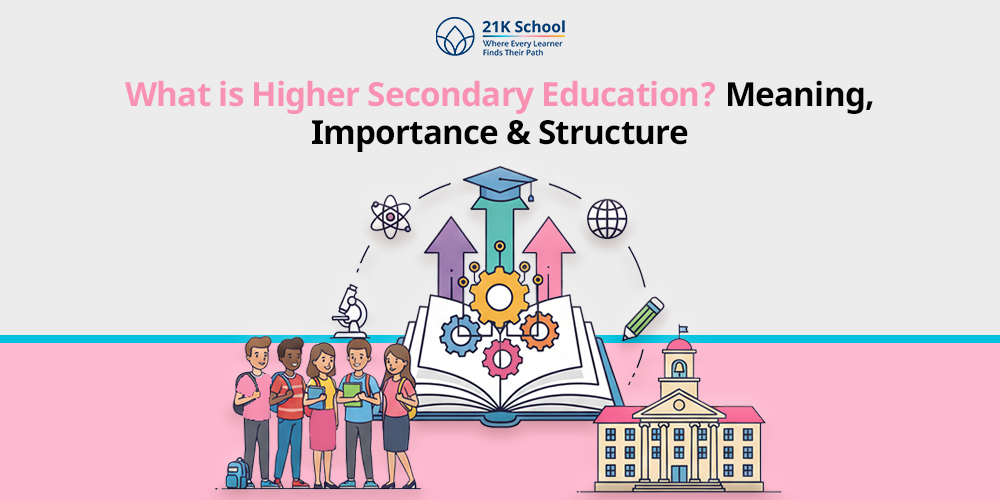
Among its many levels, higher secondary education is represented as one of the most vital phases that connects classroom learning with higher education & skill development.
It occurs during that particular time interval when the learners start to choose their streams or fields. It also helps them improve their critical thinking skills , communication skills , and make them ready for college life.
This particular blog will discover the meanings, structure, objectives, & importance of higher secondary education, mostly in the Indian context, also with key reforms & frequently asked questions.
Contents
What is Higher Secondary Education?
Meaning and Scope
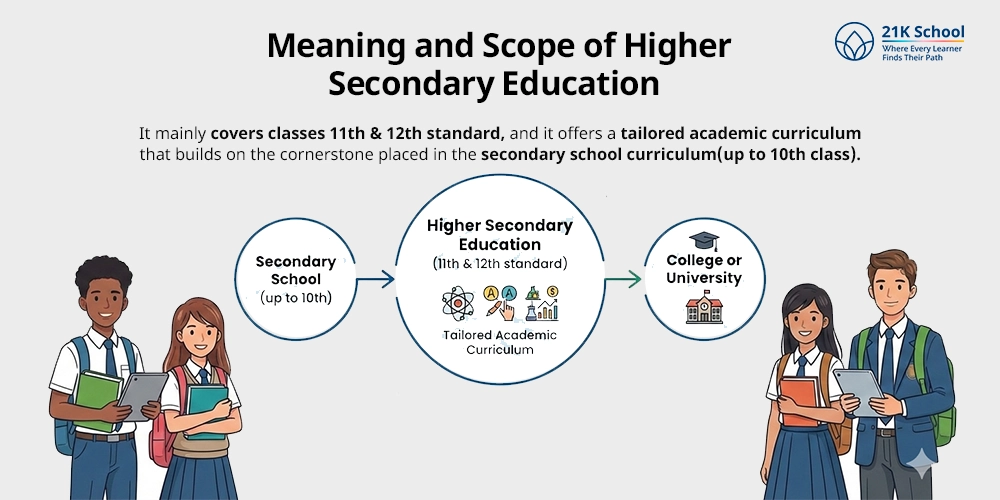
Higher secondary education is defined to be the last stage of school learning before a learner enters college or university.
It mainly covers classes 11th & 12th standard, and it offers a tailored academic curriculum that builds on the cornerstone placed in the secondary school curriculum(up to 10th class).
The meaning of higher secondary education depends on its purpose – It behaves as a link between the foundational education & higher studies or skill-based training.
Students at this phase choose particular streams or fields of study that line up with their future ambitions, be it science, commerce, or humanities.
In terms of Scope, higher secondary education offers more than just school learning.
It simultaneously focuses on the development of skills such as analytical skills , critical thinking skills, and empathy . These qualities help the learners to be ready for both academic performance & life outside the school.
Structure of higher education in India
The best ways to learn math are through daily practice, conceptual understanding, active problem-solving, mastering the basics, and others like:
- Universities: These can award degrees and can be central universities, state universities, private universities, deemed universities, or Institutes of National Importance (INIs).
- Colleges: These offer specific courses and are affliated to universities.
- Courses: These courses offer diplomas or certifcates like UG courses or PG courses and offer flexible exists.
- Regulatory and Quality Bodies: The University Grants Commission (UGC) is the main body for standards, All India Council for Technical Education (AICTE) is for technical education, and other accreditation agencies.
- Tiered system: The three-tier system is in practice in higher education in India that covers Tier 1 having top institutues, Tier 2 having reputable central or state univerities or NITs, and Tier 3 having regional or average colleges.
- NEP impact: New Education Policy (NEP) 2020 has introduced 5+3+3+4 schooling model leading to the higher education.
1. Streams and Subjects
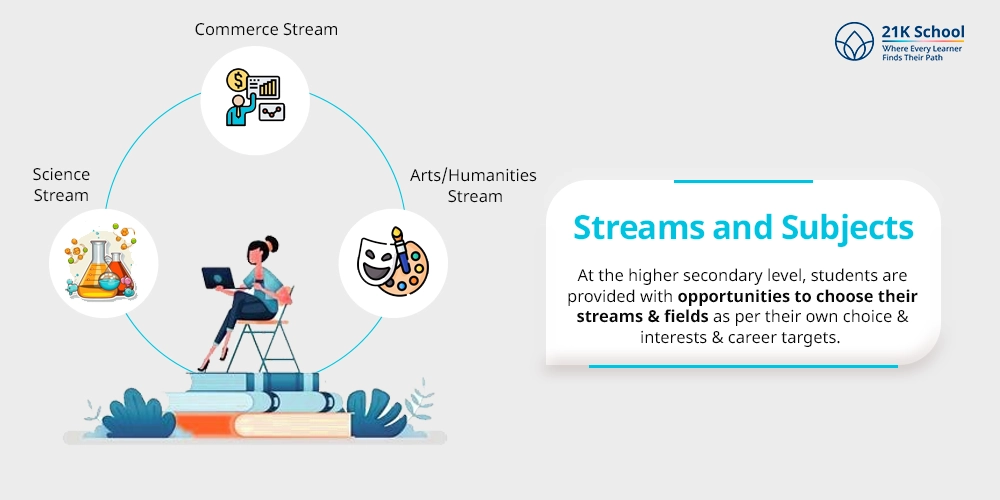
At the higher secondary level, students are provided with opportunities to choose their streams & fields as per their own choice & interests & career targets.
There are 3 categories or streams in higher secondary education, as mentioned below are the same:
- Science Stream: In this stream, it prioritizes the subjects such as physics, chemistry, maths & biology, which are the basic subjects for a student to build a future in engineering, or medical science & research.
- Commerce Stream: This stream, involves subjects like accounts, business studies, maths, & economics are involved, which best suit the students who are thinking of building a career in finance or the accounts department or want to be involved in a business.
- Arts/Humanities Stream: This stream offers subjects such as history, literature, arts, psychology, sociology, etc, which will help the students to be prepared for a future career related to these creative & social fields.
This organised process is helping & preparing the students to align themselves in their field of interest, career paths for long-term goals & this also keeps the opportunities open for interdisciplinary learning .
2. Assessment System
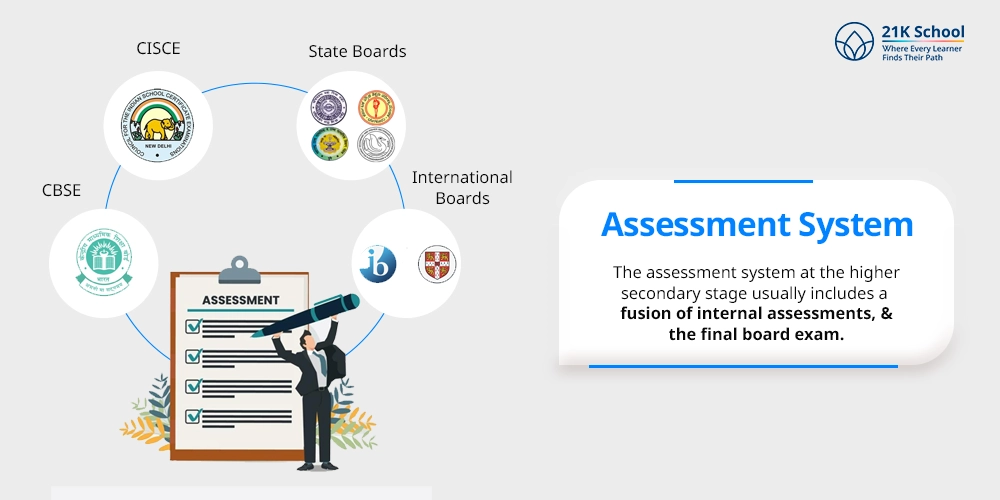
The assessment system at the higher secondary stage usually includes a fusion of internal assessments, & the final board exam.
The internals must include the class tests, practical exams, projects, and assignments. At the end, after completion of the syllabus , the final board exams take place & examine the overall academic performances of every individual.
In India, these final examinations are being organised by different boards, such as:
- CBSE(Central Board of Secondary Education)
- CISCE(Council for the Indian School Certificate Examination)
- State Boards(such as Odisha board, Karnataka board, Bihar board, etc.)
- International Boards(such as IB & Cambridge International)
This double system helps the students to maintain an equilibrium between the theoretical knowledge & practical knowledge , which helps the students to be ready for high-level assessments & professional entrances.
Objectives of Higher Secondary Education
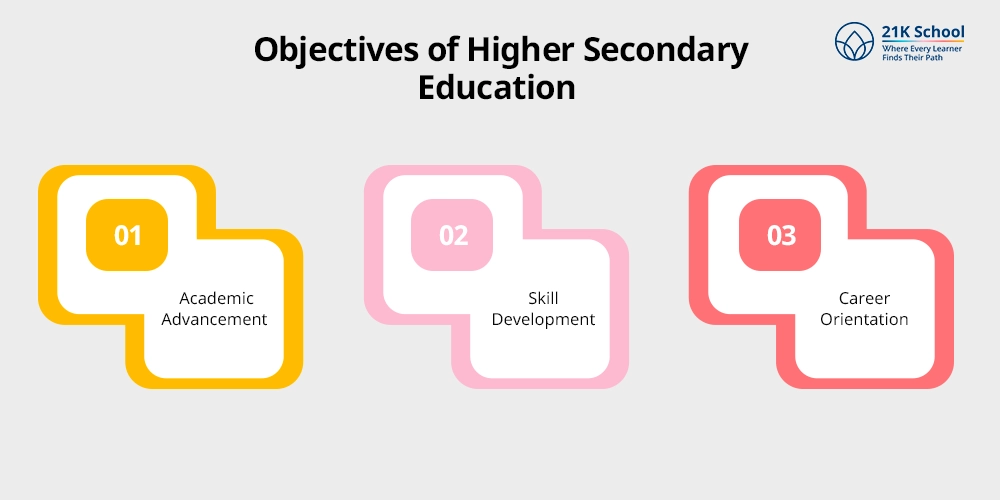
Higher secondary education offers various ways to think beyond academics, and students may not limit themselves to academics only. It helps in building the students’ careers by identifying their skills, capabilities that are important for future success.
1. Academic Advancement
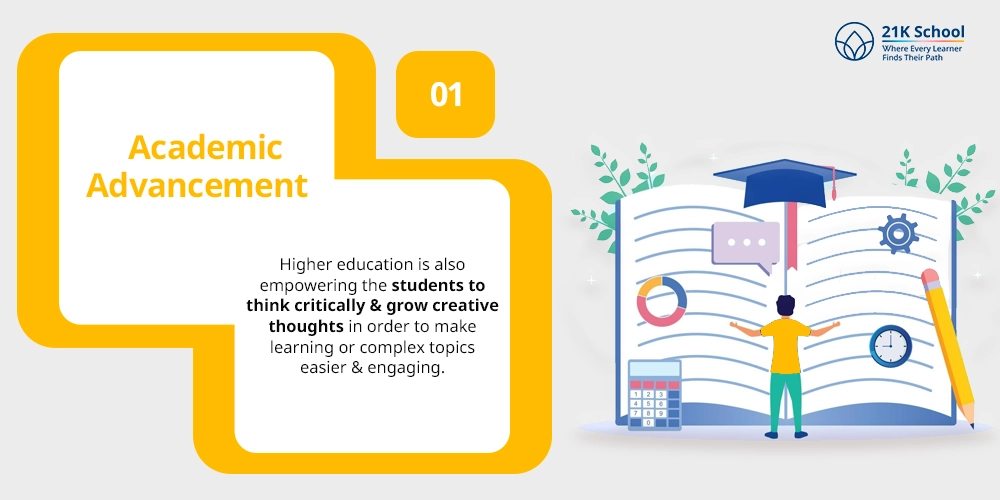
One of the main objectives of higher education is to understand the depth of academic advancement. Students are changing their perspective of normal education to career specialization, so that they can have a keen insight into their chosen streams or field of studies.
Higher education is also empowering the students to think critically & grow creative thoughts in order to make learning or complex topics easier & engaging.
2. Skill Development
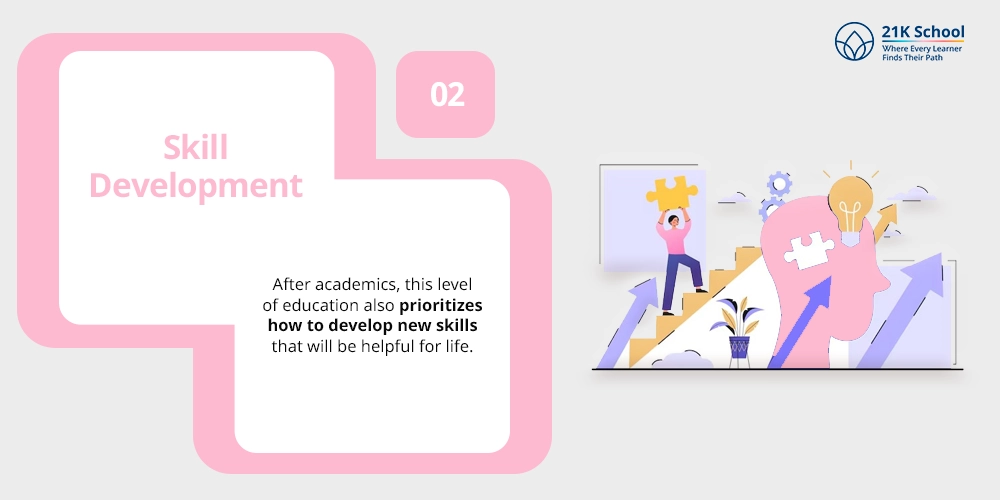
After academics, this level of education also prioritizes how to develop new skills that will be helpful for life. These skills include communication, collaboration with teams, time adjustments, & digital learning .
In the present 21st-century world, intellectual skills, emotional & mental skills play an important role in employment & help the learners to not only be prepared for exams but also for the future.
3. Career Orientation
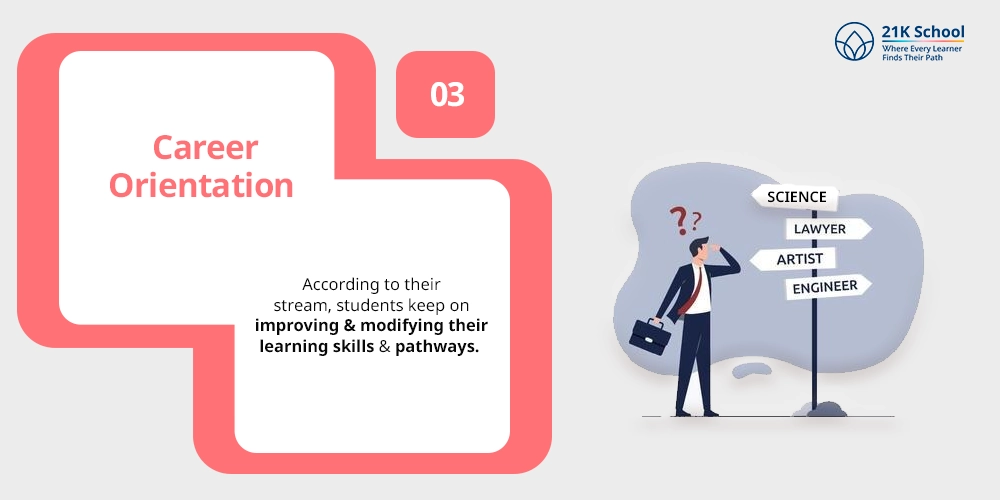
Higher secondary education serves as a career foundation for students.
According to their stream, students keep on improving & modifying their learning skills & pathways.
Career counseling, entrance tests, & vocational education are provided during this level of learning, which will help the students to take control over their learning and know their areas of strength & weakness. This entire alignment is helping students to stay confident & motivated for the future.
Importance of Higher Secondary Education
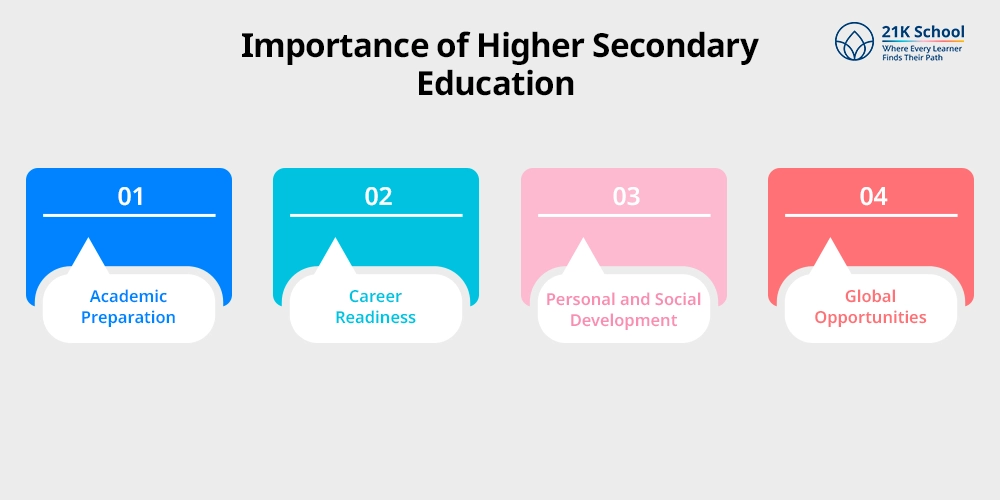
Higher secondary education is the stage that encourages students to develop academic , personal & social development. Its importance is to prepare the students for future challenges.
1. Academic Preparation
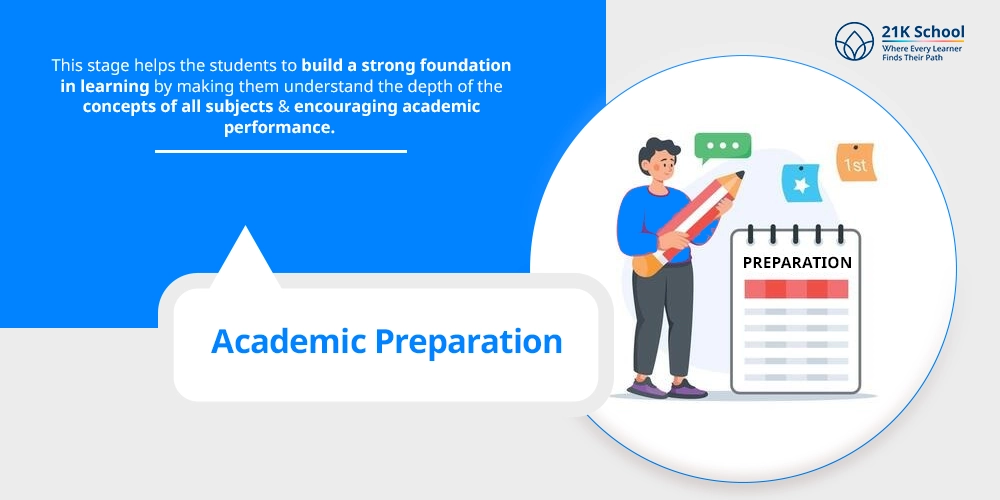
This stage helps the students to build a strong foundation in learning by making them understand the depth of the concepts of all subjects & encouraging academic performance.
Here, students will be getting the ideas & knowledge of how to solve analytical reasoning, how to improve or modify their study habits , and a lot more that are required for higher secondary education.
So, the scope of a diverse framework helps them to be intellectually efficient & makes them ready for the competitive exams such as IIT, NEET, CAT, & CLAT, etc.
2. Career Readiness
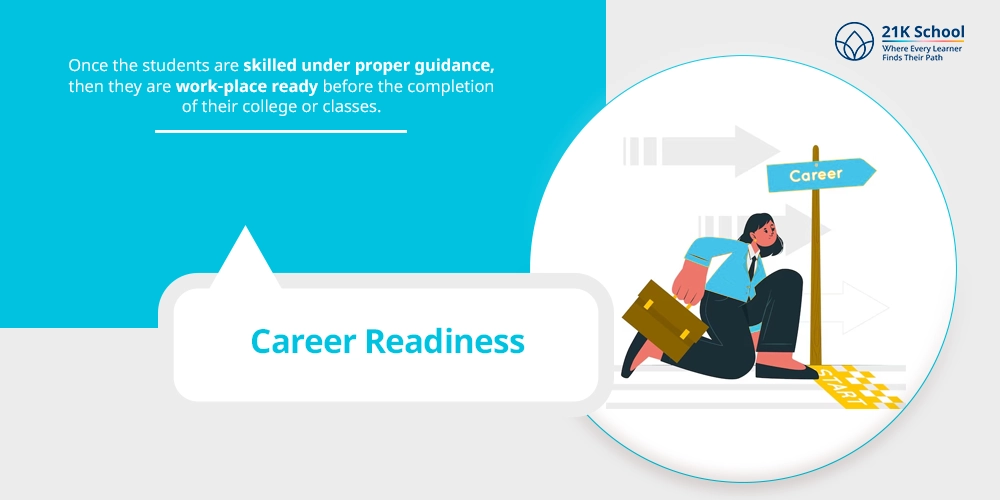
Higher secondary education offers scope for future employment or job opportunities. Once the students are skilled under proper guidance, then they are work-place ready before the completion of their college or classes.
During this phase, practical experiences, skills, vocational training programs, and internships develop the problem-solving skills , critical thinking & professional ethics – skills that are being valued for the career development of an individual.
3. Personal and Social Development
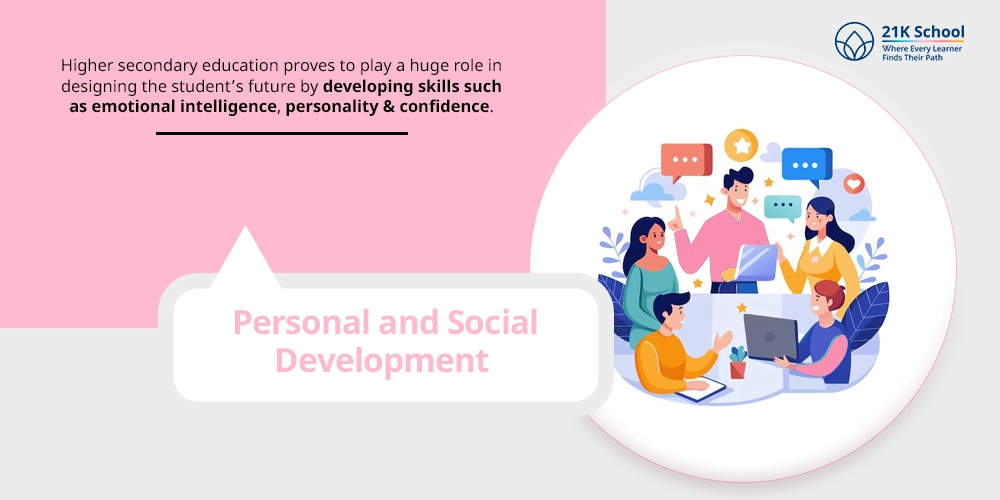
This phase is the transition phase for the students.
Higher secondary education proves to play a huge role in designing the student’s future by developing skills such as emotional intelligence , personality & confidence.
Group project works, co-curricular activities enhance teamwork among the students. Social awareness campaigns help students to understand their roles & responsibilities as primary citizens of a particular community & contribute likewise.
4. Global Opportunities
In today’s globalized world, higher education helps in providing creative thinking skills , with the help of which they can rise internationally. Being proficient in all global languages, & online learning helps the students to get various scopes in the career.
Moreover, most of the global universities & colleges prioritize students at this stage of learning to conduct entrance exams, marking this as an opportunity for global educational scope.
Higher Secondary Education in India
India’s higher secondary education system is one of the biggest in the world, built to provide for a huge number of learners across various state boards & languages.
It not only prioritizes academic progress but also helps in arranging a skilled & holistic education system.
1. Indian Education Structure
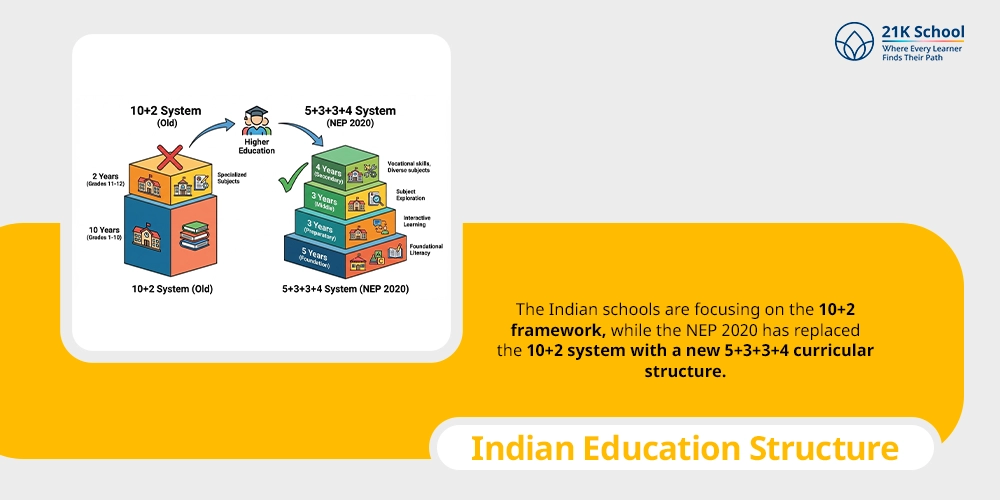
The Indian schools are focusing on the 10+2 framework, while the NEP 2020 has replaced the 10+2 system with a new 5+3+3+4 curricular structure.
At this point of learning or education, students choose a stream that suits or aligns with their career goals. Boards such as CBSE, ICSE, & State boards manage the examinations, academic standards across the world -wide.
The vocational learning plan works under the National Education Policy 2020. It also helps in motivating the students to stay fully skilled & by linking the academics & employment.
2. Recent Forums
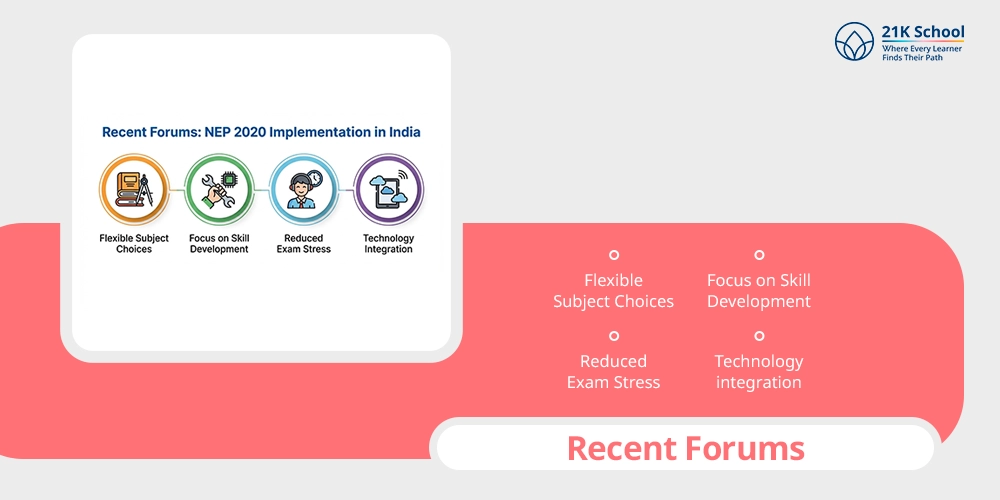
Under the implementation of NEP 2020, India’s higher secondary education is facing huge modifications.
Some of the key reforms involve:
- Flexible Subject Choices
Students are now being offered choices across arts, science & commerce.
- Focus on Skill Development
This promotes digital learning & Vocational education to be implemented in the framework.
- Reduced Exam Stress
By introducing continuous learning & section evaluations, it helps students to understand their strengths & weaknesses & work accordingly on them.
- Technology integration
The use & implementation of AI-driven tools, smart classrooms , and digital laboratories help students to keep their active participation while studying & also improve their academic performance.
These reforms aim to make higher secondary education more flexible & future-oriented by aligning students ready for opportunities & challenges.
Conclusion
Higher secondary education is not only a level of education, rather it is also the only stage where students prioritize their goals, aspirations, and dreams.
It connects childhood learning & adulthood responsibilities by the fusion of ideas, thoughts that share the values of lifelong success.
By sticking only to academic growth, career readiness, & holistic education, higher secondary education helps the learner to be confident, passionate & ready to handle any challenges in their higher studies & professional careers.

You may also want to read