Causes of Inequality in Education: Factors Affecting Learning Opportunities
 Written byAnshu KumariContent Specialist
Last modified: 7 Sep 2026 11 min read
Education is a basic right for all individuals to change their future in a better way, but not everyone gets an equal amount of resources and opportunities to avail it.
There are learners who come from different family backgrounds and castes. These learners often find it difficult to get quality education like learners from a rich background.
The unequal distribution of educational facilities among the general population due to lack of awareness and weak academic policies leads to inequality in education.
We will discuss the causes of educational inequality in detail in this article, so that we can figure out the areas that can be focused on to improve available education.
What is inequality in education?
Educational inequality is the unequal access to and participation in educational outcomes based on social, economic, regional, and cultural factors. It is an endemic problem that impacts the provision and experience of education among learners of the same country.
Learners who are from less privileged groups experience a poor academic journey due to a lack of finances and parental support. The school infrastructure, teachers, and other resources are limited, and hence the quality of delivering education and the curriculum is substandard.
Due to the above-mentioned differences in access, student outcomes such as achievement, retention, and transition to higher education are impacted, leading to limited career opportunities.
These inequities are often fairly predictable and associated with student characteristics such as family background, gender, ethnicity, and race.
When learners study with inadequate facilities, they lack confidence when they move out of their towns or villages. They feel like they can never come out of their social and economic circumscription.
Education is the only tool that can change the lives of such children, and when there is a lack of accessibility to quality education, their future lives suffer.
Resourceful kids also have access to better groups that can help them in networking and land appreciable opportunities. With the right technological equipment and well-trained staff, they get to earn an adequate living.
If you want to learn more about such disparities and the causes of inequality in education, let's read the following section of this article.
Causes and reasons of inequality in education
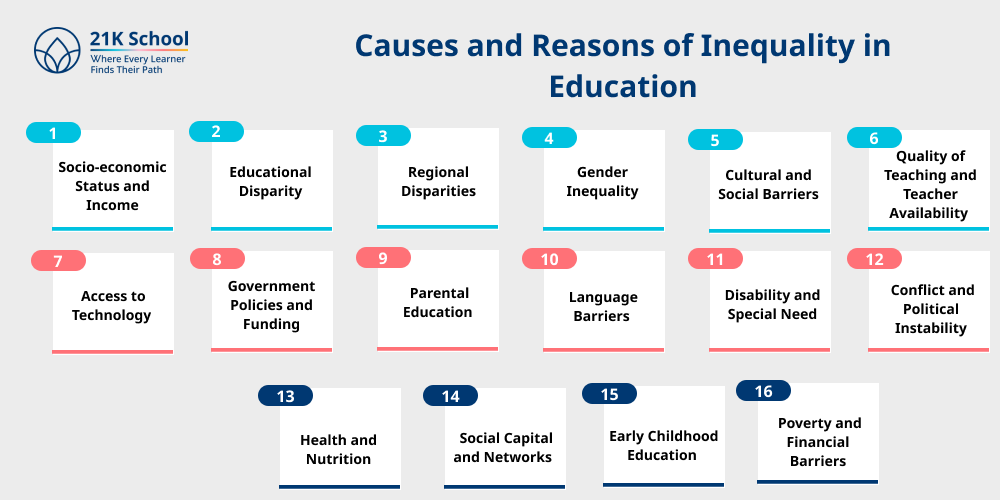
Though the government take many initiatives to bridge the gaps and manifest educational equity, the process becomes tougher due to the following root causes:
1. Socio-economic status and income
Socio-economic background is a powerful predictor of educational attainment.
Families with solid backgrounds provide the best facilities for their kids in terms of education and support. These children can also get private tuitions that can help them achieve the highest results in exams, and thus get the best opportunities ahead in life.
On the other hand, a kid from a less-resourceful and poor socioeconomic family faces more issues when it's about ensuring educational exposure. Even when these families get admission in renowned schools, the expenses on transport and books become stressful.
This also affects their health and well-being poorly, which obstructs continued learning in the long run.
2. Educational disparity
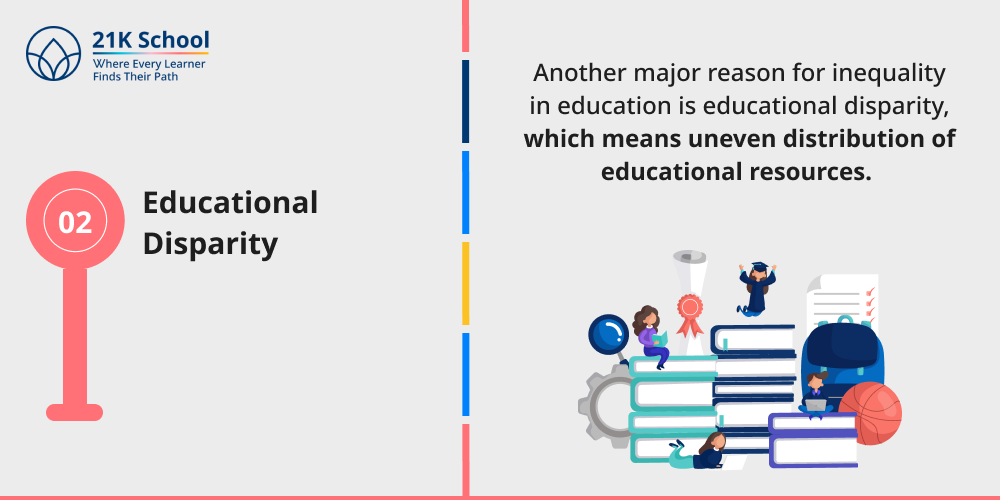
Another major reason for inequality in education is educational disparity, which means uneven distribution of educational resources. Children and schools can access books and other study materials based on their locality and social status.
To elaborate on this, a school in a marginalised region won't be able to gather as many resources as a school in affluent areas. Whether it is about the teachers, digital aids, clubs for activities, or basic commute facilities.
On top of this, schools in posh localities have rich parents/customers to support their funding and connections, which changes the whole scenario for children getting educated from there.
These children can get better networking opportunities because all rich and educated people from the locality may be sending their kids to the same school.
3. Regional disparities
Many learners give up on the idea of going to school due to long and unsafe commutes. Kids living in the cities have more schools in their vicinity and thus can have access to education without much hassle.
Learners may have to travel long distances to attend school in risky conditions, where a lack of transport and infrastructure, and teacher shortages add to the challenges.
Such access inequalities lead to a gap in the quality of education and its outcomes, with rural school students not performing as well.
4. Gender inequality
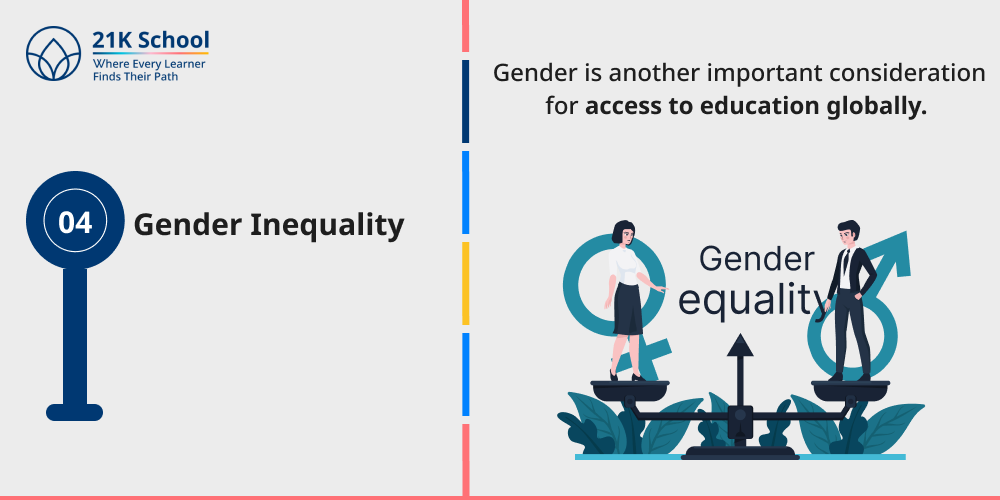
Gender is another important consideration for access to education globally.
After all these developments for setting gender-based equality and educating women, boys get the privilege to study more than girls in many regions due to cultural constraints.
Also, improper security and inadequate sanitation facilities may limit girls from attending school.
Early marriages and the stereotypical thinking that women would bring disgrace if they study too much impact the enrollment and retention of girls in school and higher education.
Only if we focus on decentralising cultural privileges and promoting girls' education in society would the world be more educated and developed.
5. Cultural and social barriers
Learning can be tough if there are social and cultural barriers that demotivate kids from choosing education as a tool to change their lives.
Many learners are fed the idea that education is for people present in the upper strata of society. However, they forget to mention that education is a fundamental right.
These social and cultural limitations limit the learners' view of the world, thus pushing them into the vicious cycles of poverty and societal exclusion.
6. Quality of teaching and teacher availability
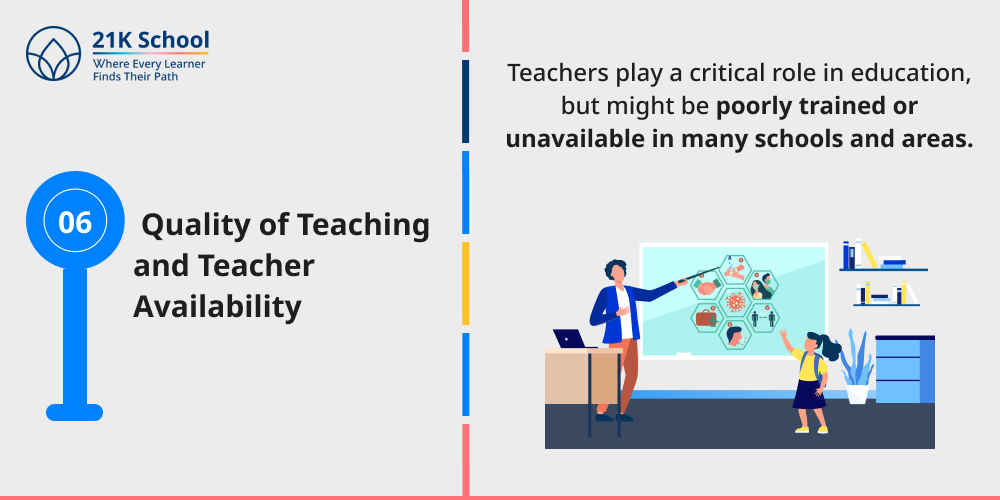
Teachers play a critical role in education, but might be poorly trained or unavailable in many schools and areas. High-quality teaching and support are crucial for equity. Variations in teacher quality can affect students' performance.
With the right training and development of teachers' skills, educational delivery can become efficient and resourceful. This can also welcome inclusive learning into the classes.
But when the quality and number of teachers are compromised, it impacts the amount of attention given to the learners and their overall educational outcomes.
7. Access to technology
Today, technology in education is fundamental for providing access to information.
Interactive learning tools and virtual classrooms make it easier for kids to connect to the world, but individuals with different levels of access to digital technology may create a learning gap.
During COVID-19, it was evident that learners needed online education to pass and continue learning without going to school. At that time, learners who came from less-resourceful families suffered as they lacked good internet and other digital devices.
Since then, online schools and virtual training have become popular among the population. But some learners still face the digital divide and inability to get quality education.
8. Government policies and funding
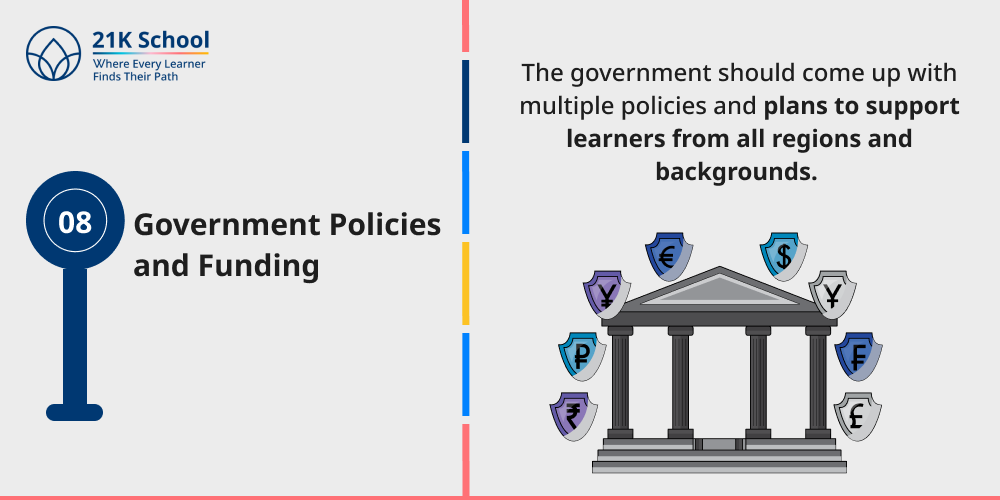
The government should come up with multiple policies and plans to support learners from all regions and backgrounds.
Unless and until the government takes educational funding seriously, a nation will always suffer from a lack of awareness and poverty. Once learners from all social strata get equal levels of quality education, the nation will show appreciable development.
But, many times, the implementation of government policies is more vital than forming them. This is because, on the ground level, the effective use of these schemes can only be possible when administrators and the public are aware of their respective responsibilities and rights.
9. Parental education
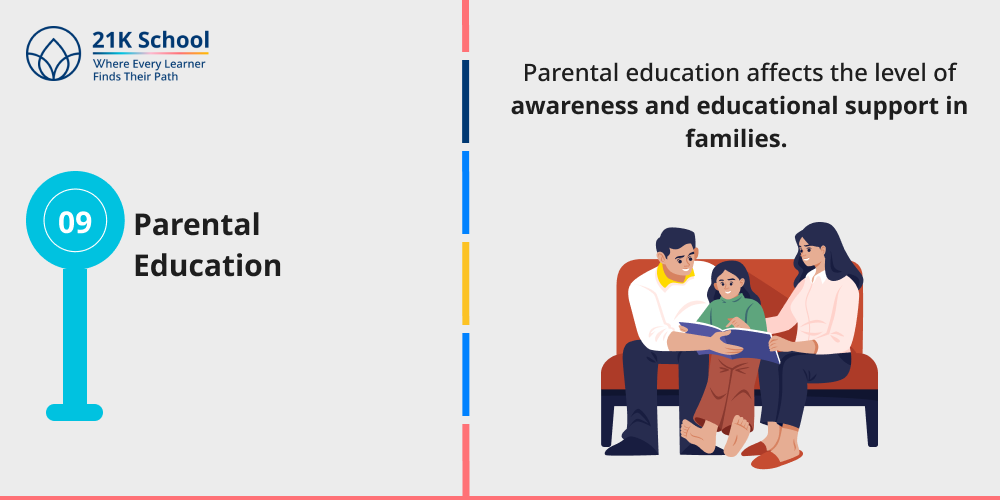
Parental education affects the level of awareness and educational support in families. Parents who are well-educated are more likely to understand the advantages of education, and thus, encourage their kids to attain education.
Contrary to this, learners from poor families and uneducated backgrounds may struggle more to continue their education, instead of being forced to look for low-pay jobs at an early age.
10. Language barriers
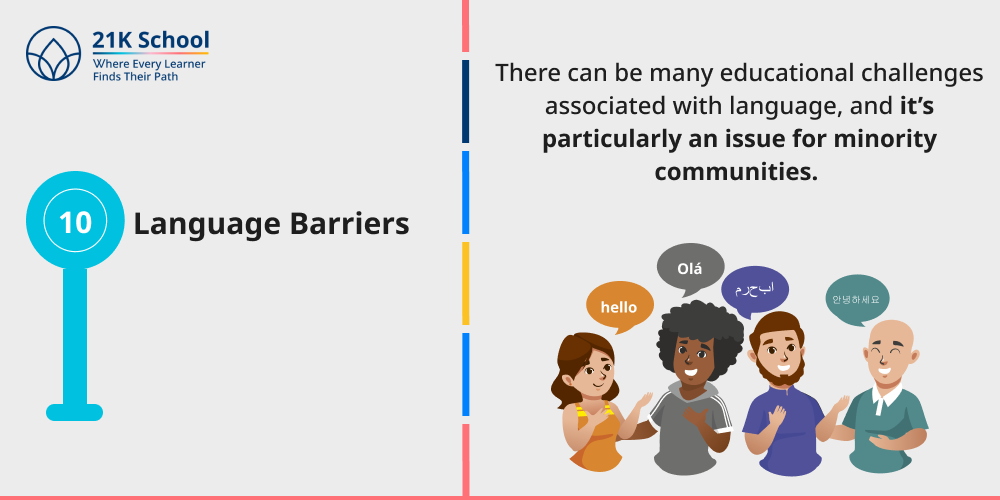
There can be many educational challenges associated with language, and it’s particularly an issue for minority communities. To support diversity, regional languages should be taught in the early years of education.
With so many languages, it can be stressful to pursue education from anywhere in the country. This can also lead to lower student engagement and academic withdrawal. However, using English and Hindi for instruction and teaching promotes equality.
11. Disability and special need
Education of children with special needs encounters other barriers that are tough to understand and often ignored by mainstream policy-making.
This discourages these learners from getting an education and restricts them from exploring their full potential and achieving success in later periods of life.
The lack of personal assistance, adequate infrastructure, and other facilities makes the specially abled children feel excluded and unattended.
Along with providing appropriate training resources, these children need empathy and acceptance rather than ignorance.
12. Conflict and political instability
Where there is conflict and political instability in a country for a long period of time, children may experience disruptions in their education, trauma, and lack of access to learning resources, which leads to inequality.
Children’s schooling may be interrupted as schools are damaged or shut down, and their families are violently displaced.
Under such circumstances, education systems may be poorly distorted, leading to hurdles in the development of the nation.
13. Health and nutrition
Learners’ health has a profound impact on their levels of learning.
Poor nutrition in childhood can result in chronic illness, and a lack of access to healthcare can lead to more skipped days in school.
Ill students will be less able to focus on their learning and more likely to experience negative academic outcomes.
14. Social capital and networks
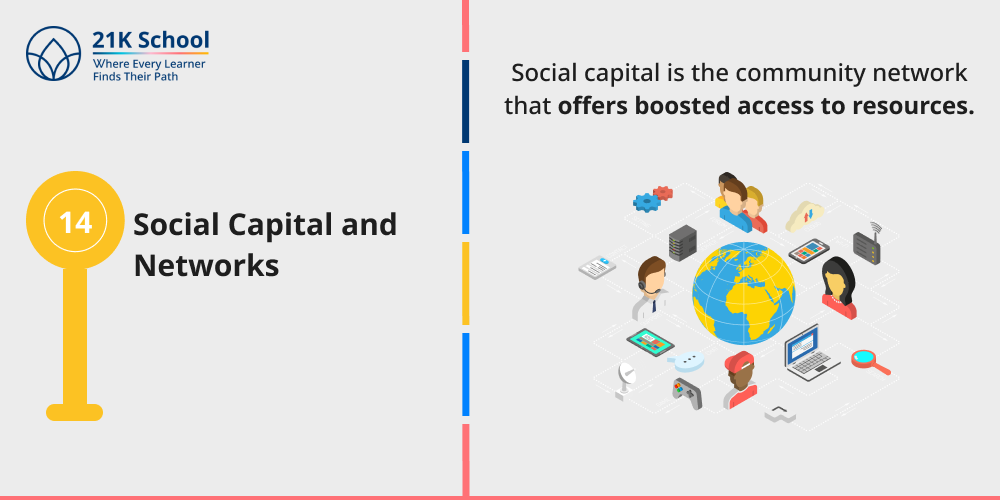
Social capital is the community network that offers boosted access to resources.
Parents with better social networks can assist their children in getting the right influence and networking.
Their children can also get the right direction and scholarship to study from renowned institutions, which might only be a dream for less-privileged kids.
15. Early childhood education
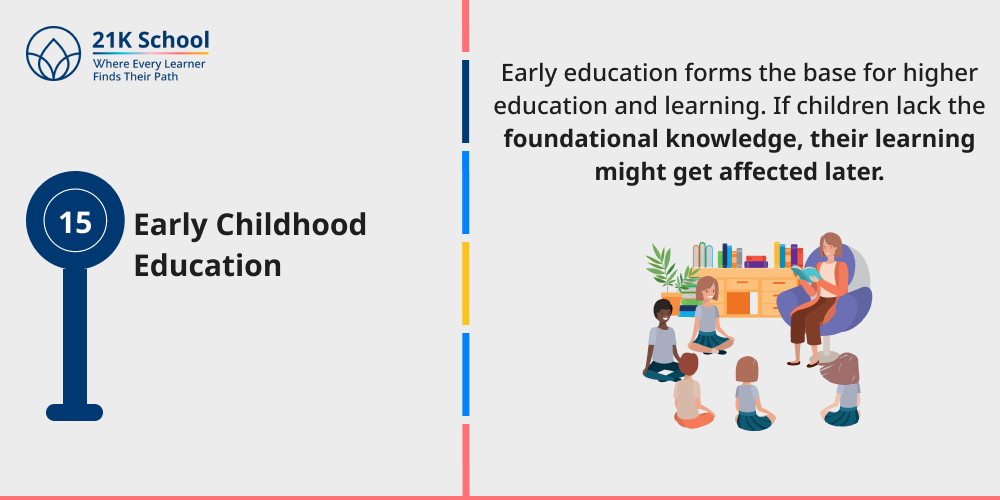
Early education forms the base for higher education and learning. If children lack the foundational knowledge, their learning might get affected later.
This might give them a disadvantage over those kids who have a strong base of skills and confidence to excel in academics. It is the responsibility of parents to provide high-quality early childhood education to their kids and encourage them to learn for schooling.
16. Poverty and financial barriers
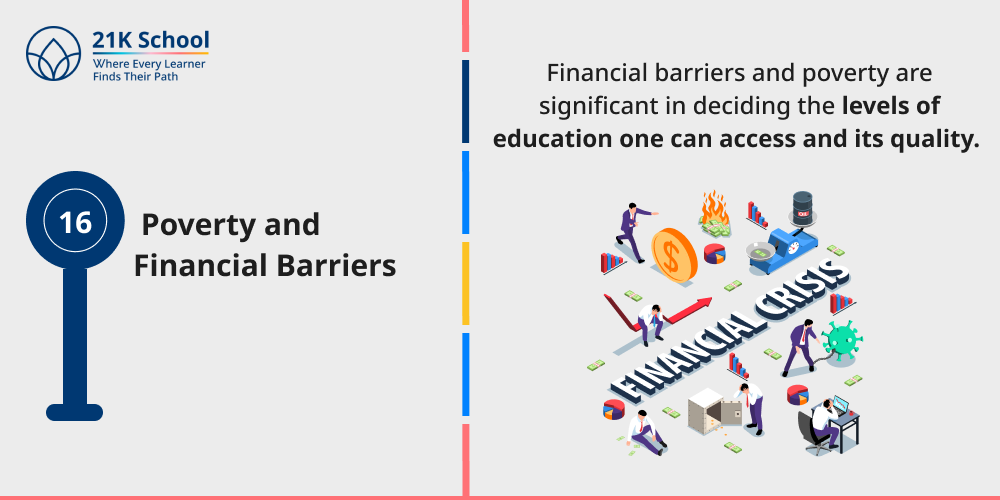
Financial barriers and poverty are significant in deciding the levels of education one can access and its quality. Children who belong to poor families are even encouraged to earn from an early age to support the family instead of continuing their education.
Apart from this, higher education universities demand higher fees. To support their education, children take huge loans and become a part of the student debt cycle.
This makes it harder to break the vicious cycle of poverty or support the next generation to study.
Educational inequality examples
Some of the major examples of educational inequality include:
- Learners in cities have access to improved schooling resources and quality teachers, but those in rural areas face a lack of commuting and other facilities.
- Girls face gender inequalities in some areas where they are denied the right to study and forced into early marriages.
- Special needs students face barriers to accessing inclusive education.
- Government-funded schools often lack basic amenities, while children studying in private institutions get quality education and personalised care.
- Learners without digital devices and connectivity miss out on participation and see their learning deteriorate, having no other option.
Conclusion
Educational inequality is an issue that needs direction and attention as soon as possible. Though the government has brought many policies and schemes to support equal access to education, it is our individual responsibility to support deprived kids to attain education.
When we understand the deep-rooted causes of inequality in education and come up with favourable solutions, every learner could study from the best.
The only way to eradicate inequality in education is by making people aware of their responsibilities and cultural barriers that need to be demolished.
Frequently asked questions
5 questions
What is inequality in education?
Inequality in education is the unequal access to educational opportunities, networking, training, and resources among learners from different socioeconomic backgrounds.
What are the main causes of educational inequality?
The main reasons for inequality in education are unequal distribution of resources, gender biases, socio-cultural restraints, lack of access to technology, geographical barriers, and many more.
How does poverty affect education?
Poverty affects access to education due to lack of awareness, educational opportunities, networking, and guidance from educated parents.
How does the digital divide impact educational acquisition?
The digital divide results in educational gaps among learners who have access to online resources and who lack them. This impacts students' access to online learning opportunities and technology skills.
What role do teachers play in reducing educational inequality?
Educators reduce inequality through effective teaching, catering to different learning styles, and fostering an inclusive classroom culture to help all learners achieve their academic targets.
About the author
Anshu Kumari
Content Specialist
Anshu Kumari is an Education Content Specialist at 21K School- a fully accredited institute- Cambridge International (IA702) and Pearson Edexcel (94883). She focuses on the in-depth research and creation of the well-drafted guides on NIOS admission, Indian Education Policy, and competitive exam preparation. With around 2 years of experience at 21K School, her psychology background informs her approach to the education content and hence focuses on creating guides to address the real anxieties of the guardians. She writes well-researched articles on competitive exam timelines, stream selection, and board choices by referring to the official resources. All Anshu’s content pieces are fact-checked against the board and primary government official resources and is dedicatedly reviewed by the school’s academic team.
Every 21K School guide is written by our education team and reviewed by a subject facilitator before publishing.
Exploring a CBSE-pathway online school?
Talk to an advisor about 2026–27 admissions — no obligation.
Talk to an advisorComments
No comments yet — be the first to share your thoughts or ask a question.