

Are you starting your NEET exam preparation but don’t know how to start?
The NEET exam is among the most prominent examinations which aspiring doctors ought to take. A good and strict approach to preparation would be required in cases where the number of applicants is above 22-24 lakh per year.
NEET not only test the knowledge of the students of Physics, Chemistry and Biology, but it is also a test of their ability to remain focused on time and in the same state all throughout the year.
It is significant to understand that it is possible to make NEET preparation a significantly less stressful process that will still provide the results through proper organisation. Probably, any student can pass NEET with appropriate instructions and attempts and take a step toward the goal of becoming a doctor.
Contents
Top 9 Strategies to Prepare for the NEET Exam
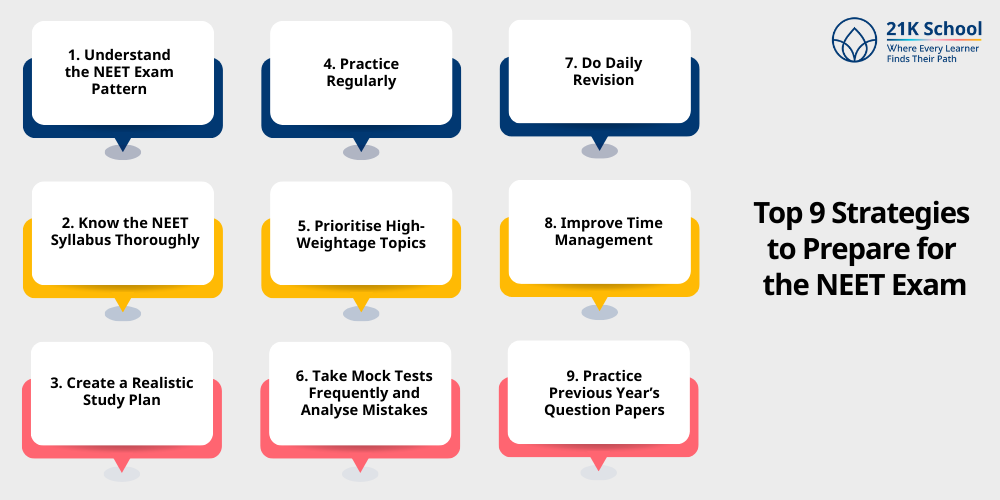
The NEET preparation tips are that one must study the NCERT models, must have a realistic schedule, must practise frequently with the past year papers and use model tests.
Revision on a regular basis, time management in terms of studying and going through exams, attention to weak points, and a good lifestyle are also important to remain a successful person. These are the strategies to be applied in the preparation for the NEET examination.
1. Understand the NEET Exam Pattern
The model format will indicate the rough idea of how the test is going to be, the number of questions that will be included in the test, and the marking scheme that will be applied to the number of questions per subject.
NEET 2025 is a test consisting of 180 compulsory questions (45 Physics, 45 Chemistry, 90 Botany and Zoology) which the applicants are expected to complete within 3 hours (180 minutes). Each correct answer receives +4 marks, and each incorrect answer results in a -1 mark deduction
Once you are familiar with the pattern, you will be able to construct more valid strategies, minimise confusion on exam day and increase accuracy. This is also useful in preparing smartly rather than studying at random.
2. Know the NEET Syllabus Thoroughly

Good knowledge of the syllabus means you save time on useless studying and being too keen on what is really important. NEET consists of Class 11 and 12 Physics, Chemistry and Biology, thus it is vital to get to know the full and revised syllabus.
It makes sure that you do not skip any important chapters and also enables you to plan your study
based on the weightage of the topic.
3. Create a Realistic Study Plan
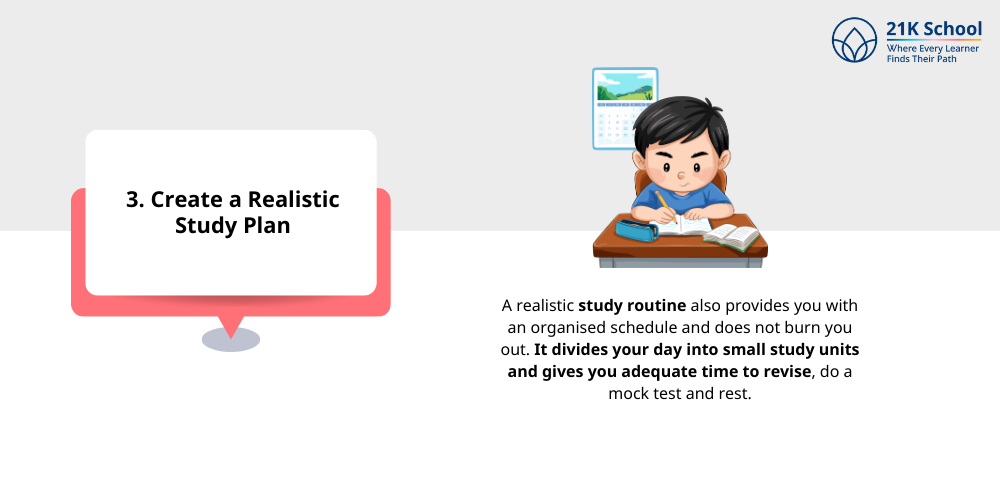
A realistic study routine also provides you with an organised schedule and does not burn you out. It divides your day into small study units and gives you adequate time to revise, do a mock test and rest.
You can stick to the realistic schedule that you have without study stress when you have it. The plan will be spacious and will introduce discipline , hence sharpening productivity and will help you remain motivated as you train in NEET.
4. Practice Regularly
Practice is what makes NEET successful because the process requires incredible problem-solving skills and thinking quickly. Answering MCQs per day will also allow you to memorise the patterns, solve more effectively and learn concepts better.
Experience produces confidence and removes exam stress . It also identifies your areas of weakness early enough and gives you ample time to work on them.
5. Prioritise High-Weightage Topics

Not all the subjects are equally significant in NEET. Chapters of high weightage will make you get more points within a short time.
This will help you earn more marks in exams , as this will make them a priority, and you are sure to have the highest scoring points first. It may also be useful during pressure taking in the act of revision.
6. Take Mock Tests Frequently and Analyse Mistakes
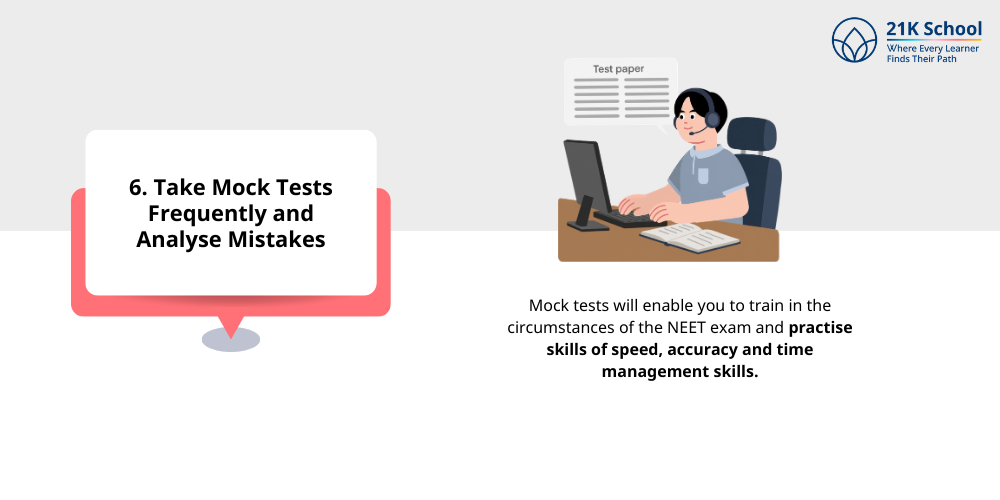
Mock tests will enable you to train in the circumstances of the NEET exam and practise skills of speed, accuracy and time management skills .
You will be aware of what you know and do not know well, of the mistakes that you make and even what you should do better by analysing your mistakes. Regular practice tests keep track of your score. This practice will help you in the process of overcoming anxiety, besides preparing your mind for the actual scenario of a test.
7. Do Daily Revision
The revision process
provides the ability to memorise and forget simple concepts. Revision is another factor which aids in the transfer of information to long-term memory, whereby the information is not hard to recall during tests. It sharpens your sense of formulas, diagrams and significant definitions as well.
Frequent and short revision sessions done on a day-to-day basis will ensure that there will be no last-minute stress and that all the topics are in your mind. Accuracy and confidence are brought about by revision. Learn more about the importance of revision .
8. Improve Time Management

Time management is important in NEET because learners are required to answer 180 questions within 3 hours (180 minutes). Subject time management can be studied in such a way that one will complete the exam in a comfortable way.
The efficiency is advanced by training the process of working with the timers, approaching the problematic questions intelligently and working on easy questions at first. Good time management techniques are also helpful in terms of study, rest and revision in preparation.
9. Practice Previous Year’s Question Papers
You will know the trends of questions, difficulty level, and repetition of the same topics by solving the papers of previous years. It provides you with a clear picture of how the concepts are examined in the test, hence your preparation becomes more attuned to the expectations of NEET.
Drilling these papers enhances speed, weaknesses and builds confidence . It also makes you know how to approach complicated questions and not to be negatively marked. This practice improves general exam preparation.
You can also explore if NIOS is valid for NEET .
Last Month’s Preparation Strategy
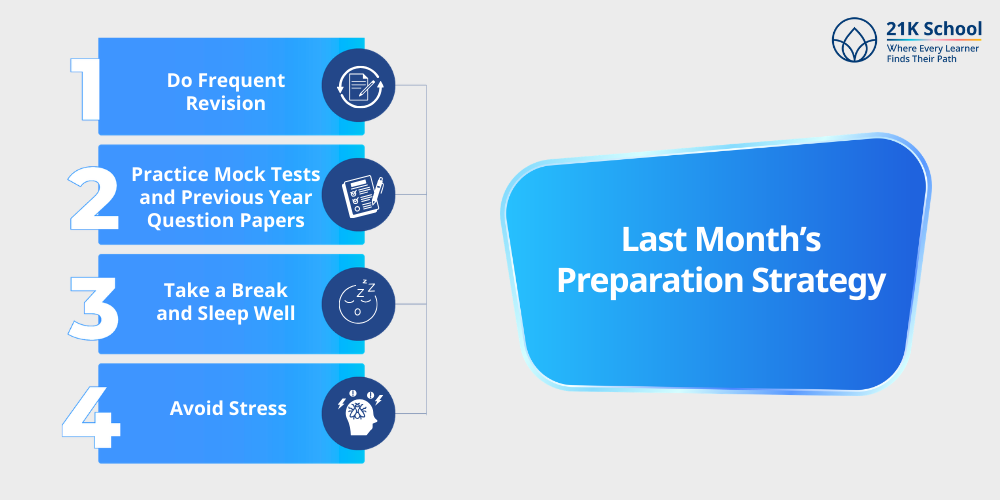
The last-month preparation plan presupposes the intense and focused revision of the major topics, the practice of the past years’ papers and mock tests, and not the new ones. This is what you can do about the preparation of last month.
1. Do Frequent Revision
The focus in the final month of NEET should be on revision. Daily update major formulas, charts and high-weight content. The memory and accuracy are increased through repetition of the concepts.
Instead of learning new issues at this time, revise them so as to avoid confusion. Proper revision ensures that one does not forget the information and will not have difficulties when taking exams.
2. Practice Mock Tests and Previous Year Question Papers
The routine of practising the mock tests will help in acquiring the routine of the exam, time management, as well as making you faster. The publications of the past years present a clear view of the questions that can be asked and the issues that can be posed quite frequently.
It is also necessary to examine the errors each time you take a test to realise that you are weak in certain areas and work on them during the remaining month.
3. Take a Break and Sleep Well

The last month of preparation is very important, and a student is supposed to take proper rest. The time of taking these breaks between the study groups will reduce the feeling of fatigue, and your brain will be fresh.
Sleeping at least 7-8 hours a day is more efficient in keeping memory, being alert and problem-solving . When your head is loose, it runs at a very high pace, and you tend to remember the concepts that are being studied during the exam.
4. Avoid Stress
Stress can lower attention and performance. Do not panic and compare yourself with other people in terms of preparation. To manage the situation, deep breathing, some light exercise or meditation.
There is no reason to lose hope in the preparation; the attitude is good. You will be sure, and you will relax, and that will see you pass the final examination.
Concluding Thought
One can be ready to write the NEET exam with the help of a systematic plan, consistency and revision. When the syllabus is well understood and planning is done carefully, and trial tests and old papers are practised, there will be the ability to perform well.
The last month must be dedicated to revision, accuracy and calm mindedness. All the students may indeed be assured of a clear way to the realisation of his or her dream of becoming a doctor through hard work, discipline and the relevant strategies.

You may also want to read