

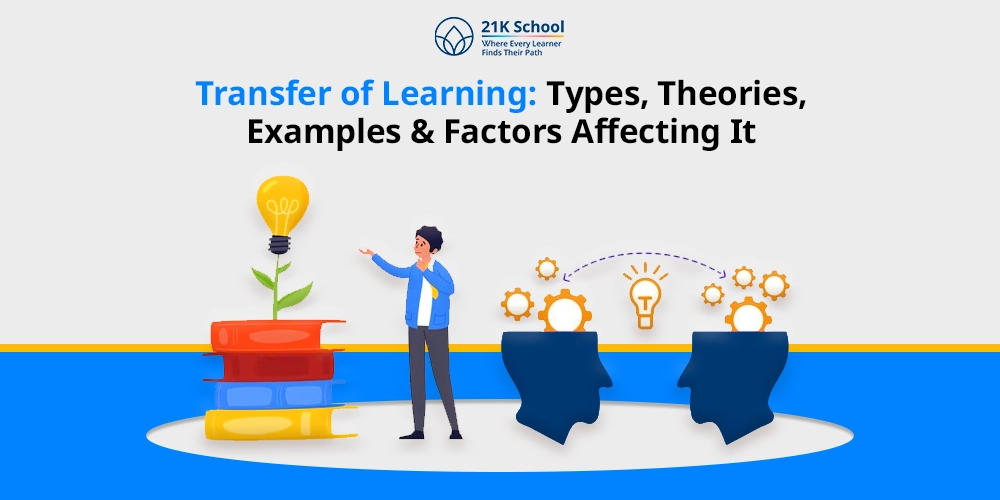
Learning is lifelong . It can be transferred and used in varying contexts throughout life.
This transfer of learning enables us to find similarities between multiple situations and find the right solutions when required.
We keep moving forward with lessons and teachings, and use it for our benefit to upgrade consistently.
For learners who are curious to know more about transfer of learning can refer to this article and explore its types, theories, examples, and limitations in detail.
Contents
- What is Transfer of Learning?
- 3 Types of Transfer of Learning
- 4 Theories of Transfer of Learning
- 6 Factors Affecting Transfer of Learning
- 6 Educational Implications of Transfer of Learning
- Examples of Transfer of Learning in Daily Life
- 5 Barriers to Effective Transfer of Learning
- 5 Strategies to Enhance Transfer of Learning
- Concluding Thoughts
What is Transfer of Learning?
Transfer of learning is the utilization of knowledge, skill , habit, or attitude gained in one circumstance to another.
It entails transferring the past learning to affect the present learning or performance.
You might witness a transfer of learning when you try to learn martial arts after you had some basics of Karate. Another situation could be a kid who is using his skills to walk to learn how to run.
These are instances where previous learning impacts new learning. But, the impacts of transfer of learning can be multiple.
Transfer of learning is crucial as it helps to establish the actual essence of getting education
Thus, proper learning is about managing to use the past information in different situations, instead of just gathering it.
3 Types of Transfer of Learning
You will notice that each transfer may not necessarily boost your past skills. This advocates for the three major types of transfer of learning as mentioned below:
1. Positive Transfer
When prior learning supports new learning with all the skills and knowledge, it can be called a positive transfer of learning.
Positive transfer adds up the new lessons with the old learnings, boosting learners’ capabilities.
An example could be when a basketball player utilizes their skills when learning playball.
2. Negative Transfer
Negative transfer occurs when past knowledge creates confusion instead of support. Previous learning poses a difficulty to the new learning.
Negative transfer can be seen in a situation where an individual who is used to driving on the left side of the road has trouble switching to driving on the right side.
Likewise, improper grammar in a given language can disrupt when acquiring another language.
Negative transfer may make the learning process slower. This might need the individual to even unlearn the wrong habits.
3. Zero Transfer
Zero transfer is when there is no influence of prior learning on new learning. There is neither a positive nor negative influence.
As an illustration, an understanding of mathematical equations would not have any effect on learning painting.
When this is the case, the two fields of study stay unrelated and there is no transfer.
4 Theories of Transfer of Learning
There are 4 main theories that are talked about most often when discussing transfer or learning. These are as follows:
1. Theory of Identical Elements
Theory of Identical Elements was proposed by Edward Thorndike. It states that when there are common elements in two different situations, then there can be a transfer of learning.
The more similar the situations the greater the transfer.
As an illustration, learning to play guitar may assist in learning sitar, since they have a similar layout.
This theory places more focus on similarity of situations in learning and application.
2. Theory of Generalization
According to the Theory of Generalization, transfer is possible when some general principles or rules are applied to different situations.
As an example, when a student learns about the concept of gravity, they can use the concept in different physical sciences.
Generalization helps in flexible and meaningful learning that makes the learner apply the knowledge to new and different situations.
3. Theory of Mental Discipline
Theory of Mental Discipline is also related to the faculty theory.
It says that our mind is made up of three faculties: memory, attention, and reasoning. With regular practicing and training the brain muscles, it could function best.
A general example with which this theory can be understood well is when we learn poetry, our memorization power improves.
It focused more on the mental processes, but ignored the contexts which could also affect an individual’s brain capacities.
Even though this theory had criticism, it brings out the significance of building mental strength and cognitive skills.
4. Theory of Insight
Theory of Insight was developed on the basis of Gestalt psychology, given by Wolfgang Köhler. This theory pays attention to the comprehension of relationships and patterns.
Transfer is the situation when a learner develops an understanding about a problem and transfers the knowledge to novel situations.
An example of this is that, after a student learns how to solve a given type of problem they can be able to reason about other similar problems in the same way.
Learning centered on insights promotes learning as opposed to memorization.
6 Factors Affecting Transfer of Learning
Some of the central factors that transfer of learning rely on are as follows:
1. Similarity Between Situations
When there are similarities between two varying situations, it can often result in positive transfer of learning.
The mind recognizes the old patterns being presented and offers those data to help in the new situations.
2. Level of Understanding
The transfer of learning also depends on the level of understanding of a learner.
A better ability to comprehend things might result in positive transfer. This is why we should focus on deep knowledge of concepts instead of rote learning .
3. Practice and Reinforcement
Having only knowledge about a certain thing might be insufficient to transfer and make it easily accessible when required.
For that, we need continuous practice and performance-based reinforcement to bring those teachings into behavior.
4. Motivation
Motivation is one of the most crucial factors that decide if you learn about something or can retain it for future transfer of learning.
Motivated learners seem to be driven internally. Learning becomes smoother for these learners.
5. Intelligence and Cognitive Ability
Learners who have a greater cognitive ability can think deeply, and are more likely to transfer learning.
They can also recognize and compare similar situations with each other more readily.
6. Teaching Methods
Teaching methods also influence how we learn things, thus affecting our abilities to transfer our learnings.
A teacher should use practical examples and storytelling to make learners familiar with the concepts being taught in the class.
6 Educational Implications of Transfer of Learning
Major educational implications of transfer of learning can be listed as follows:
1. Emphasis on Conceptual Learning
The emphasis of the teachers should be on teaching concepts instead of just facts. The conceptual knowledge is the one that allows students to use knowledge in various scenarios.
2. Use of Real-Life Examples
The use of real-life situations also assists students to understand the applicability of what they hear. This facilitates their understanding on how to apply the knowledge in real-life.
3. Encouraging Problem-Solving
Problem-solving activities help to build critical thinking skills and to push the learners to use what they learn.
When learners solve problems in daily life, they become self-reliant for utilizing their skills, thus favouring transfer of learning.
4. Interdisciplinary Teaching
Incorporating multiple subjects offers flexible learning to learners required for transfer of learning.
Due to this, learners learn to apply the concept of one subject to another and acquire holistic knowledge.
5. Practice in Varied Contexts
Offering practice opportunities in varying settings can lead to adaptation of skills and flexibility. It equips learners with knowledge on how to use skills in new contexts.
6. Feedback and Reflection
Feedback will enable the learners to comprehend their mistakes and enhance their performance.
The reflection enables them to examine how their learning applies in other areas to further reinforce transfer.
Examples of Transfer of Learning in Daily Life
You can notice many instances of transfer of learning in daily routine or lifestyle.
We know transfer of learning can be negative too. An instance of such transfer could be a situation where a person pulls hand brakes of a bike instead of leg brakes, because their prior learning of riding scooty interferes with the new knowledge.
This can also be demonstrated in another example, which is driving. When one knows how to drive a car, then they can learn how to drive a truck or scooter.
The fundamental coordination, knowledge of road signs and vehicle controls are applied to another scenario.
With logical reasoning in maths, a learner applies mathematics in other subjects such as science or computer studies.
Transfer of learning is also encountered in even social skills . Communication skills that are gained in education or at home assist one to communicate effectively in working places.
Similarly, writing acquired in one course could be utilized in writing all essays, reports, and assignments in other courses.
Individuals apply the previous experiences and learned skills to manage new circumstances effectively.
5 Barriers to Effective Transfer of Learning
Though, transfer of learning seems practical to daily applications, it can limit when faced with barriers mentioned below:
1. Lack of understanding
When learners may not comprehend a concept well, they might not try to apply it in new contexts. Shallowness of learning results can lead to inability to transfer knowledge.
2. Over-Reliance on Memorization
Transfer of learning can be limited if learners rely entirely on rote memorization.
Learners should instead be focusing on conceptual understanding of the lessons taught by teachers or in life.
3. Differences between Learning and Application Environments
If learners don’t get to practice in similar environments as practical field areas, they might fail to transfer their learning effectively.
The theoretical knowledge acquired by lack of practical exposure can result in reduced chances of gaining real-life skills.
4. Limited Opportunities to Practice in varied contexts
Learners might not be able to use the skills in new situations without practicing the skills under various situations. Practicing in various situations is essential for flexible learning .
5. Low Motivation or Lack of Interest
Unmotivated learners will not be interested in keenly absorbing the material. This makes them less able to identify and use new contexts of knowledge.
5 Strategies to Enhance Transfer of Learning
We can improve transfer of learning by educating with practical skills and following the tips mentioned below:
1. Use Analogies and Comparisons
Analogies assist learners to relate the new information to what they are already familiar with. Comparisons allow the teacher to make learning more relatable and transferable.
2. Encourage Active Learning and Participation
Being actively involved in the learning process by participating in discussions and problem solving activities, learners can learn by knowing the concepts deeply, which facilitates transfer.
3. Provide Diverse Examples
Applying examples of various scenarios that relate to different situations aids learners to understand the need to apply knowledge in varied contexts.
This enhances their abilities to transfer their learning.
4. Reflect on Learning Experiences
Making learners reflect on what they have learnt and the ways they can apply it to other places increases awareness and utilization of knowledge.
5. Seek Connections Between Subjects
Associating ideas from various subjects can allow learners to learn about their relationships and use knowledge in a broader manner.
This is what interdisciplinary learning does to promote transfer of learnings.
Concluding Thoughts
Transfer of learning is evident in all phases of our lives. It is the process to learn new things by utilizing past experiences.
We all learn through transfer of learning, applying what we learnt previously to change how we comprehend this world now.
When learners through practical applications and incorporation of multiple dsciplines, they learn better.
We should emphasize field studies and example-based teachings to make transfer of learning positive.

You may also want to read