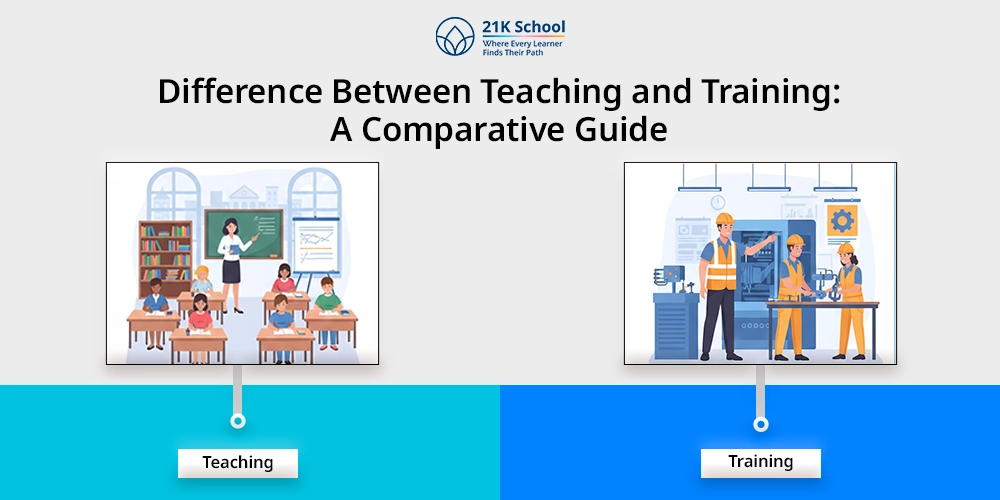
Difference Between Teaching and Training: A Comparative Guide
 Written byAnkita SinghaContent Specialist
Last modified: Jul 27, 2026 4 min read
In students’ lives, the objective of parents and teachers is to provide knowledge and appropriate skills. That’s why teaching and training is essential.
But, it is seen that people sometimes state these two terms are similar. In reality, both the terms are not replaceable and have different meanings, goals etc.
To know more go through the comparison on the difference between teaching and training
What is teaching?
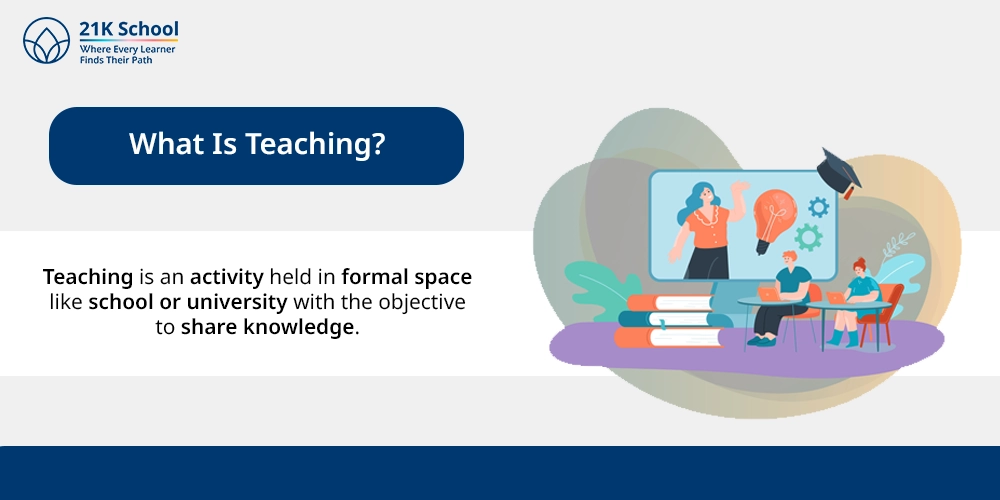
Teaching is an activity held in formal space like school or university with the objective to share knowledge.
Teachers share information based on structured curriculum . It develops critical thinking and cognitive skills.
In a simple way, it is an art of lesson designing, delivering concepts, discussion and evaluation to support students in their educational journey.
What is training?
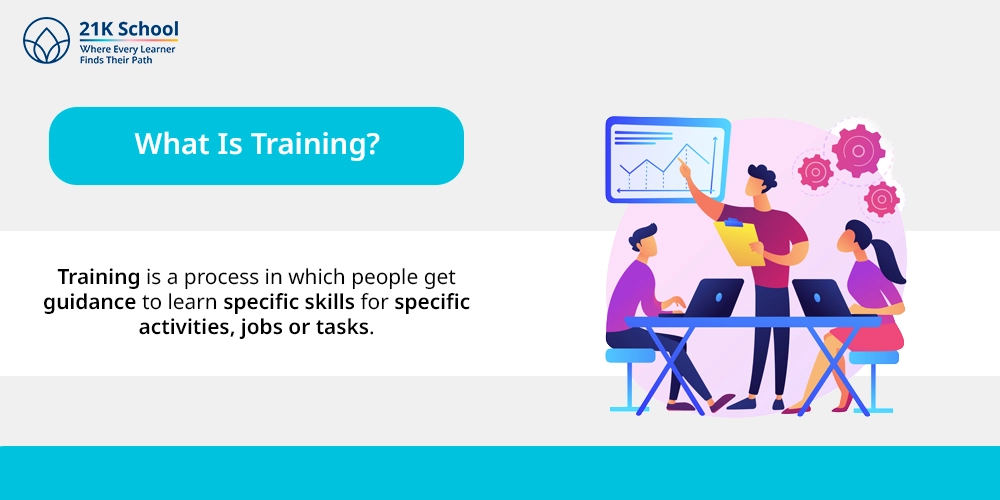
Training is a process in which people get guidance to learn specific skills for specific activities, jobs or tasks.
It is different from teaching where students get real-life experience to do tasks with accuracy.
Difference between teaching and training: 9 key comparison points
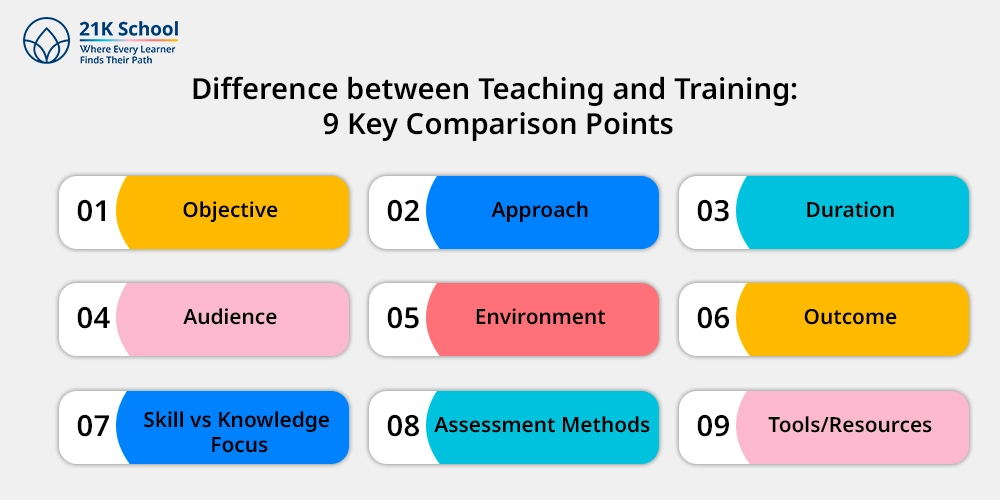
Understand the key difference between teaching and training in detail:
| S No. | Particulars | Teaching | Training |
|---|---|---|---|
| 1. | Objectives | Provide knowledge, understanding, intellectual growth, critical thinking | Learning specific skills, abilities, job performance |
| 2. | Approach | Theoretical, conceptual | Practical, hands-on application |
| 3. | Duration | Long-term | Relatively short-term. |
| 4. | Audience | Students and learners | Trainees and professionals |
| 5. | Environment | Educational institutions like school | Workplaces, vocational centers |
| 6. | Outcome | Broad knowledge base, lifelong learning | Skill proficiency, increased productivity |
| 7. | Skill vs Knowledge Focus | Knowledge based | Skill based |
| 8. | Assessment Methods | Classroom assessment like, test, assignment | practical test, perfect evaluation |
| 9. | Tools/Resources | Books, classroom lectures | Materials and equipment. |
1. Objective
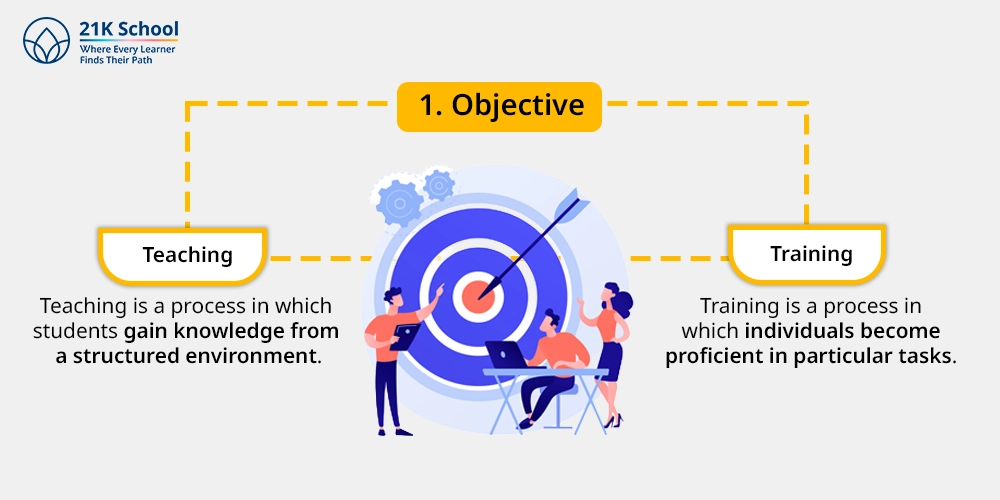
Teaching is a process in which students gain knowledge from a structured environment which helps them to progress academically.
While training is a process in which individuals become proficient in particular tasks.
2. Approach
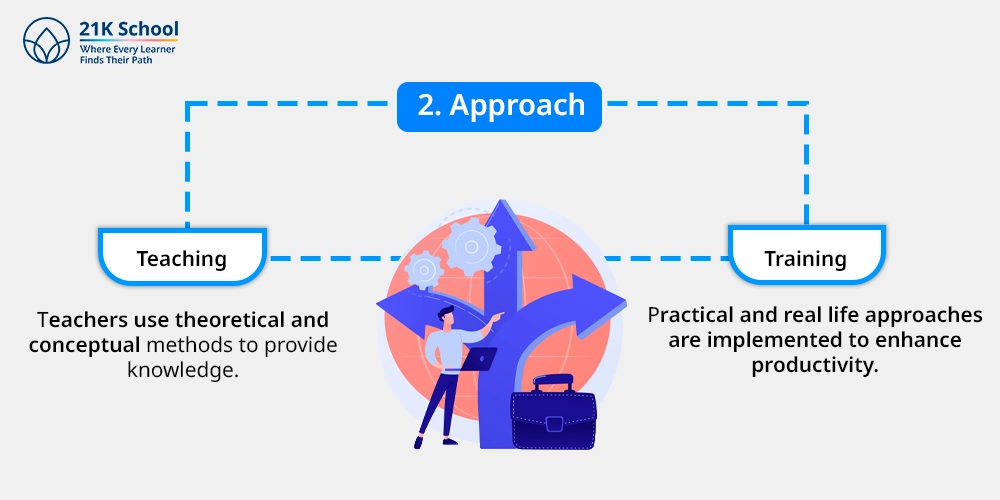
In the teaching process, teachers use theoretical and conceptual methods to provide knowledge.
While in the training process, practical and real life approaches are implemented to enhance productivity.
3. Duration
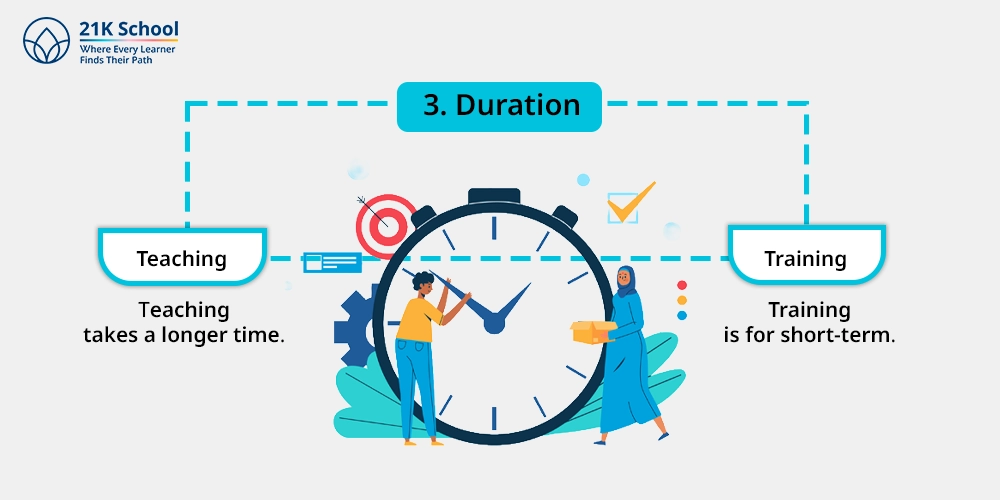
As compared to training, teaching takes a longer time.
On the other hand, training is for short-term and the duration also depends on individual practice.
4. Audience
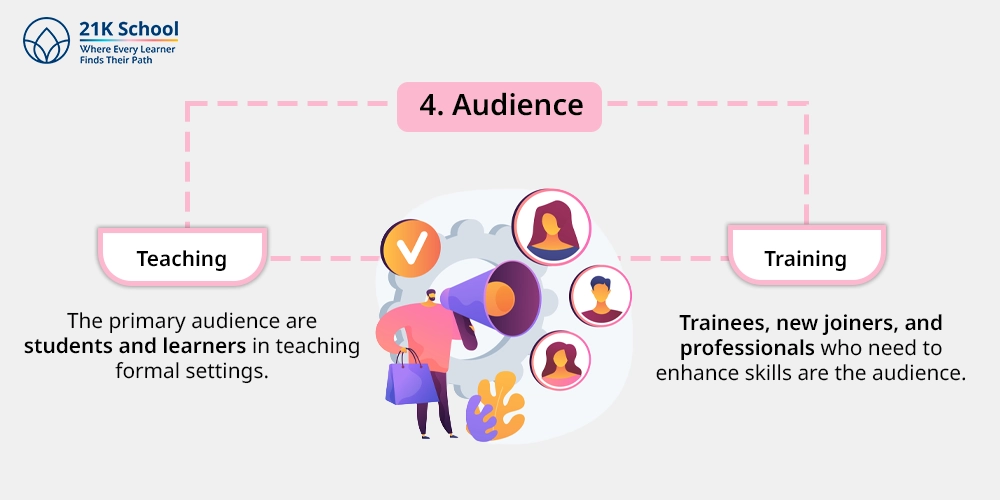
The primary audience are students and learners in teaching formal settings.
Trainees, new joiners, and professionals who need to enhance skills are the audience.
5. Environment
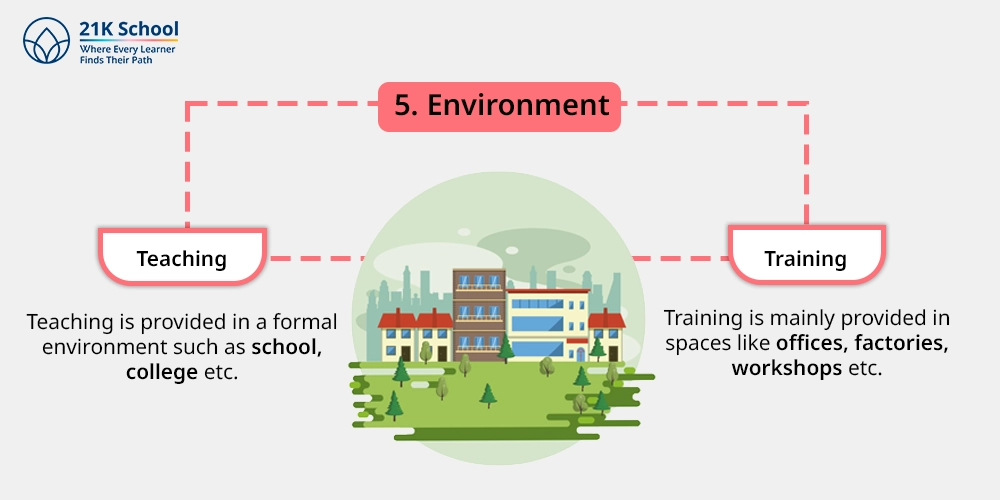
Teaching is provided in a formal environment such as school, college etc.
Training is mainly provided in spaces like offices, factories, workshops etc.
6. Outcome
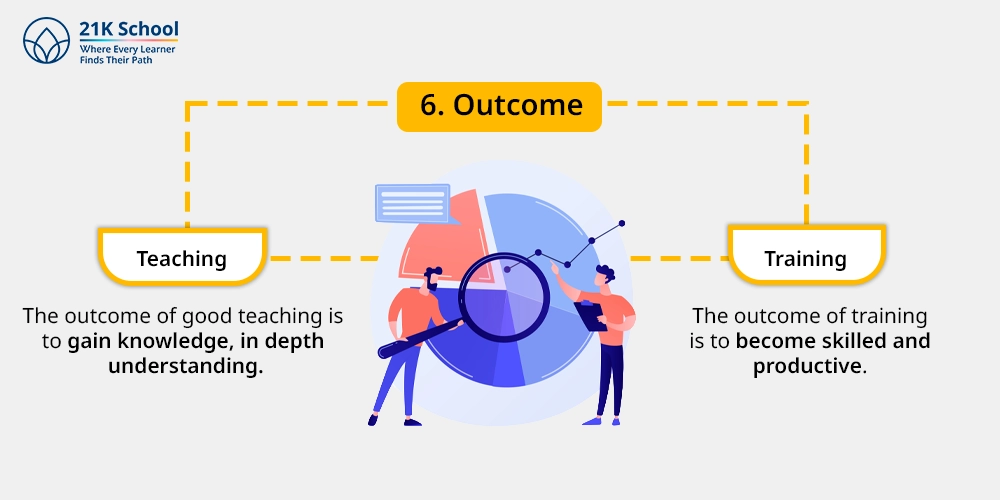
The outcome of good teaching is to gain knowledge, in depth understanding, and bring concept clarity to students.
The outcome of training is to become skilled and productive.
7. Skill vs knowledge focus
Teaching is mainly focused on knowledge gaining.
Training is focused on skill development.
8. Assessment methods
Class tests, semester or final examination etc are assessment methods of teaching.
A practical test, perfect evaluation etc are assessment methods of training.
9. Tools/resources
Book, notes, classroom lectures are some primary resources used in teaching.
Material and equipment to become skilled are some common resources of training.
In the end
Teaching and training are completely different terms where teaching is a knowledge gaining process and training means using the knowledge and acquiring skills. However, the comparison shows the importance of both terms in students’ lives. Hopefully the difference between them helped to improve the future learning.
Frequently asked questions
8 questions
When is training more effective?
Training is effective and powerful when it is based on clear and relevant objectives, student engagement, and continuous learning.
Is online learning considered teaching or training?
Online learning considers both teaching and training depending on need.
What is the role of an instructor in teaching and training?
An instructor role is to become guide, facilitator, and knowledge provider in both teaching and training. They help kids to become well-informed leaders.
What are the advantages of regular training?
Regular training in students life is advantageous because: Increase students productivity Reduced turnover Attracting top talent Boosts workplace morale
How important is teacher training?
Teacher training is essential because it is an ideal way to improve: Skill and knowledge Student engagement Inclusive classrooms etc
Which is an example of training?
Roleplay exercises to learn how to resolve conflicts.
What are the three main types of training?
Different types of training are on-the-job, off-the-job, and e-learning/technology-based training.
What is the teacher's role in teaching?
In teaching, the teachers becomes students: Educator Mentor Guide Facilitator
About the author
Ankita Singha
Content Specialist
Ankita Singha is an Education Content Specialist at 21K School, India’s first accredited fully online K-12 School. She focuses on the in-depth research and creation of the well-drafted guides on early childhood education, school admission processes, and CBSE/ICSE curriculum guidance. With more than 2 years of experience at 21K School, a fully accredited institute- Cambridge International (IA702) and Pearson Edexcel (94883), Ankita works closely with the school’s curriculum heads and academic coordinators. Ankita’s every article reflects on the official board guidelines, practical realities, and current policies of online education in 78+ countries. Ankita’s content has helped thousands of parents in understanding the topics like RTE eligibility, NIOS pathways, and age-appropriate admission criteria.
Every 21K School guide is written by our education team and reviewed by a subject facilitator before publishing.
Exploring a CBSE-pathway online school?
Talk to an advisor about 2026–27 admissions — no obligation.
Talk to an advisorComments
No comments yet — be the first to share your thoughts or ask a question.