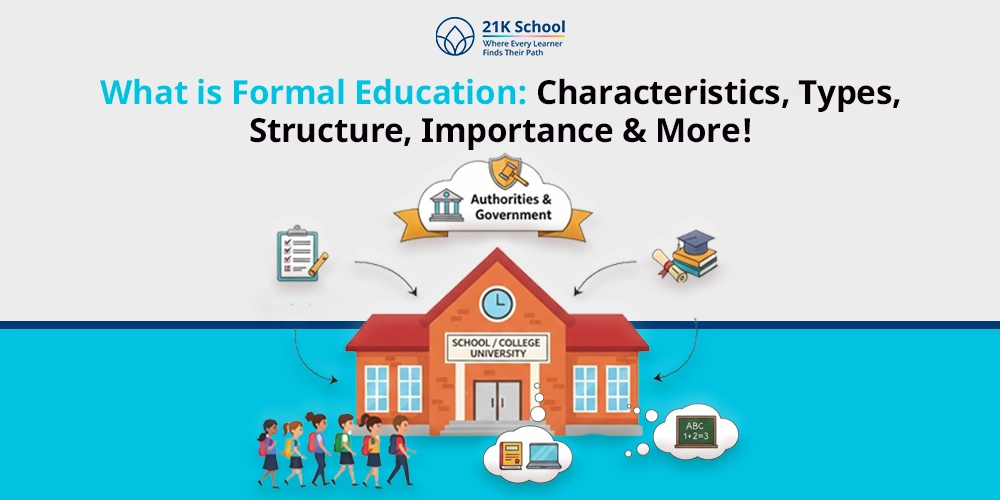
What Is Formal Education: Characteristics, Types, Structure, Importance & More!
 Written byAnshu KumariContent Specialist
Last modified: Jul 25, 2026 8 min read
Formal education is the education that we get from recognized schools and colleges.
From our early years of acquiring education, we have mostly got formal education which was systematic and well-organized.
This type of education helps in getting required certificates and degrees from accredited institutes that prepare children for the future career opportunities.
As it shapes the children's career growth, it also manages to teach kids the discipline and commitment to their development when in an organizational setting.
In this article, we will learn more about formal education, its types, structure, importance, and examples.
What is formal education?
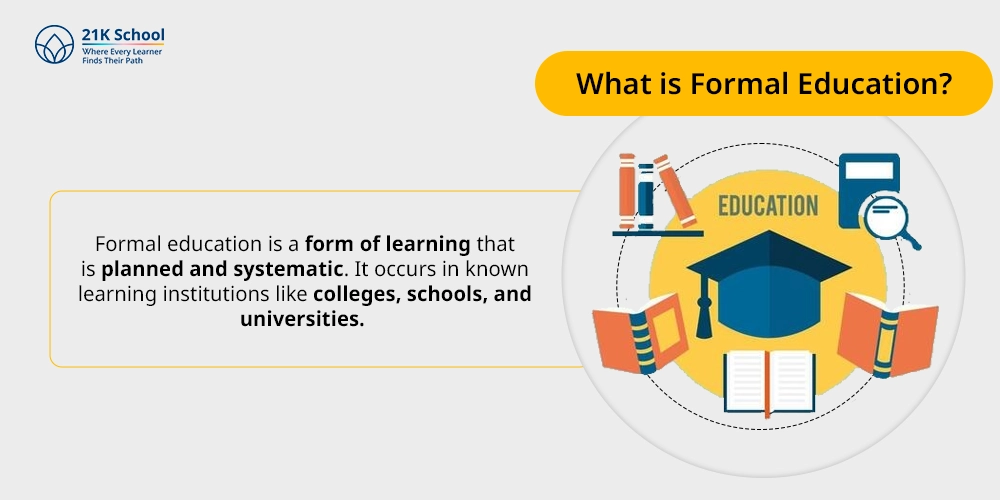
Formal education is a form of learning that is planned and systematic. It occurs in known learning institutions like colleges, schools, and universities.
These are controlled by set rules, curriculum , and standards by the educational authorities and governments.
The key objective of formal education is to introduce structured academic knowledge, useful skills, and social values.
Such an education is based on a regular schedule, standard teaching approaches , and the regular evaluations and testing.
Students progress through various levels of formal education depending on their age and educational success at the end of each level.
They get certificates or degrees that are considerable in job markets and for higher education .
6 key characteristics of formal education
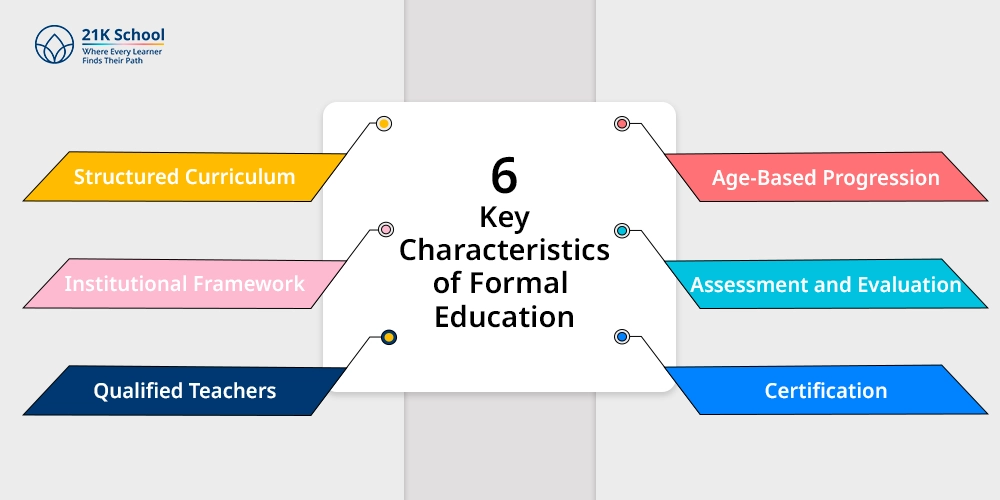
The main characteristics of formal education would include the following:
1. Structured curriculum
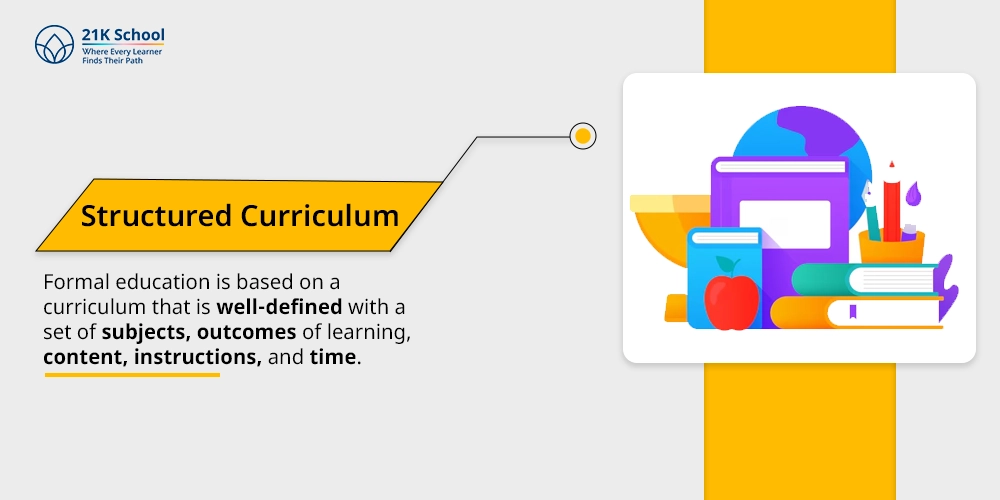
Formal education is based on a curriculum that is well-defined with a set of subjects, outcomes of learning , content, instructions, and time.
Such a structure ensures that there is consistency and uniformity in education in institutions.
2. Institutional framework
Formal education is designed around institutional framework to maintain quality of education and show responsibility.
Only the government recognized and well-accredited institutions can provide formal education through their curriculum, exams, and learning resources.
3. Qualified teachers
Teaching in formal education systems takes place under the guidance of professionally trained and qualified teachers.
They have the subject knowledge and pedagogical skills required to be able to teach and develop students.
4. Age-based progression
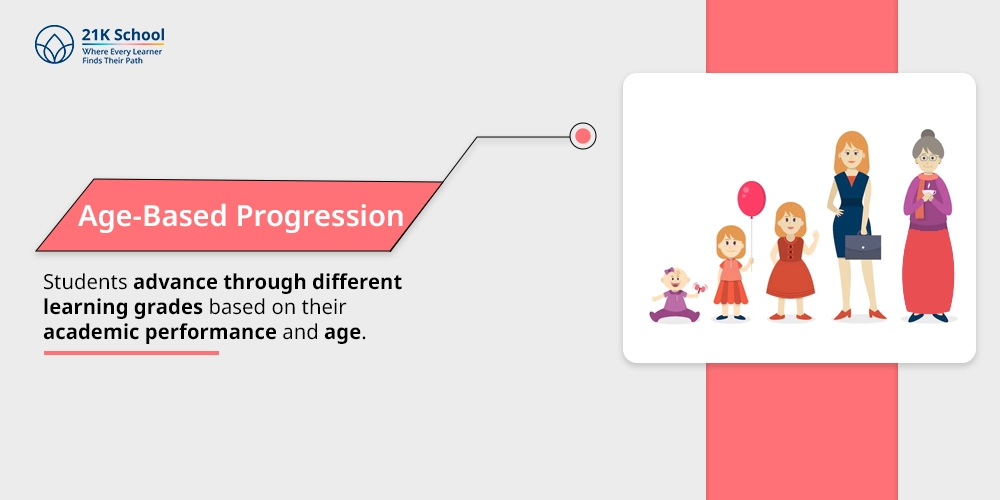
Students advance through different learning grades based on their academic performance and age.
The education levels in India and curriculum are designed in a manner that fits the developmental age of that student.
5. Assessment and evaluation
The assessment in formal education is regular and it consists of tests, exams, assignments, and projects.
Such assessments evaluate learning goals and achievements which contributes to academic development.
6. Certification
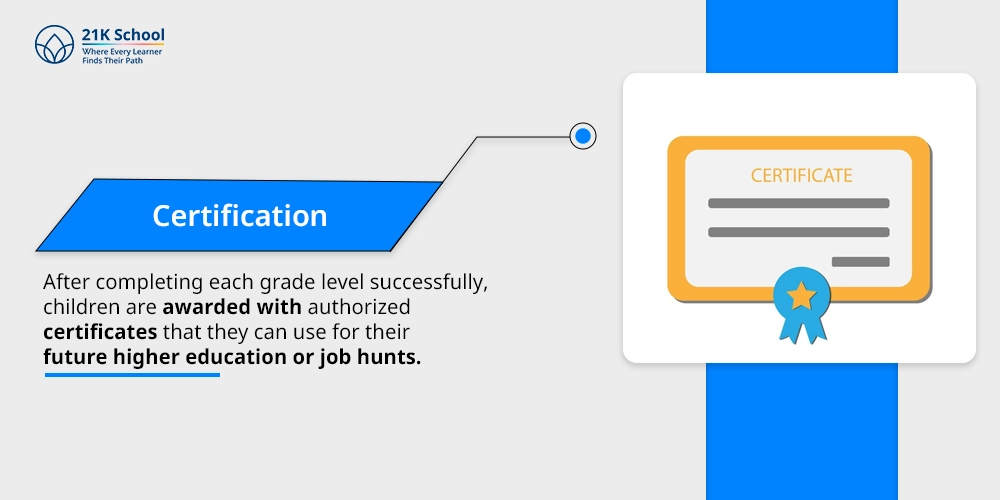
After completing each grade level successfully, children are awarded with authorized certificates that they can use for their future higher education or job hunts.
This certification provide a special quality to formal education.
Types of formal education
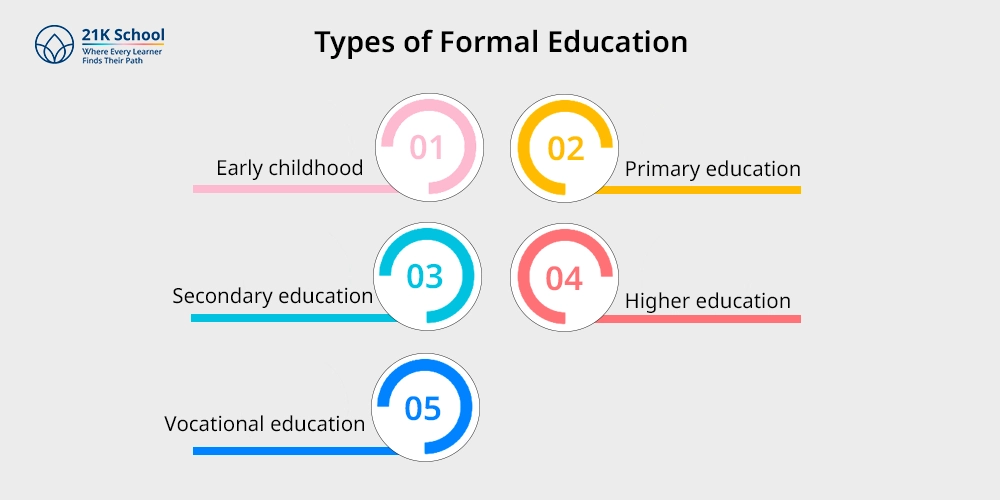
Formal education is divided into major 4 types including early childhood, primary, secondary, and higher education.
This may also include a 5th type which is vocational education that suits to prsesnt day scenarios of digital or open learning.
Every student passes one level after another in sequence to attain maximum knowledge and skills as per their choice.
Structure of formal education
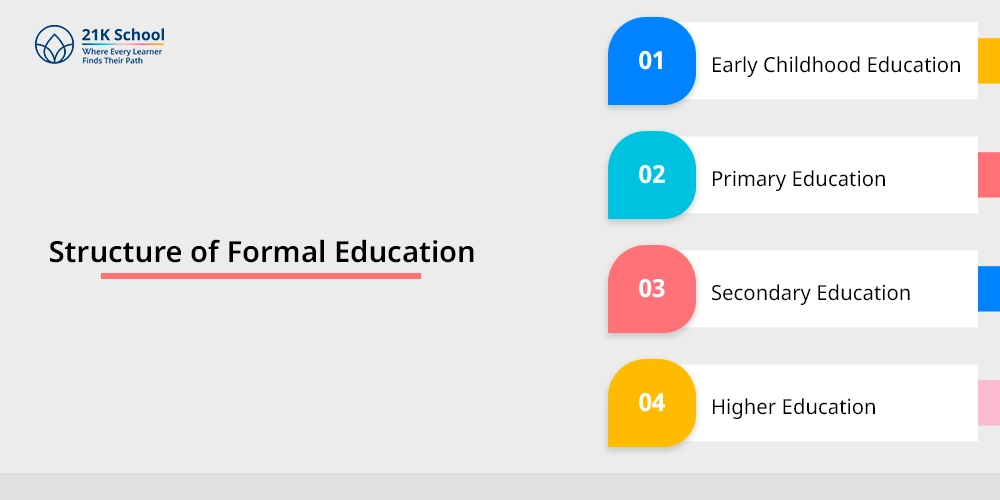
Formal education takes place in four phases that make up its overall structure as children age and get knowledge.
1. Early childhood education
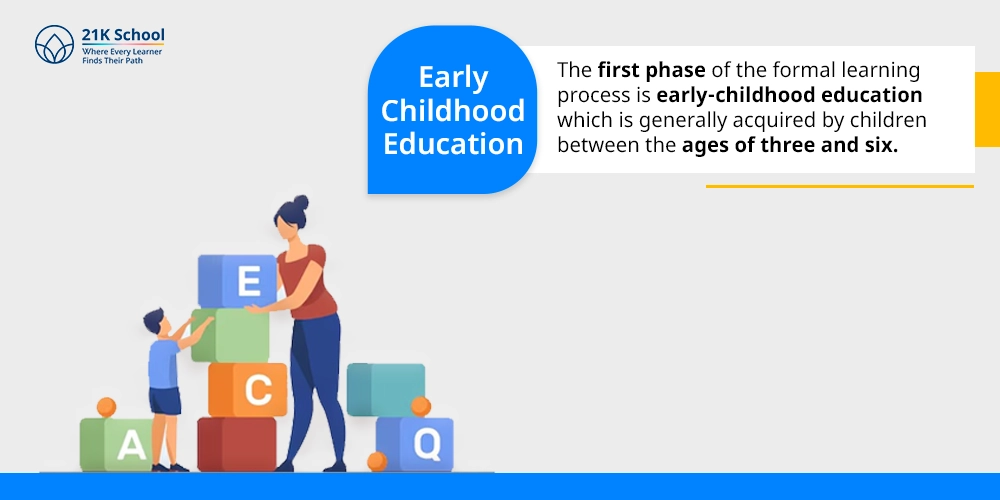
The first phase of the formal learning process is early-childhood education which is generally acquired by children between the ages of three and six.
It is concerned with the acquisition of basic 21st century skills like language development, numeracy, social interaction, and emotional development.
This level is for the preparation of children towards primary education.
2. Primary education
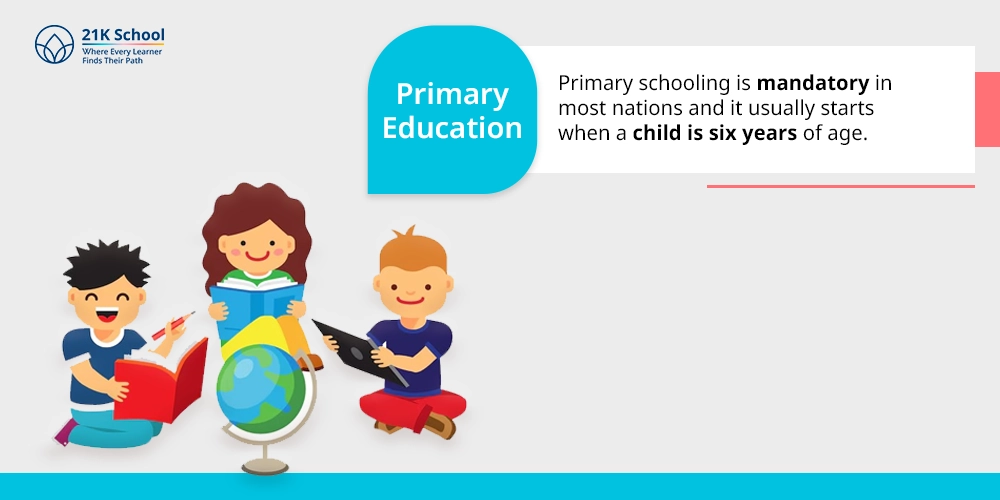
Primary schooling is mandatory in most nations and it usually starts when a child is six years of age.
It places emphasis on basics like reading, writing, mathematics, science, and social studies.
This is to establish a powerful background to lifelong learning .
3. Secondary education
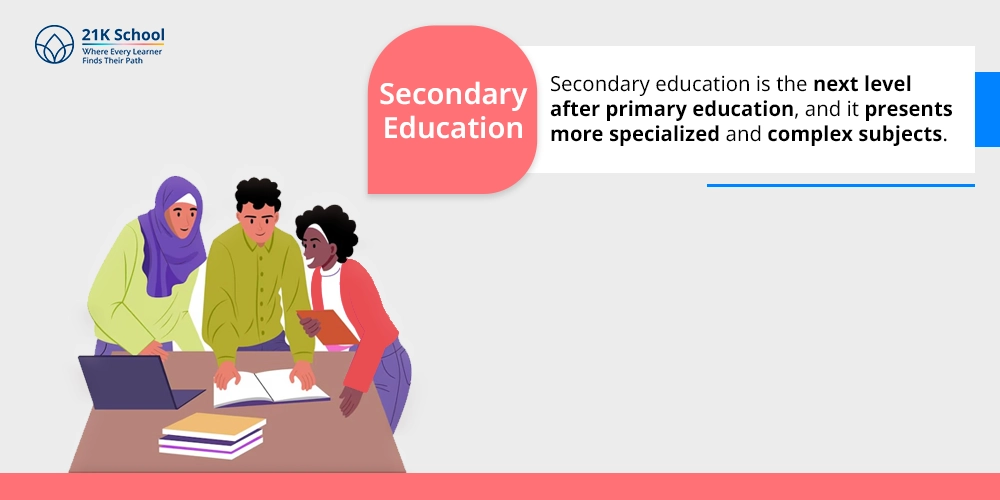
Secondary education is the next level after primary education, and it presents more specialized and complex subjects.
It equips students to gain higher education and vocational capabilities so that they get a chance in the workforce.
This is a very vital stage in career choice.
4. Higher education
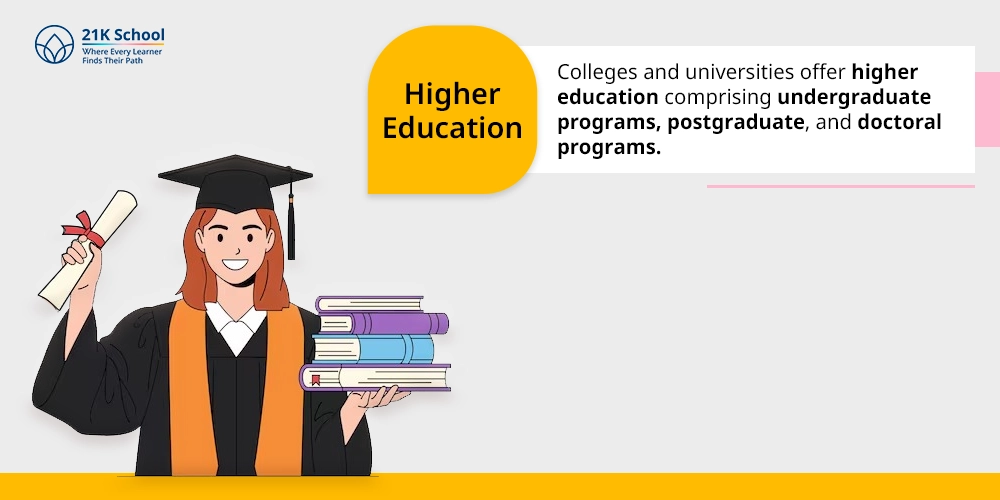
Colleges and universities offer higher education comprising undergraduate programs, postgraduate, and doctoral programs.
It also emphasizes a high level of knowledge, research, critical thinking , and specialization in different fields.
Objectives of formal education
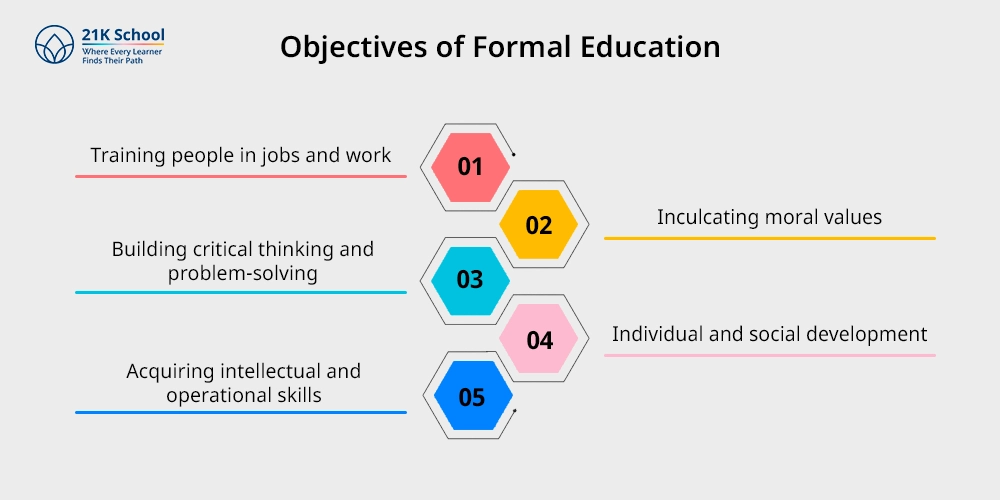
The following are the key objectives of formal education:
- Training people in jobs and work.
- Inculcating moral values for students and making responsible citizens.
- Building critical thinking and problem-solving .
- Individual and social development.
- Acquiring intellectual and operational skills.
Formal education is also centred around maintaining cultural heritage and encouraging innovative progress in the society.
5 importance of formal education
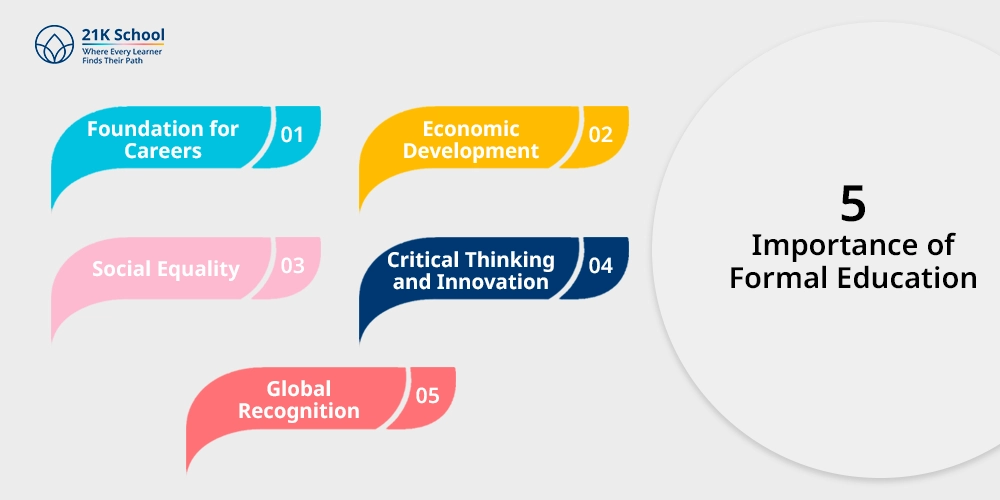
Formal education holds the following mentioned importance:
1. Foundation for careers
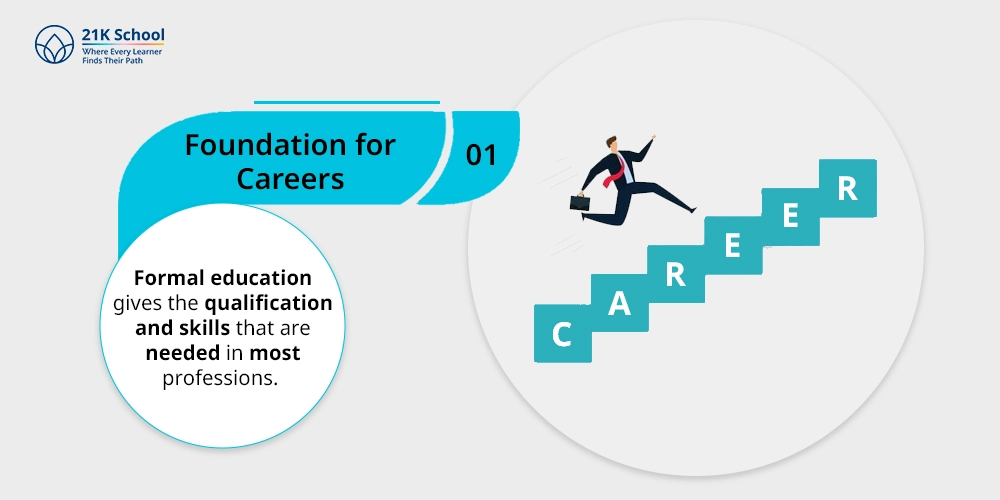
Formal education gives the qualification and skills that are needed in most professions.
Degrees and other certificates are a sign of competence, and are crucial in career development.
2. Economic development
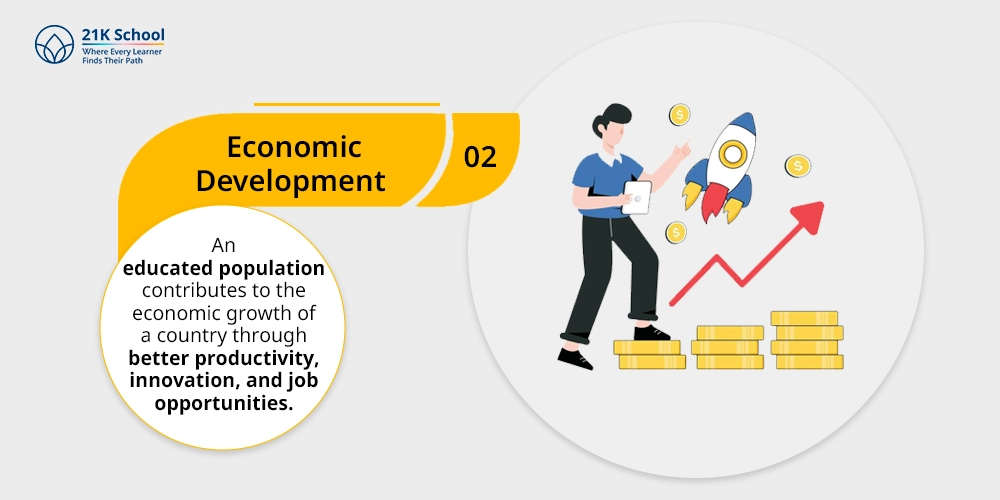
An educated population contributes to the economic growth of a country through better productivity, innovation, and job opportunities.
3. Social equality
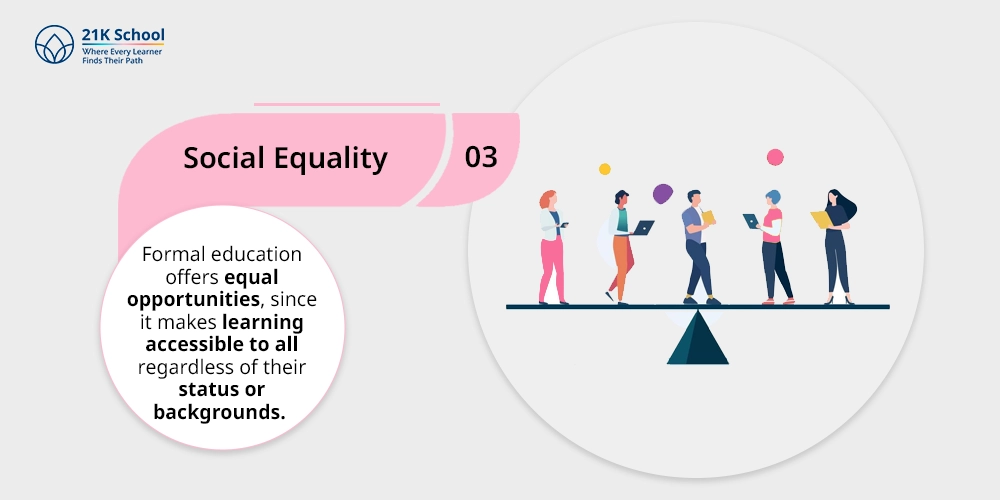
Formal education offers equal opportunities, since it makes learning accessible to all regardless of their status or backgrounds.
It reduces poverty and social inequality.
This is because in schools or universities, the idea of partiality is not promoted. Instead they learn about equality and freedom to practice any belief or culture.
4. Critical thinking and innovation
Formal education builds analytical and problem-solving skills that are critical to innovation and growth through structured learning and evaluation.
5. Global recognition
The qualifications of formal education have global recognition.
These recognitions allow young individuals to pursue education in any country or work anywhere, and be a part of the global workforce.
Examples of formal education
Here are some of the examples of formal education:
- Education in primary and secondary schools.
- The undergraduate degree programs in colleges and universities.
- Vocational training acknowledged by the government.
- Courses of professional diploma and certification.
- Certified distance learning degrees.
Difference between formal education and non formal education
Let's understand the difference between formal and non-formal education with the help of a table:
| Basis of Comparison | Formal Education | Non-Formal Education |
|---|---|---|
| Meaning | A systemic form of education led by institutions | A type of education that happens outside institutional premises |
| Learning Setting | Formal and disciplined. Takes place in schools and colleges | Takes place in community workshops or online platforms |
| Curriculum | Fixed and well-defined | Flexible curriculum based on learner needs |
| Duration | Long-term and continuous | Short-term or periodic |
| Teaching Method | Classroom-based and teacher-centered | Learner-centered and activity-based |
| Teachers | Taught by well-qualified teachers | May be taught by experts with practical experience |
| Age Group | Mostly age-specific | Open to all age groups |
| Assessment | Regular tests and exams | Usually informal or minimal assessment |
| Certification | Leads to recognized certificates or degrees | Usually does not lead to formal certification |
| Government Recognition | Fully recognized and regulated by authorities | May or may not be officially recognized |
| Objective | Overall academic and professional development | Skill development and practical learning |
| Examples | university programs, school education or college degrees | Workshops, adult literacy programs, or skill-training courses |
Conclusion
Formal education is a basic education that individuals get from schools and colleges for their primary learning.
Teachers mostly focus on the academic excellence of children in formal education settings, though other qualities like discipline and basic life skills are also taught.
Parents should pay attention while choosing online schools for their kids, as that would shape their overall personality development and skills.
Frequently asked questions
8 questions
Why is formal education important?
Formal education is significant for children's basic education and overall competency in the real world. It provides them with certificates and degrees required for getting jobs ahead.
Can you list the 4 stages of formal education?
Yes, early-childhood education, primary education, secondary education, and higher education are the 4 stages of formal education.
Can formal education include online learning?
Yes, formal education can be provided by online learning from recognized institutions providing it.
Is formal education necessary for success?
Yes, formal education is necessary for individual success because it provides them with skills and degrees that can open paths for more opportunities and professional possibilities.
What is the difference between formal and informal education?
The difference between formal and informal education is that formal education is organized and structured, but informal education takes place through daily experiences.
What are some examples of formal learning?
Some examples of formal learning are the education gained from schools, diplomas, university, and accredited web-based courses.
Can a person be educated without a formal education?
Yes, a person can be educated without formal education as education involves everything that improves the present capabilities of an individual. People gain education from experiences, schools, family, society, and much more.
Which is better, formal or informal education?
Both of them have different values and add to the individual's lifelong learnings.
About the author
Anshu Kumari
Content Specialist
Anshu Kumari is an Education Content Specialist at 21K School- a fully accredited institute- Cambridge International (IA702) and Pearson Edexcel (94883). She focuses on the in-depth research and creation of the well-drafted guides on NIOS admission, Indian Education Policy, and competitive exam preparation. With around 2 years of experience at 21K School, her psychology background informs her approach to the education content and hence focuses on creating guides to address the real anxieties of the guardians. She writes well-researched articles on competitive exam timelines, stream selection, and board choices by referring to the official resources. All Anshu’s content pieces are fact-checked against the board and primary government official resources and is dedicatedly reviewed by the school’s academic team.
Every 21K School guide is written by our education team and reviewed by a subject facilitator before publishing.
Exploring a CBSE-pathway online school?
Talk to an advisor about 2026–27 admissions — no obligation.
Talk to an advisorComments
No comments yet — be the first to share your thoughts or ask a question.