

Have you questioned yourself on how to make learning more effective and engaging?
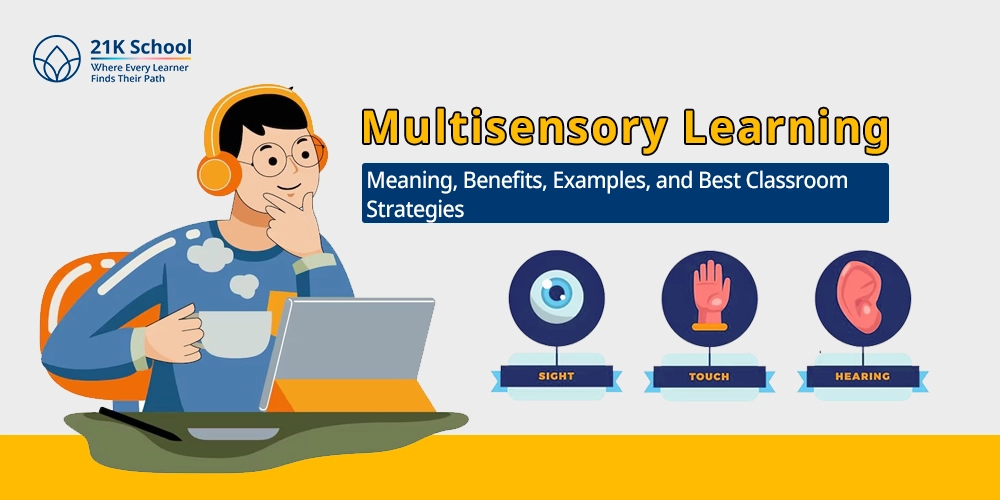
Multisensory learning is a learning method that uses more than one of the senses in children to learn, remember, and apply concepts in modern education .
This learning process therefore makes learning an interactive and interesting process. Teachers have the ability to create a non-discriminatory environment for students with diverse abilities.
So let us look at some of the practical classroom strategies and examples of multisensory learning that support and improve memory retention among learners.
Contents
- What is Multisensory Learning?
- Multisensory Learning Examples for Different Age Groups
- Key Components of Multisensory Learning in Classrooms
- Importance and Benefits of Multisensory Learning
- How Multisensory Learning Works?
- 4 Multisensory Teaching Methods & Techniques
- Multisensory Learning for Autism and Dyslexia
- Multisensory Learning Activities
- Multisensory Learning Examples
- Conclusion
What is Multisensory Learning?
Multisensory learning encourages learners to engage with their multiple sensory organs at the same time to understand and remember information effectively. Visual, auditory, tactile, and kinesthetic learning are some of the learning styles included.
The brain creates neural pathways to improve memory retention. Suppose a student does not remember the answers. These pathways can help to retrieve information through visual images, auditory cues, and physical movement.
Multisensory Learning Examples for Different Age Groups
Examples of multisensory learning for different age groups are mentioned below.
1. Early Childhood Education for Toddlers and Preschoolers
Introducing multisensory activities during early childhood helps them acquire knowledge by touching, hearing, and playing. It also strengthens cognitive and language skills in children.
Activities like tracing alphabet letters in sand trays, using physical objects like beads and blocks to memorise numbers, finger painting, and articulating letters aloud improve their phonics instruction and letter and number recognition. Storytelling and reciting rhymes build listening and speaking skills in preschoolers.
2. Primary School Students for the Age Group of 6-11 years
Primary school students begin their learning through reading, writing, learning spelling, pronunciation and mathematics.
Activities like letter sound hopscotch, in which a child jumps on alphabet squares after hearing a sound, improve phonemic awareness. Students act out different verbs and adjectives in the game of grammar charades to improve their visual and kinesthetic awareness.
Teachers encourage students to participate in finger tapping games, which makes it easier for students to identify and remember spellings accurately and engage their motor cortex.
3. Secondary School Students (Ages 12–18)
Secondary students acquire knowledge through work-based and cooperative learning methods.
Students conduct science experiments to observe reactions, perform tasks, and record results and findings at the same time.
Teachers come up with educational videos, presentations, and storyboards to demonstrate better understanding.
4. Adult and Higher Education Learning
In adults, multisensory learning combines visual, auditory, and kinesthetic learning. It assists in the use of multiple senses simultaneously to increase recollection and learn intricate ideas.
Multisensory learning enables professionals to learn new skills in the workplace effectively by enabling them to participate in something and also resolve practical problems through applied knowledge.
The online learning platforms make digital learning engaging through videos, podcasts, quizzes, animations, and interactive sessions.
Key Components of Multisensory Learning in Classrooms
The key components of multisensory learning in classrooms are mentioned below.
1. Visual learning (sight)
Students process the information through visual learning in the form of images, colours, symbols, diagrams, and infographics. Learners understand the concepts better when they visualise the concepts in a better way.
Teachers use charts, flashcards, videos, coloured based notes to strengthen visual learning in the classroom.
Visual strategies help students improve focus, recognise patterns, and retain concepts for a longer time.
2. Auditory Learning (sound)
Auditory learning involves listening and speaking. Students grasp the information through auditory instruction and communication.
Teachers implement storytelling, classroom discussions, oral reading activities, and question-answer sessions to improve listening skills . It is useful in language learning, communication development, and memory-based subjects.
3. Tactile Learning (touch)
Tactile learning helps students to physically interact with materials while learning. Touch-based activities make lessons easier to understand.
In classrooms, students learn with clay models, textured letters, sand trays, puzzles, flashcards, counting beads, and magnetic letters. This method strengthens sensory memory and supports students who learn through direct physical interaction.
4. Kinesthetic Learning (movement)
Kinesthetic learning involves body movement, actions, and physical participation during lessons. This method encourages students to actively engage and improve their concentration levels in the classroom.
Activities such as role-playing, educational games, movement exercises, and classroom stations are commonly used in kinesthetic teaching. Movement-based learning is effective in memory retention and practical understanding of concepts.
Importance and Benefits of Multisensory Learning
Some of the benefits and importance of multisensory learning are described below.
1. Enhanced Memory and Retention
Multisensory learning helps in improving memory retention by using multiple sensory pathways at the same time to create a strong neural connection to process the information better and store it to recall later.
This strengthens long-term learning and improves recall during classroom activities and examinations .
2. Improved Focus and Engagement
Multisensory learning engages students in classroom lectures by introducing interactive activities, discussions, games, and practical experiences. This environment encourages students to stay focused throughout the learning process.
3. Detailed Conceptual Understanding
Sometimes students find it difficult to understand the concepts in the traditional classroom setting. Multisensory teaching methods divide challenging concepts into simpler ones and parallel them with real-life experiences and illustrations. This method enhances conceptual clarity, analytical thinking, and deeper understanding of the subjects.
4. Inclusive Learning Environment
Each and every student has diverse abilities and needs. Multisensory learning encourages inclusion all at once. Such a type of learning is appropriate for people suffering from dyslexia, ADHD, autism, and many others. This creates a more inclusive and supportive learning environment where all students receive equal opportunities to understand and participate.
5. Improved Social and Emotional Growth
Multisensory learning boosts creativity, encourages collaboration, and cooperative communication. In addition to learning academic skills, students learn social and emotional skills.
Group activities, storytelling, and classroom games foster empathy, cooperation, listening skills, and emotional expression. Students develop communication skills to confidently conduct themselves in social situations and improve their emotional intelligence.
How Multisensory Learning Works?
Multisensory learning works based on the factors mentioned below.
1. Multi Neural Pathways
Multisensory learning is ideal for students struggling with traditional memorisation methods. When students learn through multiple senses, the brain stores information across different neural pathways instead of depending on a single memory connection.
If one memory pathway becomes weak, then other sensory connections help students retrieve the information more easily.
Multiple neural pathways process complex concepts more efficiently because the brain receives reinforcement from different sensory experiences.
2. Cross-modal Neural Response
The human brain cannot process the information in complete isolation. It does require a sensory response to communicate with each other continuously during learning.
This includes visual, auditory, tactile, and movement-based experiences to interact together to process the information. A sound, image, or physical action may remind students of information they learned earlier through multisensory experiences.
3. Active Engagement in Learning
Students study through the use of classroom activities and discussion with peers as opposed to conventional classroom lectures.
Activities such as building models, role-playing, tracing letters, solving puzzles, conducting experiments, and movement-based learning activate the brain functions more deeply.
This increases classroom participation, reduces distractions, and improves students’ cognitive thinking of the material learned.
4 Multisensory Teaching Methods & Techniques
Some of the multisensory teaching methods and techniques are discussed below.
1. Tactile Teaching Methods
Tactile learning technique involves a sense of touch and physical interaction of sensory experience with the learning materials. It builds sensory memory, connects physical movement with written symbols and helps recognise handwriting and spelling.
Activities used by teachers to make complex concepts easier to comprehend include practical activities such as Clay models, magnetic letters, counting beads, puzzles, flashcards, and building blocks.
2. Kinesthetic Teaching methods
Kinesthetic teaching focuses on learning through movement and physical activity. This method helps students stay active, improve concentration, and participate during classroom interactions.
Air writing is one of the popular methods in which a student uses their dominant hand to write letters by spelling them out in the air. This improves their muscle memory and letter formation skills. Teachers implement games like jumping, exercising, and other physical activities to process new concepts.
3. Visual Teaching Methods
Visual teaching techniques use images, colours, symbols, charts, illustrations, and timelines to help students process the information effectively.
It also improves attention span, pattern recognition, and information recall for learners who process information through observation.
Teachers often use infographics, diagrams, and mind maps to improve conceptual understanding.
4. Auditory Teaching Methods
Auditory learning methods engage students with listening, speaking, rhythm, and verbal repetition. This improves their language, pronunciation, memory, and communication skills .
Teachers implement storytelling, classroom discussions, reading sessions, rhymes, and audio recordings to reinforce learning through sound. It is also useful for developing speaking with confidence and strengthening linguistic learning.
Multisensory Learning for Autism and Dyslexia
Multisensory learning is very efficient among students with autism and dyslexia since it offers alternative methods of processing, understanding, and remembering information.
1. How Multisensory Learning Supports Students with Autism?
Autistic children learn best through visual structure, repeated exposure, routine and doing. Multisensory learning improves communication and reduces anxiety by making lessons more predictable and interesting.
Visual, auditory tactics, sensory stimulation, and movement-based learning help autistic learners understand what is being said and stay engaged in classroom lessons.
Because of the multisensory approach to learning, it also allows for a reduction in cognitive overload because it gives students another way, in addition to verbal explanations, to process information.
2. How Multisensory Learning Supports Students with Dyslexia?
Multisensory learning supports students with dyslexia by engaging multiple senses simultaneously. It activates neural pathways in the brain to recognise words, regulate memories, and build reading fluency.
Students with dyslexia use the motor cortex to learn spellings and learn through repeated multisensory experiences that help in reading and language skills.
Multisensory learning focuses on evidence-based dyslexia interventions, based on the Orton-Gillingham approach, because it breaks up learning into more manageable parts.
Multisensory Learning Activities
Multisensory learning activities help students learn through interactive activities and connect abstract concepts with real experiences. Some of the activities are explained below:
1. Sand and Shaving Cream Writing
It is one of the most popular multisensory literacy activities for young learners. They trace letters, numbers, words or shapes using their fingers in trays of shaving cream, sand, rice or salt.
The activity involves tactile learning, movement and visual recognition altogether, which enables them to practice handwriting, letter formation, spelling and phonics at the same time.
As they physically feel the shapes or numbers while articulating aloud the relevant sounds, memory retention becomes stronger and learning more enjoyable.
2. Tactile Letter and Number Activities
Textured materials such as magnetic alphabets, felt cut-outs, sandpaper letters, yarn shapes and foam numbers are often employed by teachers in order to strengthen sensory learning.
Children trace these textured letters and numbers using their fingers while they either pronounce the sounds or identify the numbers. It enhances fine motor skills, sensory memory and alphabet skills.
The activities are especially useful for children with dyslexia as well as for early learners who may need more repeated sensory reinforcement.
3. Air Writing and Movement-Based Learning
Teachers may use sandpaper letters, felt cut-outs, magnetic alphabets, foam numbers and yarn shapes to improve sensory learning.
Students trace these textured letters with their finger while they read or spell sounds or numbers. This activity helps fine motor skill development, alphabet recognition, and enhances sensory memory.
These activities can help children with dyslexia and other early readers who require “sensory” stimulation.
4. Storytelling and Visual Learning Activities
These activities include the use of visual props, puppets, flash cards, textured story sticks, illustrated charts, and so on.
Students can identify characters, a sequence of events, or make storyboards.
These activities enhance imagination, vocabulary, listening, and visual memory skills. It also makes reading activities more visually stimulating.
5. Scent and Taste-Based Learning Activities
Although this type of activity is not as popular as above, smell and taste can help sensory learning in a creative classroom setting.
Some teachers may use scented markers, food items or flavoured materials to make activities more memorable and enjoyable for young students.
These activities create stronger sensory memories and make learning more enjoyable for kids.
Multisensory Learning Examples
Go through the following multisensory learning examples mentioned below:
1. Phonics and Reading Activities
During a phonics lesson, the students can look at the letters, pronounce them aloud and trace them with their fingers. Reading fluency and letter recognition are enhanced by the combination of the three senses of sight, listening and touch.
Magnetic letters, flashcards, singing rhyming songs and singing syllables with clapping of hands are some other examples of using multisensory learning to enhance spelling and pronunciation.
2. Mathematics Learning Examples
To understand operations such as addition, subtraction, multiplication and fractions in mathematics, learners use counting blocks, beads, number lines and coloured cubes.
Many young learners still learn mathematics visually by grouping objects together rather than directly memorising the equation.
Learning to count a number while jumping on the floor number mats or counting while using hand gestures are some of the many examples of using body movements in the classroom to enhance learning in mathematical classroom activities.
3. Science Classroom Examples
Learning science helps students to actively engage and participate in practical experiments and record the observations.
Students can conduct a volcano experiment to observe chemical reactions visually, discuss the parameters of the experiment, and record values.
Using motor skills helps students to regulate sensory development and conceptual understanding and scientific thinking skills.
4. Language and Vocabulary Activities
Storytelling, visual displays, and recorded audio tools are utilised by teachers to improve the communication and vocabulary skills of the students.
Students might be required to act out scenes from a story, match pictures with words or use gestures while they are learning new words.
Auditory and reading input from listening to audiobooks with printed text is another way to help students learn in a multisensory way.
5. Technology-Based Multisensory Learning
Electronic multisensory learning tools such as videos, interactive whiteboards, animated presentations, and interactive learning apps are also used in many classrooms nowadays.
Students might be required to watch video demonstrations, listen to the teacher’s voice, touch-screen objects or engage in interactive quizzes.
The combination of auditory, visual and physical input leaves the learning enriched and inclusive.
Conclusion
Multisensory learning helps students understand concepts by combining multiple senses at the same time. It ranges from improving memory retention to classroom engagement. This type of learning helps children with diverse learning needs to make the learning process more interactive, engaging and meaningful for learners of different age groups.
Multisensory learning encourages teachers to use creative approaches that make your lessons easier to understand with real-life scenarios.
Thus, it is important to understand the importance of this approach to create an inclusive environment for students for academic and overall development

You may also want to read