


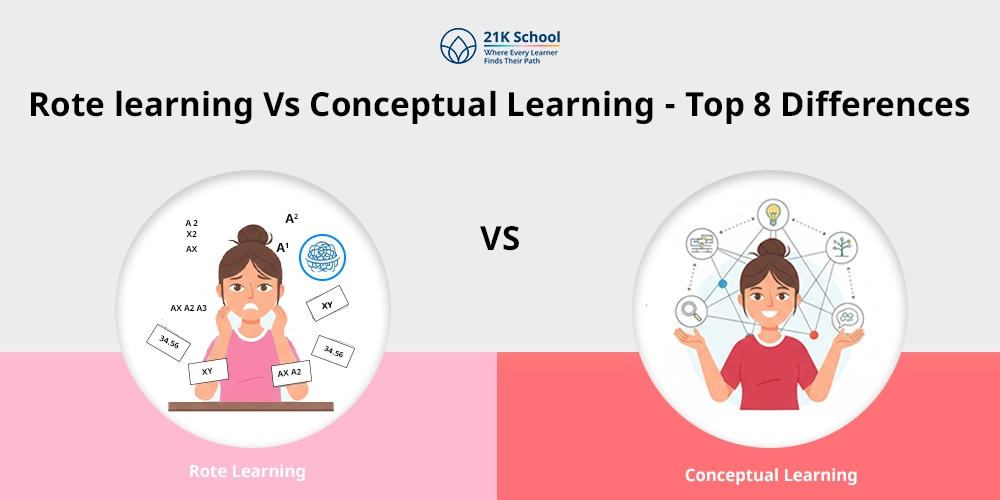
Have you ever wondered to yourself how rote learning is not the same as conceptual learning?
Learning is one of the major processes of human beings that helps them to gain knowledge and acquire skills , and become intellectuals. In the course of years, teachers have discovered some different strategies of learning; they have their own method, pros and cons.
Rote learning and conceptual learning are two of the most widespread techniques that have been discussed. The Rote learning is more based on the concept of memorisation and representation, and thus, allows the learners to memorise facts, figures and sequences when they are introduced to them in the exact manner.
On the other hand, conceptual learning is constructed on the conceptualisation of concepts, rules and relationships, and it involves the learner understanding the meaning of the information and applying the same to a new or actual situation.
Contents
What is Rote Learning?
Rote learning is a method of learning that emphasises learning more on memorisation (by repetition) instead of gaining a perception of the object of what is being learnt, or what is the meaning of the concepts being learnt. This is applied in cases where the students are expected to repeat going through information until they can learn to memorise it, as they were informed.
Rote learning is good for memorising facts and information that needs to be stored at the short-term level, yet it does not generate critical thinking skills and problem-solving . Nonetheless, basic knowledge which has been memorised can be used as an input to high-level conceptual knowledge and reasoning.
This implies that the students would be experiencing a problem of generalising the memorised information to new or realistic situations. Meaningful learning , in its turn, is based on the notion of connection making and understanding of concepts, which develops the notion of greater understanding and long-term memory.
What is Conceptual Learning?
One of the learning approaches is conceptual learning, which is based on learning of concepts, ideas and relationships underlying learning other than memorisation.
This method is aimed at the learners to attempt to understand the meaning of the information and to observe how it can relate to other knowledge so that they can be able to apply it in other contexts.
Conceptual learning fosters critical thinking , generation of solutions, creative thinking skills and long-term retention of knowledge in education since learners get to know why the fact is the way it is. Compared to rote learning, conceptual learning enables students to use what they know on emerging problems and situations; therefore, their knowledge becomes flexible and meaningful.
Difference Between Rote Learning and Conceptual Learning
Memorising the formulas and the facts without knowing and comprehending the facts is termed as rote learning, and on the other hand, the knowledge as to why things and how things work in the real world is termed conceptual learning. Here, the minor differences between the conceptual learning and the rote learning can be proved.
| Aspect | Rote Learning | Conceptual Learning |
| Meaning | Rote learning involves memorising facts and information by rehearsing to remember. | Conceptual learning is a more meaningful and profound knowledge of the connection and the functionality of concepts. |
| Nature | Mechanical and superficial; based on repetition without understanding the sense of meaning. | Critical and profound; founded on an understanding of principles and relations of ideas. |
| Retention | Rote learning may result in short-term memory as well as long-term memory, as per the frequency and intervals of practice. The information memorised by rote techniques can be remembered forever with enough practice, but it rarely has the associations that allow retrieval and adaptability of use. | Long-term retention, understanding is retained in conceptual learning due to the attachment to the existing knowledge, and may be rebuilt in the case of forgetting. |
| Procedure | Drilling, repetition and memorisation, as a result of regular rehearsing, are done to achieve rote learning. Learning is passive and requires less in-depth thinking or surface thinking. | Conceptual learning is a process that entails exploration, questioning, discussion, and relating the new knowledge to previous knowledge. Learning is participatory and dynamic. |
| Goal | The objective of rote learning is to memorise and retrieve information efficiently and fast, particularly in tests and examinations. | Conceptual learning aims to know and learn to think critically and to use the knowledge in different situations and flexibly. |
| Application | Restricted to existing scenarios; can hardly apply knowledge to new or changed situations. | Adaptability: can be flexible and utilise knowledge to solve new, unknown, and real-life problems creatively. |
| Focus | Rote learning focuses on what- the facts, formulas, definitions or steps themselves, but not the reasoning. | Conceptual learning focuses on why and how – the rationalisation, the principles, the relationships between ideas. |
| Example | Examples of rote learning are learning multiplication tables, spelling lists, definitions, formulas or historical dates. | Understanding the principles of geometry and algebra, researching scientific theories and experiments are examples of conceptual learning. |
1. Definition
Rote Learning: Rote learning is a study approach that is founded on pure memorisation and repetition. The students want to memorise facts, figures or sequences because they are presented to them with no question of what it is about or what the context is.
It is commonly used when one has to memorise exactly, as in exams or learning simple formulas and definitions.
Conceptual Learning: Conceptual learning does not mean that learners have to memorise. The learner then focuses on the reason behind the information, thoughts, and contexts, hence providing the learner with the capacity to translate it into practical application in real-life situations or in attempting to solve a problem.
2. Nature
Rote Learning: Rote learning relies mostly on theoretical knowledge . Participation on behalf of the learner is very minimal, and the process is normally routine and monotonous. It is not about critical thinking, problem understanding and problem-solving skills .
Conceptual Learning: The conceptual learning, however, is an active and promotes dynamic learning . It promotes research, discovery and critical thinking. The learner is actively involved in the material, poses questions, tries to find some connections and attempts to comprehend the meaning and implications of the knowledge.
3. Retention
Rote Learning: Rote learning also causes short-term memorisation. Information learned by memory is easy to forget unless it is drilled on, but when it is applied and known over time, it can be stored permanently.
Conceptual Learning: During conceptual learning, the long-term memory is clear, with the knowledge being even more encoded into the mind. When a learner gets accustomed to the principles of the information, it will be easier to remember, recall and apply them in the long run, as information is related to a certain substantial framework.
4. Process
Rote Learning: Rote Learning is a procedure which involves repetition, drilling and rehearsal. A learner can repeat a poem, definition or formula several times, hundreds of times, until one is able to remember, or be able to write the information.
Conceptual Learning: Conceptual learning, by contrast, is more reflective and entails a number of processes, such as exploration of ideas, relationship analysis, questioning, drawing of relationships with prior knowledge, and facilitation of concepts in new circumstances. It typically entails discussion, problem-solving, and experiential learning or reasoning.
5. Goal
Rote Learning: Rote learning is mainly concerned with the accuracy of memorising. The success of the learner is determined by the output or results in terms of ability of the learner to reproduce the facts memorised.
Conceptual Learning: Conceptual learning is the form of learning that seeks to understand, reason and be able to creatively apply knowledge. This is aimed at making sure that learners not only possess the information but also apply it efficiently in new circumstances, be critical thinkers, and be able to resolve problems on their own.
6. Focus
Rote Learning: Rote learning deals with the what of the information that one is supposed to memorise. It is not concerned with understanding, communication and reasoning.
Conceptual Learning: Conceptual learning focuses on the why and how of the driving forces, principles and interrelations of concepts. It will also make the learners see patterns, identify relationships and extract meaning from information as compared to memorising information.
7. Application
Rote Learning: Rote learning is minimally applied. The learned facts can be applicable during examinations or when one needs to apply them accurately, but the learners find it challenging to apply the learned facts in real life or in something that they have not learnt before.
Conceptual Learning: Conceptual learning is widely applicable. The knowledge acquired by virtue of understanding can be utilised to address new problems, decisions, innovation and adjustment to the new condition. It provides learners with skills that are not confined to the classroom.
8. Examples
Rote Learning: Rote learning can be memorising multiplication tables or a list of spelling, definitions, formulas or even dates in history. The information is repeated until the students memorise it word-for-word.
Conceptual Learning: Some examples of conceptual learning are the study of the rules of geometry and algebra, scientific theories and experiments, historical events and their causes, or learning programming through the study of logic, algorithms, as opposed to memorising code.
Conclusion
The two knowledge acquisition strategies are at opposite ends i.e. rote learning and conceptual learning. Even though rote learning is optimal in short-term memorisation of information, it should be supplemented with conceptual knowledge in long-term memorisation.
The ratio between rote and conceptual learning has a difference between the various developmental stages. The homogeneous rote practice will provide the younger learner with a sound base to practice on, and the older learner will have an opportunity to learn more according to the concepts.
However, even among young children, conceptual approaches are useful for scaffolded teaching. Conceptual learning, on the contrary, encourages knowledge retention and critical thinking and application of knowledge in various situations.
Moderate memorisation and conceptual knowledge may work to enable the learners to have both accuracy and meaning so that they are equipped to face the practical obstacles and learn throughout life.

You may also want to read