

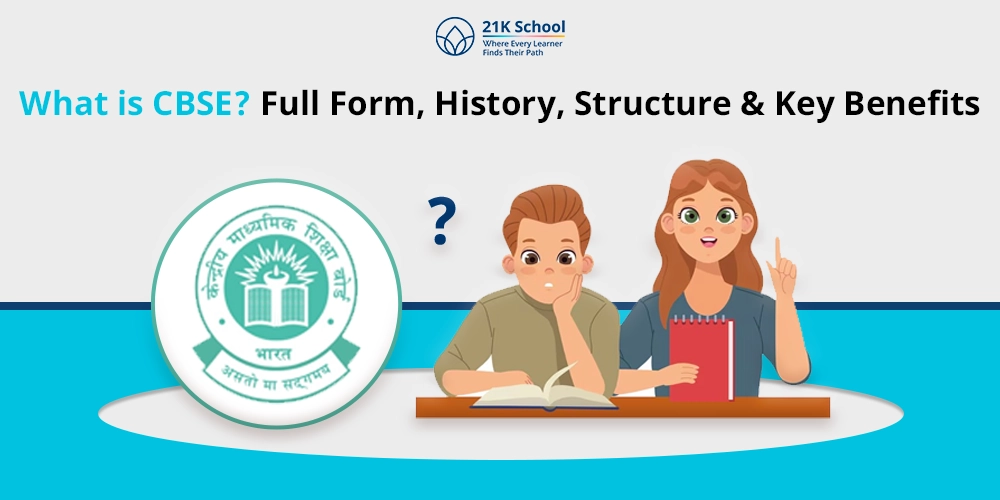
Have you ever wondered what CBSE is and how it shapes the education system in India?
The Central Board of Secondary Education (CBSE) is one of the most recognised education boards in India. It ensures that it takes care of the national-level oversight and academic regulations to be adhered to in the affiliated schools.
CBSE is expected to provide a quality education and standardised curriculum across the country. Millions of students are taking examinations offered by this board annually, including the Class 10 exam and the Class 12 exam, which are highly significant in the lives of students in terms of their education and their future, as far as their career is concerned.
Contents
What is CBSE: A Detailed Explanation

The Central Board of Secondary Education (CBSE) oversees and regulates the school education in the affiliated schools. It is an initiative by the Government of India and is oriented towards providing students with a standardised and quality education in the entire country.
The CBSE is charged with the responsibility of conducting major examinations such as Class 10 and Class 12 board examinations, designing the syllabus and setting the academic standards of the schools. The curriculum followed by the board is systematic so that it concentrates on abstract learning, the development of skills and the general development of the students.
CBSE has public and privately operated schools in thousands in India and abroad. The board also introduces a new way of teaching and a new syllabus and assessment systems to ensure that the students can receive an education that can lead them to the next level of studies and to pass the difficult exams.
History of CBSE

The history of the Central Board of Secondary Education (CBSE) can be considered since the beginning of the 20th century. Its history dates back to the year 1921, when the United Provinces Board of High School and Intermediate Education was established to conduct exams in the state schools.
In 1929, a joint Board was formed called the Board of High School and Intermediate Education, to include such areas as the Rajputana, Ajmer, Merwara, Central India and Gwalior. The restructuring of the board was done a number of times as the necessity of having one education system grew.
The board was reconstituted later in 1952, and it was renamed the Central Board of Secondary Education (CBSE). It has since grown considerably and currently manages thousands of affiliate schools not only in India but also in a few countries outside India, and has thus become one of the most powerful education boards in the country.
6 Key Features of CBSE

One of the most reliable and popular education boards in India is the Central Board of Secondary Education having its standardised curriculum, student-centred learning method and attention to learning concepts. This has made the board one of the most preferred and followed boards of education in India.
1. Uniform Curriculum

CBSE is a standardised curriculum that is used in all the affiliated schools, not only in India but also abroad. The type of standardised format means that everyone gets equal education, regardless of their location.
It also enables the students to change schools without any significant discrepancies in subjects, syllabus and learning standards happening in their learning life.
2. Focus on Competitive Exams

The CBSE curriculum is designed in such a manner that students can prepare for major competitive examinations in India. Theoretical knowledge studied in academic subjects like Mathematics and Science is helpful in preparation for exams, like the Joint Entrance Examination and the National Eligibility cum Entrance Test.
The alignment would help the students to build good basics, which would be needed in engineering, medical and other professional entrance tests.
3. Equal Learning Opportunities

CBSE is also expected to provide the same accessibility to students irrespective of their locations and backgrounds. The board promotes an equal opportunity in the access to learning materials, standardised textbooks and equality in teaching.
The CBSE ensures that every student studying in the board has equal access to education through its standardised policies that govern higher education.
4. Student-Centric Approach

The CBSE education system boasts of the holistic development of the students and not just the achievements. It encourages interaction in the classrooms, creativity and critical thinking skills.
The educators are instructed to apply the methods of teaching that would involve the students in discussions and projects, and practical work in order to ensure that they develop confidence, problem-solving skills , as well as knowledge of the topics.
5. Flexibility

CBSE gives freedom of choice of subjects and learning paths amongst students, but more in the upper classes. Students have an option of using subjects depending on their interests, career desires and capabilities.
Such an option will allow them to develop their individual academic path, which will be a better experience to learn and study and align with their future plans and career objectives.
6. Comprehensive Assessment

CBSE works under a balanced evaluation system where academic knowledge and practical skills are evaluated. Some of the types of assessments include written tests, internal tests, projects, and practical work.
This technique is helpful in assessing the students in a better way compared to the conventional methods of using the last exams as the sole method of evaluation, and enables the students to learn and improve during the school year.
Role of the CBSE Board

The Central Board of Secondary Education plays a significant role in the management of the school education in India by designing the curriculum, conducting board examinations, school affiliation and improvement of the quality of education provided to the learners.
1. Curriculum Development

CBSE prepares and revises the curriculum of the affiliated schools in India. It is premised on the academic guidelines of the National Council of Educational Research and Training (NCERT).
The curriculum focuses on abstract, practical knowledge and skills, which would help students to build a healthy academic foundation to continue their studies.
2. Examination Management

Board examinations are nationalised, and in the instance of secondary schools, the board examination is administered by the Central Board of Secondary Education. It conducts All India Secondary School Examination (AISSE) and All India Senior School Certificate Examination (AISSCE) Examinations of Class 10 and Class 12, respectively.
The board ensures fairness, transparency and standardisation on the evaluation system for millions of students who are offered the exams just once a year.
3. Affiliation of Schools

The Central Board of Secondary Education is associated with the schools, and they make sure that they meet their academic, infrastructure and administrative standards.
The schools that are affiliated are supposed to follow the CBSE curriculum and instructional demands. It is a system that leads to the standardisation of teaching, facilities and learning in thousands of schools related to CBSE.
4. Teachers Training and Development.

The Central Board of Secondary Education regularly carries out workshops, training and development programmes for teachers. These programmes will help the teachers learn modern techniques of instruction, online learning materials and new curriculum strategies.
Continuous learning improves the teaching process, and it helps teachers in improving the learning and academic development of students.
5. Skill Development Program

Vocational education and modern courses promote skill-based education in the Central Board of Secondary Education. Such programmes as Artificial Intelligence, entrepreneurship and coding can help students to gain some practical knowledge.
These programmes are creative, innovative and problem-oriented to prepare the student for future careers as well as real-world problems.
Structures of the CBSE Education System

The Central Board of Secondary Education has an organised education system, which is further broken down into primary, middle schools, secondary, and senior secondary schools, which gives gradual development in the academic aspect and offers a good learning base to students.
1. Primary Level (Classes 1-5)

Primary Level comprises Class 1, Class 2, Class 3, Class 4 and Class 5. This is the stage whereby the Central Board of Secondary Education has a role in creating good background skills in the subject areas like English, Mathematics, Environmental Studies and elementary languages.
Learning is interactive, participatory, and through it, the student is free to inquire, express and develop some simple problem-solving through games, telling stories and classroom activities.
2. Middle Level (Classes 6-8)

Classes 6, 7 and 8 occur in the Middle Level. During this stage, the students will begin studying subjects more strongly in Mathematics, Science, Social Science, English, and other languages.
The Central Board of Secondary Education emphasises conceptual knowledge, analysis and practical learning. Projects, teamwork discussions and assignments help students to enhance and provide them with greater degrees of academics.
3. Secondary Level (Classes 9-10)

Classes 9 and 10 are found in the Secondary Level. This is an important level because students are prepared to write the Class 10 Board Examination that is conducted by the Central Board of Secondary Education.
The curriculum is more educational and includes the issues of Mathematics, Science, Social Science, English, and non-compulsory languages. The students are encouraged in such aspects as creative thinking , a greater familiarity with the material being studied, and good test preparation.
4. Senior Secondary Level (11-12)

Senior Secondary Level is the Secondary Level which consists of Class 11 and Class 12. It is at this level that students can select their subjects in school, like Science, Commerce or humanities due to their interests and future career objectives.
The CBSE provides specialised subjects and advanced learning that is aimed at providing the students with reflective learning, competencies in the competitive exam and the Class 12 Board Examination, which is important in their admission into college.
CBSE Grading System

The CBSE grading system is designed in a manner to evaluate the performance of the students in the board exams. It scores marks in grades, whereby marks can be evaluated equally and reduce the pressure of exams.
1. Class 10th Board Exam (AISSE)

Students in Class 10 are given the All India Secondary School Examination (AISSE), conducted by the Central Board of Secondary Education. This test is used to measure the knowledge of the students on the core subjects of study, such as Mathematics, Science, Social Science, and languages.
The grading system applied by the CBSE translates the amount of marks into grades which in turn relieves the burden of the examinations as well as provides an accurate account of the performance as well as the academic performance of the students.
2. Class 12th Board Exam (AISSCE)

The grading system of the CBSE is made in such a way that it can evaluate the performance of the students in board exams. It employs marks into grades such that marks are able to be graded fairly and reduce the pressure in exams.
The grading system relies on the academic performance of the students who have selected the streams of study, whether it is Science, Commerce or Humanities, and it is well used to evaluate the applicants by the university.
3. Continuous and Comprehensive Evaluation (CCE)

Continuous and Comprehensive Evaluation (CCE) is an assessment procedure that was introduced by the Central Board of Secondary Education to assist in assessing students in school.
CCE involves class tests, assignments, projects, and practical activities, as compared to the use of final exams. The focus of this system is on both academic and general learning, including contribution, creativity and critical thinking.
CBSE Curriculum and Subjects

The curricula of the Central Board of Secondary Education (CBSE) are organised and balanced in such a way that it covers the aspects of academic learning, development of skills, and overall development.
It is subdivided into Core Subjects, Optional Subjects, and Skill-based Subjects, which allow the students to obtain good basic knowledge and learn what draws their interest and is applicable in practice. Each category will be generally described below:
1. Core Subjects

There are core subjects for all students that are mandatory and form the foundation of CBSE education. They include languages, mathematics, science and social sciences and are geared towards the development of a good conceptual learning base.
Languages: Communication, reading and writing skills are developed using English, regional or Hindi language.
Mathematics: Learns logical thinking, problem-solving, and problem-analysis.
Science: This has Physics, Chemistry and Biology involved in the use of experiments, observation and interpretation of natural phenomena.
Social Science: It involves History, Geography, Civics and Economics in order to create awareness about society, the government and international affairs.
These subjects are developed in such a way that the students may end up being in a position to pursue further education as well as in competitive tests.
2. Optional Subjects

Elective courses give the student a leeway to follow personalised learning interests and strengthen specific career decisions. The students can choose subjects based on their abilities and inclinations since Class 9.
Computer Science, Sanskrit, Fine Arts, Music, Dance and Physical Education are some of them.
Elective courses widen the learning opportunities, ability to express oneself creatively and help to gain professional competencies.
It is also possible that the students choose elective subjects, and this assists them in making their education more career/academic oriented and attractive.
3. Skill-Based Subjects
Skill-based subjects are designed in a way that prepares the learners to be ready to meet the real world and achieve a real career. Their orientation is towards practical education, market-driven and problem-solving skills.
They are Artificial Intelligence, Coding, Entrepreneurship, Work Experience, Health and Physical Education, and vocational courses.
These are the fields that facilitate critical thinking, teamwork and application of knowledge in the real world.
Skill-based subjects enable students to have an upper hand over other students; that is, not only academically healthy but also career-ready and prepared to work in the current work environment.
Top 5 Benefits of the CBSE Board

Among the advantages that the Central Board of Secondary Education offers to the students are the standardised curriculum, national recognition and good preparation in competitive exams like the Joint Entrance Examination and the National Eligibility cum Entrance Test.
1. Pan India Recognition

The Central Board of Secondary Education is a name that is familiar throughout India and in the majority of foreign schools.
The implication of the standardised curriculum provided by CBSE is that students are able to transfer to any school in the country and their studies will not be interrupted, and as such, they get equal learning opportunities and their education qualifications are recognised throughout the country.
2. Holistic Development

CBSE does not focus on academics, but it is based on balanced development. The syllabus will include extracurricular activities, sports, arts, together with life skills and the traditional subjects.
This is sufficient to ensure that students are always intellectually, physically, and socially balanced to the extent that they are not afraid of taking any challenge and come out as all-round individuals in order to successfully undertake their education in higher learning institutions and become successful people in career life.
3. Continuous Evaluation

CBSE monitors the performance of students throughout the year using other systems like Continuous and Comprehensive Evaluation (CCE). The assessment involves projects, assignments, quizzes, and class work and not just final exams.
This reduces student stress, facilitates normal learning and helps the teachers know the areas in which the students need assistance.
4. Student-Friendly Approach

The teaching model that forms the basis of CBSE is student-centred, which promotes learning by engaging towards interaction, problem-solving, and critical thinking. It is less burdensome and more engaging because education is not by heart, but by thought.
This approach will help the students to be confident, raise curiosity and gain competencies that will be required to pursue their higher studies and competitive exams.
5. Offers a Strong Foundation

CBSE curriculum and more so the subjects of Science, Mathematics and English give an excellent academic foundation.
It gives the students the knowledge and skills to analyse, and they finally pass the competitive tests like JEE and NEET to be accepted in higher education in India as well as abroad.
CBSE vs Other Boards

Compared to other education boards, such as ICSE, state board, IB and Cambridge, CBSE assists students and parents to understand the difference between the curriculum, examination preparation, language, depth and flexibility of syllabus on transfer.
| Aspect | CBSE | ICSE | State Boards | IB | Cambridge (IGCSE) |
| Curriculum Structure | Emphasises a systematic, logical approach | Balanced and detailed study of all subjects | Differs by state, often region-specific | Encourages inquiry and global perspectives | Internationally designed with flexible subject choices |
| Competitive Exams | Ideal for exams like JEE, NEET, UPSC | Strong conceptual understanding for competitive tests | Primarily focuses on state-level assessments | Prepares for SAT, ACT, and international education | Widely recognised for global higher education |
| Language Preference | Primarily English and Hindi | Mainly English | Regional languages along with English | English | English |
| Syllabus Depth | Moderate, practical, and balanced | In-depth and comprehensive | Varies by state | Research-oriented and analytical | Thorough, with an international outlook |
| Ease of Transfer | Smooth transfer across India | Moderate transferability | Can be difficult due to state-specific differences | Transfers within India are challenging; they are easier abroad | Highly suitable for international mobility |
List of Top 20 CBSE Affiliated Schools

Thousands of boarding schools in India and overseas come under the Central Board of Secondary Education, which provides standardised education and a homogenous curriculum, and students are getting an opportunity to perform excellently in academics and also in socialisation.
- Delhi Public School, R.K. Puram
- DAV Public School, Chandigarh
- Kendriya Vidyalaya, New Delhi
- Jawahar Navodaya Vidyalaya
- Sainik School, Chittorgarh
- Welham Boys’ School, Dehradun
- Welham Girls’ School, Dehradun
- The Heritage School, Kolkata
- Modern School, Barakhamba Road
- The Shri Ram School, Gurgaon
- Amity International School, Noida
- Ryan International School, Mumbai
- Sardar Patel Vidyalaya, New Delhi
- Lotus Valley International School, Noida
- The Millennium School, Noida
- SAI International School, Bhubaneswar
- National Public School, Bangalore
- Podar International School, Mumbai
- Birla High School, Kolkata
Conclusion
The Central Board of Secondary Education (CBSE) is a critical institution in the shift of school education in India. CBSE is pegged on a standardised curriculum, student-centred learning process, as well as being nationwide, hence providing the students with a good academic foundation and equal learning opportunities in the different corners of the country.
CBSE ensures that the students are well nurtured in terms of overall development due to the prepared education, balanced grading system and also due to various subjects and skill-based learning.
It is one of the most preferred education boards to study and register at due to the examination and the National Eligibility cum Entrance Test.

You may also want to read