

CGPA has been included in the marking scheme of CBSE for a long time, so many of you might need to know how to calculate it.
Especially when applying for higher education or a job, where either they require your percentage (derived from CGPA).
It stands for the Cumulative Grade Point Average in CBSE, in which both the marks of theory and practicals are involved.
In this article, we shall learn about CGPA, its role in CBSE results, how to calculate percentage from it, the grades table, and its merits and demerits in CBSE.
Contents
What is CGPA in CBSE?
CGPA or the Cumulative Grade point Average is a technique employed by CBSE in 2009-2010.
This was to assess the overall academic performance of the students through the grade points.
All students receive grades (A1, A2, B1, B2, etc.) as per their performance in individual subjects in comparison to others instead of granting them marks.
CGPA is the mean of the grade points that are received in the five major subjects (essentials, no 6th or extra subjects provided).
The system makes academic assessment easier as it offers one number that displays the general results.
Although the latest CBSE circular shows a new marking scheme of “relative grading”. Here grades are given the basis of relative student performance and not on individual marks.
Key points about CGPA:
- Only results of Class 10 were declared in CGPA format.
- It showed an academic performance as a whole, not subject-specific.
- The final results included both practical and theory.
- The 6th subject, if studied, was not considered in the calculation of CGPA.
While CGPA is not directly printed on the 2026 marksheets, students can calculate it from the grade points shown in their results.
How to Calculate CGPA in CBSE: Step-by-Step Guide
The CGPA system was created so that the evaluation process can be less complex and decrease the academic pressure.
Rather than getting accurate marks, students are awarded grade points on each subject on the basis of average performance of the student population.
The mean of these grade points of the five major subjects is the CGPA.
The formula used is:
CGPA = Grade Points of 5 Major Subjects/5
Let’s see the step-by-step process now for better clarity.
Step 1: Determine the Grade Points in Each one of the Subjects
CBSE gives a grade point that refers to the grade of each subject. In your mark sheet, you might have seen grades like A1, B1, C2, etc and the respective grade points.
Take the following table as an example of your Class 10 results:
| Subject | Grade | Grade Point |
| English | A2 | 9 |
| Mathematics | B1 | 8 |
| Science | A1 | 10 |
| Social Studies | A1 | 10 |
| Hindi | A1 | 10 |
The above table has grade points which shows relative student performance and marks range.
Step 2: Add Individual Grade Points of Each Subject
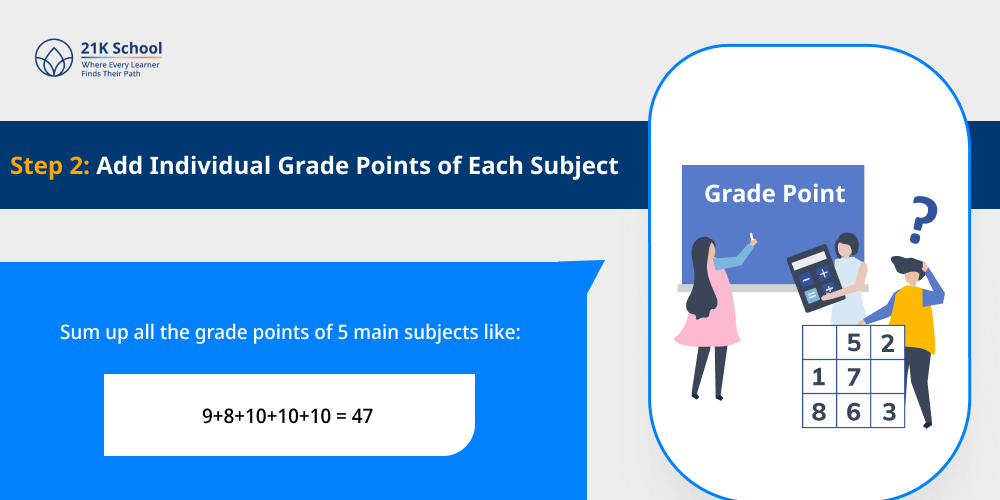
Sum up all the grade points of 5 main subjects like:
9+8+10+10+10 = 47
Step 3: Divide The Sum Total By Five
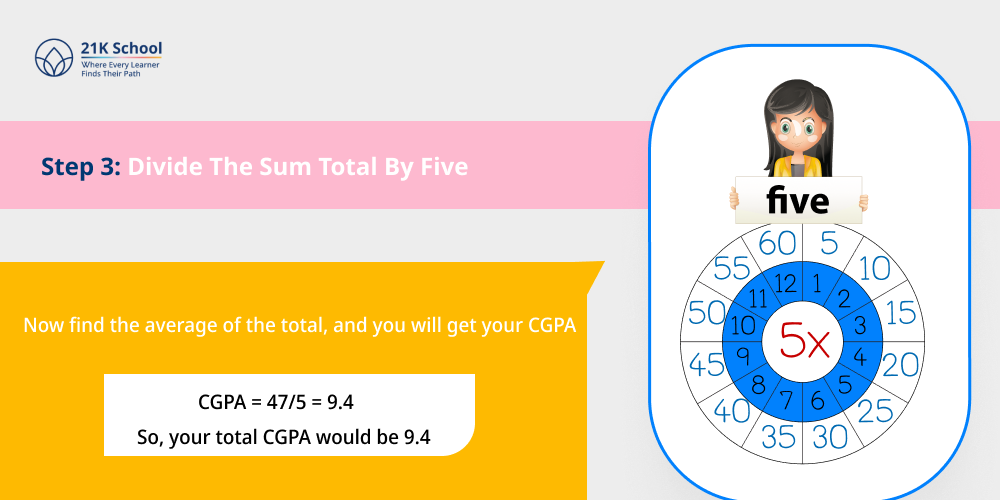
Now find the average of the total, and you will get your CGPA
CGPA = 47/5 = 9.4
So, your total CGPA would be 9.4
CBSE Grade and Grade Point Structure
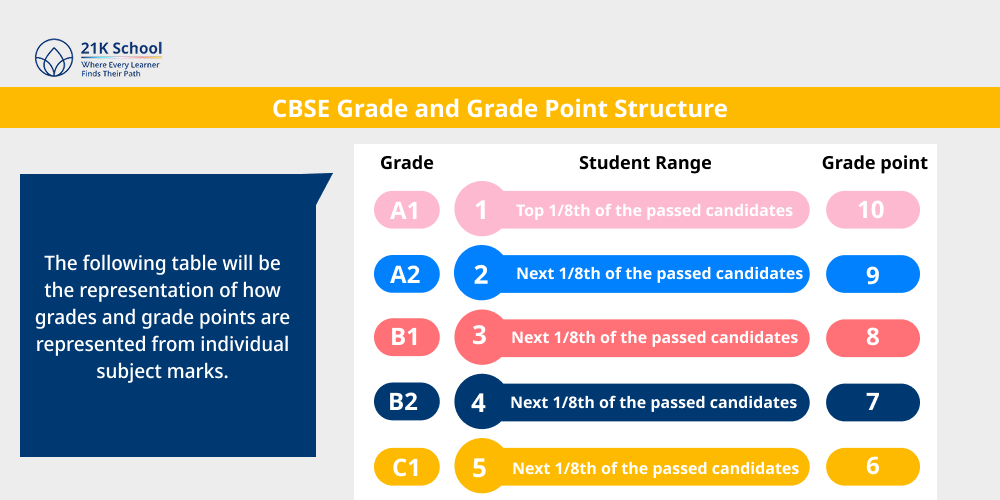
The following table will be the representation of how grades and grade points are represented from individual subject marks.
| Student Range | Grade | Grade Point |
| Top 1/8th of the passed candidates | A1 | 10 |
| Next 1/8th of the passed candidates | A2 | 9 |
| Next 1/8th of the passed candidates | B1 | 8 |
| Next 1/8th of the passed candidates | B2 | 7 |
| Next 1/8th of the passed candidates | C1 | 6 |
| Next 1/8th of the passed candidates | C2 | 5 |
| Next 1/8th of the passed candidates | D1 | 4 |
| Next 1/8th of the passed candidates | D2 | 3 |
| Next 1/8th of the passed candidates | E | 0 |
Important notes about the given table and marking scheme:
- Grades ranging between A1 to D2 have a positive grade.
- E refers to failure and bears no grade points.
- The final grade consisted of practical marks (where necessary).
How to Convert CGPA in CBSE into Percentage?
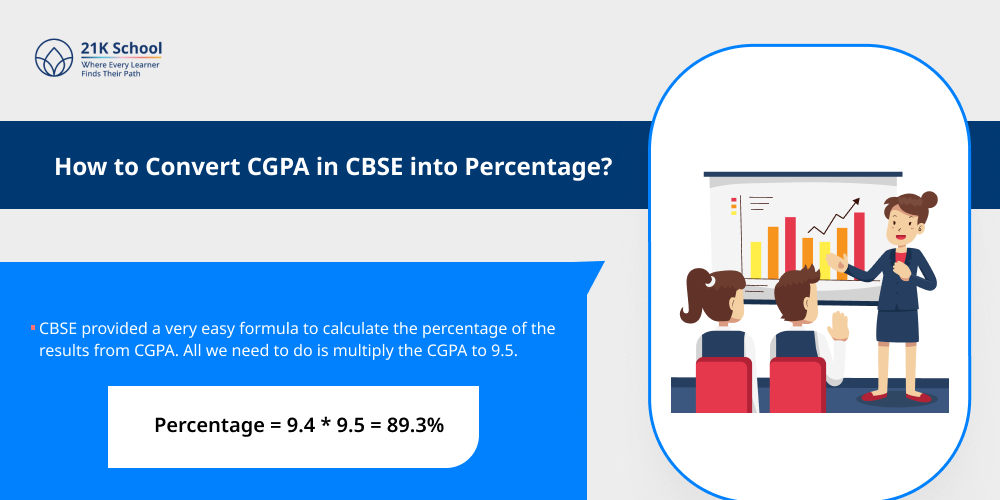
CBSE provided a very easy formula to calculate the percentage of the results from CGPA. All we need to do is multiply the CGPA to 9.5.
Here, for example, our CGPA was 9.4. So, the percentage would be:
Percentage = 9.4 * 9.5 = 89.3%
This conversion factor (9.5) was obtained by means of the average scores of high-tier students in different subjects after several years.
Merits and Demerits of CGPA in CBSE

Similar to any other assessment system, the CGPA possessed both positives and negatives.
Merits of CGPA
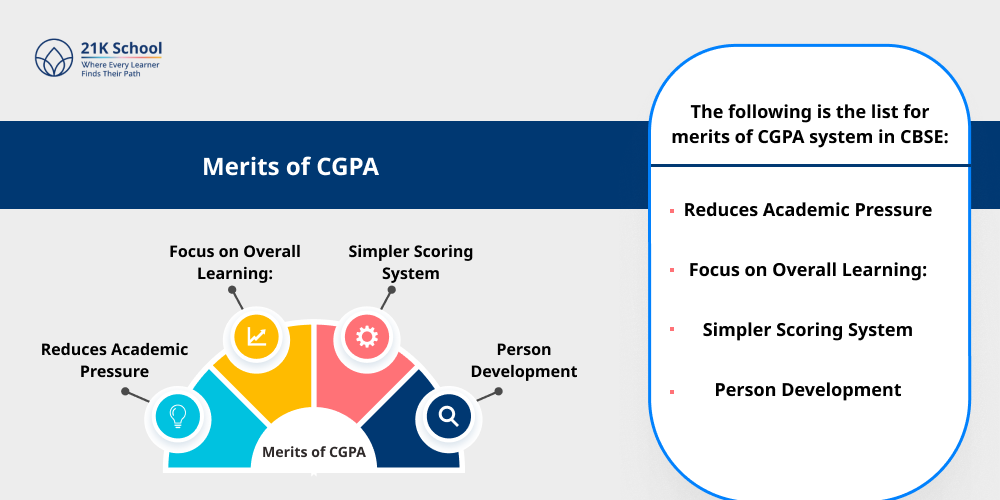
The following is the list for merits of CGPA system in CBSE:
- Reduces Academic Pressure: The students are graded with grade ranges, as opposed to dwelling on specific marks. Due to comparative marking, a student can still score good grades if a paper was difficult.
- Focus on Overall Learning: CGPA promotes ardent learning during the year and evaluates total performance including all the subjects.
- Simpler Scoring System: The overall performance can be easily determined by looking at one numerical value, which is the CGPA.
- Favors Effective Whole-Person Development: Students might spend needed time on extracurricular activities to enhance their personality development with lesser pressure and concentration on marks.
Demerits of CGPA
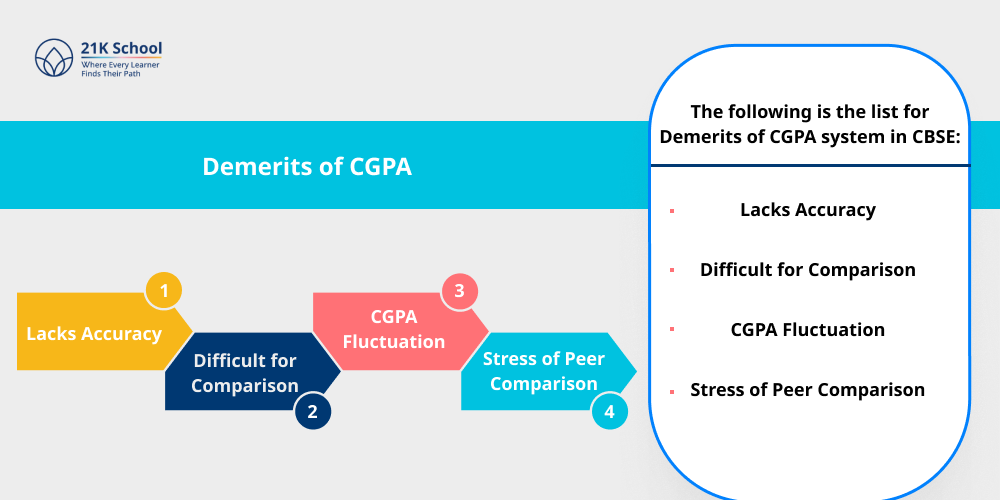
These demerits of CGPA include:
- Lacks Accuracy: CGPA does not show the exact marks because grades are represented for cohort performance. As an example, there is no difference in the results of students scoring 91 and 100, the grades are the same (A1).
- Difficult for Comparison: Academic performances are at times difficult to distinguish between, by students and also by institutions.
- CGPA Fluctuation: Since grading is dependent on collective performance of learners’s ranks, CGPA can hugely vary across subjects and years.
- Stress of Peer Comparison: While exam stress might reduce academically, there would be some thoughts to compare and think “how your mates are doing”.
Conclusion
Though the CGPA system is still practiced by CBSE for now, it is helpful to know how it is operated.
It becomes helpful in case the students have an older marksheet or seeking admission to a place that necessitates CGPA-based results.
CGPA makes it easy, because it averages out the grades in the primary subjects giving a student an overall representation of his or her performance.
The system takes pressure off academically and facilitates holistic development. Though it does not have accuracy and clarity in individual score comparisons.
This step-by-step guide can make a student able to calculate their CGPA or change it into percentage for academic uses.

You may also want to read