


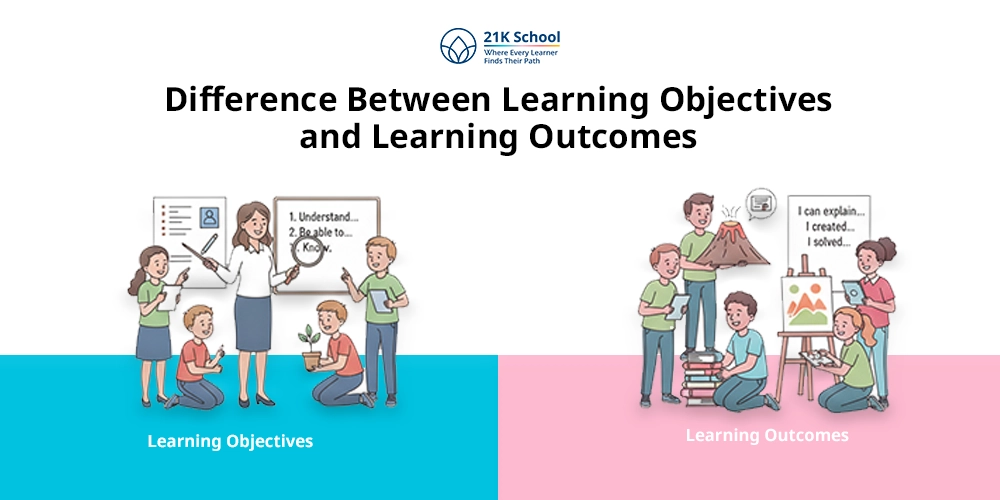
Do you know what the differences between learning objectives and learning outcomes are?
To teach and learn, learning outcomes and learning objectives are two important aspects that one must know in the education profession. The terms, though used synonymously, are, nevertheless, used in different ways, even though they are related to each other during the learning methods .
Learning outcomes are statements of what the students learn and can present after a learning experience, whereas learning objectives are statements of what a teacher wants to teach.
The awareness of the disparity assists the teachers in formulating more effective lessons, gauge the development of the pupils in a more precise manner and be confident that the objective of learning is attained.
Contents
What are Learning Objectives?

Learning objectives are concise statements which inform absolutely what an instructor desires students to obtain in a lesson, unit or course. They indicate what a student knows or is expected to know, or can or cannot do, or think at the end of the teaching.
Learning objectives assist the teachers in designing the lesson, selecting the appropriate teaching technique, and even developing the assessment that is capable of achieving the intended goals.
They are concerned with the teaching method and not the learning outcomes, which provides a direction on the way of teaching. Clear goals bring order, purpose and effectiveness to the lessons in the achievement of the learning goals .
What are Learning Outcomes?

Learning outcomes are expressions that are clear and refer to what is expected of the learner upon completion of a lesson, course or a programme of study.
The results of learning anchor the learning outcomes as opposed to the learning objectives, which are anchored on the teaching intentions. They aid in showing whether the students have acquired the required attitudes, knowledge or skills .
This is because the learning outcomes enable teachers to analyse the performance of the students to assess the students and make sure that educational goals are achieved, and the students comprehend what they need to achieve.
7 Key Differences Between Learning Objectives and Learning Outcomes.

The two important concepts in education are the learning outcomes and learning objectives, where learning objectives are the goals of learning, i.e. what the teacher wants the students to learn during the lesson or course. Learning outcomes and learning objectives vary as follows.
| Aspect | Learning Objectives | Learning Outcomes |
| Meaning | Learning objectives are the statements which define what teachers intend to teach during the lessons or course. They dwell upon the purpose of teaching. | Learning outcomes give an account of what students learn or are able to do upon learning. |
| Objective | Learning objectives are aimed at directing teaching. They assist the teachers in having clear objectives of what ought to be taught. | Learning outcomes seek to establish what students are supposed to be able to do at the end of an instruction. |
| Focus | Learning objectives are based on the didactical process, i.e. planning of the lesson, teaching methodology and the teaching content. | Learning outcomes are student-centred that are concerned with what learners are able to demonstrate, apply and perform after being taught. |
| Measurability | Learning objectives tend to be general and broad enough and therefore they might not be easy to measure directly. They lead instruction but fail to outline specific standards of assessment. | Learning outcomes, on the other hand, are precise and quantitative. They put the clear parameters on what a learner should accomplish and therefore it becomes easy to measure the knowledge level through tests, tasks or demonstrations. |
| Scope | Learning objectives span what teachers desire the learners to learn, either in terms of knowledge, skills or attitudes. | Learning outcomes encompass what students learn in reality and are able to demonstrate at the end of the instruction. |
| Assessment | Learning objectives assist the teachers in formulating assessments and instructional activities in accordance with the instructional aims. | The evaluation of learning outcomes takes place in the form of tests, assignments, projects, presentations or demonstrations. |
| Example | To take an example, students can learn about the notion of fractions and the knowledge of simple operations with them. | As an illustration, the students can solve addition, subtraction, multiplication, and division problems of fractions correctly. |
1. Meaning

Learning Objective: Learning objectives are the statements which define what teachers intend to teach during the lessons or courses. They elaborate on the plan of teaching and act as a teaching guide.
Learning Outcomes: Learning outcomes, in their turn, are statements which identify what students actually achieve or can show by the end of learning.
2. Objective

Learning Objective: Learning objectives are the most important in the direction of teaching. They assist a teacher in lesson planning, choice of strategies to be employed in teaching and planning the content in a proper way. Goals are teacher-oriented as it is what the teacher would want to provide.
Learning Outcomes: Learning outcomes, on the other hand, are student-centred and they are concerned with what the students can do at the end of learning. They also think about the success of the teaching since they give the outcome of the teaching in terms of the student achievement, acquisition and mastery of a skill, which aids in the evaluation of the outcome of teaching and learning.
3. Focus

Learning Objective: Learning objectives refer to the problems of instruction. They also underline what the teacher would like to discuss, what mode of instruction is to be applied and what points are to be raised. This makes lessons impactful, planned and in line with the learning objectives.
Learning Outcomes: Learning outcomes, on the other hand, are associated with the performance of the students. These are measures of the provable, that could be done or implemented by the learner after the instruction and such teaching should be in a position to ensure that there are meaningful, visible and quantifiable outcomes on what a learner knows, can do and learn.
4. Measurability

Learning Objective: Learning objectives can be general and broad; they give the guidelines of how the teaching is to be, but it does not always imply that they will be measurable. They are some kind of guideline of what the teachers are supposed to do, not a literal means of evaluating the results. Learning outcomes, in their turn, are specific, observable and measurable.
Learning Outcomes: The learning outcomes can be tested through exams, assignments, projects or even demonstrations, and therefore it would be easy to determine the success of the teaching process and the level of learning that the students have acquired.
5. Scope

Learning Objective: Learning objectives give the depth of what the learners are supposed to learn, i.e. what the teachers want to know, learn or be able to do. They serve as a source of lessons and teaching planning.
Learning Outcomes: Learning outcomes, in their turn, are statements defining what learning involves, what the students actually learned and what they can demonstrate.
6. Assessment

Learning Objective: Learning objectives facilitate the teacher in the planning of the teaching activities, lessons and assessments. They make sure that they are not the subject of evaluation and are centred on the objectives of teaching in the education sector.
Learning Outcomes: Learning outcomes, on the other hand, are measured to determine what has been accomplished by the students. The evidence presented in the form of tests, projects, assignments, presentations or practical knowledge can be used to assess learning outcomes.
7. Example

Learning Objective: The examples of learning objectives are that students shall be familiar with the principles of photosynthesis. It mentions the purpose and goal of the teaching, but does not show any quantifiable success.
Learning Outcomes: Some of the learning outcomes include the students being able to describe the process of photosynthesis, as well as name the key stages of it in the right sequence.
Conclusion
Realisation of the distinction between a learning outcome and a learning objective is one of the key concepts that can maximise effective teaching and learning. Whereas objectives are concerned with what the teachers wish to teach, the outcomes are concerned with what is accomplished by the students.
Specific goals inform lesson planning, and outcomes actually indicate the quantifiable indication of learning.
The combination of these will ensure that there is valuable learning practice between the teachers and the students through deliberate student-centred learning and self scaffolding learning .
