

Students have to study at many levels to actually reach where they really want. But still, among all of them the intermediate level of education is most crucial.
Intermediate education is the first step for deciding someone’s professional future.
After matriculation, in intermediate education, individuals decide their choice of stream and then their path ahead.
In this article, we will learn more about intermediate education, its structure, objectives, and significance.
Contents
What is Intermediate Education?
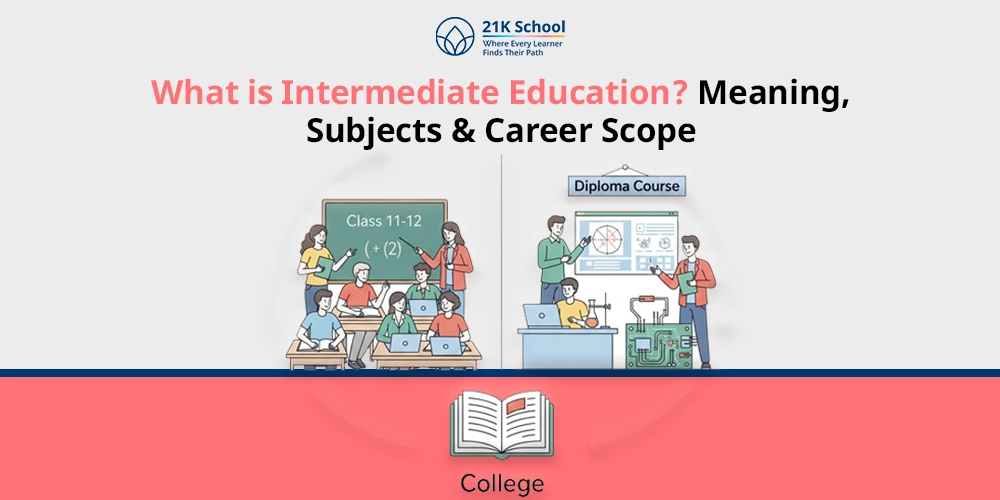
Intermediate education is the education given in class 11-12 in schools or diploma courses after class 10th.
It follows the 5+3+3+4 system of education and is also called senior-secondary or higher-secondary education in varied states.
The main goal of this level of education is to prepare children for the future higher education.
At this stage, learning is more specialised as compared to secondary education.
Students have to select a certain stream or subject combination based on their interest, talents, and career objectives.
Intermediate level is a course that equips students for university education or some professional course.
Intermediate education serves as a level of transition, which helps the students to get out of the general school education into a more specialized and advanced learning.
It offers more profound conceptual knowledge , makes one think critically, and develops intellectual maturity.
It is also an important step that helps students realize what their strengths and interests are, so they can make an informed choice of their future academic and career directions.
Structure of Intermediate Education
Intermediate education is formed by the following structure:
1. Streams of Study
Intermediate education comprises of 4 main streams of education that offer different varieties of career options ahead in life:
- Science Stream: Children interested in science stream choose subjects like Physics, Chemistry, Biology, and Maths. These subjects enable them to become doctors, engineers, scientists, etc.
- Commerce stream: The main subjects that students study in commerce stream is to understand business, taxes, interests, and accounts. Children who enjoy Business studies, Accountancy, Finance-management, and other commerce related subjects are best for this stream.
- Arts or Humanities Stream: The Arts and Humanities stream are mostly related to human civilization, living styles, languages, psychology, history, geography, etc. Therefore, students who want to do good in civil services or choose other interesting subjects can choose this stream.
- Vocational Stream: Vocational courses offer skill-based education for a particular trade or profession including hospitality, artificial intelligence, sales, IT, and agriculture.
2. Curriculum and Subjects
The curriculum of intermediate education is more advanced and comprehensive in comparison to that of secondary education.
It favors concept clarity and subject mastery. Learners spend time on more intricate academic matters, and they have an opportunity to develop a solid academic basis.
This curriculum covers theoretical learning, practical work, laboratory work, projects, and assignments.
Such practice and theory allow students to understand the subjects better and equip them with more academic challenges.
3. Assessment and Evaluation
The assessment that is commonly done in inetrmediate education consists of standardized end-term exams and internal assessments.
At last, students give board exams whose questions are designed by CBSE and other significant boards in India.
Such tests do not just measure academic knowledge, but also practical expertise, analytical skills , and concept application.
The outcome of intermediate examinations is important for college, university, and professional courses admissions, hence this is an important phase.
Objectives of Intermediate Education
Intermediate education has the following goals:
1. Academic Preparation
Academic preparation for higher education of students is one of the main aims of intermediate education.
It reinforces the knowledge of the subject and builds intellectual skills necessary to study at a university level.
2. Career Orientation
The intermediate education assists students in experimenting with various career options and know what is needed in various professions.
Subject selection and guidance help students to make career-related decisions that influence their future.
3. Skill Development
At the stage of intermediate education, students acquire very important skills which include critical thinking , problem-solving , communication, time-management , and study skills.
These skills are important in the academic field as well as life.
4. Personality Development
The intermediate education is applies to general personality development of the students.
It promotes self-confidence, responsibility, discipline , independence, and emotional maturity.
5. Social and Moral Development
The interaction between the students and peers, teachers, and society helps them to acquire social awareness, ethical values, teamwork , and responsibility towards the society.
Importance of Intermediate Education
The following are the importance that intermediate education has:
1. Bridge Between School and University
Intermediate education acts as a bridge between schooling and higher education.
It helps to train the students psychologically and academically to meet the greater demands of university life.
2. Foundation for Professional Courses
Professional subjects like engineering, medicine, law, management, and teaching need a good level of knowledge on an intermediate level.
Intermediate education is one of the most significant factors that determine success in such fields.
3. Career Decision-Making Stage
Intermediate education is an important stage for career decisions.
Students are asked to take streams and subjects that would directly affect their future possibilities.
Guidance at this level can assist one to avoid confusion and wrong choices made in career.
4. Human Resource Development
Intermediate education also helps in the creation of qualified, well-trained, and disciplined students who would be required in the economic and social growth.
5. Encourages Specialization
Intermediate education promotes specialization as opposed to the other primary levels of education.
The students specialize in certain subjects to gain a deeper understanding of subjects and competence.
Concluding Comments
Intermediate education is a crucial point where students design their future pathways and professional choices.
In case at this stage, students don’t get proper guidance or choose streams that their friends choose, they can land on future jobs that they might regret later.
Intermediate education has end-to-term exams and assignments and after clearing them you can choose your specific subject for higher education.
Therefore, parents and teachers should let students make mindful decisions at this stage of career.

You may also want to read