

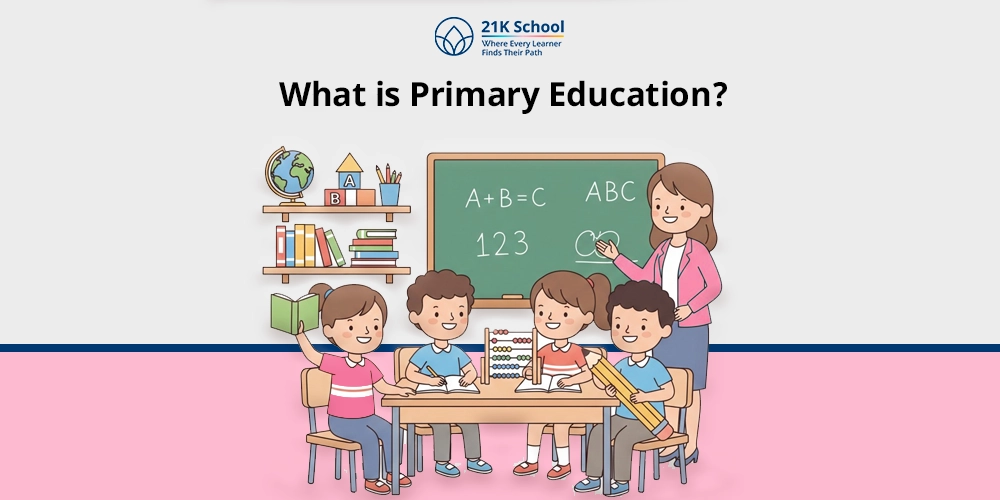
Have you ever wondered what primary education is, keeping in mind the requirement of early development?
Primary education is the first stage of formal education that provides children with academic as well as social skills.
It gives a focus to basic literacy, numeracy and problem-solving and promotes curiosity, creativity and discipline.
The stage assists children to acquire values, communication and teamwork, which form the basis of further learning. Through cognitive, emotional and social development, primary education is preparing students to take up higher education , personality development, as well as the challenges of life in the future.
Contents
What is Primary Education: Definition

Primary education is the first formal education level and is normally given to children aged between 5 and 12 years, and focuses on basic literacy and numeracy as well as general knowledge .
It also aims at fulfilling the intellectual, social and emotional skills and instilling values, discipline and inquisitiveness.
The elementary education equips the children with the advanced learning, problem-solving and creative and makes children to be capable of communicating with other people effectively which makes them grow and enables them to achieve lifelong learning .
Primary Education in India: Educational Structure

The Indian education system is also properly organised in the primary education to allow the establishment of good academic basics. It is further divided into lower and upper primary, thus ensuring the age-related learning and gradual growth of the mind.
1. Lower Primary: Classes 1-4

The lower primary education (Classes 1 -4) is provided in India, and it is related to the acquisition of the basic skills in reading, writing and arithmetic. It is also concerned with familiarisation of fundamentals, language and socialisation and encourages inquisitiveness and innovation.
This step rounds the children into the routine of studying , and they are accustomed to higher-level grades, and they fit into being a productive component of the school life.
2. Upper Primary: Classes 5-8

Classes 5-8 are the upper primary education, which is likely to expand the knowledge acquired in mathematics, science, languages, and social studies, among others. It accumulates the analysis, problem-solving skills and self-directed learning.
It also offers students extracurricular activities , project education, appreciation and teamwork, where students are willing to take the next step to secondary education and enable personal, social and academic growth.
3. Part of RTE Act Coverage

In India, primary education is also a legal right provided by the Right to Education (RTE) Act , 2009, which provides free and compulsory education to children between the ages of 6 and 14 years.
The Act has brought about accessibility, educational equity and quality in schools, compulsory enrollment, compulsory attendance, and compulsory standards in infrastructure and aims at ensuring that no child is deprived of his or her basic rights to education.
Subjects Taught in Primary Education

Primary education incorporates a well-balanced number of subjects that help in academic learning as well as general development.
The topics enable the children to have a basic base knowledge, gain interest and acquire necessary skills in life and social interactions. The topics covered in primary education can be examined below.
1. Core Subjects

The basic sciences, writing, mathematics and reading are some of the core subjects that are taught in the primary schools. It is on these subjects that learning occurs and children are taught the fundamental skills expected of them, such as the skills of literacy, numeracy, skills of observational and critical thinking skills .
Fundamental learning of the core subjects equips the students with knowledge of advanced education, as well as being aware of the fundamentals needed in life and problem-solving.
2. Elective Subjects

Elective subjects are discretionary courses to which a student can make a choice on whatever they are interested in, e.g. a second language, computer basics, art, etc.
Such courses are flexible in learning , allow one to explore his or her talents, and acquire other skills, creativity, and cultural sensibility beyond the basic academic coursework.
3. Co-curricular Subjects

The activities that accompany the academic courses also include co combination of activities like sporting activities, music, dance, debates and arts that are found in co-curricular subjects.
They promote the overall growth, enhancing physical condition, social skills, teamwork, discipline and self-respect. Co-curricular activities also help the children to investigate their interests, express themselves and have a balanced personality other than their studies.
Importance of Primary Education

Primary education is crucial in developing the future of a child since it develops basic knowledge, skills and values. It provides the base for academic achievements, personal development, and being an important member of society. Here, you can check the significance of primary education.
1. Reduces Educational Inequality

Primary education offers basic education to every child regardless of their backgrounds.
It enables bridging the gaps among different classes of people through the provision of free and compulsory education, which brings about equality, inclusion and access to education that can make any child succeed in his/her academic and social life.
2. Economic and Social Benefits

Primary education prepares children with the necessary skills and helps them be better employed in future.
Learned people enhance economic growth, social and community health, create informed citizens, less poverty, and better livelihood.
3. Prepares for Secondary Education

Primary education prepares the way to higher learning by introducing the major subjects, the habit of studying, and the ability to solve problems.
It is used to make sure that the students are academically, socially and emotionally prepared to tackle the expectations of secondary education.
4. Builds Basic Literacy and Numeracy

Children learn important skills in reading, writing and arithmetic through primary education.
Literacy and numeracy are the foundation for additional educational experience, activities of everyday life, and communication skills , allowing children to interpret knowledge, handle problems, and engage efficiently in society.
5. Cognitive Development

Primary education promotes cognitive development of children by provoking thinking, reasoning, and memory due to the organised learning process.
It also improves concentration of kids, problem-solving skills and decision-making skills , and children build intellectual capacity that is vital in lifelong learning.
6. Holistic Development

Primary education brings about general development since it embraces the studies, social development, physical education, and arts.
It enhances emotional, moral and social developments, fosters confidence and collaboration , discipline and equal personalities among children.
Objectives of Primary School

Primary schools are aimed at creating a strong foundation in education and character development. Their objectives focus on the academic growth, skills, character and turning the children into responsible and capable persons. The primary education aims are as below.
1. Academic Excellence

The elementary schools are oriented towards establishing a solid ground on the elementary subjects such as reading, writing, mathematics and science.
In creating awareness on the children of the simple concepts, critical thinking and mastery of the learning method , the academic excellence would ensure the children are ready in future to meet the challenges of learning and value knowledge in learning.
2. Character Development

The intended values that should be inculcated at primary education include honesty, discipline, empathy and respect.
The children are instructed on ethical behaviour, social responsibility and moral judgement through the use of direction, activities and the role model, and the personality formation assists a child to be raised as a righteous and ethical person.
3. Skills Acquisition

Primary schools provide the student with the knowledge that is needed in life, such as communicating, problem solving, teamwork and decision making.
They allow children to manage their everyday life, to have the possibility to communicate and to adjust to the new circumstances, to be self-confident and competent in practice at a very tender age.
4. Develops Academic Skills

The primary education is based on numeracy, reading, writing and analysis and observation.
It fosters curiosity, experimentation and logical thinking, the foundation of higher education and lifelong learning, and raises the ability to understand and apply knowledge effectively.
5. Makes Responsible Citizens

The primary schools can enhance civic knowledge and social responsibility, and obedience to rules and society.
The children are also taught to be responsible, empathetic, and participatory through values, cultural awareness, and teamwork, and hence making them responsible members of society.
Government Initiative to Promote Primary Education

Government programmes are very important in enhancing primary education by making it accessible to both equity and quality learning .
The programmes would be used to enhance enrollment, minimise dropouts, and facilitate holistic development in every child. The government initiatives towards encouraging primary education are the following.
1. Right to Education (RTE) Act 2009

The RTE Act 2009 has rendered education free and mandatory to all children between the ages of 6 and 14 in India.
It guarantees access, enrolment, attendance and quality education and fosters equity, non-discrimination and standards of infrastructures. The Act is intended to give all kids a chance to pass through primary education.
2. Sarva Shiksha Abhiyan

Sarva Shiksha Abhiyan (SSA) is the flagship programme that has been initiated in order to attain universal elementary education.
It is also oriented on enrolment growth, decreased school dropout, better infrastructure, teacher training and learning outcomes, especially among the underprivileged children and the marginalised communities.
3. Mid-Day Meal Scheme

The Mid-Day Meal Scheme is a free lunch scheme provided to the students of the government and the government-aided schools.
It improves the nutritional status, attendance and reduces the drop-out rate, and improves education since the health status of the children is taken into consideration, thus allowing the children to invest themselves to learn.
4. National Education Policy 2020 Provisions

The National Education Policy 2020 is also oriented towards delivering good primary education, early childhood care, basic literacy and numeracy to all children.
It promotes interdisciplinary learning, holistic learning, digital learning , integrated classrooms, and skill-acquisition in order to restructure primary education to be fairer and more interactive and responsive to the 21st-century learner.
Conclusion
The first pillar in the child-centred learning process is primary education that determines intellectual, social and emotional developments. It also possesses access to basic literacy, numeracy and life skills, besides values, discipline and overall development.
Primary school lessens the disparity, and individuals are empowered, and the society and the economy advance as the children are taught to learn in high school and throughout their lives.
The presence of the government, its works and policies also make it better in the quality and inclusiveness which are demanded in the creation of efficient and responsible citizens, as well as well-adjusted individuals.

You may also want to read