

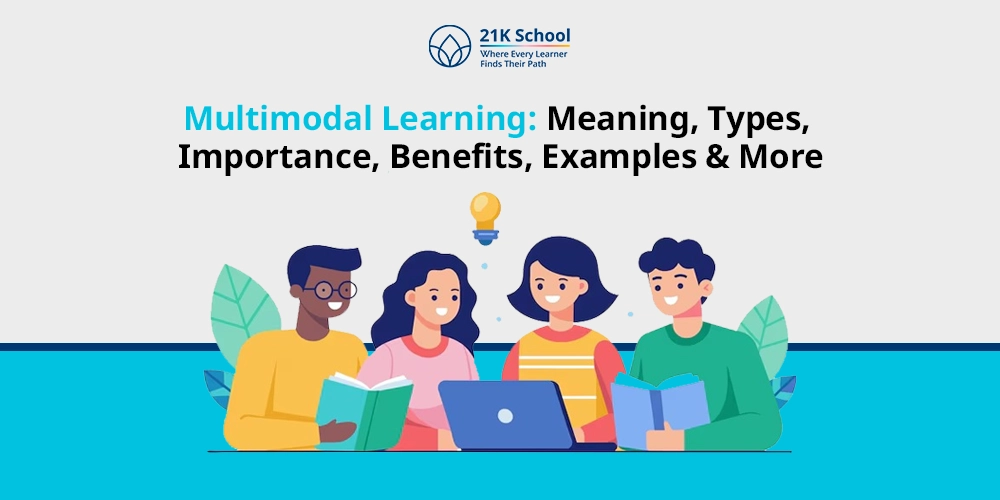
Have you ever thought about how multimodal learning is the best way to meet the diverse needs of the students?
Students receive information in a variety of ways in the current diversified learning environments. The use of one teaching method usually leaves some learners behind. Multimodal learning provides an answers to this problem in terms of the creation of more inclusive and all-encompassing learning methods.
Images, discussions, reading, technology, and practical activities can be combined to draw attention and improve the level of understanding when used by the teachers. This approach is more interactive, practical and suitable for students of different ages and levels of education.
Contents
What is Multimodal Learning?
Multimodal learning refers to a teaching approach which involves multiple approaches to deliver information and help students learn. It does not rely on a single format in conveying the information but involves the combination of the application of visuals, audio, text and practical activities in ensuring that the learners understand concepts more.
This approach recognises the fact that individuals possess varied learning styles, and they best flourish using varied approaches in instruction.
Multimodal learning enhances the processes of understanding, memorising, and involvement in both the physical and online learning spaces through the use of multiple senses.
Types of Multimodal Learning
Types of multimodal learning explain how various modes of learning can be integrated in order to accommodate different learners, increase interaction and increase comprehension by using visual, auditory, reading, writing, and practical means of learning. The forms of multimodal learning are as follows.
1. Dual-Modal Learning
Dual-modal learning integrates two types of learning, e.g. visual and auditory or reading and kinesthetic learning.
This style aids the learners to process the information better, since through this method, the learners remember the concepts more effectively as they are reinforced by more than just one of the senses to enhance their learning and memory at the same time, without confusing the learners with excessive learning inputs.
2. Tri-Modal Learning
The tri-modal learning involves three forms of instruction, such as the visual, audio, and writing/reading.
It offers a balanced learning process which entails the use of multiple senses, which allows the learner to perceive concepts in different angles and makes the learning processes to be more interactive, structured and understandable to learners who have different learning preferences.
3. Full Multimodal Learning
Combining all four major learning styles, which are visual, auditory, reading/writing, and kinesthetic, is whole multimodal learning.
This holistic approach would offer an inclusive learning environment where learners would have more means of engaging with the material, and this would allow a greater understanding, retention and an increased involvement of the learners with different learning capabilities.
4. Digital Multimodal Learning
Digital multimodal learning relies on technology, i.e., videos, interactive applications, podcasts, simulations, and online aids.
It enables learners to acquire information in different digital forms, enables learning flexibility and improves student engagement by integrating multimedia tools, interactive and personalised learning experiences.
5. Traditional Multimodal Learning
Classroom learning techniques such as lectures, textbooks, discussions, images, hands-on activities, etc., are taken into account in traditional multimodal learning.
The strategy upholds the various learning styles without necessarily being too technological, therefore, complementing the learning lessons that are more interactive, systematic and efficient in the face-to-face learning process.
Importance of Multimodal Learning
The concept of multimodal learning is applicable because it optimises student engagement, motivation, problem-solving skills, practical learning, flexibility and comprehension, which leads to more inclusiveness and efficiency in the process of learning among all learners. These are the significances of multimodal learning.
1. Increased Student Engagement
Multimodal learning draws the attention of the students because they are given information in different forms, which include images, discussions, activities and technology. This diversity makes it less boring and more participatory.
The more the learners are involved in the process using the various senses, the higher the chances of remaining focused, being interactive and contributing to the process of learning significantly.
2. Better Motivation
Multimodal learning helps students have confidence and feel more at ease since they are offered alternative learning methods.
The learners have the opportunity to apply the methods that they find comfortable, which lowers the frustration and anxiety. This feeling of power and achievement promotes motivation in education, curiosity and the desire to become an active participant in the learning process.
3. Better Problem-Solving
Multimodal learning empowers problem-solving skills because it enables learners to look at a problem from different perspectives. The visual and discussion, reading, and practical work allow a student to analyse information, test their ideas, and reason.
This diversity promotes critical thinking and allows a learner to come up with effective, innovative solutions to complex problems.
4. Real-World Application
It is a learning approach that involves applications of real-life events to real-life studies through real-life activities, simulations, case studies, and group work. Multimodal learning assists the students in acquiring theoretical knowledge in the real world situations.
This translates into practical skills acquired by the learners, improved decision-making skills as well as the learners having a better idea of how the concepts might work when they are not in the classroom.
5. Flexibility
The other way multimodal learning can be said to be flexible is that it can accommodate various learning abilities, style and speeds. Students are able to learn using the best modes, which may be reading, listening, observing, and doing.
This flexibility enhances learning among different learners in different learning environments.
6. Enhanced Comprehension
Multimodal learning strengthens comprehension and enhances knowledge retention because the information is presented in more than one format.
Different channels allow learners to process the same concept in order to help them clarify challenging ideas. This repetition in modes enhances memory, builds understanding and achieves success in long-term learning.
Multimodal Learning Style: Understanding the VARK Framework
The VARK model clarifies that multimodal learning can serve other types of learning styles to enhance the knowledge acquisition, interest and retention of knowledge in visual, auditory, reading/writing and kinesthetic modes of learning. The VARK model conssist the following.
1. Visual Modality
The visual modality is based on images, diagrams, charts, video, and graphs. Students can comprehend information better when they can observe patterns, relationships and pictorial representations.
The visual aids not only make the difficult concepts easier and faster to learn but also to remember, and help the ability to understand the abstract concepts in the lessons or presentations.
2. Auditory Modality
Explanations, discussions, lectures, podcasts, or audio recordings are the most important ways through which students learn.
Learners who require information to be remembered by their sound, tone, and verbal learning are supported by this modality, and therefore, discussions and storytelling are effective in learning information.
3. Reading/Writing Modality
The modality of reading/writing focuses on the written word-based learning. Students prefer reading textbooks, articles and notes and writing summaries, essays, and lists.
This method enables learners to process information with the help of the text, enhance understanding, and strengthen knowledge through structuring the ideas in written form.
4. Kinesthetic Modality
The kinesthetic modality emphasises movement and practical experiences for learning. Students learn more through doing activities, experiments, role-playing or by practising in life.
Exercise enables them to connect theory with practice, and learning will be more vivid and effective since it will be directly involved.
Benefits of Multimodal Learning
Multimodal learning has various strengths, including improved retention of knowledge, improved accessibility, increased levels of confidence, critical thinking, simplification of complex subjects, and improved memory, which enable the various learners to acquire a higher level of knowledge and engagement. These are the benefits of multimodal learning.
1. Enhance Knowledge Retention
Multimodal learning enhances the retention of knowledge since there is a combination of information presented in various formats, i.e. visuals, audio, text and hands-on activities.
The brain forms stronger links when the learners are presented with the content in varying ways. This repetition makes information more permanent in the memory and makes remembering concepts easier upon assessment or in the real world.
2. Better Accessibility
The instructional model is helpful to students who may have different abilities, backgrounds, and learning requirements. Multimodal learning eliminates obstacles for those learners who might be poor learners using conventional methods, given that there are numerous means of accessing information.
It generates accommodating environments in which learners have the opportunity to use formats in which they excel effectively to enhance comprehension and engagement.
3. Boost Confidence
The multimodal learning mode creates confidence because the learners are free to peruse the material at their own pace. Students are more successful when they comprehend concepts in a mode of their preference.
This will minimise frustration, motivate the involvement of participation and make the learners have a positive attitude towards learning and their abilities.
4. Promotes Critical Thinking Skills
The variety of learning modes would stimulate analysis, comparison and application of information in learners as opposed to memorisation. Visuals, conversations, reading, and practical activities will help the students think and draw conclusions.
The approach improves the ability to reason and think critically and prepares the learners with the skills to solve complicated academic and real-life problems.
5. Makes Complex Subjects Easy
Multimodal learning simplifies complicated issues since they are broken down into simpler ones. Concepts are explained by means of some graphical illustrations, any uncertainty is explained by discussion, and exercises are taught.
Such a scaffolding technique helps the learners to comprehend difficult concepts with less effort and relieves the burden on the brain, therefore making the difficult subjects less burdensome and understandable.
6. Boost Memory
The use of several senses improves memory by boosting brain connections. Memorisation is easier when the learners read, hear, see and practise the information.
Multimodal learning aids long-term memory because the concepts trained in the various modes are reinforced, and the learners recall the information correctly when the need arises.
Examples of Multimodal Learning
Multimodal learning involves different approaches to explore the learners by incorporating various senses. They are gamification, multimedia projects, case-based learning, collaborative learning, and personalised journals, among others, which is why education has become interactive and more effective. The following are examples of multimodal learning.
1. Gamification
Gamification employs the use of game elements to make the learning inclusive (points, levels, quizzes, challenges, and rewards). It involves visual images, hearing, reading, critical thinking, and real-world activity.
This method adds motivation and interest and assists the learners in learning by participating actively, competing with one another and immediately receiving feedback in the digital and classroom learning platforms.
2. Multimedia Research Projects
In multimedia research, learners explore a topic by using text, images, videos, audio and presentation. Students study, examine and report information in various formats.
The methodology promotes the various styles of learning, improves creativity, refines communication skills, and enables learners to acquire a better comprehension by incorporating diverse approaches in the creation of content.
3. Case-Based Learning
Case-based learning presents real-life scenarios to be learned and solved by learners. It is a combination of reading case materials, group discussions, visual information, and practical decision-making tasks.
The method encourages critical thinking, problem-solving, and theoretical theory to practice and helps learners in the process of applying the academic concepts to real-life situations and practice to the profession.
Think-Pair-Share is a cooperative learning technique where a student is asked to think individually and then discuss with a partner and, in the end, with the class
It is a combination of reflection, speaking, listening and in other cases, writing.
This type of multimodality encourages active learning, enhances communication, and allows learners to polish their knowledge by discussing it and receiving feedback about it.
5. Personalised Journals
Personalised journals enable the learners to reflect in writing, drawing, diagrams or digital media. Students give knowledge in their language of expression, where reading, writing and thinking are used to give an understanding.
This strategy promotes self-reflection, enhances learning, and assists teachers in perceiving the progress of individuals, as well as inviting them to learn more about themselves through interacting more with content.
Challenges in Multimodal Learning
Although multimodal learning has numerous advantages, it also has issues. The process of implementation can be complicated and sometimes difficult when considering factors such as time, resources, technology, assessment and personal learning preferences by educators. The challenges of multimodal learning are provided below.
1. Time Consuming
The time of planning and execution in the implementation of multimodal learning can be very time-consuming. Educators must ensure that they have materials in various forms, including graphics, audio and practical tasks.
The additional planning may drag out the delivery of the lessons and take up more classroom time, which will make it difficult to address all the curriculum issues in an effective manner.
2. Technical Issues
Digital multimodal learning is based on technology, which may meet some problems with software failures, the internet or some incompatibility of devices.
These issues interfere with the lesson, impede access to the learning materials and can frustrate students and teachers, making the multimodal approach less engaged and effective.
3. Resource Constraints
Multimedia equipment, printed materials, software or laboratory materials are other resources that are normally needed to assist multimodal learning.
These facilities may not be affordable for schools with low funding, and because of this, the application of multimodal strategies may not be applied comprehensively, and this leaves a gap between the learning experiences of the different students.
4. Assessment Complexity
The evaluation of the students in a multimodal setting can be an issue since there are various modes of learning existing. Conventional tests might fail to identify skills acquired during a discussion, project, or practical work.
It takes good planning and imagination to be able to design just, all-inclusive assessments that indicate the results of learning in all modes.
5. Lack of Teacher Training
The achievement of multimodal learning relies on the knowledge of teachers about the effective implementation of multiple modes.
Educators can be unaccustomed to using visuals, audio, practical activities or digital learning tools without appropriate training and make the approach less effective, as well as possibly confusing students instead of making the learning process more productive.
6. Not Suitable for Everyone
It is possible that some learners are overwhelmed by several modes of instruction or would rather be in a single modality of learning.
Attention problems, sensory sensitivities, and students who prefer one style of learning can be distracted by multimodal learning, thus not being effective for all students.
Conclusion
Multimodal learning is an active and accommodative strategy that accommodates the needs of different learners since it involves the use of several senses and styles of learning.
Visual, audio, text, and hands-on activities make it more effective in increasing the level of understanding, retention, and critical thinking.
Although it is accompanied by challenges such as time, resources, and technical requirements, it is an important tool in contemporary education due to its benefits when it comes to motivation, engagement, and practical application.

You may also want to read