

Have you ever thought how critical pedagogy has changed the entire teaching and learning process?
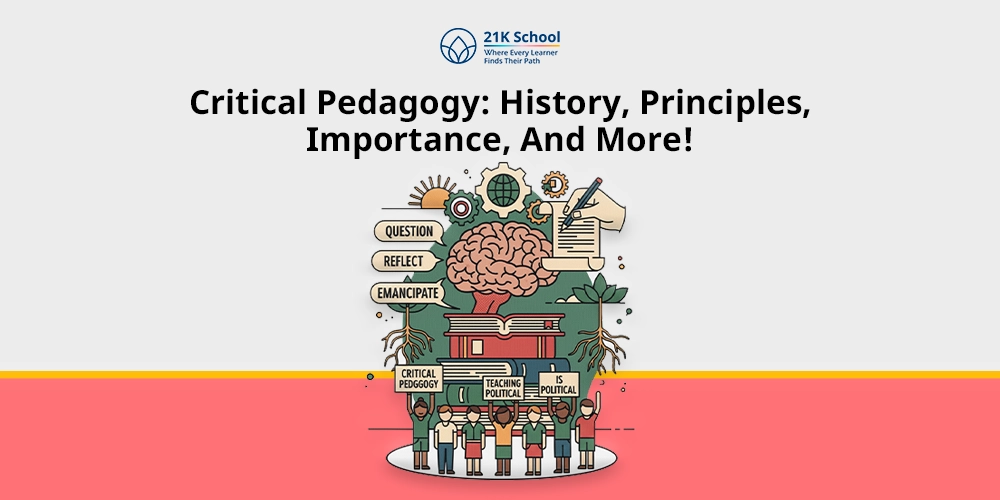
Critical pedagogy is a teaching/learning philosophy which views teaching and learning as a political practice. It relies on the effort of Paulo Freire, who denounces the conventional system of education that puts students in the position of passive consumers of knowledge.
In its place, critical pedagogy facilitates questioning the most dominant forms of power and encourages learners to reflect on their social reality, along with being participants in the knowledge production process.
Critical pedagogy aims at letting students acknowledge the unfairness and take action in transforming their communities, through bridging the classroom learning with the social, cultural, and economic issues of the greater world. Last but not least, it is set to not only inform, but also emancipate so as to build up critical consciousness and promote education as practice of freedom.
By this, critical pedagogy is not only concerned with what happens in the classroom, but it represents a call to justice, equity and human liberation. It is a challenge to educators and students to consider education as a process of equipping them with the means to live, as well as to make the world a better place.
Contents
What is Critical Pedagogy?
Critical pedagogy is a type of education which views instruction and instruction as directly tied to the aspects of power, justice, and social change. It also says that education is never neutral; schools are more likely to reflect what is presented in society and uphold it.
This is criticised by critical pedagogy, which asks students to learn to think about the power structure of their own lives and community, and to provide students with the ability to think about and transform injustice.
Critical pedagogy is the result of the contribution of Paulo Freire, especially of his book Pedagogy of the Oppressed, which is concentrated in dialogue, critical thinking and reflection.
It does not reduce students to passive consumers of information since it would cause them to be active participants to add value experiences and perspectives to the learning method .
History of Critical Pedagogy
The history of critical pedagogy could be traced to a set of social, philosophical and educational inclinations that questioned existing points of power within society and education.
Its early origins can be equipped with the Marxist theory, which revealed the problems of inequality of classes and the strength of ideology and with progressive educators like John Dewey, who proposed democratic learning processes and experiential learning .
The Frankfurt School theorists, such as Adorno, Horkheimer and Marcuse, also contributed to this philosophical schooling; their critical theory examined the position of cultural institutions in aiding domination. Critical pedagogy, which was formalised in that way in the 1960s and 1970s, started with the work of Brazilian educator Paulo Freire.
1. Early Influences (19th to early 20th century)
Before the development of critical pedagogy as a subfield, a series of intellectual traditions were its precursors:
Karl Marx and the Marxist theory focused on the ideology, inequality and struggle of classes, which were later applied to the educational thinkers.
John Dewey was the spearhead of progressive education that supported social betterment through experiential education and learning, and democratic classes.
The Frankfurt School (Adorno, Horkheimer, Marcuse) introduced a critical theory and examined how culture, institutions and knowledge support power. Their work provided the philosophical basis for the follow-up criticism of the educational systems.
2. Paulo Freire: The Birth of Critical Pedagogy (1960s-1970s)
Critical pedagogy as a concept came into official existence thanks to the efforts of a Brazilian educator by the name Paulo Freire, who taught the poor and the marginalised communities.
His most popular Book was Pedagogy of the Oppressed (1970), which said that education is usually a kind of oppression in cases when students are exposed to passivity. It is important to note here that it was originally written 1967-68 and published in Spanish in 1968.
Banking model of education: The banking model views students as passive consumers of information and limits the dialogue, discouragement critical thinking and unequal power over education.
Problem-posing education: Problem-posing education is more conducive to dialogue and reflection, which challenges the students to question reality, co-construct knowledge, develop a critical consciousness, and transform communities in a significant manner.
Conscientization: Conscientization raises critical consciousness since it equips students with skills of analysing the social reality critically, recognising oppression, questioning prevailing norms, and acting to establish justice.
His ideas went around the globe, and they shaped literacy curriculum , liberation activities, and lessons on social justice.
3. Growth in North America and Europe (1980s-1990s).
During the late 20th century, scholars generalised the contributions of Freire to other educational criticism domains. Notable figures include:
Henry Giroux, the original originator of the term critical pedagogy who linked it with the concept of cultural studies and youth resistance.
Peter McLaren researched the reproduction of the inequalities of class, race and gender in the schools.
The teaching was introduced by bell hooks and was based on an intersectional feminist approach that gave more emphasis on love, voice and liberation.
4. Existing Developments (2000s-present)
The development of critical pedagogy has been based on the emerging social problems. The tendencies in the contemporary world are:
Critical race pedagogy focuses on how racism is maintained within school education systems and how students can recognise, challenge and restructure the oppressive learning systems.
Feminist, queer and decolonial pedagogies are also critical of intersecting power systems, construct inclusive knowledge, support resistance, and accept transformational learning to equity.
Critical of both the strength of technology, surveillance, and algorithmic bias, digital and media literacy helps students make deliberate decisions, circumventing the digital world.
Global and postcolonial are indigenous oriented and language rights and anti-colonial movements, and reject the dominance of narratives and promote a just methodology.
4 Principles of Critical Pedagogy
The principles of critical pedagogy can be applied in the process of developing learning environments that improve inquiry, equity and empowerment.
Such values rest on dialogue, reflection, and social consciousness to help educators in the encouragement of students to dispute the existing discourses, understand forces, and play an active role in their self-education. Critical pedagogy has the following principles.
1. Dialogical Learning
The mode of communication between instructors and learners and the exchange of ideas are focused on dialogical learning. Instead of a top-down approach, both parties will engage in active discussions, create assumptions, and co-construct knowledge.
This is one of the mechanisms to develop critical thinking, gain an appreciation of the divergent views and attitudes and a reflection on the experiences the learner has gone through and this aspect of establishing a working environment of dynamic learning and is meaningful and not merely didactic.
2. Problematising Knowledge
Problematising knowledge refers to the process of investigating information, ideas and societal norms critically rather than literally. Students are asked to question what interests some knowledge is achieving, how some power defines what is understood and which voices are suppressed.
It promotes the growth of critical thinking, exposes the dominant discourses, and prepares learners to reflect on the complex issues of social, cultural, and political issues.
3. Student Empowerment
Student empowerment in critical pedagogy is concerned with empowering the learners and ensuring that they feel positive about their learning. Students are encouraged to express their views, make decisions and be responsible in their education.
The style is an enabler of autonomy, leadership , as well as participation. With empowerment, education will enable the students to become self-determination tools in order to ensure the learners are able to impact positively on both their academic life and society in general.
4. Social Justice and Equity
Critical pedagogy is egalitarian and fair in the sense that it becomes concerned with the inequality in education and society. It also makes the students learn that something is not right when it is not right and question discriminatory practices to bring about equality.
Education is not merely academic but also civic, compassionate and activist. By introducing equity in education, the students would understand the issues in society and how they can be utilised in order to ensure that society is inclusive and just.
5 Importance of Critical Pedagogy
The importance of critical pedagogy is that it allows making education a place where the students question, analyse, and make sense of the world.
It helps to develop the ability of critical thinking among learners through promoting reflection, dialogue and cultural awareness . The importance of critical pedagogy has been enumerated below.
1. Empowers Students
Critical pedagogy is empowering because it gives students a voice in the learning process, besides motivating them to be participatory.
Learners possess confidence, decision-making , and they possess a sense of self-awareness, which enables them to question assumptions and take charge of their learning. This does not end in the classroom, and students would be capable of affecting their communities and making society change.
2. Promotes Critical Thinking Skills
The critical thinking process is achieved through critical pedagogy, which provokes the capacity of the learners to interpret, challenge and meditate on knowledge and societal standards. Students learn how to feel when biases are present and how to evaluate evidence and criticise a mainstream narrative.
The capability will see them able to reason independently, make sound decisions independently in the classroom and real world, hence, allowing them to manipulate tricky situations in a rational manner.
3. Combines Theory and Practical Subjects
Critical pedagogy facilitates the seamlessness between theory and practice as it offers a connection of the concepts acquired in the theory to the experiences in life.
Through this, students are able to discover the topicality of the learning process, apply the knowledge to a more practical context, and learn the social, cultural, and political implications. This combination will render the learning process meaningful and experience-based, and allow students to react to the issues of real life.
4. Promotes Democratic Education
The feature of democratic education which is encouraged in critical pedagogy is the dialogue, participation, and involvement in the classroom. Students are forced to be able to treat various opinions with respect, be able to collaborate and engage in a fruitful argument.
Such practice promotes the promotion of active citizenship, moral thinking and the spirit of responsibility to prepare learners to play a major role in democratic societies.
5. Promotes Equality
Critical pedagogy is founded on equality in terms of addressing discrimination and social, economic, and cultural inequalities. Education is used to ensure that the marginalised people are given a voice and that they are given equal opportunities to access knowledge and opportunities.
By creating awareness regarding systemic injustices, students get empathy and the willingness to transform schools and other educational facilities into inclusive places.
How to Integrate Critical Pedagogy- 5 Ways
It is not just a question of incorporating activities into a lesson plan in case critical pedagogy needs to be incorporated it is also about how the learning environment must be changed in order to provoke inquiry and challenge assumptions, and allow students to become a part and parcel of the learning process. The following ways can be used to integrate critical pedagogy.
1. Fosters Inquiry-based Learning
Inquiry-based learning encourages the students to enquire, explore deeper and acquire knowledge as a learning process as opposed to information memorisation. Curiosity and exploration help the learner to develop problem-solving and analytical skills.
In doing so, the learners are able to own the learning process, think independently and critically engage in the learning process, and this generates a culture of profound discovery and intellectual growth.
2. Create a Collaborative Learning Environment
Collaborative learning is an environment which facilitates group work and discussion together with collective responsibility amongst students and teachers. Group discussions, peer feedback and collaborative projects help learners to exchange ideas, make assumptions and collaboratively construct knowledge.
Such a climate leads to the practice of being able to communicate, to respect one another, solve problems together, and the classroom will become the positive learning environment where the differences of opinion are valued, and the learning process becomes a social process.
3. Use Real-world Problems
The gap between classroom knowledge and aspects of life is filled through the use of real-life issues in the teaching process. Students look into the current social, economic or environmental issues and apply the theoretical knowledge to practice.
This is used in enhancing the critical thinking, relevancy and engagement that will allow the learners to feel the impact of learning and generate solutions that can positively impact their communities and society.
4. Consider Social Implications
Critical pedagogy encourages the learner to reflect on the impact of ideas, policies and knowledge on the society. The students take into account the elements of power relations, inequality, and ethics under various circumstances.
It is also through this reflection that students get to become socially conscious, intellectually quiet and empathetic thus they are able to learn how learning and doing can impact communities and think in an informed and responsible manner about how to go about social issues.
5. Promote Diverse Perspectives
Fostering diversity of perspectives implies that diversity of voices, diversity of cultures and experience in learning is evident. Students are given skills on how to appreciate and accept differences, criticise mainstream discourses and accept the marginalised views.
The model generates a feeling of inclusiveness, critical thinking, and educates the learners on how to empathise and be sensitive to cultural things and learn to interpret the intricate social realities.
Conclusion
Critical pedagogy transforms education to become the tool of social change, justice and empowerment. It encourages critical thinking, discussion, and reflection in students so that they would be able to challenge inequalities, actively participate in the learning process, and apply the knowledge to practical problems.
Eventually, it will make society more equal, inclusive and more aware, where education is a kind of liberation and communal transformation.

You may also want to read