

The terms knowledge and curriculum differ in their meaning and functions. But some of us still might be confused.
The educators, parents, children, and academic administrators might get assistance in understanding both the terms.
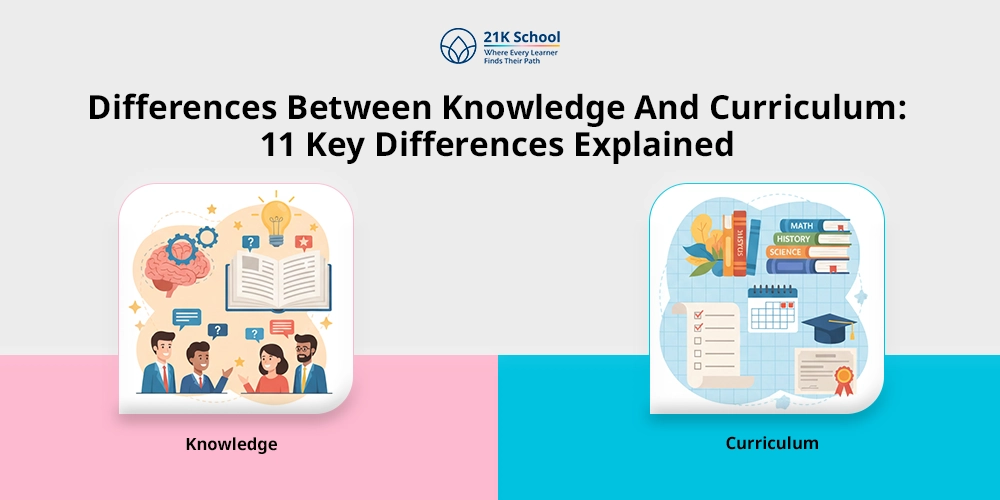
While knowledge is about having understanding or insights on something, curriculum is all about education , syllabus, and tests.
In this article we will be covering in-detailed comparison to figure out the difference between knowledge and curriculum.
Contents
What is Knowledge?
Knowledge is a bit of information, understanding, skills, and learnings that an individual acquires either through education , experience, or observation.
It is what a learner finally holds in their random thoughts, concepts, facts, methods, and principles.
The knowledge increases consistently.
A child starts with the simplest ideas and progressively constructs his/her deeper and more sophisticated knowledge.
It is personal and ever changing as the learner grows with the world.
Knowledge can be:
- Theoretical, e.g. studying mathematical formulae or scientific principles.
- Practical, e.g. the ability to ride a bicycle or real-world problem-solving .
- Tacit, which is by experience.
- Explicit, when it is written down or is taught.
What is Curriculum?
Curriculum is a form of organized learning that maps out what is to be learned by students, the way it is to be learned, and the medium of teaching the knowledge.
It consists of the subjects , learning outcomes , teaching strategies , learning assessments , and learning resources.
The curriculum directs the teachers and standardizes learning while making students acquire the necessary skills at every level of education .
It is officially structured by learning institutions, schools, or curriculum commissions unlike knowledge.
Although knowledge comes as the learned things, curriculum is the outline on which learning is arranged.
11 Differences between Knowledge and Curriculum
The main difference that makes knowledge and curriculum different include the following criteria.
| Basis of Difference | Knowledge | Curriculum |
| Definition | Information, understanding, or skills gained by learning and experience | A structured plan that outlines what and how students learn |
| Nature | Dynamic, personal, ever-changing | Systematic, organized, and formal |
| Function | Helps individuals think, analyze, and act | Guides teaching, learning, and evaluation |
| Flexibility | Highly flexible and adaptable | Less flexible; requires official revision |
| Measurement | Hard to measure fully; often qualitative | Measured through assessments and outcomes |
| Growth & Change | Continually expands with experience | Changes only when redesigned |
| Ownership | Belongs to the learner | Created and managed by institutions |
| Scope | Unlimited and lifelong | Limited to specific subjects and academic levels |
| Purpose | To understand, apply, and interpret reality | To organize learning for systematic growth |
| Role in Education | End result of learning | Roadmap for learning |
| Example | A student understanding trigonometry | Maths curriculum including topics on angles and triangles |
1. Definition
- Knowledge: What a learner knows or comprehends is knowledge.
- Curriculum: Curriculum is an official guide on what is to be taught.
2. Nature
- Knowledge: Experience broadens knowledge and makes it dynamic.
- Curriculum: Curriculum is determined and designed, to bring order in learning.
3. Function
- Knowledge: Knowledge enables us to find solutions to problems and reasoning behind those solutions.
- Curriculum: Curriculum serves a guiding process to teachers and learners., where they learn what lessons to be taught and how.
4. Flexibility
- Knowledge: Knowledge can change with new situations and new experiences with ease.
- Curriculum: Curriculum only changes when some official revision is done.
5. Measurement
- Knowledge: Knowledge is unmeasurable in quantities, due to the fact it incorporates experiences and practical lessons of life.
- Curriculum: Curriculum specifies evaluations of learning and outcomes through formative and summative assessments in schools and colleges.
6. Growth and Change
- Knowledge: Research and life experiences contribute towards development of knowledge.
- Curriculum: A curriculum is dynamic in the sense that it would change only when authorities change it, which mostly takes several years.
7. Ownership
- Knowledge: The individual with experiences and lifelong learning is the owner of knowledge.
- Curriculum: Curriculum is a part of the education system or institution, which is owned by administrative officials.
8. Scope
- Knowledge: The knowledge is endless and permanent.
- Curriculum: Curriculum is confined to certain content, subjects, boards, and grade levels.
9. Purpose
- Knowledge: Knowledge seeks to mould perception and thoughts of learners.
- Curriculum: The curriculum is oriented to impart knowledge and skills in individuals.
10. Role in Education
- Knowledge: The final result of education is knowledge.
- Curriculum: Curriculum is the direction that is taken by learners.
11. Example
- Knowledge: The understanding about the analyzing of a poem is knowledge.
- Curriculum: The English curriculum is the one which contains that poetry.
Concluding Points
We are now confident on how knowledge and curriculum are different on the basis of their nature, objective, methods of acquisition, and measurements.
Knowledge expresses the real experiences and skills acquired through life, while curriculum offers all the ways for learning, lesson planning, and tests conduction.
Education is most effective when the curriculum is carefully planned and at the same time when the learners thoroughly invest themselves in the curriculum.
This could be beneficial in constructing substantial knowledge.
A balanced system will mean that the curriculum would allow creativity, critical thinking , and personality-development in learners.