

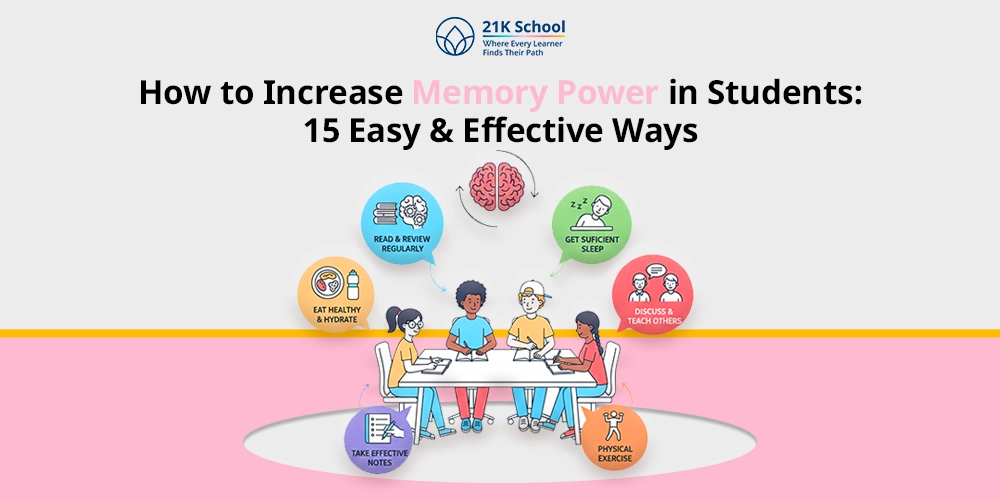
As a parent, you might be concerned about your kid’s memory power.
Though every student has a different way of learning as well as the ability to grasp faster, still their memory power can be improved by following some tips.
Be it in their exams or in general life, memory power is really crucial to attain success.
In this article, we will discuss how to increase memory power in students, but before that let’s understand what memory power is.
Contents
- What is Memory Power in Students?
- How to Increase Memory Power in Students – 15 Effective Ways
- 1. Understand Concepts Instead of Rote Learning
- 2. Use Active Learning Methods
- 3. Practice Spaced Repetition
- 4. Break Information into Smaller Chunks
- 5. Minimize Distractions
- 6. Study with Clear Goals
- 7. Adequate Sleep
- 8. Balanced Nutrition
- 9. Regular Physical Activity
- 10. Practice Brain Games
- 11. Visualization Techniques
- 12. Use Mnemonics
- 13. Manage Stress and Anxiety
- 14. Developing Positive Study Habits
- 15. Practice Pomodoro Techniques
- Conclusion
What is Memory Power in Students?
Memory power is actually a skill, due to which a student is able to store, remember, and retrieve the stored information whenever required.
It entails three major processes including acquisition of knowledge , retention, and then accurate retrieval of that knowledge during exams or discussions.
Learners apply various kinds of memories like short-term memory when they have immediate things to do, and long-term memory when they have to remember some concepts over a period of months or years.
High memory power can enable the students to comprehend the subjects more, do better in the exams, have less exam-stress , and also be good at school work.
Weak memory, on the other hand, can cause frustration, lack of confidence, as well as average performance despite the effort.
How to Increase Memory Power in Students – 15 Effective Ways
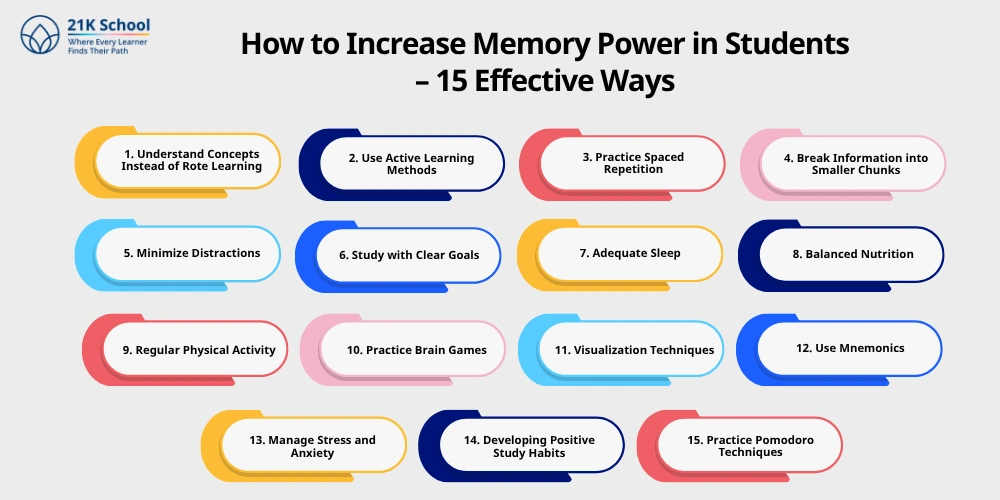
Following are the ways that can help to increase memory power in students:
1. Understand Concepts Instead of Rote Learning

Rote learning is based on memorizing without understanding, because of which students forget the lessons easily.
When students learn to comprehend something by going deeper into the concepts, their brains create better associations, thus making it easy to recall.
Understanding the what, why and how of a subject can enhance memory and application of skills in the long run.
2. Use Active Learning Methods
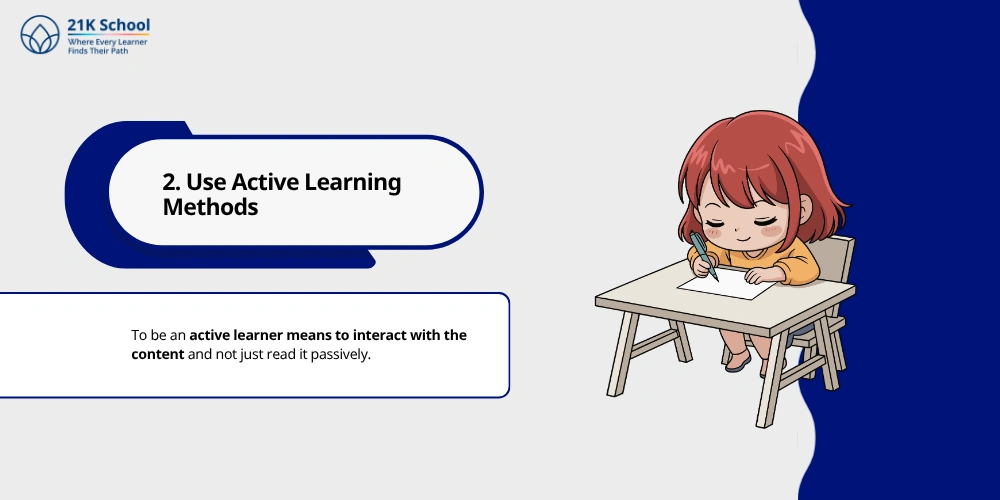
To be an active learner means to interact with the content and not just read it passively.
Memory can also be improved by active learning methods like summarizing lessons, explaining some topics, teaching other people, making notes, asking questions, etc.
The more actively the brain is functioning, the more it memorizes.
3. Practice Spaced Repetition
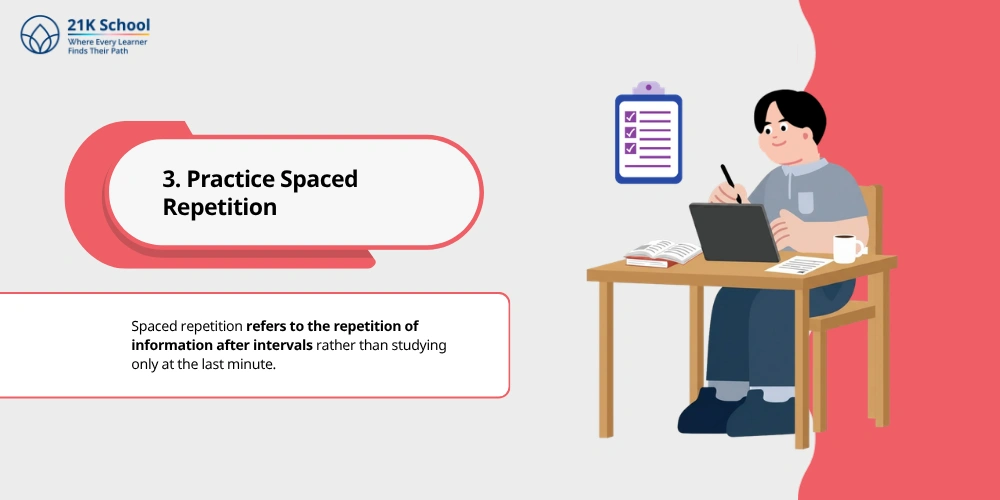
Spaced repetition refers to the repetition of information after intervals rather than studying only at the last minute.
Daily, weekly, and monthly reviews help transfer the information from short-term to long-term memory, which makes the process of learning more permanent.
4. Break Information into Smaller Chunks

Information is easier to remember when it is split into small bits. This is referred to as chunking.
Students use this technique to memorize long answers, formulas, or definitions.
5. Minimize Distractions

Memory power is generally better when the brain is focused on one thing at a time.
Mobile phones, social media, and multitasking decrease concentration and deteriorate memory formation.
Therefore, it would ensure that students have a quiet and a positive learning environment , avoiding any type of distraction.
6. Study with Clear Goals

Learning aimlessly tends to result in a lack of retention.
Clear and realistic goals, like to read one chapter or to learn a particular topic, enhance concentration and make the learning process more significant.
Study sessions with objectives enhance the capacity to remember.
7. Adequate Sleep

Adequate sleep of 7-8 hours per night plays an essential role in memory consolidation.
Before moving ahead, read about how many hours of sleep is enough for a student .
When a person is asleep, the brain processes all the learned information and stores it well.
Students who sleep adequately are better concentrated, can remember and perform in exams.
Sleep deprivation has an adverse impact on memory and learning ability.
8. Balanced Nutrition
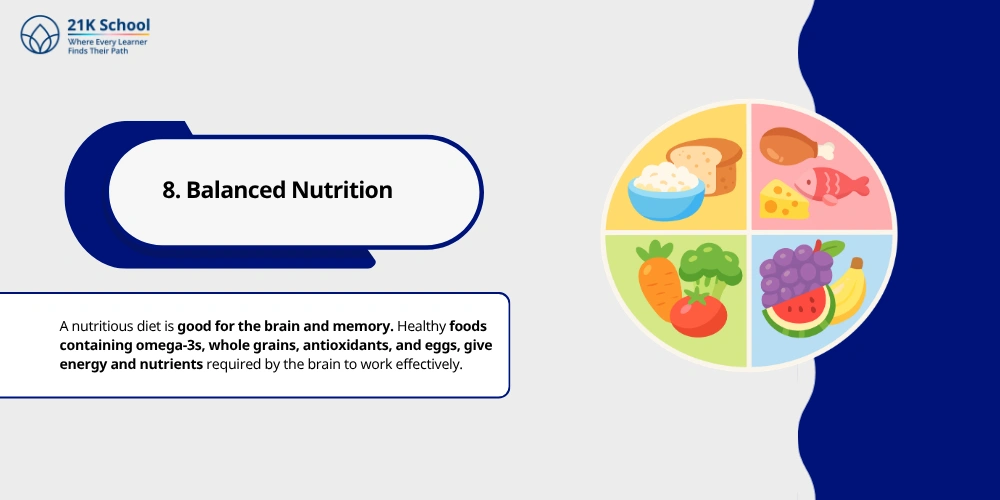
A nutritious diet is good for the brain and memory.
Healthy foods containing omega-3s, whole grains, antioxidants, and eggs, give energy and nutrients required by the brain to work effectively.
It is also necessary to drink a sufficient amount of water since dehydration may decrease the level of concentration and memory.
You can also include dry fruits and vegetables in your kid’s diet to boost their memory and retention.
9. Regular Physical Activity
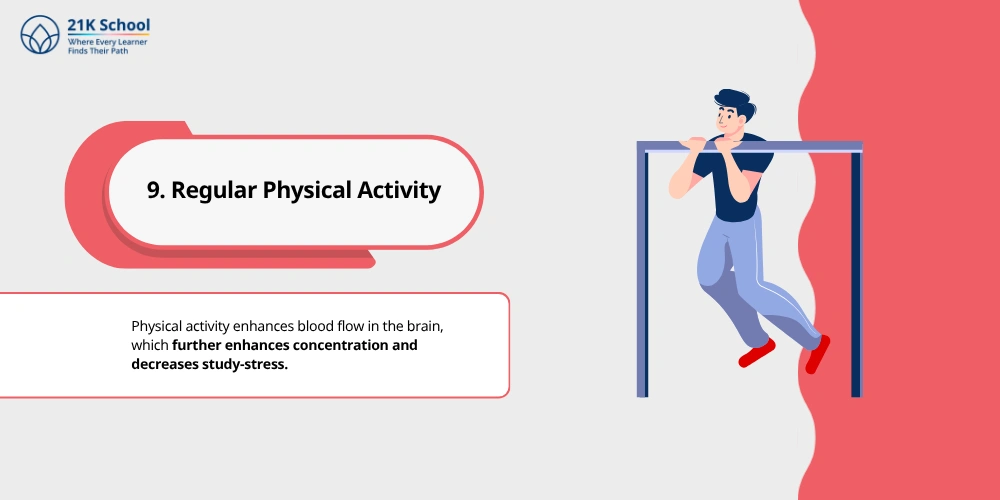
Physical activity enhances blood flow in the brain, which further enhances concentration and decreases study-stress .
Walking, sports, yoga, or stretching are some of the activities that refreshes the mind.
Memory can also be enhanced by having short breaks with movements, between study sessions.
10. Practice Brain Games

Solving puzzles, crosswords, number games, or sudoku can influence brain functioning and also enhance mental abilities.
Such exercises improve neural connectivity and cognitive performance in terms of attention, problem-solving , and recall.
11. Visualization Techniques

The brain better retains images than plain texts.
Visualization is a process of making mental images, diagrams, charts, or mind maps for the subject being studied.
The information is easily learned and recalled with the help of visual learning , particularly when the topic is complex.
12. Use Mnemonics

Mnemonics are memorizing tools that include acronyms, rhymes, songs, or stories to remember lessons easily.
For example, a simple sentence made to memorize a list of points can be recalled easily when giving exams.
13. Manage Stress and Anxiety
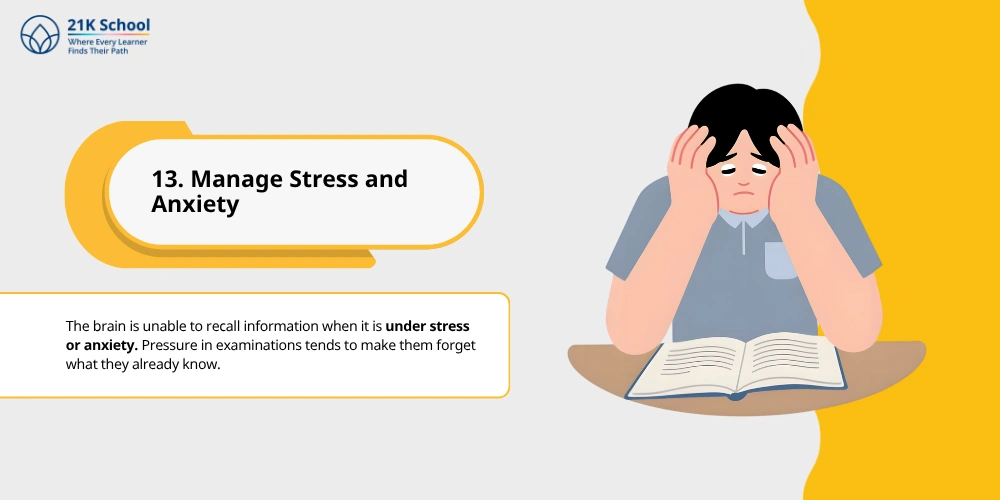
The brain is unable to recall information when it is under stress or anxiety. Pressure in examinations tends to make them forget what they already know.
Deep breathing, meditation, and positive thinking are some of the relaxation methodologies that help in calming the mind and enhancing memory performance.
14. Developing Positive Study Habits
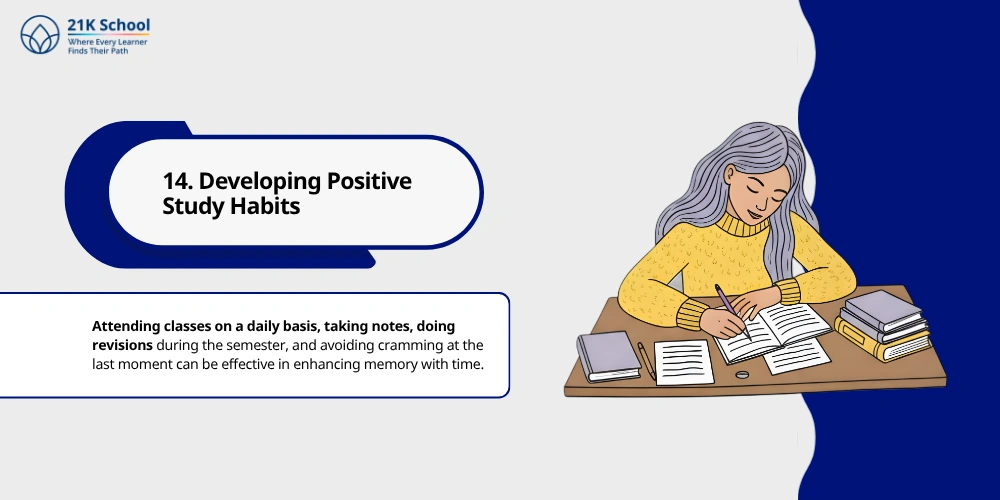
Regular study routines enable the brain to be more focused.
Attending classes on a daily basis, taking notes, doing revisions during the semester, and avoiding cramming at the last moment can be effective in enhancing memory with time.
Good study-habits would result in the improvement of academics in the long-term.
15. Practice Pomodoro Techniques
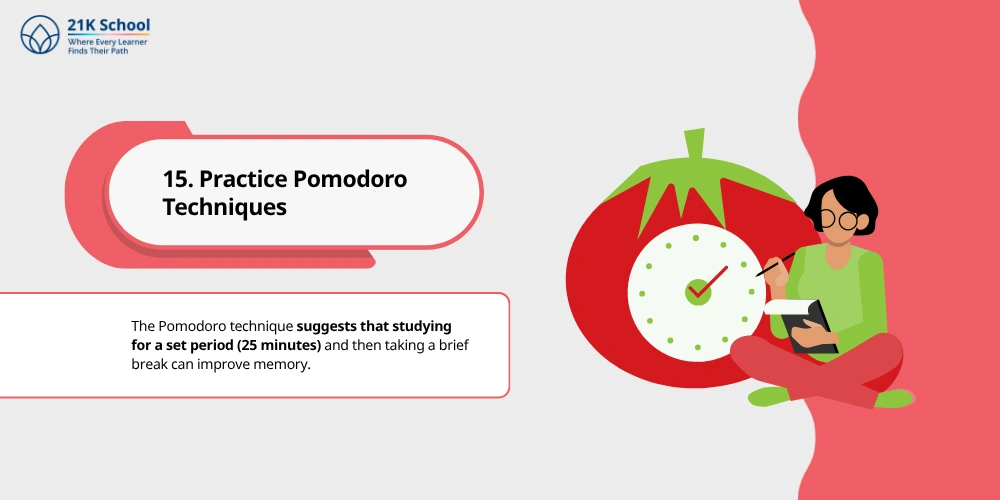
The Pomodoro technique suggests that studying for a set period (25 minutes) and then taking a brief break can improve memory.
This could avoid mental fatigue, enhance concentration, and retention of information in the mind, as the mind remains fresh and focused.
Conclusion
Though memory power is a crucial factor in deciding student achievement, it might vary in individuals.
Children can improve their retention by applying some techniques like getting enough sleep, eating healthy, following a good routine, visualization, brain games, and others.
With proper attention and care, memory power can improve and thus, students can perform well in their academics as well as their professional life.

You may also want to read