

In early childhood, learning is not limited to textbooks, syllabi, and curriculum, it is also based on play.
In this changing world, education has adopted new approaches that make learning more meaningful, interesting, and outcome-oriented.
For young children, play-based learning is a powerful educational approach that promotes holistic development . It allows children to explore, understand, and engage in learning.
To know more about play-based learning (PBL), let’s begin with a detailed blog.
Contents
- What is Play-based Learning?
- Importance of Play-based Learning
- Play-based Learning Activities
- Play-based Learning Examples
- Play-Based Learning vs Traditional Learning: Key Difference
- 5 Key Benefits of Play-based Learning
- Play-Based Learning Across Age Groups
- Challenges of Play-Based Learning
- 5 Strategies to Implement Play-Based Learning in the Classroom
- Conclusion
What is Play-based Learning?
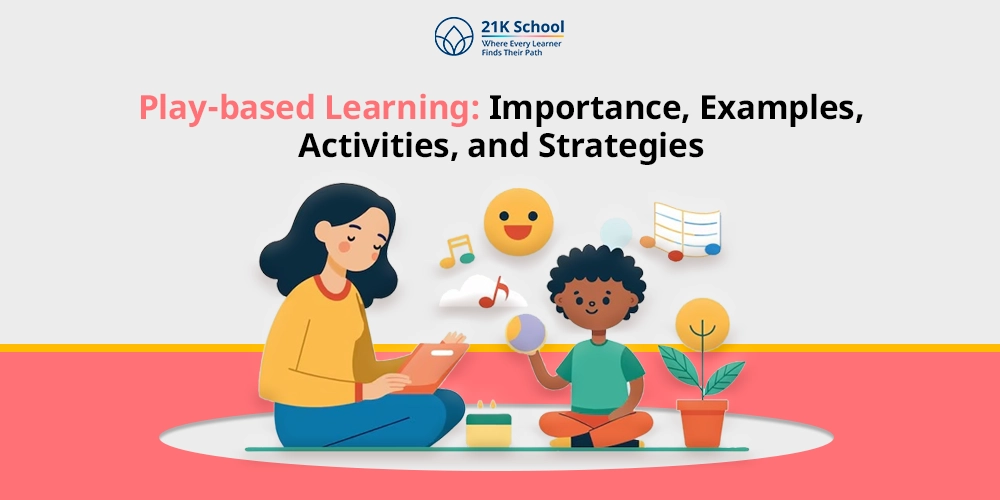
Play-based learning (PBL) is an educational approach in which learning is done through a child-centered approach . Students learn via self-directed, freely chosen play.
The technique is ideal to increase curiosity and love of learning through play . In this way, students at a young age develop 21st century skills.
In play-based learning, teachers act as facilitators who observe, guide, and introduce new resources to support learning.
By understanding the importance of play in early childhood, nurture children’s lives toward growth and development.
Importance of Play-based Learning
In students’ lives, play-based learning is one of the crucial strategies that help them to explore new things especially in the initial stage of education.
Some key importance of play based learning include:
- To improve language skills, play-based learning offers a vocabulary development environment.
- For students’ emotional development, regulation, and empathy, play-based learning is an effective approach.
- Students often feel socially introverted. However, play-based learning helps them to collaborate with teachers and peers.
- To ensure logical thinking and resilience in students from early childhood implementation of play-based learning is important.
Play-based Learning Activities
Using child-centered play-based learning activities creates a positive environment for learning and development of children from a young age.
Some common play-based learning activities include:
1. Dramatic Play
Dramatic play is also popular as pretend or imaginative play in which children enact favorite characters like superheroes, princesses, famous personalities etc.
The activity helps children in developing various skills such as empathy, problem-solving, collaboration, language and communication skills.
For example, a group of students set up pretend kitchens, doctor’s offices, or shops to run.
2. Scavenger Hunts
Scavenger hunt is a play-based learning activity in which kids get clues to find treasure or hidden objects.
It ensures students think, observe, and solve through clues. Scavenger hunt is an engaging physical activity that offers benefits like:
- It is effective to enhance memory and attention.
- Develop problem-solving skills of students.
- It encourages students to think logically.
3. Nature Exploration
Nature exploration is a play-based learning activity connecting children with the real-world where they learn through observation.
Some simple examples are gardening, walks, planting, collecting leaves, stones, flowers, and sorting natural objects.
It is beneficial for children to increase curiosity, independence, and creativity. Nature exploration promotes experiential learning in students’ lives.
4. Musical Exploration
Musical exploration is a play-based activity that exposes children to different sounds, rhythm, movement, and melody.
Using musical instruments or singing songs are some common ways to get involved in this activity.
It is beneficial to improve listening skills, memory, language development, emotions, and expressions.
5. Provide Open-Ended Materials
Providing open-ended materials is one of the play-based learning activities in which children use materials in different ways.
The activity promotes creative thinking skills and encourages students to learn at their own pace and style.
Some common examples are blocks, dress-up clothes, and art supplies.
Play-based Learning Examples
Parents and teachers need proper real-life examples to implement play-based learning in day-to-day activities of children’s life.
- Art and Creative Play
Art and creative play includes various activities such as drawing, painting, and crafting activities which engage children in becoming creative and independent in life.
- Outdoor Play
Classroom learning is effective but including outdoor play-based activities increase students’ curiosity to explore new things. For example, sand play, water play, and element collection.
- Games and Puzzles
Teachers introduce board games, memory cards, and easy to complex sorting activities in the classrooms to students to enhance their cognitive development.
Play-Based Learning vs Traditional Learning: Key Difference
Check out the key comparison of play-based learning vs traditional learning through a quick table.
| Number | Aspect | Play-Based Learning | Traditional Learning |
| 1. | Learning Approach | Child-centered and exploratory | Teacher-centered and instructional |
| 2. | Curriculum Structure | Flexible and adaptable to children’s interests | Fixed and predetermined |
| 3. | Role of the Teacher | Facilitator and guide | Instructor and authority |
| 4. | Learning Pace | Individualized; children learn at their own pace | Same pace for all learners |
| 5. | Social Interaction | It includes sharing, negotiation, cooperation, empathy, and conflict resolution. | It includes group work, discussions, and peer interactions. |
5 Key Benefits of Play-based Learning
To understand why teachers and parents implement play-based learning in early stage of children development, let’s go through some of the key benefits in detail:
1. Cognitive Development
One of the biggest reasons for implementing play-based learning is cognitive development of children. It encourages them to improve 21st century skills.
For example, critical thinking skills, problem-solving skills, holistic development and creativity.
2. Language and Communication Skills
Playing is a language of young children through which they can communicate and express their feelings.
Students engaging in different play-based learning activities like play or collaborative games helps them to connect, learn, and understand each other.
3. Social and Emotional Development
A child learns through play-based learning to develop both socially and emotionally. They can easily share their thoughts, cooperate, negotiate, and resolve conflicts.
It is a good start to any relationship whether it is with teachers, peers, or relatives. To create a supportive environment at home and in the classroom children should have emotional intelligence.
4. Physical Development
With mental growth, students also need to develop physically and play-based learning promotes gross and fine motor skills development.
Some common examples how play-based learning activities improve students physical strength are:
- Including gross motor skills activities like jumping and hopping, climbing stairs, throwing, and catching a ball.
- Including fine motor skills activitieshomeschooling like using tools like scissors, moving objects with their fingertips, and gripping pen or pencil.
5. Creativity and Imagination
One of the key benefits of play-based learning is creativity and imagination through which children are able to increase their curiosity.
In this way, a child can learn how to think out of the box and build a unique and attractive personality in the world.
Play-Based Learning Across Age Groups
For different age groups, kids need simple to complex play-based learning such as:
1. Play-based Learning in Infants and Toddlers (0-2 years)
- Focus: Sensory exploration, bonding, and motor development.
- Activities: Tummy time, sensory bins (textured objects), singing, peek-a-boo, and using mirrors to explore facial expressions.
- Goal: Building trust, early language, and sensory awareness.
2. Play-based Learning in Preschoolers (3-5 years)
- Focus: Social skills, cooperation, and language development.
- Activities: Collaborative building, dramatic role-play (dress-up), arts and crafts, board games that require turn-taking, and outdoor nature scavenger hunts.
- Goal: Understanding rules, empathy, and early literacy/numeracy.
3. Play-based Learning in Early Childhood Education (6-8 years)
- Focus: Critical thinking,
- resilience, and complex social interactions.
- Activities: Strategy games (chess, card games), building complex structures (LEGOs), collaborative multi-step projects, creative writing, or designing games.
- Goal: Developing high-level cognitive abilities, perseverance, and teamwork.
4. Play-based Learning in Older Children (9-12 years)
- Focus: Advanced problem-solving, decision-making skills, emotional resilience and self-confidence.
- Activities: Problem-solving challenges, STEM-based projects and experiments, sports, team games, and leadership activities.
- Goal: It supports higher-order thinking skills , creativity, and emotional well-being.
Challenges of Play-Based Learning
As we explored the key importance and benefits of play-based learning in students’ lives, its effective implementation also comes with some challenges.
1. Curriculum Pressure
Due to rigid curriculum in some schools play-based learning is often avoided by teachers. A fixed curriculum often demands to meet learning outcomes within strict timelines.
That’s why implementing child-led learning activities is difficult. Teachers prioritise learning mentioned in the syllabus and rote learning in higher preschool and early primary grades.
2. Teacher Training Gaps
Teachers often lack the ability to provide an appropriate environment to students for play-based learning due to training gaps.
Active play-based learning can only be implemented by a well-trained educator who understands the objectives of play-based learning and how to implement effectively.
3. Parental Expectations
Parental expectation is also one of the challenges in implementation of play-based learning. A lot of parents feel studying traditionally through books, homework, and visible academic progress is the right way of learning.
This hinders children from learning effectively through play-based learning.
4. Resource Limitations
Limited resources is one of the reasons through which play-based learning impacts negatively. A student needs appropriate age-appropriate materials, a positive environment, and people around them.
5. Managing Large Classrooms
For teachers managing large classrooms is a challenge while implementing play-based learning. Students who are learning in their own way through fun activities require more attention as compared to traditional learning
5 Strategies to Implement Play-Based Learning in the Classroom
Effective implementation of play-based learning in the classroom helps students to achieve desired skills and knowledge. Some key strategies include:
1. Create Structured Play Zones
Creating structured play zones for kids ensures they get meaningful learning experiences. Students can choose desired activities.
This encourages students to learn independently in a positive environment.
2. Use Open-Ended Materials
Open-ended materials help students to think creatively and solve problems. Through these materials students become independent to use them out of the box.
It promotes experiential learning and innovation which develop imaginative skills.
3. Incorporate Outdoor Learning
Learning is not limited to the classroom and home. Incorporating outdoor learning such as nature walks, observation activities, sand and water play, etc., increase curiosity and sensory development.
4. Incorporate Hands-On Learning Activities
Hands-on learning is an educational approach in which learners instead of traditional education actively participate in physical or real-life challenges.
Some common examples such as experiments, projects, role-playing, and problem-solving exercises.
5. Promote Collaboration and Communication
Play-based learning promotes collaboration and communication skills. In this way, one can interact, share ideas, and work together to enhance learning.
Including different activities encourages confidence and leadership skills in students.
Conclusion
Exploring powerful educational approaches like play-based learning (PBL) help students build a better and positive learning environment for early childhood.
Learning through play is an ideal approach to improve skills like problem-solving, communication, creativity, and collaborative skills.
Hopefully, all the above-mentioned information will help you in effective implementation of PBL in students’ learning.

You may also want to read