

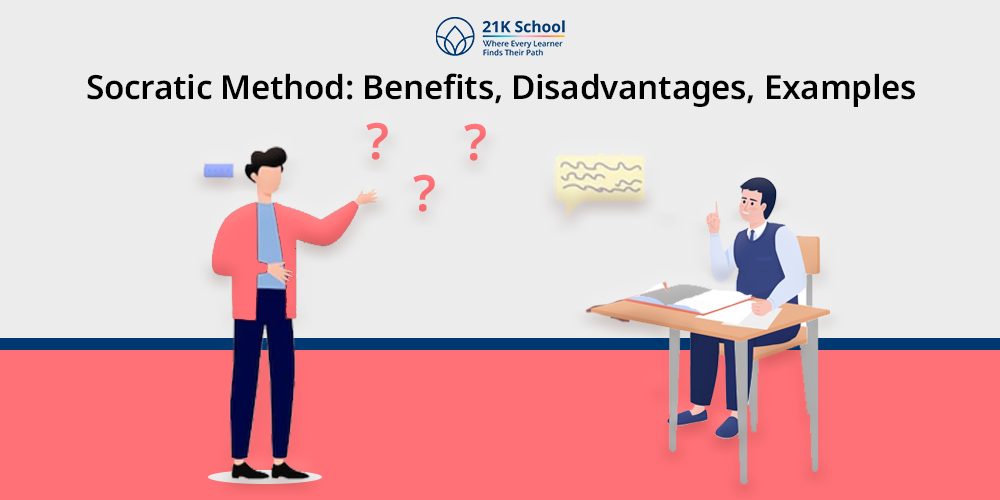
The term “socratic method” is one of the popular techniques of 21st century education . But why does it become so important in learning?
Education is all about focusing on facts, memorizing them and completing the assignments and tasks as soon as possible. However, true learning should be more deeper and understandable to the learner.
This is where socratic methods take part in the individual learning process. An ideal way which involves asking and answering questions to improve critical thinking skills and deeper understanding.
If you are someone who wants to explore more about socratic methods, it’s time to continue their blog to understand its requirements, advantages, disadvantages and popular examples of this timeless method.
Contents
- What is the Socratic Method?
- What is the Socratic Method of Teaching?
- Why is The Socratic Method Important?
- How does the Socratic Method of Teaching work?
- Key Aspects of the Socratic Method of Teaching
- Benefits of Socratic Method
- Disadvantages of Socratic Method
- How Socratic Method works in Education?
- Subjects Based Examples of Socratic Method
- Socratic Method Examples
- Conclusion
What is the Socratic Method?
“Socratic Method” refers to a question and answer style of dialogue in which teachers ask open-ended questions to learners which help in enhancing critical thinking skills .
The term is named after a popular Greek philosopher Socrates because he famously employed it in his philosophical discussions with others.
What is the Socratic Method of Teaching?
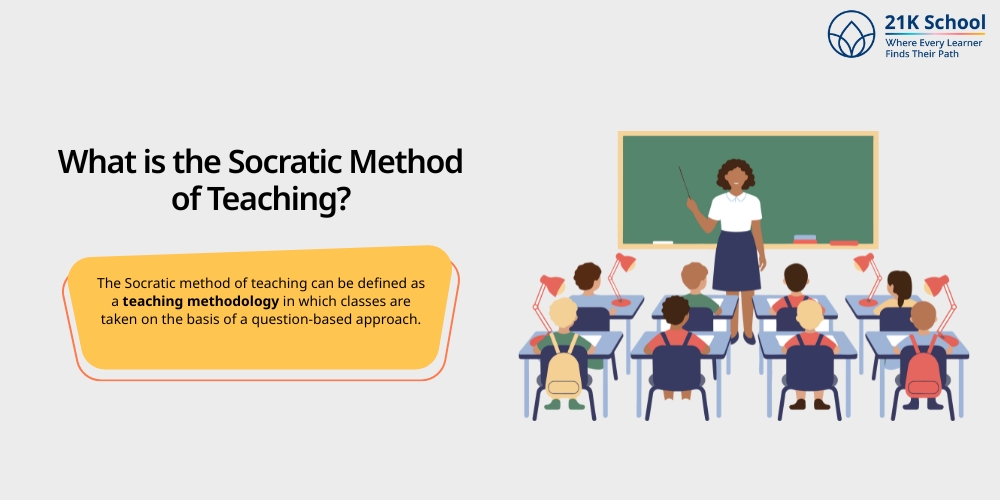
The Socratic method of teaching can be defined as a teaching methodology in which classes are taken on the basis of a question-based approach.
In the Socratic method, the main focus was laid on conversations between teacher and student over a class topic.
Unlike traditional aspects of teaching and learning, in which classes are conducted by teachers speaking and students listening. The Socratic method of teaching was first introduced by the ancient Greek philosopher Socrates in 470-399 BCE.
In several of Plato’s works, Socrates and his teacher debate philosophy with an interlocutor or partner.
The Socratic method of teaching is well known for posing open-ended questions that encourage discussion in the classroom rather than providing students with facts and information.
Students are encouraged to participate and are given the chance to pursue lifelong learning through the question-based approach of the Socratic method.
The Socratic method places more emphasis on experiential learning than traditional education , which only stresses rote learning .
Why is The Socratic Method Important?
The socratic method is important because it helps in fostering critical thinking, active learning and deep understanding of different topics and subjects.
It helps learners to ask questions, analyse and find solutions for better academic performance.
True socratic method learners can be involved in an engaging and positive learning environment while studying.
How does the Socratic Method of Teaching work?
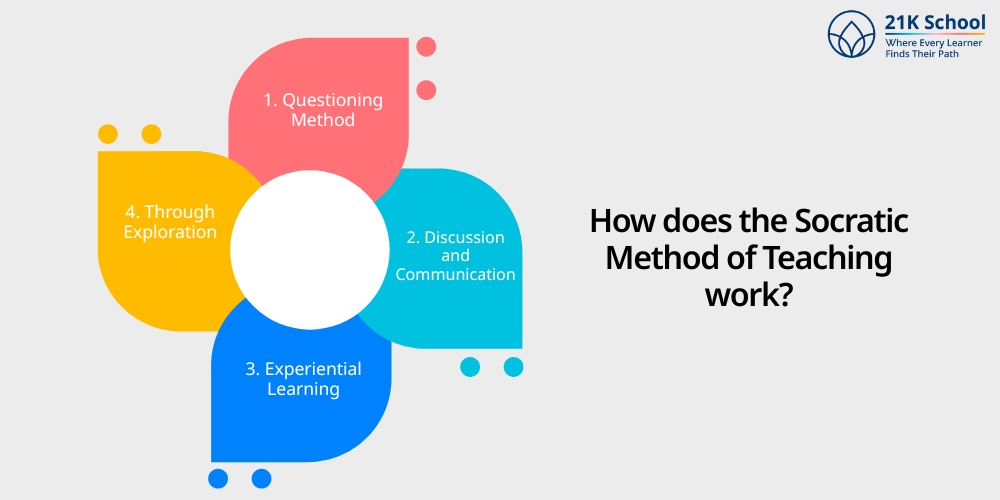
Question-based instruction is a fundamental component of the Socratic method, which aims to promote students’ inquiry-based learning .
The Socratic teaching method is different from the traditional learning approach, which only relies on theoretical knowledge.
This method is known to enhance students’ curiosity and communication abilities. The Socratic method of teaching functions in this way.
1. Questioning Method
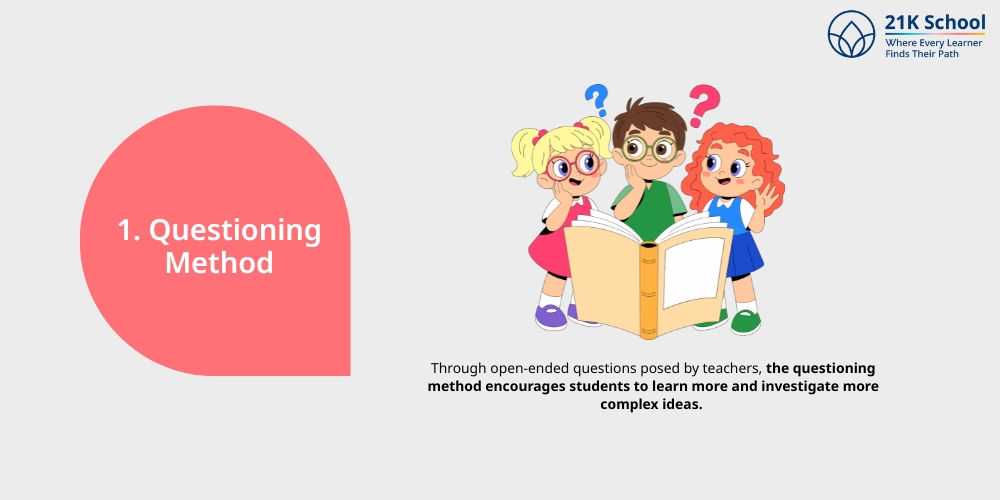
Through open-ended questions posed by teachers, the questioning method encourages students to learn more and investigate more complex ideas.
Students can gain a deeper understanding of the concepts of knowledge comprehension based on their learning abilities by using the questioning method.
Pupils are more likely to acquire creative thinking skills if they learn to ask questions with curiosity.
2. Discussion and Communication
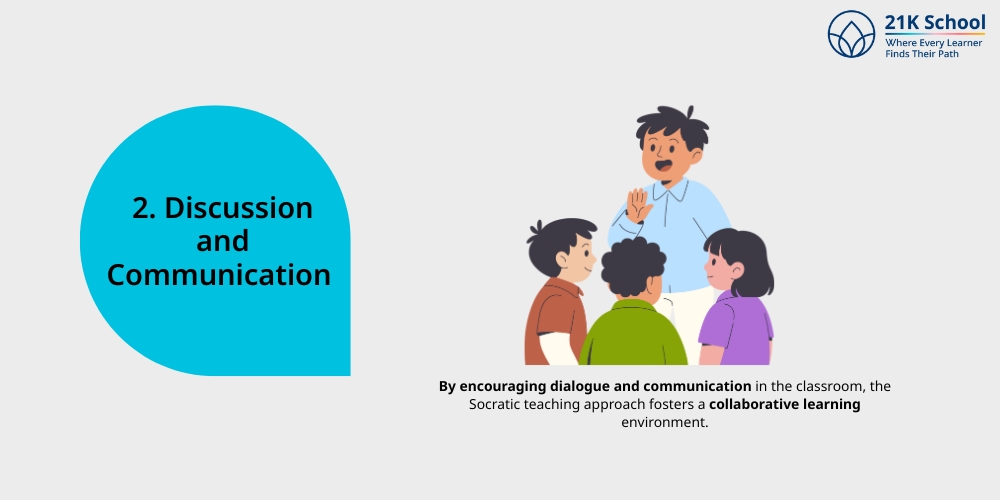
By encouraging dialogue and communication in the classroom, the Socratic teaching approach fosters a collaborative learning environment.
Children are encouraged to actively participate in cooperative learning through the communication approach of the Socratic method of instruction.
By using this approach, students are encouraged to engage in dialogue, listen to others and share knowledge and ideas across the classroom.
3. Experiential Learning
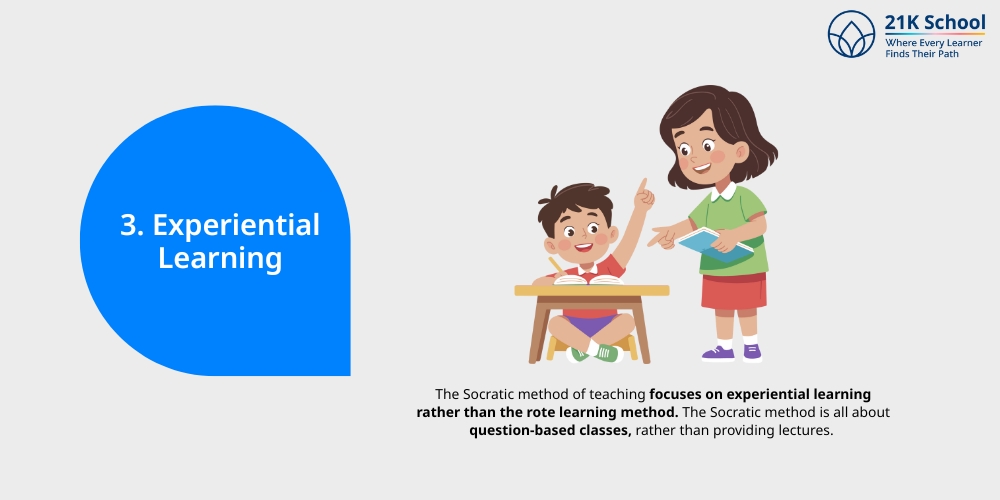
The Socratic method of teaching focuses on experiential learning rather than the rote learning method . The Socratic method is all about question-based classes, rather than providing lectures.
Through this method, students are better able to see challenges as opportunities and develop problem-solving skills . This also allows them to make connections between theoretical aspects and real-world scenarios.
4. Through Exploration
The Socratic method of teaching solely focuses on exploration, allowing children to explore the best possibilities of educational aspects.
The Socratic method allows children to indulge in self-directed research, based on their ideas and concepts, which also allows them to develop curiosity towards learning.
Self-exploration allows children to gain a deeper understanding of concepts and make a correlation between two concepts as well.
Key Aspects of the Socratic Method of Teaching
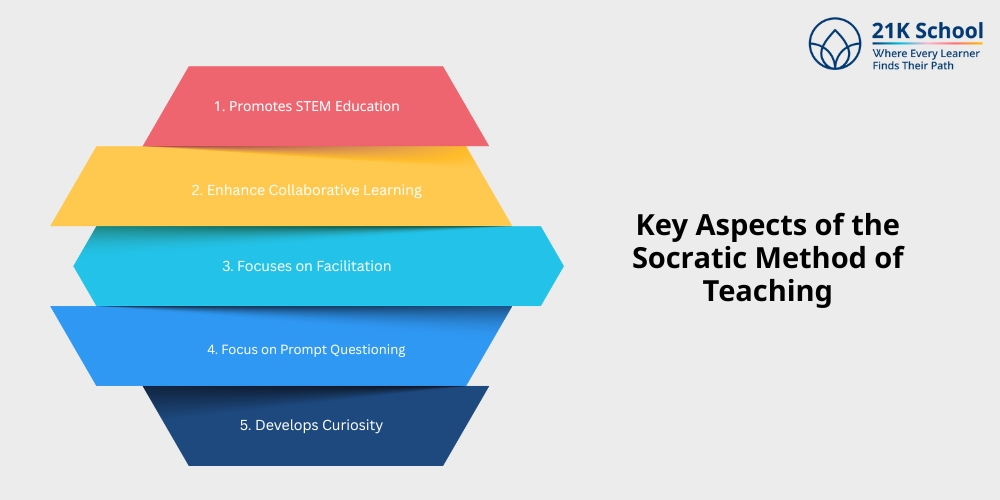
The key aspect of the Socratic teaching method is solely dependent on the improvement of children’s education by a question-based approach.
This method enables students to grasp deeper knowledge through conversational classes.
This teaching process is known for promoting self-directed learning among children, enabling them to take charge of their own education. The following are the key aspects of the Socratic method of teaching.
1. Promotes STEM Education
The Socratic method of teaching is known for promoting STEM education with the help of inquiry-based learning.
As the Socratic method is completely based on the question-based approach, it allows students to actively engage in the learning process.
The goal of STEM education is to help kids learn how to solve problems. The approach helps kids think more critically, which helps them comprehend difficult scientific and mathematical ideas.
This method widens the scope of educational limits by integrating Science and Maths in subjects in order to improve student engagement .
2. Enhance Collaborative Learning
The Socratic method of teaching also enhances collaborative learning environments by creating discussion-based classes.
Through the Socratic method, every student can share their thoughts, viewpoints and information by means of discussion and debates.
This method enhances collaboration skills among children and enables them to respect and empathise with others.
Through the Socratic method, children are better able to develop communication skills and confidence, which is essential for both academics as well as personal growth.
3. Focuses on Facilitation
The Socratic method mainly focuses on facilitation rather than information provider.
The Socratic method allows teachers to create a positive learning environment through discussion, conversations, one-to-one communication, and so on.
As a facilitator, teachers serve as mentors and support systems for students at every stage of their educational journey.
This approach is also regarded as student-centred learning since it allows students the freedom to conduct their own research and hone their critical thinking abilities.
4. Focus on Prompt Questioning
Prompt questioning is the primary goal of the Socratic teaching approach. Teachers are able to assess students’ performance by using prompt questions that are relevant to the subject matter.
Students’ analytical and critical thinking abilities are also fostered by this approach, which improves their capacity to understand material more precisely.
Through prompt questions after every class, teachers can help students enhance their engagement.
5. Develops Curiosity
The curious nature of the Socratic method encourages people to ask questions and seek answers, which develops love towards learning and gives students the confidence to try new things.
Students’ curiosity and openness grow as they participate in discussions and consider different viewpoints.
Their learning experience is enhanced, and educational equity is advanced as a result of their increased curiosity.
Benefits of Socratic Method
There are many benefits of the Socratic method which helps students while learning like developing critical thinking, improving communication skills , and independent learning skills.
To understand each benefits in details here’s an elaboration:
1. Clarifying Question
Clarification of questions is one of the advantages of the Socratic method in which questions are designed to improve student understanding.
For example, the facilitator asks the learner, “Can you explain it in another way?”
This type of question helps to refine the answer and learner elaborate and redefine each point in depth.
2. Promotes Communication Skills
Dialogues are the crucial part of the Socratic method in which learners respond to the question asked by the facilitator.
It promotes communication skills because the answer is given after detailed analysis and discussion.
With time, learners build a Socratic method which is not only beneficial for academic excellence but also real life situations like job interviews.
3. Deeper Understanding
Deeper understanding means learners develop deeper comprehension of concepts, improve analytical skills and communication skills.
The technique shows that kids love learning. It ultimately leads to better retention of knowledge in future especially in exams.
4. Enhance Critical Thinking Skills
Socratic methods enhance critical thinking skills in learners by encouraging active learning, deeper understanding, and the development of well-reasoned arguments.
These skills are not only for academic improvement but also enhance everyday life.
5. Develops Empathy
The Socratic method enhances inquiry and expresses different perspectives which enhance empathy , compassion and tolerance.
This is possible by engaging in discussion, active listening and concept understanding and appreciating diverse viewpoints.
6. Promotes Active Participation
The socratic method promotes active participation by shifting the focus from passive information reception to dynamic student-led inquiry.
This will encourage more discussion which leads to better understanding of concepts.
7. Promotes Teacher-Student Relationship
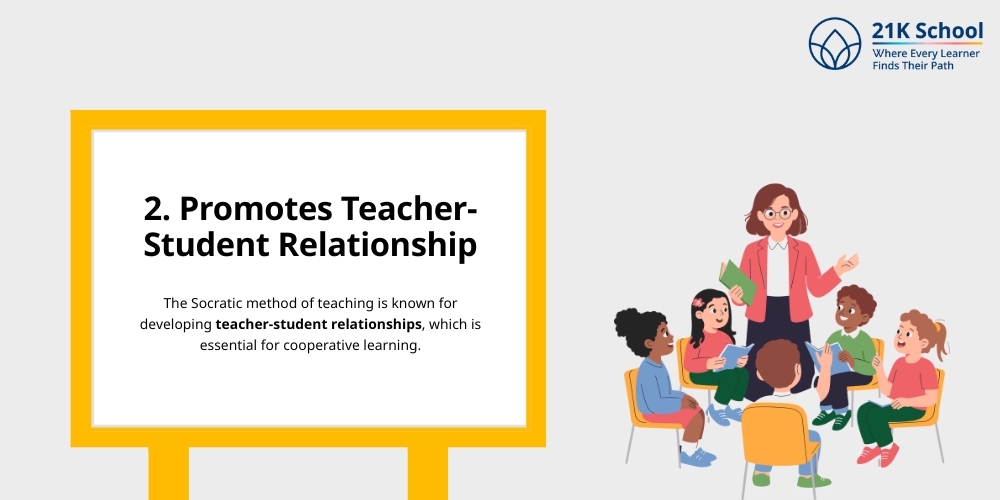
The Socratic method of teaching is known for developing teacher-student relationships , which is essential for cooperative learning.
Through this method, teachers can encourage students to actively participate in the discussion and conversation.
Proper facilitation and guidance from teachers help in setting a dynamic learning environment, which creates trust between the teacher and students, creating a supportive and positive learning environment.
8. Promotes Lifelong Learning
Children are able to engage in self-regulated learning and lifelong learning because of the Socratic method of curiosity.
This approach makes it simple for students to collect data, analyse it and come up with potential solutions to issues.
With this approach to learning, students can cultivate a growth mindset toward learning and view obstacles as opportunities.
9. Develops Intellectual Thinking
By encouraging students to think from a variety of angles, the Socratic method of instruction significantly improves intellectual thinking.
Students with intellectual thinking skills are able to think critically, participate in group discussions, synthesise information, assess concepts and form their own well-informed opinions.
Disadvantages of Socratic Method
The socratic method is beneficial for improving critical thinking skills and deep understanding but it also comes with some disadvantages.
Some common disadvantages of sacredic method are:
1. Time Consuming
The method is time consuming for individuals which potentially makes it impractical especially for those situations which need quick decision making.
It also required experience facilitator and learner to implement accurately with patience.
2. Not Suitable for Every Child
The socratic method is not suitable for every child because of difficulty for some learning styles, anxiety, and potential for confusion or frustration.
However, it may also not be ideal for all the subjects, especially those that need quick and direct instructions.
3. Dialogue Based Classes
The method only depends on dialogue based classes like discussions and verbal communication.
This may not work each time, especially when there is a large class, digital classrooms , smart classrooms or students uncomfortable to interact.
4. Limited Scope
The socratic method has limited scope because it is not suitable for all subjects. Various subjects in which it is applicable are business, maths, law.
It is less effective due to limited scope of the subject and application.
5. Resistance to Change
Resistance to change means schools and facilitators sometimes have difficulties choosing new methods of learning.
This happened due to active question answer based technique which can be boring at some point.
6. Dialogue Based Classes
The method only depends on dialogue based classes like discussions and verbal communication.
This may not work each time, especially when there is a large class, digital classrooms , smart classrooms or students uncomfortable to interact.
7. Limited Scope
The socratic method has limited scope because it is not suitable for all subjects. Various subjects in which it is applicable are business, maths, law.
It is less effective due to limited scope of the subject and application.
How Socratic Method works in Education?
Socratic method is one of the effective ways which can be implemented while learning. However understanding how it works in education will help both learners and facilitators.
Here how it works:
1. Open Ended Question
It starts with the facilitator asking open-ended questions which don’t have simple or predictable answers.
Learners need to find away by deep understanding answer the question. This improves their critical thinking skills and explores speed of response.
2. Facilitation
With the help of facilitation through discussion learners can obtain an effective answer by using their presence of mind.
The facilitator guides them by starting a conversation or discussion which works positively. Students here can express their ideas and collaborate with peers.
3. Exploration
The method challenges students to examine their own beliefs and the underlying reasons for those beliefs, fostering intellectual flexibility and a willingness to revise opinions.
This ultimately encourages deep understanding of particular subject learners and facilitators working on.
4. Experiential Learning
Experiential learning is important for socratic methods, it is a technique in which individuals learn in direct experience and reflection instead of going traditional.
This helps them to express what they learned previously.
5. Project Based Learning
Project based learning is all about connecting with real life scenarios which help learners to understand in more effective matters than ever before.
Using questions strategy in projects encourages PBL. It leads to more thoughtful conclusions and real-world application.
6. Discovery and Research
Discovery and research is what the socratic method promotes. Individuals not memorerise their research analysis, observe and discuss to draw conclusions.
This leads to stronger reasoning and analytical skills.
Subjects Based Examples of Socratic Method
1. Science
Popular subjects like science can use Socratic questioning which leads to hypothesis testing. It is also helpful in understanding science principles by questioning methods.
For example, what is the proof of Earth revolving around the sun or what does chemical reaction Conclude?
2. Maths
In maths, the method is helpful in understanding the concept and problem solving . A deep understanding of math chapters fostered by this approach which explores theorems, applications, proofs and limitations.
For example, what happens if we interchange both variables or how to prove it another way?
3. Arts
In the arts, the Socratic method encourages Socratic questioning. It guides learners to share their ideas, thoughts and encourages them to engage.
For example, what emotion painting reflects or what is, the moral of the story?
4. Business
The Socratic method can be used in business studies by to discuss ethical dilemmas, market strategies, or leadership styles.
For example, What would you do if your product harmed the environment or how company values influence customer trust?
Socratic Method Examples
Some common example of Socratic method questions:
- Clarification: What do you mean by that? Can you explain further?
- Challenging Assumptions: Is that always true? What other possibilities are there?
- Probing Evidence: What evidence supports that claim?How reliable is that evidence?
- Exploring Implications: What are the consequences of that idea? How does that affect other things?
- Questioning the Question: Why do you think I asked that question? What is the purpose of this question?
Conclusion
The Socratic method is not limited to the teaching style used in learning but also a mindset that builds with the time. It encourages us to ask questions, reflect and grow.
It is an ideal technique to reduce memorizing based learning traditionally used. Instead it offers an opportunity to explore and answer new ideas.
However, it is not suitable for all subjects. But offers a powerful body, understanding empathy, critical thinking and learning something new.
The Socratic method transforms the learning by implementing it in the right subjects such as science, maths, business etc.

You may also want to read