

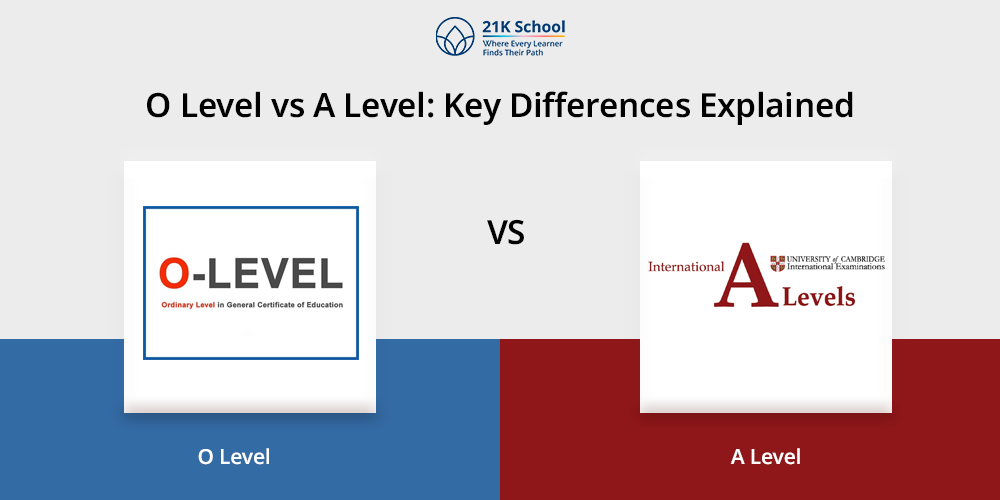
The most known examples of qualifications in the British curriculum are the O Level (Ordinary Level) and the A Level (Advanced Level) both of which strongly determine higher education and career prospects.
The qualifications are usually acquired at the secondary education level and post secondary education and vary in their format, content and intent. Learn problems of secondary education .
O Level, which is taken at the age of about 16 gives an overview of subjects and so also does the A Level but this time at the age of around 18 and allows one to specialize.
Now, if you are still finding it difficult to spot how these two terms are varying. Then, we guess it is high time you go through this article and end up having some real difference on O-levels vs A-levels.
O Level vs A Level: Key Differences
O-level vs A-level have effects on how to prepare children for the future . The basic differences between o-levels and A-levels are:
| Criteria | O Level | A Level |
| Academic Difficulty | Less challenging, broader focus | More advanced, in-depth study |
| Duration | Typically 2 years | Typically 2 years |
| Subject Options | Limited subject options | More subject options and flexibility |
| Assessment | Exams and sometimes coursework | Exams, coursework, and practicals |
| University Recognition | Recognized, but less valued for admission | Essential for university admission |
| Entry Requirements | Generally no formal prerequisites | Higher entry requirements |
| Cost Implications | Typically less expensive | More expensive, especially with multiple subjects |
1. Academic Difficulty and Depth
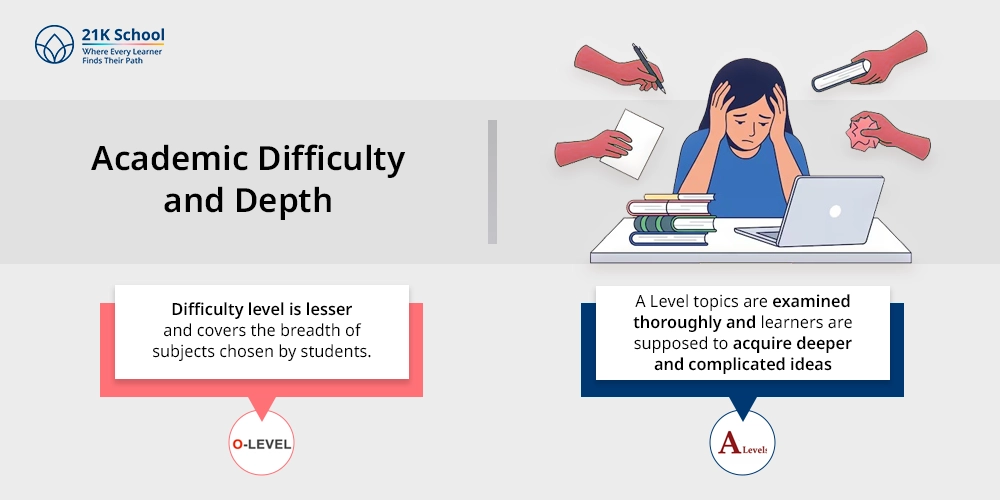
- O Level: Difficulty level is lesser and covers the breadth of subjects chosen by students.
- A Level: A Level topics are examined thoroughly and learners are supposed to acquire deeper and complicated ideas as it involves a greater degree of analytical and critical thinking skills .
2. Subject Options and Flexibility
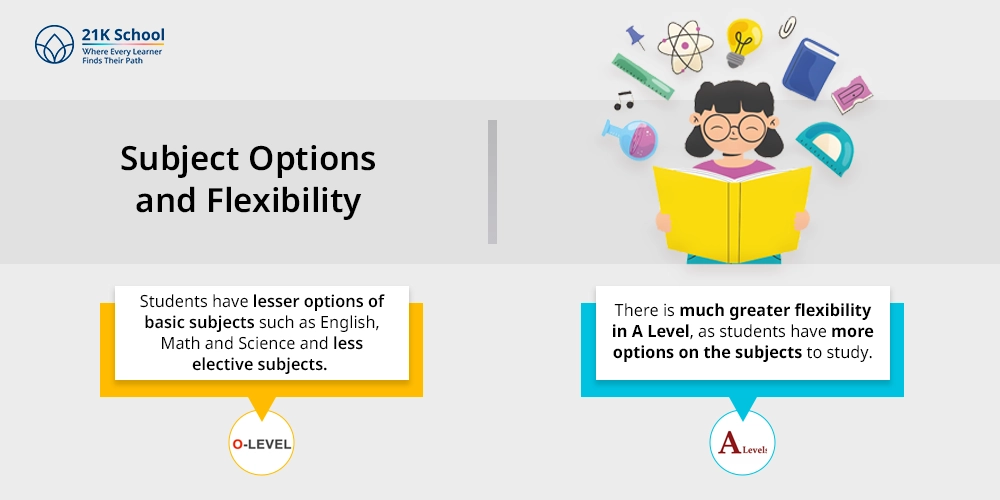
- O Level: Students have lesser options of basic subjects such as English, Math and Science and less elective subjects. Mostly there is less flexibility, but depending on the schools and education systems followed, scope of subjects might vary.
- A Level: There is much greater flexibility in A Level, as students have more options on the subjects to study such as humanities, sciences, arts and even vocational subjects.
Learn the importance of vocational education before moving ahead.
3. Career and University
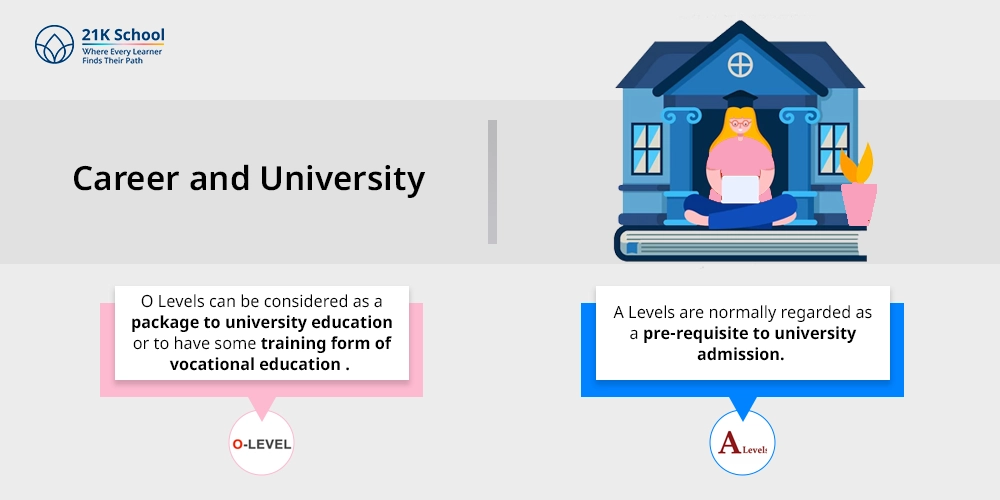
- O Level: O Levels can be considered as a package to university education or to have some training form of vocational education . You might apply for small jobs through this, but direct admission to university might need more than just o-levels.
- A Level: A Levels are normally regarded as a pre-requisite to university admission. In most countries such as the UK, or Singapore among others, good performance in the A Level may also award scholarships and subsequent higher education.
4. Duration and Time Commitment
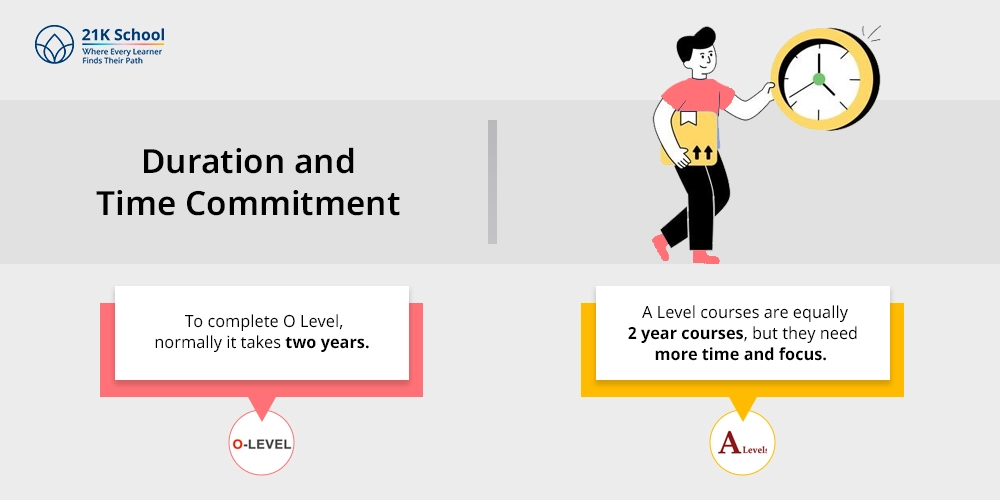
- O Level: To complete O Level, normally it takes two years. Students might have less study time than the A Levels and they can easily handle workload.
- A Level: A Level courses are equally 2 year courses, but they need more time and focus. The intensity of study and the difficulties of tests requires a higher level of student discipline and time management skills .
5. Assessment and Grading Systems
- O Level: Assessments at O Levels are mainly taken as course written examinations. Their grading system was formed in 1975 in which A to E is for pass and, F and U (Unclassified) for failed, but later F was not used.
- A Level: A-levels evaluations are taken through assignment submission, written tests, and courseworks. The grading scale ranges from A to E, but the best universities prefer A* and B grades only.
6. International Recognition
- O Level: Acceptance from most countries highlighting specifically that of the UK or Singapore. The current equivalent for 14-16 year olds in the UK is the GCSE, with Cambridge O Levels offered internationally through Cambridge International Examinations.
- A Level: A Levels are very popular in foreign universities in the UK, USA, Canada and Australia and other countries accept them. They are listed as being among the most prestigious pre university qualifications on the planet.
7. Entry Requirements
- O Level: To be in an O Level program, students having attained lower secondary education (similar to classes 9 or 10 in most countries) is enough.
- A Level: A Level subjects typically expect students to have completed O Levels or have attained an equivalent secondary level of qualification.
8. Cost Implications
- O Level: Examination and preparation of O Levels cost less than A Levels in most cases. Although there may be some costs in the form of materials and exam costs.
- A Level: A Levels are also usually more expensive because of the higher number of subjects taken with it, the cost of preparation material, private tutoring and examination fees is also higher.
What is O-Level?
The O Level (Ordinary Level) is a qualification, which is recognized worldwide and is usually a high school certificate for higher learning .
Children from 14-16 years can mostly study and qualify these o-levels.
It’s been long since O-levels were replaced with the General Certificate of Secondary Education (GCSE) in 1988, in the UK.
And what this qualification can provide you is the ticket to end on small future jobs in the 21st century or either move forward with A-level education.
What is A-Level?
A stricter and advanced level can be found in A-levels, than O Levels.
Up to the age of 16-18 years, your kids can actually pursue higher educational learning in Universities and attain successful careers in future.
Now, after the O-levels educational certificates, an advanced level (denoted as A-level) of education should also be completed by learners.
It is really necessary in university admissions of children, particularly in the UK and Commonwealth states.
In Conclusion
Parents should relax now as they know both O and A levels of education are fruitful for their kids as they attain college and university level education.
The main attention can be dragged towards the age of children and how they want to end up in life for getting education.
One might take you to the higher college applications (O-level) and other could directly land you up on a good university or jobs (A-level).
We hope this article could help you in reaching out on a conclusion and now you are better able to decide what’s best for you at your age.

You may also want to read