


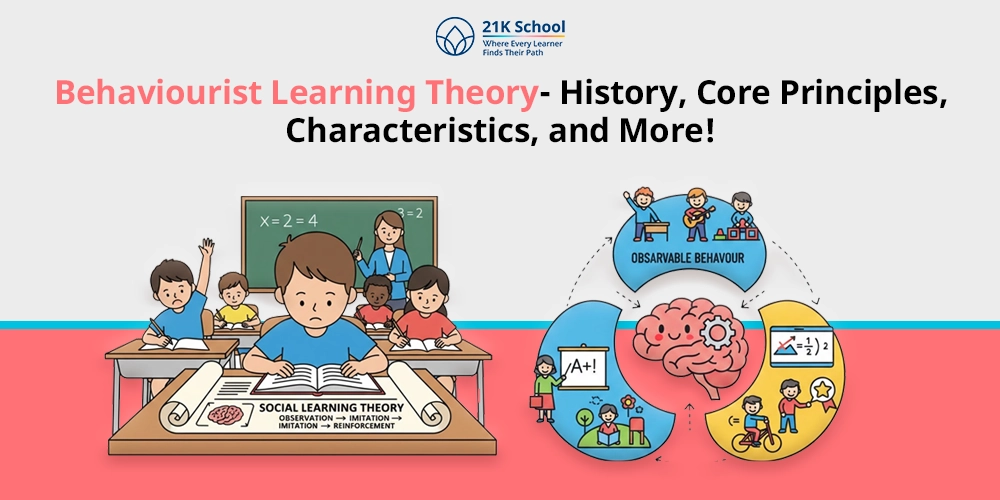
Behaviourist learning theory has been influential in present-day educational practice and psychological studies. This theory was developed at the beginning of the twentieth century out of the need to examine learning in a scientific and objective way.
It highlights the role of the environment in determining human behaviour and the role played by experience in human learning. This theory holds that learning happens when behaviour is consolidated by rewards or undermined by consequences.
Behaviourism has significantly impacted the teaching methods, classroom management, and training in learning institutions based on skills as opposed to thoughts.
Contents
- What is Behaviourist Learning Theory?
- History of Behaviourist Learning Theory
- Core Principles of Behaviourism
- 4 Branches of Behaviourist Learning Theory
- 1. Methodological Behaviourism
- 2. Radical Behaviourism
- 3. Theoretical Behaviourism
- 4. Psychological Behaviourism
- 6 Characteristics of Behaviourist Learning Theory
- 1. Learning is Observable and Measurable
- 2. Learner is Passive
- 3. Stimulus-Response
- 4. Reinforcement and Punishment
- 5. Environmental Determination
- 6. Learning as Behaviour Change
- Top 5 Benefits of Behaviourist Learning Theory
- Top 5 Teaching Techniques for Implementing Behaviourist Learning Theory in Schools
- Top 5 Examples of Behaviourist Learning Theory
- Conclusion
What is Behaviourist Learning Theory?
Behaviourist learning theory is a learning theory that emphasises behaviour, which is observable as opposed to internal thoughts or feelings. The behaviourist theory of learning describes learning as an observable behaviour change that comes as a result of interactions with surroundings.
It was developed by theorists like John B. Watson, Ivan Pavlov, and B.F. Skinner focuses on stimulus, response, reinforcement and punishment. It describes learning as a consequence of environmental interactions with a learner.
This theory argues that learning and modifying behaviours are a result of conditioning, reinforcement, and punishment. Based on a behaviour and the reward, a behaviour that is followed by a reward has a higher likelihood of being repeated, whereas a behaviour followed by a negative consequence has a low likelihood.
History of Behaviourist Learning Theory
Learning behaviourism theory originated during the early twentieth century, when psychologists aimed at examining the learning process in terms of observable and measurable behaviours. Initial studies were on stimulus-response relationships and reinforcement effects on learning.
The contributions of important theorists Edward Thorndike, Ivan Pavlov, John B. Watson and B. F. Skinner helped to make behaviourism a prevailing approach in psychology and education, with a major influence on the teaching methods, training courses and behaviour management strategies.
1. Edward Thorndike (Law of Effect)
One of the first contributors to behaviourist thought was Edward Thorndike. He suggested the Law of Effect, whereby behaviours that are followed by satisfying outcomes have greater chances of being repeated, whereas those that are followed by unpleasant outcomes have fewer chances of being repeated
His animal experiments formed the basis of learning, coming to realise it was a relationship between a stimulus and a response.
2. Ivan Pavlov (Classical Conditioning)
Classical conditioning can be explained as a concept proposed by Ivan Pavlov, who conducted experiments with dogs.
He showed that learning is possible through a process of matching a natural stimulus with a neutral stimulus, which leads to a learnt response. The work by Pavlov revealed the conditioning of involuntary behaviours by recurring association.
3. John B. Watson (Birth of Behaviourism)
As a movement within psychology, behaviourism was absolutely established by John B. Watson. He emphasised the need to give up the study of internal mental conditions and instead focus only on observable behaviour when studying psychology.
Watson had believed that everything one does is a result of environmental influences; therefore, learning is a result of conditioning.
4. B. F Skinner (Operant Conditioning)
B.F. Skinner further developed behaviourism by coming up with the theory of operant conditioning. He described how the consequences of behaviour affect the behaviour and applied it through reinforcement and punishment to boost or reduce the behaviour.
The works of Skinner had a significant impact on the education process and methods of behaviour modification.
Core Principles of Behaviourism
The concept of behaviourism is concerned with the process of learning, the concept of observable behaviours, the association of stimuli and responses, reinforcement and consequences, and it is believed that consequential variables can shape, reinforce or change behaviour. Some of the principles of behaviourism include the following.
1. Classical Conditioning
Classical conditioning explains the aspect of learning as a result of stimulus association. Otherwise it may be introduced by Ivan Pavlov; when a natural stimulus is combined with a neutral stimulus, the latter is repeated and turns into a similar reaction.
This type of learning mainly involves involuntary or automatic behaviours such as emotional reactions, and it reveals how an experience can shape behaviour upon being linked to such behaviour through repeatedly being linked to that behaviour.
2. Operant Conditioning
B.F. Skinner formulated operant conditioning, which describes learning as the outcome of consequences after behaviour. Reinforcement strengthens behaviours, while punishment weakens them.
This principle is concerned with voluntary actions and puts more emphasis on how rewards and consequences can affect future behaviour and, hence, is extensively applied in education and behaviour modification.
3. Positive Reinforcement
Positive reinforcement entails inserting something good following a behaviour to enhance the possibility of the behaviour being repeated again.
These may be praise, rewards or good grades. Positive reinforcement is used in the positive learning environments to promote the desired behaviours by letting the learners connect the desired behaviours to the positive outcomes to serve as a motivator to credible responses with the passage of time.
4. Negative Reinforcement
Negative reinforcement reinforces the behaviour by eliminating an aversive stimulus in the event of desirable behaviour. It is not a process of punishment. As an example, study behaviour is reinforced by doing homework to prevent additional tasks.
This law demonstrates the way behaviour may be promoted by removing discomfort and induces people to repeat the behaviour that would allow them to escape negative experiences.
5. Punishment
Punishment is applied in order to reduce or eradicate negative behaviour by adding an aversive stimulus or subtracting a positive stimulus.
They can be reprimands or deprivation of privileges. Punishment can only temporarily prevent behaviour, but behaviourists observe that it is not necessarily effective in teaching the right behaviour, and instead, it can cause fear or avoidance.
6. Extinction
Reinforcement is removed, and after some time, the learnt behaviour tends to die out.
To illustrate, a behaviour that has been rewarded in the past would come to a halt by neglecting to reward it. This principle indicates the relevance of reinforcement in sustaining behaviour and indicates that behaviours deteriorate when not continuously reinforced.
4 Branches of Behaviourist Learning Theory
The areas of branches of behaviourist learning theory help in explaining various methods of studying and applying behaviourism, observable behaviour, and effects of the environment, as well as the use of reinforcing factors in the development of simple and complex behaviour. The 4 branches of behaviourist learning theory can be checked below.
1. Methodological Behaviourism
Methodological behaviourism emphasises observable and measurable behaviour. It denies the investigation of inner mental life, including thoughts or feelings, since these cannot be directly perceived.
This school of thought places more importance on a scientific approach, experiments, and objective measurement in its approach to the study of learning and behaviour, with the belief that psychology can only study things which can be observed and measured.
2. Radical Behaviourism
Radical behaviourism, the term developed by B.F. Skinner, acknowledges observable behaviour and internal processes such as thoughts and social emotional learning and treats them as behaviour under the influence of the environment.
It pays attention to the impact of reinforcement and consequences on the formation of behaviour. This approach addresses the circumstance that the environment is the factor of both the overt and internal behaviours.
3. Theoretical Behaviourism
Theoretical behaviourism does not restrict the application of theoretical constructs and inner processes in explaining behaviour as long as they are associated with observable actions. It means that mental states are possible, and they should be behaviourally operationalised.
This branch is an attempt to mediate behaviourism and cognitive accounts, but observable behaviour is made the main focus.
4. Psychological Behaviourism
Psychological behaviourism combines the principles of behaviourists with psychological processes like personality, emotion and language. It describes the complicated human behaviour in terms of the learnt habits of students and environmental factors.
This method is an application of the principles of behaviourism to practical learning environments, such as education and therapy, and its focus is on the ways in which the learning history is related to shaping the behavioural patterns of individuals.
6 Characteristics of Behaviourist Learning Theory
The learning theory by behaviourists emphasises the fact that learning is concerned with observable behaviour, the environment and the role of reinforcement and punishment in the creative learning method in order to modify and maintain the desired behaviour. The following are the features of the behaviourist learning theory.
1. Learning is Observable and Measurable
Behaviourism lays emphasis on observable and measurable learning. The thoughts or feelings within the individual are neglected since they cannot be measured objectively.
The primary signs of learning are changes in behaviour, such as task-performing or stimulus-reactive behaviour, which makes it scientifically testable and experimentable and classroom-assessable.
2. Learner is Passive
Learners in behaviourism are regarded as passive consumers of information. They react to the stimuli as given by the teachers or the environment, as opposed to actively building on knowledge.
The learner is expected to respond properly to reinforcements or punishments, whereas the teacher or environment controls the process of learning.
3. Stimulus-Response
Learning takes place in a vivid relationship between a response and a stimulus. A stimulus elicits a predetermined response when it is introduced.
These associations create habits and conditioned behaviours by repeated association. Simple and complex learnt behaviours in humans and animals can be explained using this principle.
4. Reinforcement and Punishment
The learning in behaviourists is defined by consequences. Positive or negative reinforcement is used to create repetition in desired behaviours by reinforcing the desired behaviour, whereas punishment discourages the undesired behaviour.
These are processes that modify learning behaviours whereby learners develop behaviours that are rewarded and avoid behaviours that are punished.
5. Environmental Determination
Behaviour is mostly influenced by the outside. The environment has stimuli, rewards and consequences that define the behaviour and reactions of learners.
Behaviourism postulates that learning is directly affected by the alteration of the environment and experiences, not inborn capabilities and internal psychological conditions.
6. Learning as Behaviour Change
Learning according to behaviourism is a permanent modification in behaviour. Learning has taken place when the learners behave differently because of the experience, practice, or reinforcement
By using such focus on behaviour change, educators and psychologists can determine the progress objectively and trace the effectiveness of teaching practices or early interventions.
Top 5 Benefits of Behaviourist Learning Theory
The benefits of the behaviourist learning theory highlight the significance of reinforcement, repetition and utilisation of structures in upgrading the learning behaviour, classroom behaviour and student behaviour, thereby rendering education more productive, quantifiable and encouraging. The following are the advantages of behaviourist learning theory.
1. Clear and Measurable Outcomes
Learning behaviourism focuses on behaviour that can be observed so that teachers can easily quantify the progress of students. Learning objectives are specific and measurable by emphasising activities and responses.
The concrete evidence of success is presented by tests, assignments, assessments and performance tasks and allows educators to assess effectiveness and change the teaching plan accordingly to ensure that learning objectives are achieved effectively.
2. Better Classroom Management
Behaviourism assists in upholding discipline and order in the classrooms. Teachers can regulate student behaviours by reinforcing positive behaviours and punishing negative behaviours through the implementation of reinforcement and punishment, respectively.
This is an organised strategy that will reduce distraction and encourage collaboration skills and a productive learning atmosphere, where every student will know the effects of their behaviour.
3. Simple and Structured
Behaviourist approaches give step-by-step instructions to the learners. Lessons are structured, foreseeable and simple to follow, which assists students to comprehend expectations and concentrate on a particular task.
Such a systematic method is particularly useful when teaching the basics and whole routines so that there can be continuity and minimised confusion in the learning process.
4. Wide Range of Applicability
The behaviourist doctrine is universal and can be used in all subjects, ages, and environments.
Reinforcement, punishment and conditioning strategies may be used to shape learning in the classroom and in professional training as well as in therapeutic intervention. This flexibility renders behaviourism a useful instrument of education as well as actual skill growth in life.
5. Creates Positive Behaviour
Behaviourism promotes the occurrence of desirable behaviours through regular reinforcement. Rewards encourage positive behaviours and will encourage the learners to keep doing it and eventually adopt good habits.
In the long run, students absorb the behaviours, thus making them more disciplined, motivated and sociable, an improvement in the overall learning and personality development.
Top 5 Teaching Techniques for Implementing Behaviourist Learning Theory in Schools
The techniques of teaching that can be used in implementing behaviourist learning theory in schools are based on employing reinforcement, repetition, and guided practice to influence the behaviour of students.
Through these practices, students are able to acquire social skills, rectify wrongs, and develop positive habits that become effective.
1. Drill Practice
Drill practice is the repetition of activities so as to strengthen learning and build automatic responses. Students reinforce stimulus-response associations by engaging in repetitive activities.
It is an efficient method of memorisation, skills acquisition, and mastering simple concepts, whereby the learners develop accuracy and confidence due to repetition and consistency.
2. Modelling and Acting
Modelling requires the display of specified behaviours or skills for the students to emulate. Teachers serve as role models in demonstrating proper procedures, reactions or social behaviours.
Watching and imitating the model will assist the learners in the ability to know what is expected and attain skills efficiently, and learning is done through demonstration and practice.
3. Immediate Error Correction
Fixing the errors as they happen will make sure that the students never repeat them in the future. This method is able to give clear feedback, and learners know what to do or how to behave.
Timely correction enhances learning and thus instils the right behaviour and avoids the development of bad habits or misconceptions.
4. Reward and Prais
Positive reinforcement encourages students to reinforce what they want. Praise, tokens or privileges as rewards for good performance motivate participation and work.
This method will enhance learning, instil confidence and encourage the continuation of rules and desirable behaviours by associating good performance with the appropriate behaviour.
5. Shaping
Shaping is a technique of guiding students to a desired behaviour by reinforcing approximations in a gradual manner. Gradual steps are compensated as students move on in their learning so that they can acquire complex skills in the long run.
This process involves dividing difficult tasks into attainable parts, which will guarantee gradual progress and learning of behaviours or skills.
Top 5 Examples of Behaviourist Learning Theory
The behaviourist learning theory has examples that demonstrate the application of the concepts of reinforcement, repetition and stimulus-response to real-life learning situations.
Such examples show how the desired behaviours can be promoted, mistakes can be rectified, and skills or habits can be formed. The following are a few examples of the behaviourist learning theory.
1. Game-based Learning Apps
Rewards, points and levels encourage learning in game-based learning applications. Students get instant feedback and rewards when they do tasks or answer correctly.
This style inspires the learners, reinforces the wanted behaviours and promotes repetition, and therefore learning is interactive, measurable and in line with behaviourist theories of reinforcement and conditioning.
2. Learning a New Language
In language learning skills, repetition, drills and reinforcement tend to play important roles. Correct pronunciation, grammar or vocabulary and mistakes are corrected in real time by use of praise or progress tracking.
This is because the stimulus-response rehearsal is an effective technique in strengthening memory and the development of fluency, which is a behaviourist concept of learning through reinforcement.
3. Buying Behaviour
The behaviourist theory is used to explain consumer behaviour in terms of conditioning and reinforcement. Promotions, discounts and advertisements are some of the stimuli which encourage making purchases.
The behaviour is reinforced through positive experiences, such as satisfaction with a product, thus increasing the chances of a repeat occurrence. This shows that behaviour can be conditioned by the use of rewards and environmental stimuli.
4. Academic Reward
Positive reinforcement can take the form of grades, certificates, or praise to use in schools in order to promote learning behaviours.
Rewards will be obtained after completing assignments, classwork or passing tests, which will encourage students to repeat the good academic behaviours. This is an aspect of behaviourism in that performance is associated with measurable and observable results.
5. Animal Training Using Treats
Pets are trained through the use of operant conditioning, where treats are rewarded to pets to teach them new behaviours.
Good behaviours are encouraged, whereas negative behaviours are either ignored or discouraged. This step-by-step modelling behaviour exemplifies the behaviourist theories and how repetition and reinforcement can be effective in the acquisition of new skills and behaviours.
Conclusion
The behaviourist theory of learning describes learning as a behavioural change due to experiences and the surroundings. It deals with observable things where rewards and punishments are used to define behaviour.
Such strategies as repetition, reinforcement, and conditioning aid the learners in mastering the skills and good habits. Although it does not research thoughts or feelings, it is highly applicable in school, training, and day-to-day life. On the whole, it demonstrates that practice and feedback allow individuals to learn and become better behaved.

You may also want to read