

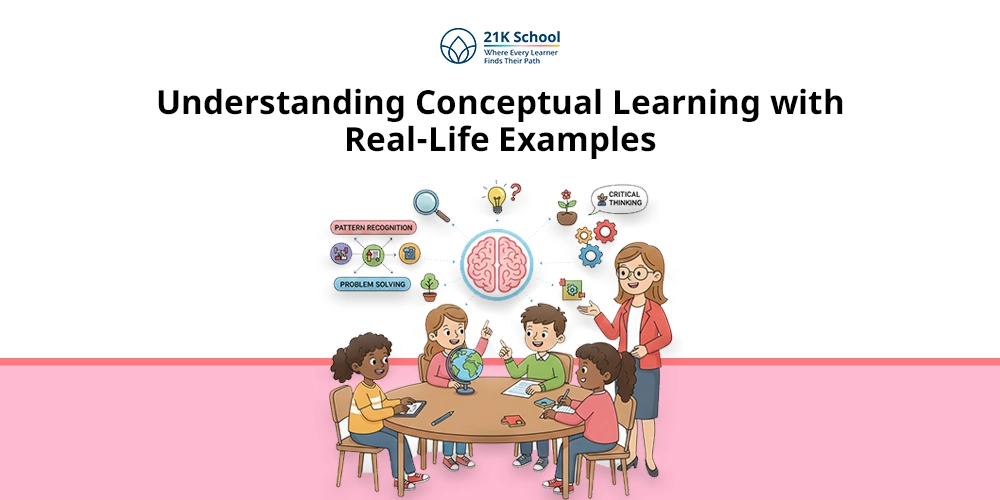
Conceptual learning entails helping the students to learn concepts and precepts as opposed to memorising. It encourages the learners to see patterns, create comparisons and apply their practical knowledge in life
This gets the students to learn to think critically through a better understanding of the concepts, and this provides more insight that is learnt in the long run.
Conceptual learning is more easily understood through practical, everyday illustrations, where one can be more comfortable with how the process can build something that is meaningful and transferable, that is not just rote learning .
Contents
- What is Conceptual Learning?
- Top 11 Conceptual Learning Examples
- 1. Conceptual Learning in Language Arts
- 2. Conceptual Learning in Machine Learning
- 3. Conceptual Learning in History
- 4. Conceptual Learning in Mathematics
- 5. Conceptual Learning in Science
- 6. Conceptual Learning in Music
- 7. Conceptual Learning in Programming
- 8. Conceptual Learning in Counting and Sequence
- 9. Conceptual Learning in Fine Arts
- 10. Conceptual Learning in General Education
- 11. Conceptual Learning in Language
- Conclusion
What is Conceptual Learning?
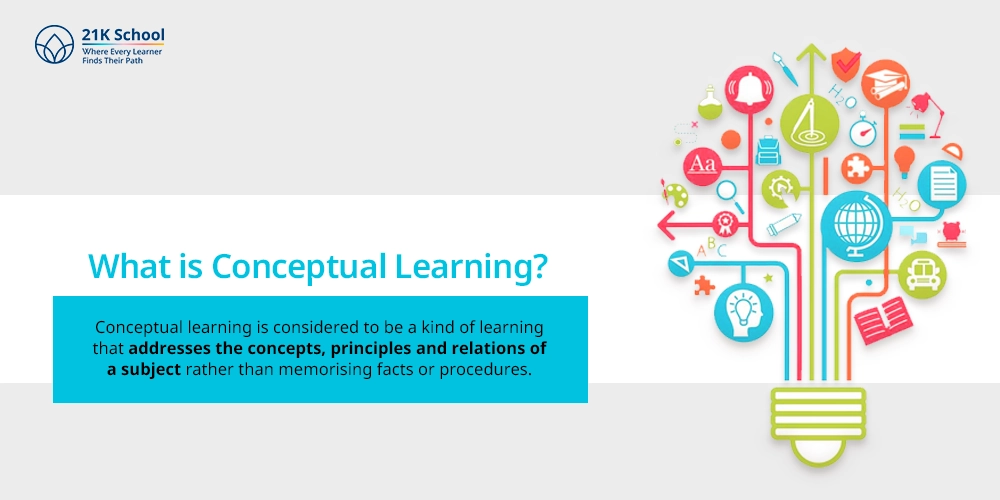
Conceptual learning is considered to be a kind of learning that addresses the concepts, principles and relations of a subject rather than memorising facts or procedures.
Conceptual learning stimulates the learners in generating the big ideas and the relationship of the knowledge to other subjects and real-life scenarios, rather than learning the information.
This will improve critical thinking, problem-solving and the development of long-term memory. Understanding content rather than memorising it allows students to learn how and in new contexts to apply what they have acquired and make reasonable decisions, and develop a more flexible and comprehensive vision of the world.
Top 11 Conceptual Learning Examples
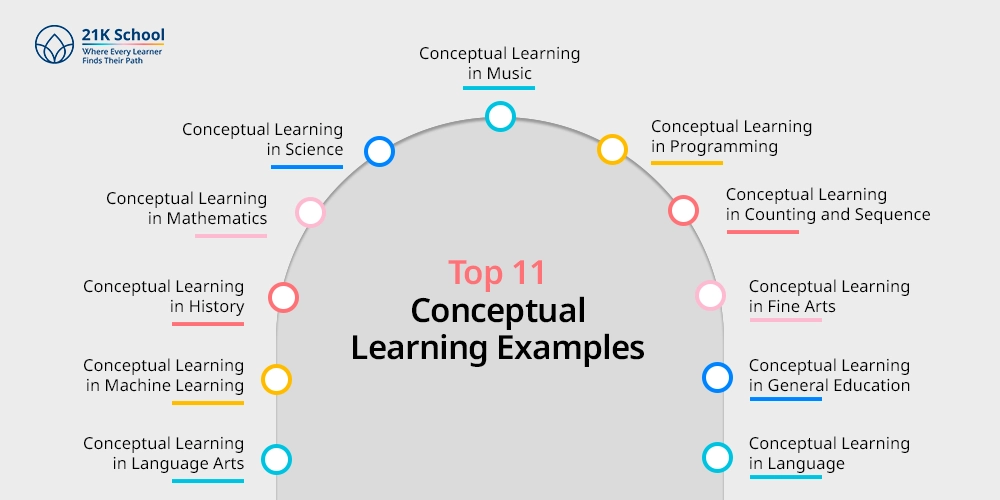
The type of learning that can be called conceptual can be applied to a wide range of topics and education . This is aimed at moving past memorisation to enable the students to relate ideas, make patterns and use knowledge in new forms. The examples of conceptual learning are the following.
1. Conceptual Learning in Language Arts
Conceptual learning in the language arts concerns itself with a form of understanding of themes, motivation of characters, literary devices and the rationale of the choices made by the author rather than remembering some definitions or plot twists.
Students get to study such concepts as symbolism, perspective, and tone to interpret texts intensively. They learn critical thinking and analysis by relating concepts in a variety of stories, genres and writing styles. The strategy will make them learn how language influences meaning and improves communication in the real world.
2. Conceptual Learning in Machine Learning
Conceptual learning in machine learning implies learning what all the fuss is about algorithms, and not being required to memorise equations or algorithms.
Examples of concepts that are analysed by students include overfitting, bias-variance tradeoff, data trends and model generalisation. They are aware of the rationale of the applicability of specific models to specific tasks and the influence of information.
This advanced knowledge helps them to design, test and debug machine learning systems more successfully and create solutions based on conceptual thinking and not on a trial-and-error basis.
3. Conceptual Learning in History
Conceptual learning is gone where memorising dates and events is not given more attention than a pattern, cause and consequences. Such broad concepts as revolution, migration, conflict, governance, culture and social change are covered by the students.
They get familiar with the values of relating the past to the current problems, evaluation of divergent perspectives and the influence of historical forces upon societies.
Such a style would stimulate the critical thinking and make the students discover a more profound angle on the relations that have taken place in the past to make the students perceive the events in a meaningful, informed manner.
4. Conceptual Learning in Mathematics
Mathematics conceptual learning is founded on learning why the formula and procedures work, as opposed to memorisation. Numbers, place value, patterns, functions and real-life applications are related, and these are introduced to the students.
They are taught how to justify their thought, relate ideas in different subjects and use mathematical reasoning in solving new problems. This better understanding makes them find the answers to questions which they have not encountered before easily, and they also cut down on memorising procedures.
5. Conceptual Learning in Science
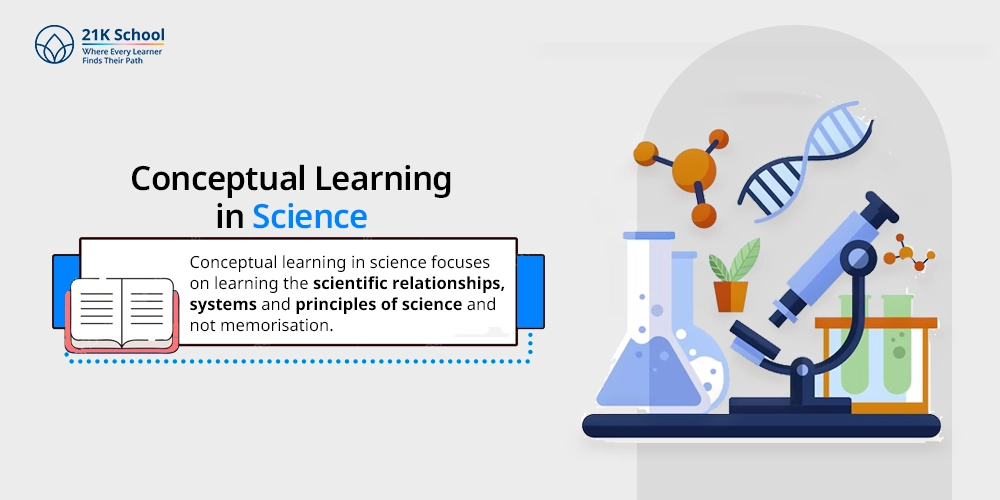
Conceptual learning in science focuses on learning the scientific relationships, systems and principles of science and not memorisation. Students discuss the concepts of energy flow, ecosystems, forces, chemical interactions, and the scientific method.
In physics, biology and chemistry, they examine how and why it happens in nature, relating concepts. This method promotes questioning, exploration and reflection. Taking big scientific ideas, students get a chance to use their knowledge in the real world as well as in scientific issues.
6. Conceptual Learning in Music
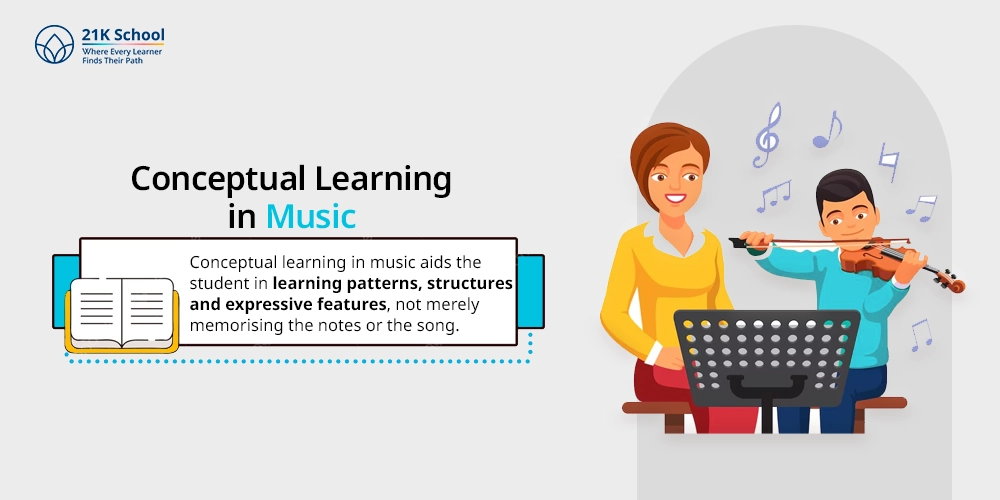
Conceptual learning in music aids the student in learning patterns, structures and expressive features, not merely memorising the notes or the song. They discuss such concepts as rhythm, harmony, melody, dynamics, and musical form and observe the interaction between these elements.
Students draw parallels in terms of genres, cultural awareness , and emotional manifestations in music. This higher level would allow greater creativity, performance and appreciation of the diversity of music and allow learners to interpret, compose, and be able to analyse music in a deeper manner.
7. Conceptual Learning in Programming
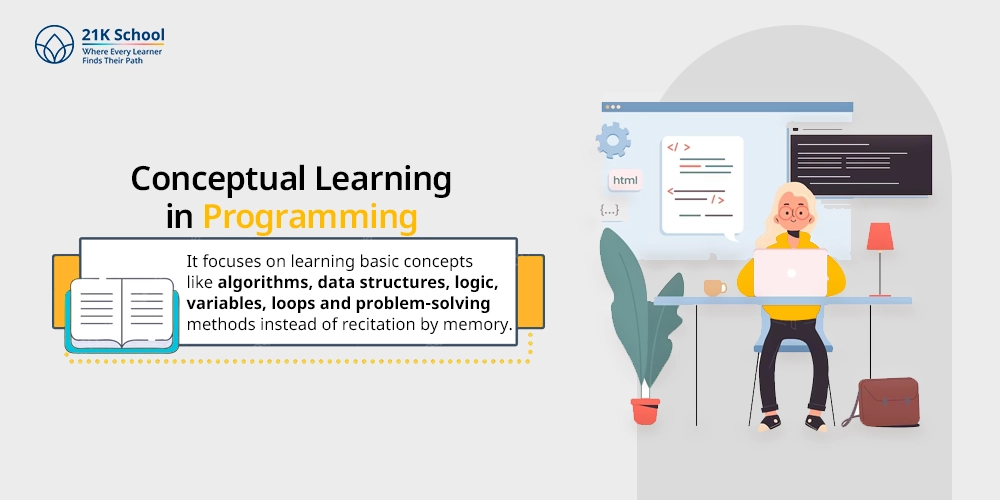
Conceptual learning in programming that focuses on learning basic concepts like algorithms, data structures, logic, variables, loops and problem-solving methods instead of recitation by memory.
Students learn to know the reason why some solutions are effective, how systems react and how to break down problems into manageable parts.
The habit of such an attitude makes them bend their knowledge to new languages of programming and problems. Learners who study concepts instead of syntax are more elastic, productive and can make well-developed software.
8. Conceptual Learning in Counting and Sequence
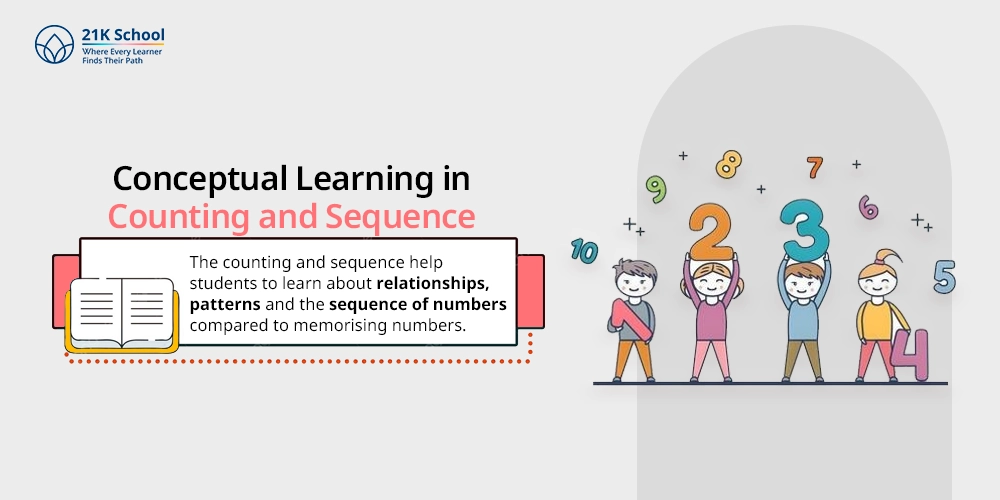
The counting and sequence help students to learn about relationships, patterns and the sequence of numbers compared to memorising numbers. They study such concepts in their day-to-day activity, one-to-one correspondence, quantity, ascending and descending order, skip counting and sequencing.
Children can develop a better sense of numbers and more knowledge of the fundamentals of math by learning to find the relationship between numbers. The knowledge assists in problem solving, early arithmetic and the meaning that can be used in real life, of utilising numbers.
9. Conceptual Learning in Fine Arts
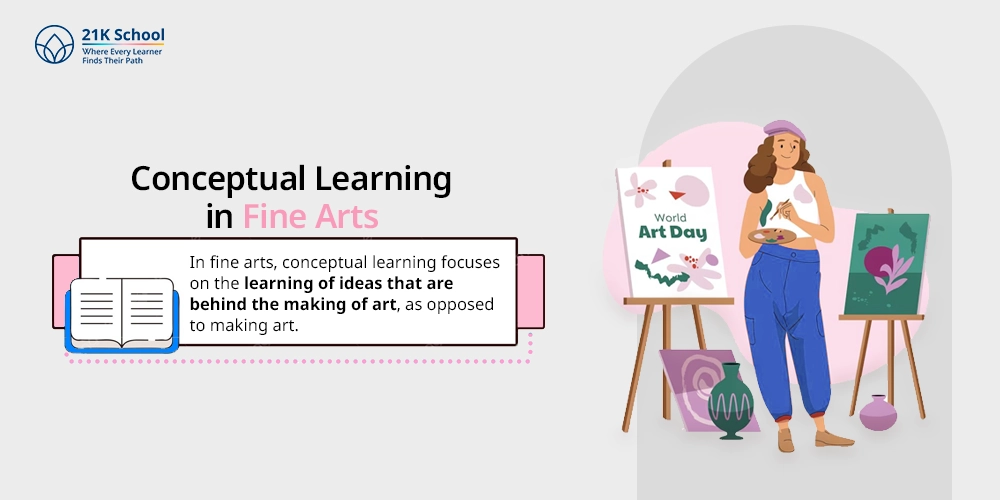
In fine arts, conceptual learning focuses on the learning of ideas that are behind the making of art, as opposed to making art. The composition, colour theory, symbolism, perspective and emotional impact are some of the concepts that are discussed.
They become familiar with ways artists can make statements, how culture, history and individual experience of the artist influence art.
This enlightenment will help them perceive the work of art in a more profound manner and will help them find their own ideas more eloquently; hence, art is a more valuable form of expressing and communicating.
10. Conceptual Learning in General Education
In general education, conceptual learning is based on general knowledge of the subjects compared to memorising the subjects one by one. The linkages between ideas in math, science, language and social studies allow the students to think critically and are aware of interdisciplinary learning .
This is the most appropriate manner of making them realise the real world, applying the knowledge to new fields and acquiring problem-solving skills .
This has the effect of giving the learner a better understanding and long-term memory since the facts were not the driving force but the knowledge of the concepts, which gives him the capability to think at a higher level and make decisions in their daily life.
11. Conceptual Learning in Language
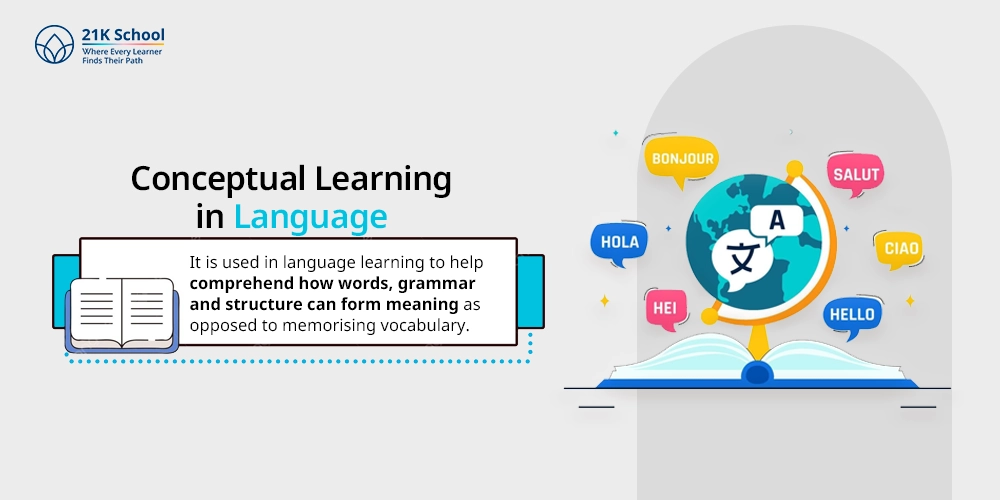
Conceptual learning is used in language learning to help the student comprehend how words, grammar and structure can form meaning as opposed to memorising vocabulary. They question such concepts as context, tone, sentence structure and communication purpose.
The strategy promotes them to identify patterns, establish correlations among languages and use the knowledge in actual dialogues. Students learn concepts rather than single words and hence develop better communication skills and gain a better understanding of how language works.
Conclusion
Conceptual learning will help the students to stop memorising and shift to a more advanced level of learning to know how concepts work and can be applied in real-life scenarios. By doing this, learners would be able to form more effective critical thinking or creativity and long-term memory because they focus on general principles rather than just a single fact.
Conceptual learning helps students to make significant associations and to apply knowledge in a flexible way, be it in language arts, math, science, programming or fine arts.

You may also want to read
What is CBSE? Full Form, History, Structure & Key Benefits
- Last updated on: 17 Mar, 2026
- 14 min read