

With time, education has evolved and various effective approaches have been introduced to fulfill the learning needs of students.
In education, learning
theories are effective approaches to help people understand how
people learn, process information, remember things, and apply it in real life.
To know some of the popular theories in education, let’s begin a simple guide on how we learn through different learning theories in education, its benefits, challenges and many more.
Contents
What are Learning Theories in Education?
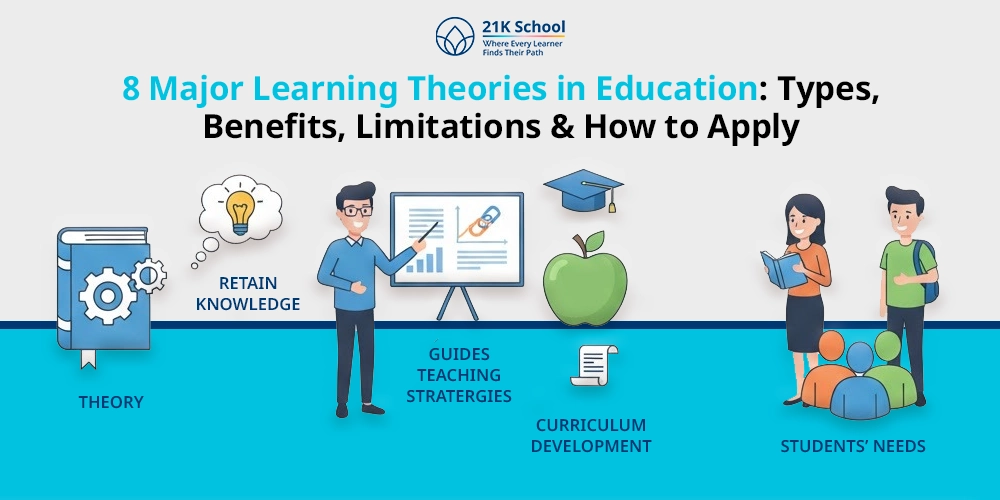
In education, learning theories are frameworks that help students to learn and retain knowledge for a long time.
Through learning theories, teachers understand the process of learning and apply as per students needs and successful curriculum development.
Each learning theory offers different benefits in education . To know in detail go through 8 major types of learning theories.
5 Importance of Learning Theories in Education
Learning theories are not just ideal but an effective way of learning which offers various benefits such as:
1. Guides Teaching Strategies
Learning theories in education are important to guide teachers on how to teach. In this way, teachers understand when to discuss, analyse, and provide feedback to students.
2. Enhances Communication
To enhance communication and collaboration between teachers and students, learning theories help in exploring how students think and feel while learning.
3. Curriculum and Technology
Through learning theories, teachers can implement design curriculum and integrate technology in education .
This makes education more engaging and meaningful for students.
4. Links Research to Practice
Implementation of learning theories in the classrooms bridges between research and the classroom.
The outcomes help in understanding the effectiveness of the theories in education.
5. Empowers Students
Learning theories are beneficial for both teachers and students. Teachers understand how to teach and students understand how to learn effectively for exams.
8 Major Learning Theories in Education
Check out 8 major types of learning theories in education in detail:
1. Behaviorism Learning Theory
In education, behaviorism is a learning theory in which facilitators focus on how students learn through their interactions with the environment.
Behaviorism Learning Theory was developed by some popular psychologists named B.F. Skinner, John B. Watson, and Ivan Pavlov.
The psychologists stated that an individual’s behavior can be observed, measured, and modified with time which can offer positive outcomes.
The objective of behaviorism is to shape the individual’s behavior through encouragement and practice. It focuses on improving students’ discipline
, concentration and learning habits.
Example in Education
- Teachers give stars, grades, or any kind of praise for students’ correct answers.
- Learning multiplication tables daily to improve good habits.
- For not completing homework a student gets punishment.
Strengths of Behaviorism
- Behaviorism learning theory is ideal for basic skills.
- For early education, behaviorism is effective.
- Through this theory teachers can easily measure learning outcomes.
- The theory works effectively for habit formation in students.
Limitations
- It often ignores critical thinking and creativity.
- Behaviorism encourages rote learning .
- It doesn’t focus on understanding.
2. Cognitivism Learning Theory
Cognitivism is a learning theory that focuses on students’ mental processes such as thinking, understanding, memory, and problem-solving .
Including cognitivism in education helps students in grasping concepts, develop problem-solving skills , promotes retention, and lifelong learning.
This learning theory is ideal to improve cognitive abilities and their ability to acquire information easily.
Through cognitive learning students are better able to perform in their academics.
Example in Education
- Students learn by observing practical experiments in the science labs.
- Using effective teaching memory techniques while learning.
- Individuals learn by doing instead of focusing on theoretical education.
- Students unknowingly acquire new information without making a relation between existing information.
Strengths of Cognitivism
- For meaningful and deep understanding cognitivism is beneficial.
- It increases students’ memory and understanding.
- Cognitivism allows them to enhance their decision-making skills .
Limitations
- The theory is less focused on emotions and motivation.
- It is not always practical for all learners.
3. Constructivism Learning Theory
Constructivism Learning Theory is a modern approach in which students instead of passively receiving information actively construct their own knowledge based on experiences.
In this process, students do not limit themselves in books, instead, they interact with the real world to gain knowledge and experience.
In this way, students explore, question, and reflect to understand in detail.
Example in Education
- Students implementing project-based learning activities like presenting a science project.
- Students schedule group discussion
- on topics learned last week.
- Hands-on learning activities like letter scavenger hunts, role-playing.
Strengths of Constructivism
- Constructivism encourages students for deep understanding.
- It promotes student engagement and motivates them for active participation.
- By questioning, evaluating evidence, and solving problems students can improve academically.
Limitations
- The process is time-consuming which also requires teachers’ efforts to implement.
- It also becomes difficult to manage in the large classrooms.
- For effective implementation it requires skilled teachers.
4. Connectivism Learning Theory
Connectivism was introduced by two theorists, George Siemens and Stephen Downes, in 2005.
Connectivism Learning Theory is a digital approach to education in which technology plays an important role to connect and share knowledge.
It is an ideal way to promote digital literacy in the 21st century. Now, students can adapt and continue learning with the changing world.
Connectivism promotes students’ learning beyond the classroom and textbook. It helps them to connect via social media, online networks, blogs, or information databases.
Example in Education
- Students using virtual learning platforms .
- Participating in various social media learning communities is helpful for problem-solving.
- Students connect with cross border experts through MOOCs and webinars.
- Using various digital platforms to complete assignments.
Strengths of Connectivism
- Connectivism supports diversity of opinions in the 21st century.
- It supports lifelong learning by connecting students worldwide.
- Connectivism in education encourages digital literacy from early childhood.
Limitations
- It highly depends heavily on technology.
- It often makes learning difficult for young learners.
- overloaded information can negatively impact or distract students.
5. Humanism Learning Theory
Humanism in learning theory led by psychologists Abraham Maslow and Carl Rogers. It focuses on an individual’s personal growth, self-actualisation, and fulfilling potential.
It demonstrates that education is not limited to academic growth, but it also develops confident, responsible, and emotionally healthy individuals.
Example in Education
- Student choose desired topics in learning
- Open discussions and reflection with peers and teachers.
- Emotional support in classrooms.
Strengths of Humanism
- Humanism builds self-confidence in students.
- It promotes overall development of individual rather than academic growth.
- It encourages continuous learning and supports mental well-being.
Limitations
- Hard to measure learning outcomes.
- The theory focuses less on structured curriculum .
- For effective implementation, it requires supportive and positive learning environments.
6. Social Learning Theory
Social Learning Theory is a psychological theory developed by Albert Bandura. It posits that skills and knowledge are learned through observation, interaction and collaboration.
Social learning is important in modern education to enhance an individual’s personal and professional life.
It prepares students for academic growth and skills development that helps them communicate well in society.
Example of Social Learning
- Teachers praise students for their good behavior in the classroom.
- Students schedule group learning for better understanding.
- Peer learning to improve academic performance.
- Learning from videos and demonstrations for deep understanding.
Strengths of Social Learning
- The social learning model in education promotes students’ positive behaviour.
- Including social learning theory in education encourages collaboration and teamwork.
- To improve academic and personal life, regular interaction and collaboration with teachers and students is ideal.
Limitations
- Social learning often leads to inner conflicts where learners may imitate negative behavior.
- The theory is less focused on students’ independent thinking and learning.
- Group activities often discourage innovation of new concepts or ideas.
7. Experiential Learning Theory
Experiential Learning Theory (ELT) is based on the process of acquiring knowledge through hands-on experiences.
Experiential Learning Theory (ELT), developed by David Kolb. The four stages of Kolb’s cycle include concrete learning, reflective learning, abstract learning, and active learning.
The objective of Kolb’s learning cycle is to improve the learning experience and provide an idea about the logical sequence.
Example in Education
- Through internships, students who have graduated from school or college can get experiential learning through hands-on practice.
- Field trips in education are ideal for real-life exposure.
- Through role-playing students can experience different scenarios.
- Participating in school events is a kind of real-world exposure for students.
Strengths of Experiential Learning
- Including experiential learning in day-to-day life is effective for practical exposure.
- It improves students’ knowledge retention and helps in reducing rote learning.
- Students can experience real-world skills through internship or employment.
Limitations
- Experiential learning theory faces a lack of resources. For example, budget issues, practical objects, transportation costs, materials, equipment, etc.
- Experiential learning is not suitable for all topics and subjects.
8. Transformative Learning Theory
Transformative Learning Theory is developed by Jack Mezirow. It posits that true learning changes beliefs, perspectives, and attitudes.
The impact of Transformative Learning Theory in education goes beyond professional growth. It also plays a major role in personality development.
The objective of transformative learning in education is to empower individuals to change their beliefs and assumptions of the world.
Example in Education
- Visiting social awareness programs help students to transform learning.
- Students reading journals and interviews to gain diverse perspectives.
- To adapt new perspectives, group discussion with peers is an ideal example.
Strengths of Transformative Learning
- Transformative learning encourages deep learning by providing the opportunity to understand diverse perspectives.
- It supports self-directed learning in which students take responsibility for their own development.
- It builds self-awareness in students.
Limitations
- Implementation of transformative learning in education takes time and patience.
- It is an emotionally demanding theory which requires self-awareness.
- Teachers need specialised training to guide vulnerable, emotionally charged processes.
How to Implement Learning Theories in the Classroom?
Application of learning theories in the correct manner is highly important for better implementation in education.
Some effective ways to consider while implementation of learning theories in education are:
- To implement learning theories in the classroom, one should use a blended approach.
- Use different activities and projects in classroom learning .
- Promote group tasks and peer collaboration.
- Allow students to share what they have learned.
- Motivate them and give feedback for improvement.
5 Role of Learning Theories in Modern Education
In modern education, learning theories play a major role. Some key roles to consider are:
1. Curriculum Development
Learning theories help teachers to develop effective and structured curriculum.
In this way, one can understand what to teach, how to sequence topics, and depth of learning. Using multiple learning theories is highly beneficial.
2. Teaching Strategies
Learning theories are ideal for teachers where they understand the use of group activities, digital tools etc based on students’ subject, age, and level of learning.
This helps them in creating a child-centric learning environment.
3. Classroom Management
Learning theories are effective for classroom management because it helps teachers to maintain discipline, respect, empathy etc.
In this way, teachers handle the classroom chaos and challenges.
4. Assessment and Evaluation
Through learning theories teachers often design assessment and evaluation strategies to understand students progress and provide effective feedback for improvement.
5. Special and Inclusive Education
There are various learning theories designed for students’ special and inclusive education . Some common examples include Behaviorism, Humanistic, and Constructivism.
These theories are helpful in supporting students with disabilities, slow learners, and gifted students.
4 Challenges in Applying Learning Theories in Real Classrooms
Learning theories are powerful but come with some challenges. Applying in real life brings challenges like:
1. Large Class Sizes
Schools with large class sizes make it difficult to implement learning theories. In this situation, teachers often rely on traditional approaches.
2. Rigid Curriculum
Due to the rigid curriculum of school teachers are unable to implement different learning theories in the classroom.
3. Exam-oriented Education Systems
Education often focuses on marks and academic outcomes. It often neglects some important theories that focus on overall development instead of academic achievement.
4. Teacher Training Gaps
Correct implementation of learning theories in the classroom is important for students’ growth. But, teachers often lack training which can impact negatively.
Conclusion
Learning theories in education are powerful yet effective ways teachers should use in the classroom. It helps students understand the unique way to learn effectively.
Hopefully, the above-mentioned different kinds of learning theories helped to understand its importance in students and teachers’ lives.
Remember, education is not only reading books and gaining knowledge. It is about deep understanding, growth, and lifelong learning .

You may also want to read