

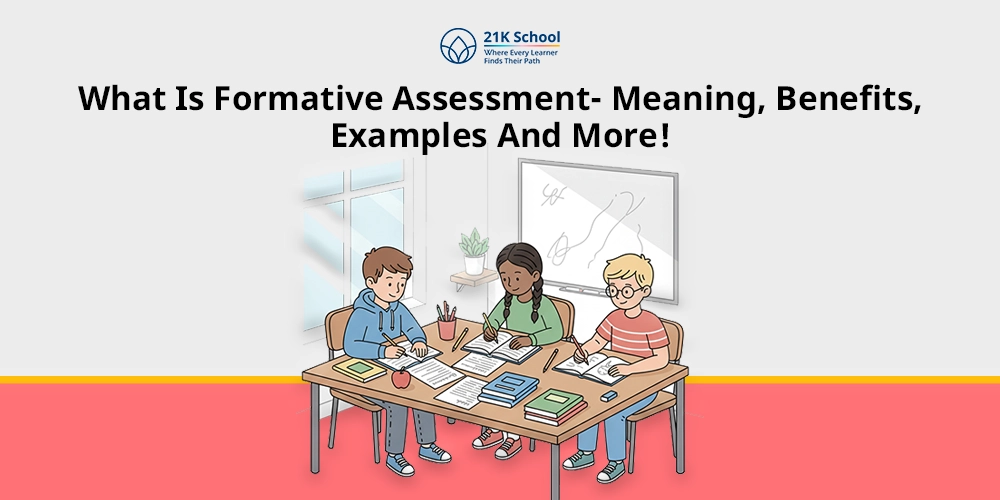
Formative assessment is a form of assessment that is employed by teachers to identify the learning and comprehension of the students in the learning method .
The formative assessments give feedback on a continuous basis compared to the final exams, whereby a student writes exams at the end of a semester based on what they have learned at the end of the semester.
It will enable the teacher to know the area of weakness in the learning and modify the teaching, and enable the student to achieve their potential. It is a tracking progress as well as an active learning and self-reflection, and a progress in life.
Contents
What is Formative Assessment?
Formative assessment is a continuous learning exercise where the teachers assess the progress, knowledge and skill of the students through a teaching process .
This is unlike summative assessment , where, after the end of a course or a unit, an assessment is conducted in order to determine what has been accomplished. Formative assessment will give feedback immediately, and this information will enable the instructors and students to know what they should do better.
It puts an emphasis on lifelong learning , participation and progression as opposed to traditional issuance of a grade. The examples are quizzes, discussions in classes, peer reviews and in-class activities that can be used to monitor the understanding and provide instructions.
Benefits of Formative Assessment
Formative assessment would enhance the learning process since it offers feedback at all times, engages the student, defines strengths and weaknesses, and teaches the teacher to plan the instruction so that students comprehend and advance to the next level. These are the advantages of formative assessment.
1. Personalised Learning
Formative testing also assists teachers in knowing the strong and weak aspects and learning pace of each student. The teachers can be able to determine the needs of the people so that they can streamline the customisation of the lesson, resources, and even activities.
Such an personalised learning approach will lead to increased understanding, skills development and academic development of the students as each student will be approached in a unique way and will not be taught in a blanket manner.
2. Data-Driven Learning
Formative assessment gives actual information on the student’s performance and learning trends. The information will help the teachers make effective instructional decisions, modify their instructional methods and concentrate on the areas that must be strengthened.
Data learning is useful in the discovery of patterns, present developments with time, and making teaching personal, hence, achieving high-quality and more targeted educational results.
3. Enhance Student Engagement
Formative assessment is also done regularly and enhance student engagement in the learning process. The activities that include quizzes, discussions and interactive exercises, among others, ensure that the students are alert and motivated.
The act of constant assessments will make the learner more responsible in terms of self-improvement, focused, and will also understand what they are learning better, thus showing increased interest in the lesson and becoming participants in the classroom.
4. Targeted Feedback
Among the greatest advantages of formative assessment, it is necessary to mention instant and practical feedback. The students can be aware of areas they have excelled and where they have not done well.
This is presented in the narrow form of feedback in order to help them rectify their errors in order to solidify the learning, as well as develop confidence . It also enables the teacher to make any modifications in the process of instruction so that the teacher can provide the student with the necessary help at the necessary moment and time.
5. Enhance Student Motivation
The idea of a formative assessment inculcates the spirit of development, where the learners will be inspired to learn even at the onset. Through small and attainable challenges, confidence and motivation are boosted.
By telling students of their progress, students become more assured in mastering the learning process; they are also more active, and this motivates them to study on a regular basis and which improves students performance and academic outcomes in the long term.
Disadvantages of Formative Assessment
Although formative assessment will help in the learning process, it has a downside. It may be time-consuming, resource-consuming and may even be subjective and thus not easily applicable to teachers and students in the same way to determine it objectively. The disadvantages of formative assessment are the following.
1. Time-Consuming Process
Formative assessment involves routine planning, execution and evaluation , which is time-consuming in the classroom as well as for the teacher.
The workload is usually an addition of the planning activities, which monitor the progress of the students and offer them feedback, and when the teachers do not have time or when they have many students in a classroom, it becomes difficult to work with.
2. Resource Intensive
Some extra resources, including technology, worksheets, or specialised tools, might be necessary to use the formative assessment efficiently as well.
Schools that have low budgets or have limited access to learning materials might have difficulties in terms of providing continuous assessment and, therefore, have difficulties in terms of affording to give one-on-one learning or feedback to the learners in a time-sensitive manner.
3. Resistance to Change
Formative assessment can be agreeable to some level of resistance to the present teaching and testing methods, practised among teachers, students or institutes.
Replacing summative and exam-based assessment with one which is founded on constant feedback may be an overwhelming task that could require some thinking change, training and a reformulation of new classroom-based practices.
4. Subjectivity
The forms of formative assessment are vulnerable to teacher prejudice or bias, which consist of class discussion, peer to peer learning , or open-ended assessment. The impartiality and objectivity may be affected by such subjectivity, leading to poor feedback and unfair evaluation of the performance of the student.
5. Skill Variability
Formative assessment is equally effective as the teacher with regard to handling tasks, interpreting data and offering constructive feedback.
The unprofessional or poorly trained teachers might find it hard to take advantage of the assessment and lower the achievement of the students, which in turn will be confusing or frustrating to the students.
Examples of Formative Assessment
Formative assessment may assume a great number of forms: it may be quizzes, in-class tasks, snap-on or strategic questions. They may be interactive and give feedback to the students to learn on the spot. Formative assessment entails the following.
1. Classroom Projects
The projects conducted in classrooms enable the students to put their knowledge into practice by being innovative. By cooperating in projects, teachers can monitor the understanding, skills in problem solving and cooperation.
Formative assessment is an intriguing and feasible task, as the project might be introduced to the students as the process goes on, the students might be advised on the misleading impressions and learning how to learn better, hence it can be a component of a continual evaluation.
2. 3-2-1 Countdown
A countdown, 3- 2- 1, is a reflection tool, in which the learners are provided the opportunity to write down three things learned, two things that were interesting/surprising, and ONE question they still have.
It is also allowing the active participation to be easy, resulting in better learning, and it also provides the educators with real-time information of what the students have learned and what they should have known more about.
3. One-Minute Paper
A one-minute paper is an exercise where the paper is limited in length, and the students have to give a conclusion about the main points, answer a question or even express their scepticism within one minute.
It allows the teachers to make a quick grasp of the understanding, detect the gaps and talk to the students instantly to keep them active during the learning process.
4. Strategic Question
The teachers pose provocative questions that aim at strategic questions that are presented in the classes. They make people think critically , generate a conversation, and allow the teachers to figure out the degree of comprehension of the students.
The responses will enable the teachers to revise teaching, explain the concepts and make sure that the learners have understood the information accordingly.
Conclusion
Formative assessment is an effective instrument, which promotes lifelong learning, practical learning and individual learning.
Although this would not happen overnight, it would demand resources and professional implementation, but its advantages, including motivation and the ability to provide specific feedback to the learners and teaching on the basis of the data, are much more than the difficulties.
Considering the formative assessment in the context of the normal study, the teachers will be in a position to facilitate the level of knowledge, eradicate the time gaps and help the students achieve their full potential.

You may also want to read