

If you are someone who wants to learn a new skill,
trust me, you don’t have to tick an age bar or qualification.
Whether you are a parent, a teacher, or a student, learning
a new skill is always exciting and challenging, but the self-satisfaction that comes after is incomparable.
Besides that, these new skills can always level-up your resume and self-confidence.
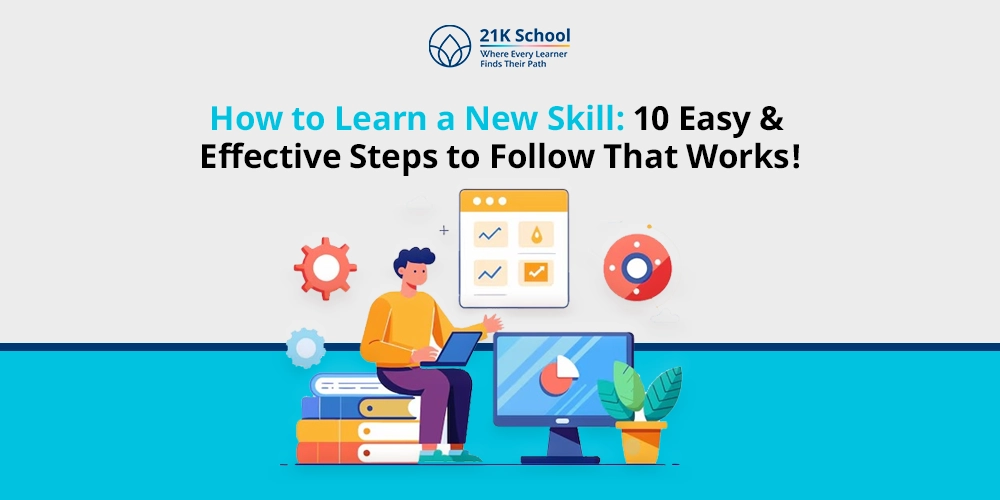
So, now the question arises: how to learn a new skill?
This article will guide you to know the steps you need to learn a new skill, but before that let’s find out what it means to learn a new skill and why it is important.
Contents
- What It Means to Learn a New Skill
- How to Learn a New Skill: 10 Easy Yet Effective Steps
- 1. Identify the Skill You Want to Learn
- 2. Set Clear and Realistic Goals
- 3. Create a Learning Plan
- 4. Choose the Right Learning Resources
- 5. Learn the Basics First
- 6. Practice Regularly
- 7. Learn from Mistakes and Feedback
- 8. Stay Motivated and Disciplined
- 9. Apply the Skill in Real Life
- 10. Be Patient and Persistent
- Final Comments
What It Means to Learn a New Skill
Learning skills involves the knowledge
and habits of learning a given task and being competent while performing it.
A skill can be of two types: non-technical like time-management,
communication, or problem-solving,
or technical like editing, content creation, coding, etc.
Acquiring a skill is also associated with rethinking or re-adjusting behavior. It improves after repeated practice sessions and multiple trials and errors.
For example, if you want to be good at public-speaking, apart from learning its technicalities, you will need to rebuild your confidence, way of thinking, and even work on controlling emotions.
Notably, acquisition of a new skill is a process. It consists of learning from failures, working on feedback, strategy modification, and constant upgrading.
Now, if you wonder why you should learn a new skill? The answer is simple. It is for your personal gains and professional development.
When you learn a new skill you realise that you are more than your current perception and you can always upskill yourself for better pay or other opportunities.
How to Learn a New Skill: 10 Easy Yet Effective Steps
Follow the following easy and effective steps to learn a new skill:
1. Identify the Skill You Want to Learn
First of all, choose a skill that you really want to learn. A goal like “I want to learn something new” is very vague, and in most cases causes confusion and loss of interest.
So, instead, be specific. As an example, when you think of learning a new language, begin with simple conversational sentences.
Before learning a new language, read the benefits of learning a second language.
Ask yourself:
- Why do I want to acquire this skill?
- What will it do for me or my career?
- Do I have a real interest in it?
Once you get your learning motivation in check, it would be much easier to remain committed.
2. Set Clear and Realistic Goals
After identifying the skill, subdivide it into some attainable and realistic goals.
Clear goals provide direction and act as a measure of progress. Do not strive to be perfect, target small achievements first.
For example:
- Learn 5 new words per day.
- Practice on the guitar for 30 minutes a day.
- One online lesson every two days.
Ensure that you set achievable and short-term goals. Our failure to achieve what is unrealistic usually results in disappointments and failure.
3. Create a Learning Plan
A learning plan is essentially a roadmap. It gives you the information
of what you are going to learn, how you will learn it, and when you would apply it.
If your learning plan is unplanned or disorganized, you might not successfully learn the new skill.
Your plan should include the amount of time you would invest in one day or a week.
Sub-skills such as practice sessions or review feedback are also things that you need to concentrate on.
4. Choose the Right Learning Resources
One major step in learning a new skill is choosing the right resources.
In present times, there are a lot of resources and information on the web as well as offline. Working with too many resources can deviate your attention unnecessarily and affect your practice outcomes.
So, begin with either one or two trustworthy sources, and get well acquainted with the sources before proceeding.
5. Learn the Basics First
Strong basics lead to a successful future. Many people aim for mastery at once which can demotivate them and result in knowledge gaps, if they don’t achieve it sooner.
You should remember that learning basics is the foundation of learning a new skill.
As you learn the basics, gradually your skills will get refined, which will automatically lead to mastery.
6. Practice Regularly
It is through active and repeated practice of the skills that the skills get refined.
Instead of passive learning through books and videos alone, you need to actively participate in learning skills.
Consistency is important instead of intensity. For example, exercising for 20 minutes daily is usually more effective as compared to doing it for three hours once a week.
This practice enhances and consolidates memory, improves confidence, and better performance as time passes.
7. Learn from Mistakes and Feedback
Mistakes do not mean ultimate failures, but a chance to learn. It is better to make mistakes and reflect on them, instead of never trying.
Each mistake gives you a chance to improve, so better grab it. Ask teachers, friends, other professionals, or colleagues to provide feedback as much as possible.
Constructive feedback is one that will identify your weaknesses and eliminate bad habits early before you realize it. A learner who embraces feedback is stronger than a learner who does not know how to take feedback.
8. Stay Motivated and Disciplined
During the process of learning you might lose motivation, but that’s when you need to continue doing the repetitive practices to learn a new skill.
Discipline comes in at this point, and means continuing to work even when you lack motivation. This discipline can make you a totally different individual.
You can track your progress and focus on minor accomplishments to stay motivated. You can also try to work in groups that are motivated and disciplined. When you surround yourself with such people, you feel drawn to do a certain task.
9. Apply the Skill in Real Life
When you apply your skill in real life, you notice some mistakes that can improve your skills if worked on.
For example, if you try to communicate in a meeting, your self-doubts and other insecurities might come to the surface. This can give you the opportunity to improve your communication skills while facing your insecurities.
Using the skills brings out strengths and weaknesses, and develops self-confidence in the skill acquired.
10. Be Patient and Persistent
Acquiring a new skill is time-consuming. Normally, progress appears uneven consisting of a number of plateaus and highs.
Patience contributes to the acceptance of low progress and persistence keeps you moving forward.
It is important to keep in mind that mastery requires consistency and resilience in students.
A winner is someone who stays committed to his practice daily, instead of someone who practices for long hours for one day and forgets to do so on another day.
Final Comments
Learning a new skill is an exciting practice when approached with well-planned strategy and by being disciplined.
By setting realistic goals and depending on the right resources, learning a new skill becomes easy.
You need to be patient and persistent while you upskill. You will gradually notice the shift in your capabilities and feel confident about the changes.
With the help of feedback from your friends and teachers, you can improve your skills gradually. This skill will add to your resume and personality, thus bringing you lots of opportunities.

You may also want to read