

In earlier times, all we focused on was academic achievements.
But, in present scenarios, we focus more on values that make a child capable of changing society for the better.
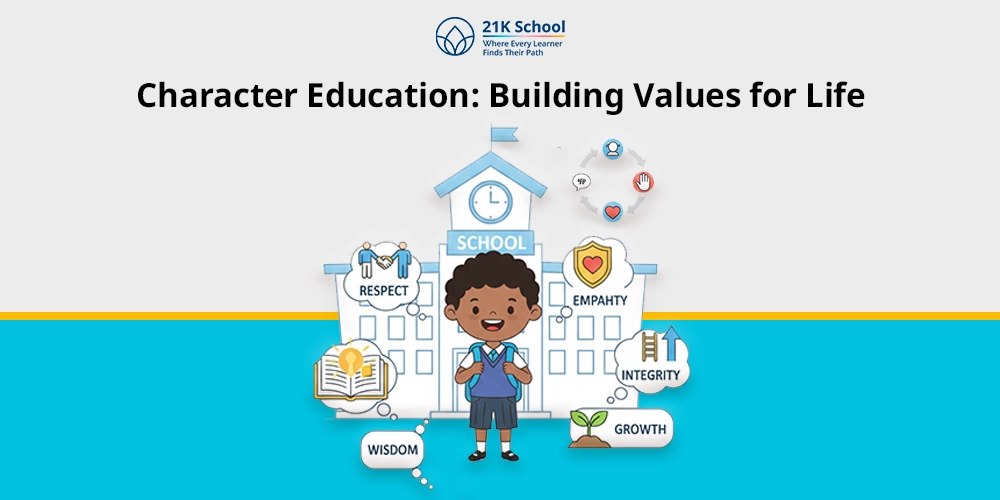
This is why character education came into existence. A type of education that revolves around social, emotional, ethical, and moral values of learners.
As time has passed, more schools and colleges have put emphasis on character education .
Through this article, we will dive into deeper meanings of character education, its implication in schools, its core components, benefits, examples, activities and much more.
Contents
- What is Character Education?
- What is Character Education in Schools?
- Why is Character Education Important – 6 Reasons
- 7 Core Components of Character Education
- 7 Benefits of Character Education
- Character Education Examples
- Character Education Activities
- 7 Challenges in Character Education
- 7 Effective Methods for Implementing Character Education
- Character Education in the Modern World
- Wrap It Up
What is Character Education?
Character education refers to the form of education that is aimed at the formation of moral virtues, ethical conduct, and positive personality characteristics in learners.
It also seeks to make learners responsible, respectful, honest, and compassionate persons, and not merely successful in school.
Character education educates students on ethics, emotion management, positive relationships, and positive contribution to society.
Schools and colleges do it through classroom lessons, school culture, role-modeling and real-life activities.
Character education equips students to navigate life-challenges with resilience, integrity, compassion, and a high degree of responsibility.
What is Character Education in Schools?
Character education in school is a premeditated and organized method of instructing learners with values related to morals, ethical conduct, civic sense, and social-emotional skills.
Schools and colleges teach character education so that it leads to personality development and social responsibility in learners.
It shifts from traditional schooling to emphasize on the kind of people students become, rather than what they study in their books.
At its core, character education aims at inculcating qualities of honesty, respect, responsibility, fair play, empathy , perseverance, and even kindness.
These values are infused in the classroom activities, school culture, extracurricular activities , and in daily interactions of students with their teachers.
Character education which is developed in school can be seen in all aspects of life. Here, teachers lead by example and portray good behavior.
Students can learn the skills of making ethical choices and schools strive to make positive learning environments , conducive to respect, and inclusion.
The students get to know how to apply these values in the real world through consistent reinforcement.
Why is Character Education Important – 6 Reasons
The following list has the reasons for why character education is crucial for upcoming educations systems:
1. Complements Academic Development
Character education with its core values of emotional intelligence and resilience can enhance academic excellence.
Students with self-control and a strong work ethic becomes better at concentration and solving academic problems.
In addition to that, character education leads to a good learning environment where the students feel safe and motivated.
In environments where showing respect and cooperation is emphasized by the classroom setting, students become more active and ready to get involved.
2. Shapes Ethical Decision-Making
In everyday life, students have to make decisions that can challenge their values.
Such as whether to be honest, engage others, challenge bad behavior, or accept responsibility.
Character education gives students a moral code to utilize in making good and ethical judgments.
Through real-life situations and ethical dilemmas, students are able to learn how to judge the consequences and act with integrity.
Such skills are vital in school and also in adulthood where the challenge of ethics emerges in personal relations and civic life.
3. Strengthens Social and Emotional Skills
Character education has a crucial part in the acquisition of social-emotional learning (SEL) skills, empathy , emotional regulation, communication, and conflict resolution.
These skills assist the students in knowing themselves and others, controlling emotions, and establishing healthy relationships.
Emotionally intelligent students can cope with stress better, achieve peaceful conflict resolution, and effective collaboration.
Subsequently, character education helps in a decrease in bullying, building up of peer connections, and inclusive school culture.
4. Builds Healthy Communities
When the students are taught values such as respect, cooperation, fairness, and civic responsibility, they bring the same into their families and community.
Character education teaches the students to visualize themselves as a part of the bigger picture and to realize the significance of playing a positive part in society.
Character education in the form of promoting kindness, serving, and valuing diversity, can help to create closer and more caring communities.
Students are taught that their behaviors are impactful not only on themselves, but on others.
In this way, a sense of shared responsibility and social cohesion is established.
5. Prepares Students for the Future
The contemporary world requires a lot more than technical expertise.
Employers increasingly value character qualities like integrity, teamwork, and problem-solving alongside technical expertise.
Character education can provide students with these critical skills in life, which are important to succeed in higher education and get future jobs in the 21st century .
With a good character, students are more resilient, adaptive to change, and better equipped to handle complicated situations.
6. Promotes Personal Well-Being
Character education can also work for the welfare of the students, as it ensures that they gain purpose and moral identity.
Students are more confident and have more inner peace when they understand their values and learn to act in coordination with them.
Also, character education promotes positive coping skills, emotional integrity, and good relationships, which promote mental and emotional well-being.
When students feel appreciated and encouraged, their chances of succeeding academically and personally tends to be high.
7 Core Components of Character Education
Character education consists of the following main components:
1. Citizenship and Community Engagement
Character education gives much value to active citizenship and community involvement.
Students can get to know about civic responsibility and democratic principles that need to be followed while serving the society.
Community service-work and volunteering activities related to civic education might make students perceive their responsibilities as a good citizen.
These experiences can give way to empathy, leadership, and commitment to common good.
2. Respect
Character education and healthy relations are based on respect.
It includes the importance of valuing one self and other people, and having tolerance for divergent cultures and beliefs.
By learning to be respectful, the students can learn to speak politely and take care of the surroundings, thus creating an inclusive environment.
3. Integrity
Integrity means that one is honest in their actions and upholds great moral standards.
It is about acting right even when nobody is around to see.
The students practicing integrity might gain trust and respect for themselves as they are trained to stand their values.
Through integrity, ethics are created to influence and promote consistency in actions.
4. Responsibility
Responsibility is an act of being responsible to what we do and what decisions we make.
It educates people to be able to stand by their commitments and realize the outcome of their decisions.
Through instilling responsibility, learners can become independent while understanding the significance of contributing positively at home, school, and society.
5. Perseverance
The trait of perseverance is the skill to work on the goals in spite of obstacles or failures.
Perseverance could teach students to be resilient and have a growth-mindset .
One can learn that the only way forward is by working hard and not giving up on the set goal.
6. Empathy
Empathy means the power to put yourself in the other’s position.
It can promote gentleness and sensitivity towards others, reflecting a good character.
Empathy can enable students to understand how to value other opinions, be helpful to the needy, and establish meaningful relationships.
This element is important in conflict minimization and enhancement of collaboration .
7. Fairness
Fairness is about doing what is right to other people and making decisions without favour.
It can teach them how to adhere to the rules of equality and defend the right perspective.
With emphasis on fairness, people would know how to be open-minded and solve conflict without violence.
This could also instill trust and protection towards one another.
7 Benefits of Character Education
Now, let’s understand how character education benefits students and society in general:
1. Improved Behavior
Better student behavior can easily be manifested when character education is being followed in schools.
Schools with high character values are relatively known to have fewer cases of lack of discipline or bullying.
Have a look at these school bullying statistics for reference.
Students are taught to manage their actions positively and accept the consequences which can make the learning environment to be less chaotic and rude.
2. Enhanced Academic Performance
Character education can contribute to academic achievement as it enhances characters like self-drive, and self-control.
Young learners with a good character may have increased interest in education and greater ability to rise above the obstacles in education.
Focus and participation can also be improved through a favorable school setting that further can improve academic outcomes.
3. Stronger Relationships
Character education can help students to develop a better peer-relationship, teacher-student relationship , and family relationship by embracing empathy and respectful communication.
Good relationships are known to promote belongingness and emotional security.
Good social relations can also facilitate cooperation and teamwork , which are key competencies for academic and career achievements.
4. Increased Resilience
Character education might allow students to be resilient individuals, thus enabling them to endure a setback and adjust through hardships.
Grit, optimism, resilience , and courage are some of the traits that can help students to tackle anything with confidence.
Strong students can have a better chance of seeing failures as an opportunity to learn instead of an obstacle.
5. Positive School Climate
A culture that is based on character education in a school is characterized by trust and respect for inclusivity.
Students feel secure, appreciated, and encouraged, thus improving their overall well-being and participation.
A positive environment in the school is good to both teachers and learners as it establishes a cooperative and inspiring atmosphere.
6. Long-Term Success
Character education is beneficial for lifelong learning besides being advantageous during school years.
When students grow into good character it increases their chances of doing well in their education as well as personal relationships.
Integrity and responsibility can make a person successful and fulfilling in life.
7. Social Responsibility
Character education can lead to a feeling of social responsibility because it helps students to think of the implications of their behaviors on other people.
Students are taught how to be concerned about social justice, environmental sustainability, and community well being.
Such a sense of responsibility can equip students to be ethical and compassionate individuals in society.
Character Education Examples
Character education can be carried out in a number of practical ways in the school environment.
These might include the following:
- Classroom Discussions: Teachers can incorporate character themes in the literature, history, and social studies lessons and discuss their powerful traits in the class.
- Service-Learning Projects: Students should be given an opportunity to engage in community services projects that would help them become empathetic and responsible members of society.
- School-Wide Values Programs: At the school level, core values are incorporated into schools and reinforced in assemblies through recognition programs.
- Peer Mentoring: Older students will mentor the younger students in the program which can promote leadership and responsibility.
- Restorative Practices: Schools employ restorative methods to settle disputes and give rise to accountability.
- Extra-Curricular Activities : Clubs, sports, and arts programs stress on teamwork, student-discipline , and respect.
- Daily Reflection Activities: These activities will involve group reflection involved in evaluating the behavior and overall growth of learners.
Character Education Activities
Character education can be built in in students with multiple ways which are based on their age and capability to comprehend these values:
1. Character Building Activities for Preschoolers
Character development can begin from the preschool years. Children at this stage are mostly taught through play and imitation.
Reading success stories that also have the essence of respect, understanding, honesty, and resilience can motivate kids to behave as such heroes.
Besides this, role-playing games can teach them how to make friends and resolve conflicts at an early age.
Another activity can be sharing circles where kids share their feelings and understand why and how for future character development.
This can also be assisted through reflective talks in the mirror.
2. Character Education Activities for Elementary
Elementary students can cope with more complicated values and relationships. The practices in this level are concerned with cooperation, responsibility, and mutual respect.
You can begin by creating classroom rules that each learner has to follow to promote responsibility and fairness.
Appreciable characters can also be developed through kindness challenges including school community projects that can bring these traits into practice.
Elementary students might also learn journalling that can assist in reflecting on their mistakes and further self-management .
3. Character Education Activities for Middle School
The students of the middle school are in the process of forming identity and independence.
At this age, character education is aimed at ethical choice, peer pressure, and emotions control.
Here, group discussions on real-life situations can help to understand ethical dilemmas that are common in society.
Children can also take part in community volunteering that can build their leadership skills as well as consideration for others welfare.
Another activity is peer-mediation programs that can teach how to resolve conflicts that can be common as adolescents at this stage.
4. Character Building Activities High School
The high schoolers are getting ready to be adults and citizens. There are activities that can focus on global citizenship, leadership, and accountability.
Social-issue debates, mentorship programs, service projects, and internships can build positive traits that are needed for global good.
Other than these, student-initiated programs like reflective essays can also assist in knowing ownself and their contributions to the society.
7 Challenges in Character Education
Character education is pretty hard to implement in general classes due to the following limitations:
1. Differences in Values
Students with varied backgrounds have different cultural and religious value systems.
Such diversity might complicate the process of defining a universal set of values which may appear to be acceptable to everyone.
In a bid to respect cultural diversity, schools need to aim at common and universal values like respect, responsibility, fairness, and empathy.
2. Limited Instructional Time
Academic requirements usually do not allow much character education.
Therefore, teachers might face a challenge of adding lessons about character when there already is a fixed curriculum .
The integration of character education into more subjects instead of making it an additional subject can be used to overcome this challenge.
3. Inconsistent Reinforcement
Character education has a lower efficacy when values are not conveyed or supported in the classrooms.
There must be consistency of teachers, staff, families, and the community so as to see impact in the long run.
4. Measuring Outcomes
Character development faces challenges when it comes to evaluation unlike in academic subjects.
Behavior and attitude change is usually slow and relative, which can not be measured effectively.
Instead of standardized tests, schools are forced to use observations, self-reflections, and qualitative feedback.
5. Social Influences
Character education can be sabotaged by peer influence or online media.
The students are exposed to a contradictory set of messages which can conflict with school values.
Critical thinking and digital literacy can be used to guide students in overcoming these influences.
6. Teacher Training
It is likely that teachers would be ill-equipped to find ways to impart ethical and emotional skills without being offered proper support.
Professional development programs are necessary so that the teacher is prepared with useful strategies.
7. Sustainability
Long-term character education can fail to always suit changing leaders, policies, or resources.
Environmentally friendly programs need dedication, strategy, and participation of the communities.
7 Effective Methods for Implementing Character Education
Since the challenges has been discussed already, we can look for the strategies that can be effective for implementing character education:
1. Classroom Instruction
Discussions, group work, reflective writing, and storytelling can be used to build character education in an everyday lesson.
Literature, history, and social studies are all subjects that are easy to explore morally.
2. School-Wide Initiatives
Assemblies, campaigns, reward systems, and visual reminders all can support common values of school-wide programs.
One combined solution can offer consistency and visibility of the core values and their incorporation.
3. Modeling by Teachers and Staff
Teachers can be strong role models. Students learn through observation when the teachers are respectful, just, and empathetic.
Lessons reinforced positively by adult behavior works better than only instructions.
4. Collaboration with Families
Caregivers and parents are very important in developing characters.
To make schools work with families, the schools may develop bonding between the school and the family through workshops and frequent communication.
5. Service Learning
Service learning is the community service where students learn to relate values to action.
These are experiences that can create empathy, responsibility, justice, and civic engagement.
6. Creating a Positive School Culture
A positive school climate leads to inclusion and emotional safety between each other.
Positive culture is provided by clear expectations, restorative practices, and student voice.
7. Regular Assessment and Feedback
Observations and reflections can allow continuous evaluation of the school and enhance the programs. Feedback promotes self-knowledge and development.
Character Education in the Modern World
As we are moving forward in reshaping the educational methodologies, character education would also be involved in the modern world.
1. Digital Citizenship
In the online era, appropriate online conduct can be seen as a part of character education.
Students are taught the concept of cyberbullying, ethics on the internet, privacy, and proper communication.
2. Global Awareness
Students should be ready to engage in various cultures and worldviews to foster globalization.
Character education creates tolerance, cultural awareness , and open-mindedness for acquiring global citizenship.
3. Emotional Well-Being
Contemporary character education has been focused on student mental-health and emotional resilience.
Instructing emotional awareness through coping skills and mindfulness can help students to feel well.
4. Social Justice and Equity
Character education can promote tolerance and justice.
Students are taught to oppose discrimination and ensure that there is educational equity in their schools and societies.
5. Environmental Stewardship
One of the most crucial modern values could be environmental responsibility.
Schools can promote sustainability and educate students to be protective of the planet.
Wrap It Up
Character education is the need of hour to promote all-rounded development of individuals.
This is because, now we are well-aware that just being bookish can not be enough for developing this world as a whole.
We need young learners and adults who view education as more than passing exams and can work towards community growth.
Besides all the limitations, character education can still be incorporated in classes through instructional subject-integration and optimum teacher training.
Character education makes you believe in justice, respect, empathy, and responsibility.

You may also want to read