


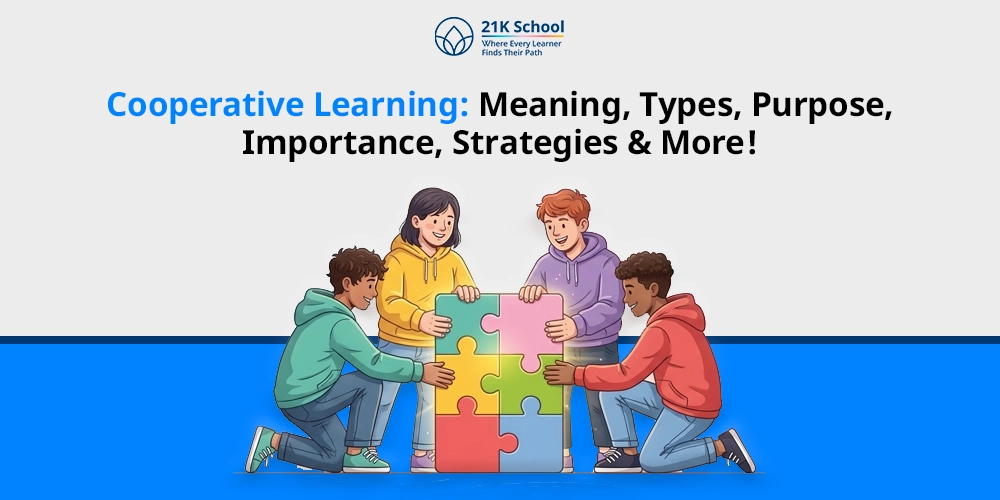
Do you know how cooperative learning helps in enhancing the learning outcomes of students?
The methods of listening and memorisation are no longer the only forms of learning in modern classrooms. Through communication, students can perform at a high level as they are able to share ideas and solve problems together.
Cooperative learning assists in creating an environment that can be employed by the teams as a powerful learning tool.
It can transform the classroom into a space in which it becomes easy to work with interactivity, self-esteem, interpersonal skills and further academic growth of the learners by encouraging group work, responsibility and team spirit.
Contents
- What is Cooperative Learning?
- What is Cooperative Learning Theory?
- 4 Types of Cooperative Learning
- 5 Purposes of Cooperative Learning
- 5 Key Elements of Cooperative Learning
- 5 Importance of Cooperative Learning
- Cooperative Learning vs Collaborative Learning
- 10 Popular Cooperative Learning Strategies/Models
- 5 Advantages of Cooperative Learning
- 5 Common Challenges in Cooperative Learning
- 5 Examples of Cooperative Learning Activities
- Conclusion
What is Cooperative Learning?
Cooperative learning involves a teaching method where students are put to work in small groups towards achieving common academic goals.
The members will not only be expected to learn, but also to help teammates succeed. It highlights positive interdependence, individual accountability and initiative.
Indeed, cooperative learning enhances the degree of knowledge, builds the socialisation process, and offers a cordial environment within the classroom that can give any learner an advantage through discussion, collaboration, and joint problem-solving.
What is Cooperative Learning Theory?
Cooperative learning theory is a method of learning in education that concentrates on learning through grouping and collaborating. It is based on the fact that learners understand better when they work towards achieving a shared goal.
The theory highlights the existence of positive interdependence, individual responsibility and participation. It promotes social interaction, teamwork, improved academic results, communication, and learning overall.
4 Types of Cooperative Learning
The methods that encourage teamwork and participation, as well as cooperation among students, are types of cooperative learning. The level of understanding, communication and problem-solving is enhanced by such practices through the use of organised group work in the classroom.
1. Formal Cooperative Learning
Formal cooperative learning involves teamwork over one lesson to a few weeks. They present teachers with the tasks, roles, and objectives in such a way that they will be able to be accountable and participate.
Students work together to implement projects, address problems or create presentations. This type facilitates deep learning, creative thinking, teamwork and collective responsibility towards the academic goals.
2. Informal Cooperative Learning
Informal cooperative learning is short-lived, and it is used a lot during a single lesson. In order to explain things, students can talk about a question in brief, sum it up or even practice in pairs. It keeps the learners on track, encourages participation and increases comprehension.
The interactive style allows the student to remain on track, as well as allowing the students to process in unison as the teaching process occurs.
3. Cooperative Base Groups
Cooperative base groups are groups that are long-term, stable groups that last for a semester or school year. The members encourage each other both academically and in social life, monitor their progress and encourage each other.
The groups are also closely interconnected; the groups must make the students feel responsible and belong, especially when they are motivated and successful at all times.
4. Constructive Controversy
Constructive Controversy This learning strategy involves cooperative groups in which students are given opposing sides of an issue and their task is to research, discuss and debate their sides.
Once they have given arguments, they will alternate positions to gain insights about the other person, which encourages critical thinking, openness, and collaboration, as well as more insight into complex issues.
5 Purposes of Cooperative Learning
Cooperative learning is meant to enhance academic knowledge by working and collaborating in a team. Cooperative learning has the following purposes.
1. Enhance Knowledge Retention
Cooperative learning enhances knowledge retention by promoting explanation of concepts, discussion of ideas, and teaching others. As the learners are actively involved in some material and communicate with each other, they process information on a deeper level.
Such productive interaction makes the learning process more effective, and students can remember the information better with time than without active participation.
2. Increase Independence
Cooperative learning promotes independence even though it involves group work. All students receive their roles and responsibilities, which allow them to become self-organised and contribute personally.
The preparation and contribution of the individual in group activities help the learner to acquire confidence and skills in making decisions, to be responsible for self-regulated learning, and to have a supportive group.
3. Increase Students’ Motivation
Learning is made more enjoyable by the interactive environment that is created by working in groups. The inclusion provides motivation towards the achievement of common ends and peer rewards.
This favourable feeling enhances enthusiasm, interest, and engagement and thus creates a rise in motivation and a desire to be actively involved in academic activities.
4. Promotes Accountability
Cooperative learning promotes the personal and collective responsibility. Every member has a role in accomplishing the designated tasks and making the team successful. Such a setup minimises free-riding and makes it fair.
Responsibility promotes effort, and commitment whereby the students get to know that their input directly influences individual group performance.
5. Encourage Active Participation
As part of co-operative learning, every student is involved in discussions and activities. Formal roles and teamwork demand that each member put forth ideas and solutions.
This participatory action makes it more engaging, helps students to better understand and avoid passivity. The engagement and collaboration between the students and instructors help them develop an interest in learning.
5 Key Elements of Cooperative Learning
The positive interdependence, individual accountability, face-to-face interaction, social skills and group reflection are the main elements of cooperative learning that will lead to improved collaboration and learning outcomes.
1. Positive Interdependence
Positive interdependence means that the individual in the group should rely on the other group members in the group in order to achieve a common goal. The success of each of the students is associated with the success of other students.
The activities, materials and positions are structured such that everyone has to make contributions. This assists in developing teamwork, collective responsibility, cooperation and mutual support such that the students are not working in solitude but collaborating.
2. Individual Accountability
One will bear the individual responsibility of ensuring that every student has their role to play and material to learn. In case of cooperation within the group, each individual must be engaged, comply with the assigned task and be capable of demonstrating the degree of knowledge.
This will prevent free-riding and will be fairer. To ensure that there is participation of people, teachers can test them separately, and this will lead to responsible behaviour, hard work and also contribute equally to the success of the group.
3. Face-to-Face Promotive Interaction
The face-to-face interaction will assume that the students will discuss the ideas, that they will explain the concepts and support each other face-to-face. Active communication would allow the learners to clarify their doubts, express their views and increase knowledge.
This kind of interaction will lead to the establishment of trust and the strengthening of relationships among the members of the group. It also enhances interaction and provides the students with a chance to learn valuable communication and cooperation skills.
4. Social Skills
In cooperative learning, the students must also acquire the necessary social skills that include communication, leadership, conflict resolution, and decision-making skills. These are the skills that assist in making members of the group work effectively.
Students are usually instructed on the importance of listening, appreciating views and solving disputes positively by the teachers who ensure a positive and healthy learning experience.
5. Group Processing
Group processing is a process of group execution and a dialogue about what worked well and what needs improvement. Members take into account their collaboration, team communication and achievement.
This reflection helps in the development of teamwork, the development of future performance and ongoing development. It encourages self-realisation and collective responsibility.
5 Importance of Cooperative Learning
Cooperative learning is relevant as it leads to better performance, social and communication abilities, teamwork, confidence, and active involvement that promotes an intriguing and positive learning environment among all students.
1. Improves Academic Achievement
Cooperative learning will result in an increase in academic performance since it encourages students to discuss ideas, share concepts and solve problems together. The peer learning method consolidates the learning and increases retention.
The group discussions clarify all and make things clear. Engagement in content facilitates the students to do well compared to passivity in the learning styles, which leads to good academic performance.
2. Develops Social Skills
Group work requires the student to acquire the necessary social skills such as communication, listening, empathy, leadership, and conflict resolution.
They get to learn to respect other points of view and work together. These people skills will not just ensure success in classrooms but also in professional and personal relationships in the future.
3. Encourages Teamwork
Cooperative learning leads to team building in which students are encouraged to depend on each other to achieve tasks and reach shared goals. Each member brings strengths and ideas.
This teamwork environment does not have any negative competition but fosters cohesion, responsibility, and a feeling of belongingness to the team.
4. Builds Confidence
Group work helps the students exchange ideas within a conducive environment. Their self-esteem increases and boosts their confidence as they contribute and receive positive feedback.
Cooperative learning eliminates fear of failure, fosters involvement and assists timid or reserved students to be confident in sharing their ideas.
5. Promotes Active Participation
Unlike the traditional learning method, in cooperative learning, all students are engaged in discussions and activities. Formal positions and teamwork require every single member to present ideas and solutions.
This action of participation makes it more interactive, serves to understand and prevent passivity. The interaction and cooperation between the students and instructors enable them to have more attention and interest in learning.
Cooperative Learning vs Collaborative Learning
Cooperative learning and collaborative learning are interactive forms of learning that entail the interaction of students. In contrast to cooperative learning, structured with defined roles and teacher supervision, collaborative learning is not strict, student-centred and directed more to collective responsibility and idea discovery.
| Aspect | Cooperative Learning | Collaborative Learning |
| Definition | The group learning approach involves students in collaborative sessions, with each student having their designated roles to fulfil the shared objectives. | The learner-centred teaching/learning model in which the students freely collaborate and exchange ideas to develop meaning. |
| Structure | Cooperative learning is very organised with prescribed functions and activities. | Learning through collaboration is less formal and more liberal. |
| Accountability | Cooperative learning lays stress on personal and collective responsibility. | Collaborative learning is more based on group responsibility. |
| Goal | Cooperative learning aims at attaining a shared academic goal. | Collaborative learning aims at discussing ideas and building knowledge. |
| Example | Jigsaw activity, Numbered Heads Together, group project with assigned roles. | Group discussion, brainstorming session, and team research project without assigned roles |
10 Popular Cooperative Learning Strategies/Models
The most widely used models of cooperative learning include Jigsaw, Think-Pair-Share, Round Robin, Numbered Heads Together and Group Investigation and Learning Together, which are designed to have students collaborate with one another in order to be more active and gain increased knowledge.
1. Jigsaw Method
The Jigsaw Method is a method that entails dividing students into small groups, and in this case, a student is allocated a certain portion of the subject. The members are initially brought together with the members of other groups that also assume the same role as experts.
They move back to their initial unit and teach their section. This plan encourages accountability, teamwork, and tolerance.
Think-Pair-Share is where students are asked to think individually on a question or a problem. They will then be divided into pairs and share their ideas.
Lastly, pairs will provide their answers to the class. It is an effective strategy of participation that enhances communication skills, as well as giving students time to digest information before sharing their ideas in a group.
3. Round Robin
The Round Robin strategy is a structured way for students to share ideas in a group in a turn-taking manner. The members give one idea at a time until they are all done.
This will give all students an equal chance, avoid domination by any single student and will promote active listening, collaborative efforts and diverse opinion in discussion.
4. Numbered Heads Together
In Numbered Heads Together, the students get into groups, and they are given numbers. The teacher poses a question, and the members of the group debate on the reply.
Then the teacher refers to any number randomly, and the student having the number answers. This plan encourages responsibility, collaboration and makes all members comprehend the content.
5. Group Investigation
Group Investigation is a technique that involves students choosing a topic, planning research, collecting information, and sharing the results. It promotes investigation, critical thinking, and self-directed learning in a teamwork structure.
Students are interested in studying topics, processing information and collaborating to create valuable results and presentations.
6. Learning Together
Learning Together emphasises small group work in which students are exposed to working together on tasks or assignments. Goals and roles are organised in such a way that the teacher provides positive interdependence and accountability.
This model enhances teamwork, communication and problem-solving skills and assists the students in common academic objectives in a conducive atmosphere.
7. Team Games Tournament (TGT)
Team Games Tournament is a combination of team learning and academic games. The students learn in teams and then perform in competitions with the representatives of other teams in a fun learning way.
The accumulation of points leads to the total score of the team. This model enhances participation, strengthens learning in competition, and encourages the students to help each other.
8. Three-Step Interview
In the Three-Step Interview, the students work in pairs. In the first, a student interviews their counterpart on a subject.
Then the roles are reversed. Lastly, every individual presents the group with the responses of his or her partner. Communication, participation, understanding, and listening skills are enhanced by this strategy using peer interaction.
9. Inside-Outside Circle
In this plan, the students are organised in two circles facing each other. Pairs discuss a question briefly, and after that, one of the circles turns to form new pairs.
This will enable students to exchange ideas with several peers. It promotes participation, allows immediate thinking, social interaction and deepens understanding by repeated discussion.
10. Reciprocal Teaching
Reciprocal teaching is a practise where students alternate roles of leading a discussion or teaching a part of the lesson. These roles are summarising, questioning, clarifying and predicting.
The approach provides understanding, critical thinking, communication and personal involvement and contributes to student learning responsibility.
5 Advantages of Cooperative Learning
Clearly, as a learning technique, cooperative learning has the advantage of improving communication skills, developing critical thinking skills, improving motivation, reducing competition, and inclusive learning, thereby making the learning process interesting, effective and useful to students.
1. Enhances Communication Skills
The students will be able to express themselves, listen and respond intelligently to each other because of cooperative learning. With the help of group discussion and common activities, students can rehearse speaking, questioning, and describing ideas.
This active interaction improves the spoken language, self-confidence and interpersonal knowledge, and trains the students to give academic and live presentations at the same time.
2. Encourages Critical Thinking
Working in groups exposes the students to divergent thinking. In the case of opinions, they contrast opinions, analyse information and justify their answer.
Such interaction encourages more rational and critical thinking as opposed to rote memorisation. Cooperative learning is also known to enhance problem-solving skills as well as help students gain logical and analytical thinking skills.
3. Increases Motivation
Group work offers favourable and interactive learning. It encourages the students to strive towards shared goals, and in addition, it enables them to find favour among their peers.
A sense of belonging and achievements boosts working motivation. Cooperative learning promotes the aspect of interaction between the lessons and makes the lesson enjoyable, hence increasing interest, effort and motivation in the learning activity.
4. Reduces Competition
This eliminates stress and unhealthy competition, and a good classroom atmosphere is formed where the learners encourage and applaud each other in their development.
This does away with the student stress and unhealthy competition among the students, and a favourable environment in the classroom is created where the students congratulate and applaud one another in their progress.
5. Supports Inclusive Education
Cooperative learning is appropriate for different learning styles, capabilities and backgrounds. Students work with one another, and students who are more advanced assist those who may need assistance.
This is an inclusive learning strategy that creates equality, respect and involvement of all members, as each student will feel appreciated and included in the learning process.
5 Common Challenges in Cooperative Learning
The obstacles facing cooperative learning are unfair contribution, group conflicts, time management issues, assessment problems, and dependency, which may in turn influence the performance of a group and the entire learning process.
1. Unequal Participation
In cooperative learning, there are students who might take most of the discussions and others who can make minimal or no contribution. This disparity limits the chances of the members who are quiet to participate and learn efficiently.
In the absence of a structured role, distinct duties, and supervision, unbalanced participation might influence justice, accountability, and unity within a group, inhibiting the effectiveness of collaborative learning in general.
2. Group Conflicts
One of the misunderstandings and conflicts in a group may be the differences in opinions, personality or styles of work. The existing conflicts are interfering with the teamwork and slowing down the speed and inspiration.
To reach harmony, the teachers will train the students about the aspects of communication, negotiation, and conflict resolution. Good management transforms conflict into a learning process as opposed to hiccups in the path of accomplishing a shared academic goal.
3. Time Management Issues
Cooperative learning activities are usually more time-consuming than the individual ones since the discussions, coordination and decision making are carried out. Such activities of this nature might prove to be more time-consuming than the time allocated to a specific class and might hamper the teaching performance unintentionally.
To ensure that the groups remain focused, time is manageable, and that the tasks of learning are accomplished within the time frame assigned to them, the teachers must know how to formulate clear goals, assign roles, as well as organise jobs.
4. Assessment Difficulties
Individual contribution in teamwork is difficult to measure. The students can also contribute more than the other students, and there are also students who may be dependent on the other students; they struggle to give the grades fairly.
Group evaluation should be incorporated with individual responsibility, and observation should be used to offer a good assessment, which should combine group evaluation and individual accountability.
5. Dependence on Others
During cooperative learning, there is a high likelihood of some students becoming overdependent on stronger individuals in order to finish tasks. This reliance hinders critical thinking and does not allow one to see the entire picture.
Lack of active student engagement might prevent students from learning relevant skills and knowledge. The teachers should design activities and functions in a way that allows every participant to take an active part in the process and become autonomous as well as collaborative.
5 Examples of Cooperative Learning Activities
Cooperative learning activities may be group projects, peer tutoring, classroom debates, problem-solving, and role-plays, among others, that will encourage collaboration, active learning and learning among the students.
1. Group Projects
Group projects are some projects undertaken by students within a duration of time in order to complete a common project like a presentation, research report, model or creative project. Every member is given certain roles and duties.
Students collaborate, share ideas and work in teams, and also solve problems in teams. By participating in the group projects, teamwork, communication, responsibility, and additional insight on the topic are also facilitated.
2. Peer Tutoring
Peer tutoring is a team activity where learners guide each other in the learning process or in doing assignments. A better student or one with a high level of confidence will give motivation to a student who may need further counselling.
This conversation is beneficial to both the learners, since the tutor reinforces the knowledge of the learner, and the learner, at the same time, receives clarity. Peer tutoring will strengthen a sense of confidence, relationships and create a positive learning environment.
3. Classroom Debates
Classroom debates are aimed at asking students to work in groups to research, create arguments and present their opinion on a particular subject. The members of the team cooperate to obtain evidence and structure ideas.
Debates will train critical thinking, communication skills and appreciation of other viewpoints. The given activity can encourage active involvement and allow students to examine the issues, considering various perspectives.
4. Problem-Solving Tasks
Problem-solving tasks need students to collaborate in order to analyse a scenario and identify solutions. Teams discuss, deliberate, and rationalise. This teamwork strategy improves the ability to think and create logically.
Throughout the process of exchanging various opinions, students can understand more and know how to handle challenges as a team.
5. Role-Playing
The use of role-playing activities entails the students performing scenarios based on the lessons. Every member in the group is assigned a particular role and works together in order to offer situations like historical events or social interactions to them.
This plan enhances compassion, empathy, and communicative abilities. Role-playing allows for interactive learning methods and makes students relate the theoretical knowledge to real-life experience.
Conclusion
Cooperative learning is a dynamic, student-centred learning that converts traditional classrooms into collaborative learning classrooms. It promotes academic knowledge, interpersonal skills and critical thinking by emphasising the importance of teamwork, shared responsibility and active participation.
The obstacles of participation differences or problems of evaluation notwithstanding, cooperative learning is very effective with well-organised strategies and planning.
It has finally led to engagement, confidence, inclusiveness, and lifetime skills that students are equipped with to achieve academic and real-life success.

You may also want to read
Why Technical Education Matters: Role in National Development
- Published on: 23 Mar, 2026
- 12 min read