

All of us study. Study and learn something new daily. But why?
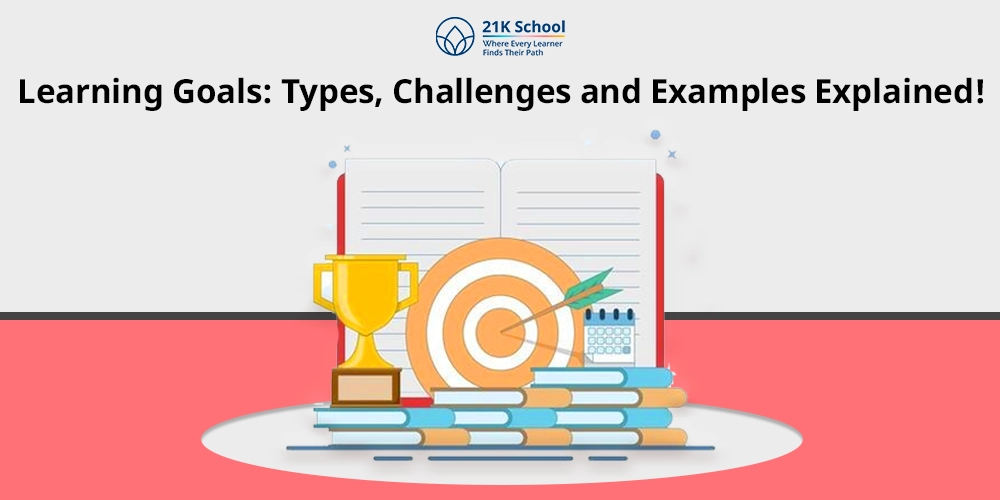
Do we have a list of targets that we need to reach after completing a certain course? Yes, these targets are what we like to call learning goals.
When these goals are clear and precise, learners and educators know how and what changes should be brought in teaching practices for best results.
Learners are also evaluated on the basis of these learning goals.
In this article, we will understand everything about learning goals including its types, features, benefits, challenges in implementing and whatnot.
Contents
- What are Learning Goals?
- 3 Common Types of Learning Goals
- 5 Prominent Characteristics of Effective Learning Goals
- 6 Top Importance of Learning Goals in Education
- 6 Popular Principles for Writing Effective Learning Goals
- Easy and Effective Steps in Setting Learning Goals
- Learning Goals vs Learning Objectives
- Common Examples of Learning Goals Across Subjects
- Impact of Learning Goals on Teaching and Learning
- 5 Common Challenges in Implementing Learning Goals
- 5 Effective Strategies to Overcome Challenges in Implementing Learning Goals
- Concluding Thoughts
What are Learning Goals?
Learning goals are generalized statements that present what the learners are expected to know or do after a course completion.
They point out the overall trend of learning and not some specific tasks.
The learning objectives focus on the conceptual learning and general long-lasting competencies instead of the instant skills.
As an example, a learning objective in a science class can be when students learnt that living organisms are interdependent in ecosystems.
Learning goals are characterized by aspects such as:
- They are usually linked to curriculum frames or disciplinary competency.
- They are a mirror of what the learners will internalize and implement in the outside world.
- They are detailed and summarise the lessons.
- They focus on long-term comprehension as opposed to short-term memory.
Learning objectives guide the learners and the instructors too.
Firstly, instructors feel confident to design curriculum and decide examination patterns.
On the other part, learners end up showcasing expectations, which makes the learning process more meaningful.
3 Common Types of Learning Goals
It is possible to arrange learning goals into three great areas of learning, including cognitive, affective, and psychomotor following the Bloom’s Taxonomy.
1. Cognitive
Cognitive learning goals are depicted through cognitive development , problem-solving , logical reasoning, and knowledge acquisition.
They concentrate on mental capabilities and ability to learn concepts of different degrees of complexity.
Cognitive goals may involve remembering information, analyzing relationships, or evaluating ideas that you should acquire.
2. Affective
Affective learning objectives include attitudinal, emotional, value education , and motivation .
They target the feelings and values of the learners evaluating the extent to which the learning experiences affect the behavior.
Affective goals are necessary in matters of social-emotional learning , civic learning, teamwork, and character-building.
It shows in collaborative learning, positive attitudes towards learning, holding responsibility, and managing emotions during setbacks in learning.
With this, students would be able to appreciate cultural diversity in the community or the school.
3. Psychomotor
Psychomotor learning goals are associated with the physical abilities, coordination, accuracy, and performance of learners.
These apply particularly in disciplines that need practical skills.
These objectives take center stage in physical education , vocational training, art, music, engineering workshops, and lab work.
For example, when students would show correct ways to play badminton or kho-kho in the field.
5 Prominent Characteristics of Effective Learning Goals
Quality learning goals have a set of features that make them clear, relevant, and long-term in their nature.
These include:
1. Broad and Visionary
Learning goals are expected to envision how the learning should be and what should continue to be used years after the lesson.
These general objectives are usually in a unit, term, or whole course.
For example, when learners memorize the definition of photosynthesis, they would also be able to comprehend how the energy is converted by plants and how they support ecosystems.
2. Learner-Centered
Good learning goals must put the emphasis on the needs of learners rather than the teacher.
The focus is changed to learning rather than on activities of teaching.
3. Aligned with Curriculum Standards
Learning goals must be related to official standards, competencies, or national structures of subjects.
Alignment with curriculum brings coherence and consistency at grade levels, institutions, and systems of education.
4. Time-Independent
Learning goals are defined as long-term results without having a time-specific limitation.
They are not fixed to individual classes or on short-term time lines.
5. Conceptual Rather Than Procedural
As opposed to learning objectives, which can be step-by-step skill or particularly task-oriented, learning goals are concept-based.
They always focus on long-term ideas.
6 Top Importance of Learning Goals in Education
The 6 most powerful importance of learning goals include as following:
1. Providing Direction and Focus
Learning objectives can assist teachers and students to know the end objective of the lesson or course.
They serve as a guide to ensure that the instructional-planning process remains focused and avoid unimportant distractions.
2. Enhancing Motivation
When learners are aware of their learning goals and they know what they need to achieve, they naturally feel motivated to act towards them.
This is how students work with increased persistence and student-engagement .
3. Improving Instructional Design
When teachers are aware of the intended results then they are able to design lessons in a more effective way.
These learning goals guide the instructional strategies, learning activities, learning materials, and the speed of learning for learners.
4. Facilitating Assessment and Evaluation
Learning goals can direct teachers to utilize relevant evaluation measures.
The exam patterns, question formulation, and basis of assessment, everything seems predictable with known learning goals.
5. Supporting Differentiated Instruction
Well-articulated learning goals can emphasize the required skills and concepts.
So that teachers can adapt the teaching process to the needs of different learners.
6. Encouraging Self-Regulated Learning
When students have the knowledge of the goals, they can plan, monitor as well as assess their own learning.
Self-regulated learning develops as an outcome when learners are able to determine progress by having clarity of expectations.
6 Popular Principles for Writing Effective Learning Goals
To compose effective and quality learning objectives, there are a number of principles that guide teachers.
1. Align with Curriculum Standards
All learning objectives must demonstrate national or institutional standards of competencies and expectations.
Such alignment provides accuracy and consistency of discipline-specific relevance at different grades.
2. Focus on the Learner
Learning objectives underline what the students should know or do.
The actions of the teacher, or what the classroom operations are of least focus.
3. Use Clear and Simple Language
The learning goals must be understandable to every party involved, teachers, learners, parents, and administrators.
Therefore, these learning goals should be written in generic words without any complicated technical phrases.
4. Ensure Breadth and Relevance
A clearly constructed learning goal addresses a long-lasting theme or concept.
It should be broad and relevant, that can bring out the knowledge or skills that have long-term appeal.
5. Encourage Higher-Order Thinking
The learning goals should be beyond mere memorization.
They should allow and develop analytical skills , problem-solving abilities , creativity, and application.
This would build greater learning and transferable knowledge.
6. Consider Long-Term Impact
Even when the assessment is done, the best learning goals do not lose their relevance.
Those mirror the big picture of the core competencies that the learners might bring into further learning or real-life situations.
Easy and Effective Steps in Setting Learning Goals
The following rules would help you curate learning goals for yourself or the school curriculums.
Step 1: Identify Desired Learner Capabilities
The first step is to identify the high-level competencies that learners should acquire. Such abilities can be conceptual, practical, value-based, or dispositions.
Step 2: Analyze Curriculum Standards
You should make sure that learning objectives are in line with the demands and subject standards.
So, first go through all these curriculum standards and what best suits to be included.
Step 3: Determine the Learning Domain
It involves determining whether the goals represent cognitive skills, affective skills, or psychomotor skills.
Knowledge of the domain will guide you to choose the right activities to evaluate the learners.
Step 4: Write Broad, Overarching Goal Statements
Write broad and overarching statements outlining the end desired results.
Such statements need to be simple in order to cover several lessons or units.
Step 5: Break Goals into Specific Objectives
Goals should be general but can be split into performance objectives. These should be measured daily while giving instructions and conducting evaluations.
Step 6: Align Teaching Methods
Teaching methods should be aligned with what you aim to learn.
These can be either with fun-learning activities or direct instruction.
And on top of that, collaborative learning and inquiry-based learning can also assist in making learners reach their true potential.
Step 7: Design Assessments
Flipped learning assessments might be apt for assessing the learning goals.
Formative assessments will help in guiding instruction, and summative assessments will help measure mastery.
Step 8: Reflect and Revise
Reflect on your written learning goals using feedback from learners or other stockholders.
Review these goals according to the needs to enhance clarity and relevance.
Learning Goals vs Learning Objectives
At this point, you might think that learning goals and learning objectives are both the same. But, that is not true.
Let’s understand with a table.
| Aspects | Learning Goals | Learning Objectives |
| General properties | Collaborative, extended, and theoretical. | Specific, measurable and short-term. |
| Focus on | Elaboration of overall results. | Speak about specific competencies or activities. |
| Caters as | Teacher-centered and learner-centered. | Firmly connected to both lessons and activities. |
| Time-dependency | Time-independent. | Time-bound. |
| Example | Learners will be able to appreciate the need to conserve the environment. | Students will name the top 5 big sources of pollution. |
Goals tend to be visionary, while objectives outline the action.
Common Examples of Learning Goals Across Subjects
The learning goals can be varying depending on different subjects.
Let’s have a look at them individually.
1. Language Arts
Students would learn to appreciate multiple literary genres.
They would even be able to understand the significance of language skills and power of words.
Their vocabulary would also improve as they reach the end of the semester in language arts.
2. Science
Learners could realize the ways in which all phenomena in this world occur because of scientific revelations.
And by discovering more of them, we can find solutions to real-world atrocities.
They would attain the environmental awareness required for sustainable education in present scenarios.
Another learning goal could be the ability to counter questions and reason about different scientific phenomena of the world.
3. Maths
The students can be aware of patterns and able to reason mathematically to make conclusions in practical scenarios.
They would learn the connections between the numbers, operations, and problem-solving.
4. Social Studies
The students might learn about the historical, cultural, political, and economic forces that form societies, while assessing various ideas regarding past and present issues.
They can also acquire skills of becoming responsible citizens, thus engaging in civic activities.
5. Physical Education
Physical education is a subject that can inform students of the significance of physical exercises and how to take care of their health.
They might also learn to build teamwork strategies, depicting empathy , collaboration, and confidence through physical activities.
Impact of Learning Goals on Teaching and Learning
Learning goals can impact every level of education and educational planning.
Not just the learners, but teachers also get involved in how educational planning results in a better future for the kids.
1. Impact on Teachers
Instructional planning is anchored on learning goals.
In the case of teachers, clear and well-defined learning goals are a form of clarification for their teaching process.
This is because a learning process involves a lot of activities that need planning rather than being spontaneous or abrupt.
Even the evaluation methods, including differentiated-learning strategies can be better executed.
This gives professional autonomy and confidence while handling classes.
2. Impact on Students
Good learning goals can directly benefit students.
Learning goals are more than just administrative or curriculum statements.
They assist in developing attitudes and behaviors among students to determine how successful they would be in their studies.
These learning goals give learners the ability to follow self-regulated learning with enhanced motivation and confidence.
3. Impact on Educational Institutions
The learning objectives affect the whole functioning system of the educational institutes.
Starting from curriculum coherence to utilizing the data in decision making, learning goals shape how education operates.
By understanding and reviewing the learning goals, schools and colleges can ensure better professional cooperation and greater accountability for lesson-plannings.
5 Common Challenges in Implementing Learning Goals
The learning goals implementation might face some challenges that need everyone’s attention including that of teachers, learners, and institutional administrators.
These are as follows:
1. Lack of Training
Limited professional development in terms of learning goals can be one of the most prevalent obstacles.
Most educators lack the knowledge of how to write effective learning goals or how to match them with their instructions and assessments.
In the absence of proper training, learning purposes can be either vague and inconsistent.
2. Overemphasis on Measurable Objectives
There can be pressure in certain environments to develop measurable learning goals.
With its increased emphasis, the real essence of learning, having critical thinking and creativity, slips out of attention and evaluation.
3. Diverse Learner Needs
There can be differences in students in terms of their background, abilities, learning styles, and interests.
Therefore, it may be challenging to develop inclusive goals.
Educators might be hampered by the fact that learning goals can no longer be pertinent to every learner.
Learning goals need to align with everyone including children with special needs .
4. Limited Resources
Implementing learning goals can be a time-consuming process that needs the right amount of time, materials, and support.
Some institutions might be deprived of required resources, which include training programs, planning-time, or reference materials.
The limited resources can make it hard for educators to match instructions with learning goals.
5. Misalignment with Assessment
Issues of non-congruence between assessment methodology and learning goals can be common.
In case the assessments fail to gauge on the desired learning goals, then the students are given false information, and educators find it hard to assess actual learning.
5 Effective Strategies to Overcome Challenges in Implementing Learning Goals
We can follow the following strategies to overcome above-mentioned challenges while formation and implementation of learning goals.
1. Professional Development
To reach learning goals, teachers need to be well-trained.
This professional development can lead educators to assign, assess, and assist children to reach their desired learning goals.
These learning goals can be manifested differently in different individuals and educators need to understand this.
With repeated practice, attending educational workshops, and seminars can surely make a huge difference.
2. Collaborative Planning
Cooperation can make implementation of learning goals stronger.
Collaborating teachers will be able to exchange ideas, revise and correct learning objectives, establish interdisciplinary relationships, and set high consistency grade-wise.
Teamwork can support innovativeness and can aid in developing coherent teaching plans.
3. Student-Centered Approaches
The goals become more meaningful by placing students in the centre of learning.
Teachers can provide the knowledge of learning objectives.
This would enable learners to form their own targets, monitoring their progress, and reflect on their learning.
The student-centered learning practice can enhance their involvement while assisting them to relate these goals to the real world.
4. Flexible Teaching Methods
Different needs of learners cannot be satisfied by the use of a single instructional approach.
There are methods that should be employed by teachers which include inquiry-based learning, differentiated tasks, project-based learning , and cooperative learning .
Flexibility simply means that every student should have access to the resources for achieving the objectives of learning.
5. Continuous Reflection
Continuous reflection can aid in improved teaching and schools to become better.
The teachers must consistent enquire:
- Do the learning objectives specify and have meaning?
- Does the teaching methodology fit the objectives?
- Do they measure what they should assess?
- What are the reactions of students about the goals?
Reflection can give rise to revisions which make the entire learning process stronger.
Concluding Thoughts
Learning goals can be said to be the result of all of your hard work and persistence in academics.
Even teachers should work in favour of students to prepare them for the future shortcomings with these learning goals.
Having clear goals while learning something new gives you a pathway and scope of improvement, which should be utilized wisely.
Read all the learning goals above and work for their attainment by following certain strategies mentioned in the article.

You may also want to read