

Learning can be classified into two major types: active learning and passive learning. But what is the difference, and is there one which is better than the other?
Well, you might find out what is the case, once you read the following article on active learning vs passive learning.
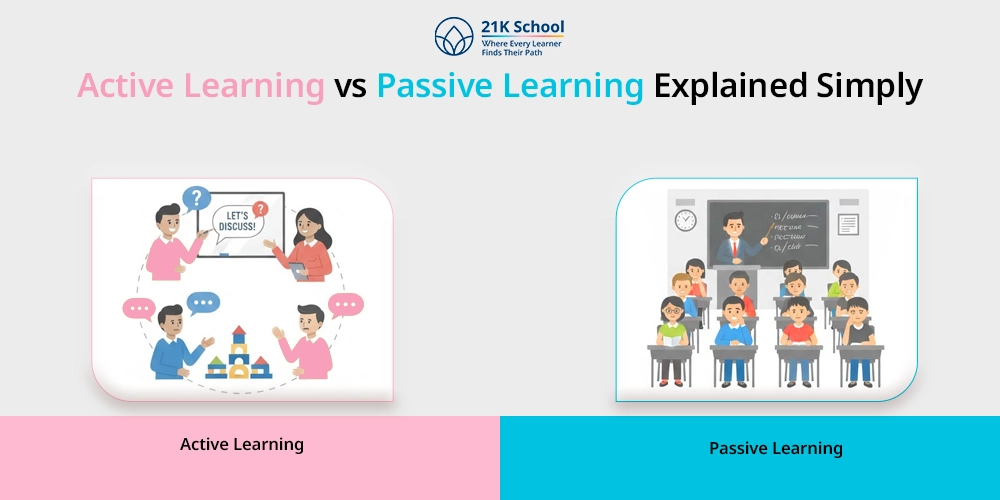
For a brief introduction, active learning involves students in the learning process actively.
For example, when students engage, ask questions, do experiments, read the lessons themselves, or work in collaboration with others it is active learning.
On the other hand, passive learning is where teachers take charge of the learning process. They design what and how learners study to ace in exams.
Contents
What is Active Learning?
Active learning is a teaching method where the learners are active participants in the learning process and not passive receivers of information.
It insists on involvement, interaction, teamwork , and self-reflection.
Through analysis, questioning, discussing, applying, and creating knowledge learning becomes a dynamic participatory process.
Active learning is based on the constructivist learning theory. It involves learners who build knowledge from experience and reflection, instead of merely receiving facts taught to them by a teacher.
If you want to learn more, you can read about constructivism in education .
Characteristics of Active Learning
Active learning includes the following features that set it apart from passive learning:
- Student-oriented: The students play an active role in learning.
- High degree of involvement: Students interact with the content, peers, and instructors.
- Critical thinking and problem-solving: Focus is laid on evaluation, application, and analysis of knowledge.
- Teamwork: Discussions, teambuilding, and peer learning are typical.
- Reflection: The students are supposed to reflect on what they have studied and how they have acquired the knowledge.
- Real-world use: Learning exercises are usually imitations of a real-life scenario.
Examples of Active Learning
Active learning can be seen as the following instances:
- Discussions and debates in groups
- Case studies
- Simulations and role-playing
- Think-pair-share activities
- Practical experiments and laboratories
- Peer-led presentations or instructions
These activities involve students in thinking actively and practical application of knowledge as opposed to passive memorizing of information.
What is Passive Learning?
Passive learning is a traditional method of instruction, which provides information with minimal involvement of the learners.
The teacher is considered to be the primary source of knowledge and the students are supposed to listen and memorize information.
This type of learning includes one-way transfer of knowledge without giving much space for students to express their thoughts.
Passive learning is a learning process which is considered to be a reaction to outside stimuli or resources.
Characteristics of Passive Learning
These are the features of passive learning:
- Teacher-oriented method: The teacher decides the process of learning.
- Reduced engagement of students: Students mostly listen or watch.
- Memorization: It is concentrated on memorizing facts and information.
- Constrained interaction: Students are not given many chances to interact.
- Standardized teaching: The teaching is the same for all the learners.
- Assessment based: Exam and quiz-based learning is common.
Examples of Passive Learning
As a student, you can witness passive learning through:
- Reading textbooks without discussions
- Watching educational videos by yourself
- Listening to presentations
- Rote memorization
- Taking notes directly from teachers’ writings from whiteboards.
- Traditional lectures
Passive learning is good when a large audience is to be catered to, but it reduces the retention levels and lacks deeper understanding of lessons that are taught.
Active Learning vs Passive Learning: 11 Key Differences
The following table and its detailed explanation below will assist you in deciding between active learning vs passive learning:
| Differentiating Aspect | Active Learning | Passive Learning |
| Learning Approach | Experiential and participatory | Information-based |
| Student Role | Active participant | Passive recipient |
| Teacher Role | Facilitator or guide | Instructor or lecturer |
| Interaction | High | Low |
| Critical Thinking Skills | Strongly developed | Minimally developed |
| Retention | High long-term retention | Lower retention |
| Learning Style | Collaborative and flexible | Individual and rigid |
| Classroom Environment | Dynamic and interactive | Structured and quiet |
| Engagement | High engagement | Low engagement |
| Responsibility | Shared responsibility | Teacher-centered responsibility |
| Learning Outcome | Deep understanding | Surface-level knowledge |
1. Learning Approach
- Active Learning: Active learning is based on a learning-by-doing strategy in which students perform activities that involve the application of learned concepts.
- Passive Learning: Passive learning is based on the process where information is fed to the learner by the teacher and there is a one-way flow of knowledge from the teacher to the learners.
2. Student Role
- Active Learning: In active learning, learners are the players and the responsible contributors for their learning.
- Passive Learning: Passive learning involves students who act as listeners/observers in the learning process and there is minimal involvement by the learner.
3. Teacher Role
- Active Learning: Active learning introduces the teacher as a guide or helper for the students who discover and learn new things.
- Passive Learning: In passive learning, teachers are the main source of information who plan and execute learning in the traditional schooling systems.
4. Interaction
- Active Learning: Active learning classrooms have a higher level of interaction among learners, their mates, and teachers as they discuss lessons and collaborate to enhance learning.
- Passive Learning: Passive learning involves little interaction because students only listen and take notes of what is taught by teachers.
5. Critical Thinking Skills
- Active Learning: Students who are involved in active learning might have better critical thinking abilities as they plan, discuss, and learn independently.
- Passive Learning: It is quite challenging to build critical thinking in learners who rely on memorization through passive learning.
6. Retention
- Active Learning: Active learning results in an enhanced retention rates in the long-run since students actively engage with the content.
- Passive Learning: Passive learning usually leads to a short-term memorization and the learning acquired is soon forgotten, usually once the tests are over.
7. Learning Style
- Active Learning: Active learning accommodates different learning styles by involving the use of visual, auditory and kinesthetic activities.
- Passive Learning: Passive learning tends to be homogeneous which generally favour auditory learners.
8. Classroom Environment
- Active Learning: Active learning produces an interactive, positive learning environment in which participation and discussions are typical.
- Passive Learning: A passive learning setting is usually organized and quiet as teachers give lectures.
9. Engagement
- Active Learning: Participation tends to make students more motivated and more attentive in the course of active learning.
- Passive Learning: Passive learning may result in decreased involvement from students and lack of interest in the long run.
10. Responsibility
- Active Learning: In the process of active learning, the responsibility of learning is distributed between teachers and students.
- Passive Learning: During passive learning, the teacher is the one who has the greatest responsibility and the students are highly dependent on them.
11. Learning Outcome
- Active Learning: Active learning leads to good comprehension and development of life skills that can be transferred even outside the classroom.
- Passive Learning: Memorization and rote learning involved in passive learning may result in superficial knowledge acquisition ignoring the practical skills required.
Conclude It All
Though active learning may seem to be the best option for teaching students, passive learning is also necessary for teaching fundamental lessons like alphabets and numeracy.
These things can only be learned through repeated memorization which is taught by the teachers in the classrooms.
After a certain age, students can learn actively and explore whatever they would like to learn and engage with others to build their academic and non-academic proficiency.

You may also want to read