

Growing up, we often used the terms knowledge and information exchangeably.
But are they the same? We know that many of you would agree with that.
Here’s the surprise that information and knowledge are completely different concepts and need your attention to get the dissimilarity.
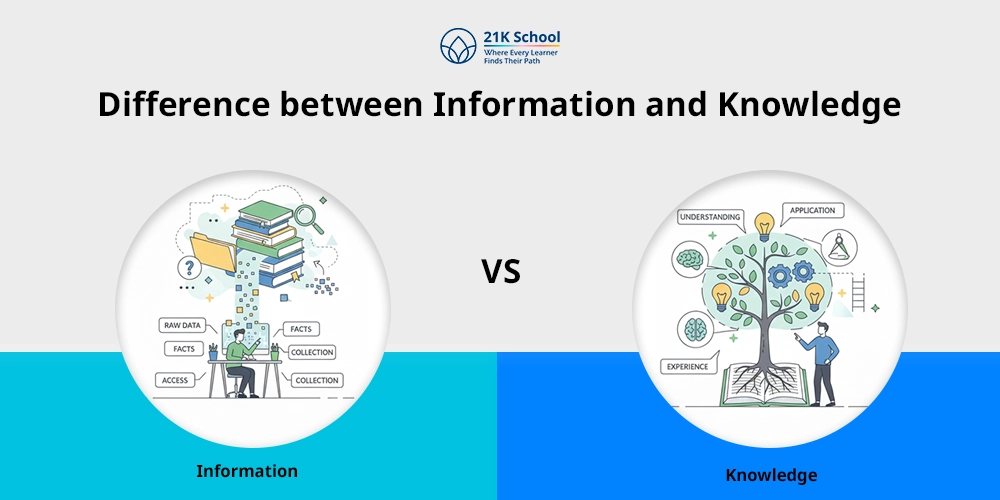
Information is completely fact-based, but knowledge is more about your perception of the information, based on your observation of life.
This article will give a detailed view of the difference between knowledge and information, clearing your confusion.
Contents
Key Difference Between Information and Knowledge
Let’s see some more differences between information and knowledge with a table:
| Aspect | Information | Knowledge |
| Definition | Data is organized/processed which has meaning and can be communicated. | The realization that comes as an experience, as learning, or through information interpretation. |
| Nature | Objective, factual, and statistical | Subjective: Involving personal knowledge as well as personal perception and experience. |
| Dependence | Based on data; information derived out of raw data. | Depends on information; knowledge comes out of the perception of information. |
| Form | Can be presented either verbally, numerically, symbolically, or pictorially. | It is in the human mind in the form of experience and learning. |
| Function | Helps minimise uncertainty and contextualises. | Assistance in decision-making , problem-solving and putting learnt concepts in practice. |
| Action | Easy to share using documents, books, or digitally. | It is applied to make judgments, predictions, or actions. |
| Example | The sun rises in the east and sets in the west. | To know why the sun always sets in the west and rises in the east. |
| Transformation | Processed data becomes information. | Information becomes knowledge when internalized and applied through experience. |
1. Definition
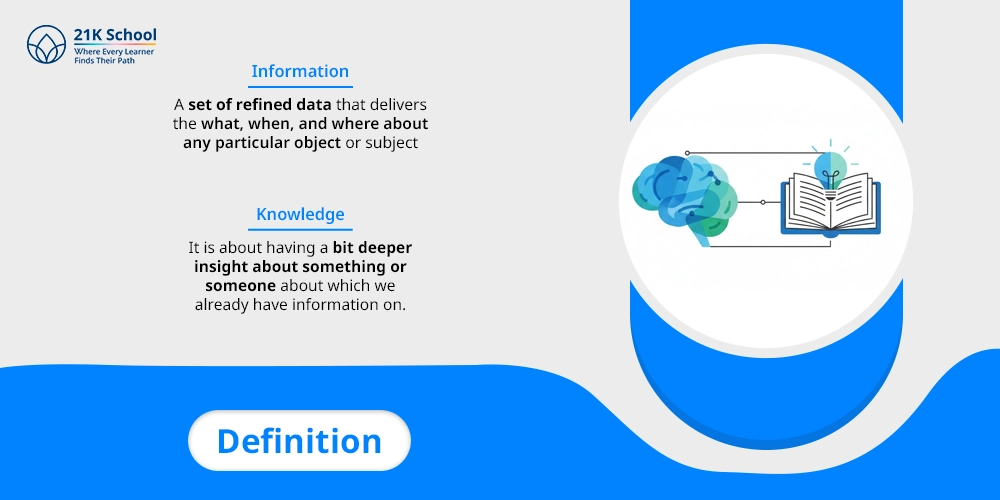
- Information: A set of refined data that delivers the what, when, and where about any particular object or subject in question.
- Knowledge: Knowledge is about having a bit deeper insight about something or someone about which we already have information on. It comes with understanding of how and why.
2. Nature
- Information: Information can be as it is wherever it goes. It can be transferred because it is objective, and external facts.
- Knowledge: Knowledge on the other hand is much more internalized and subjective based on an individual’s opinions. It can evolve with our own understanding of life and other things.
3. Dependence
- Information: Information is a product of organized data, and so is dependent on external facts for its credibility.
- Knowledge: Similarly now knowledge states its dependency on personal perceptions and information. The basic information becomes better once it is combined with prior learning .
4. Form
- Information: Information is unchanged, which means it can be stored for long-term as videos, text books, or voice recordings and retrieved whenever we want.
- Knowledge: The basic form of knowledge is malleable that changes over time and experience, even when with the same person. Teachers can not give you knowledge, they can give you information.
5. Function
- Information: All the information that you get is to deliver or state facts about the topic you have been searching for. It informs you about everything related to that subject.
- Knowledge: When you get all information about something, based on the knowledge that you have gained, you can make desired decisions that favours your situation.
6. Action

- Information: Information is for gathering knowledge only. Facts are organized to deliver information.
- Knowledge: This information now can be utilised to get things done with actions. It means you can make decisions based on information gathered from external means and internal supervision.
7. Example
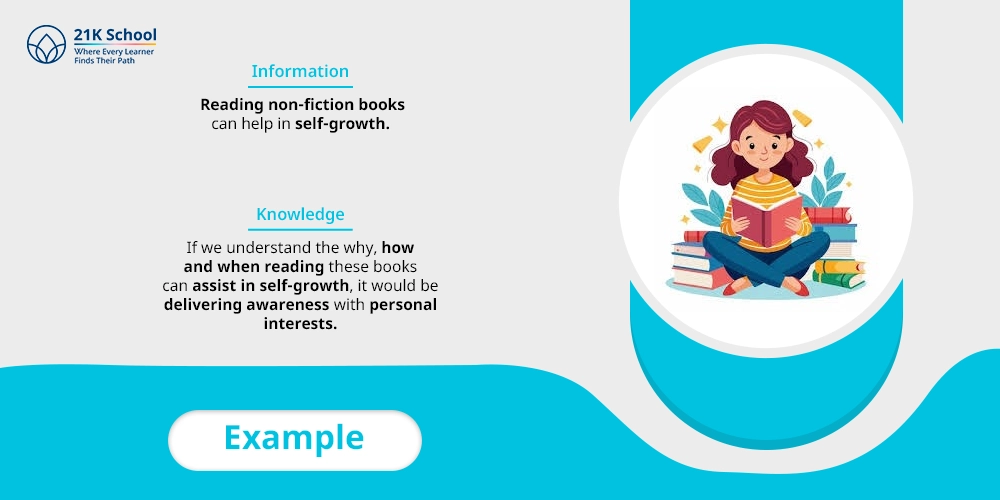
- Information: Information can look like “reading non-fiction books can help in self-growth”. This is a fact.
- Knowledge: Now, if we understand the why, how and when reading these books can assist in self-growth, it would be delivering awareness with personal interests. This shows knowledge.
8. Transformation
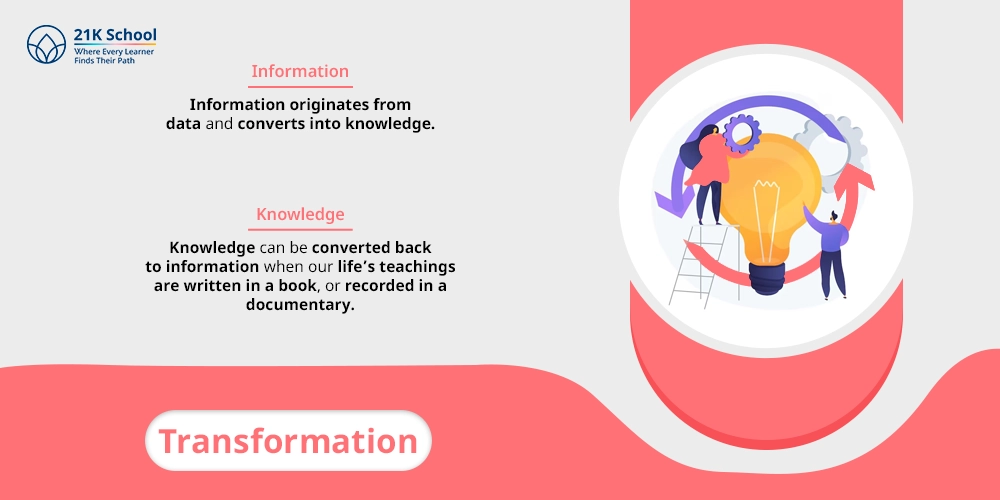
- Information: We already saw how information originates from data and converts into knowledge while also accumulating personal consciousness and interests.
- Knowledge: Knowledge can be converted back to information when our life’s teachings are written in a book, or recorded in a documentary.
What is Information?
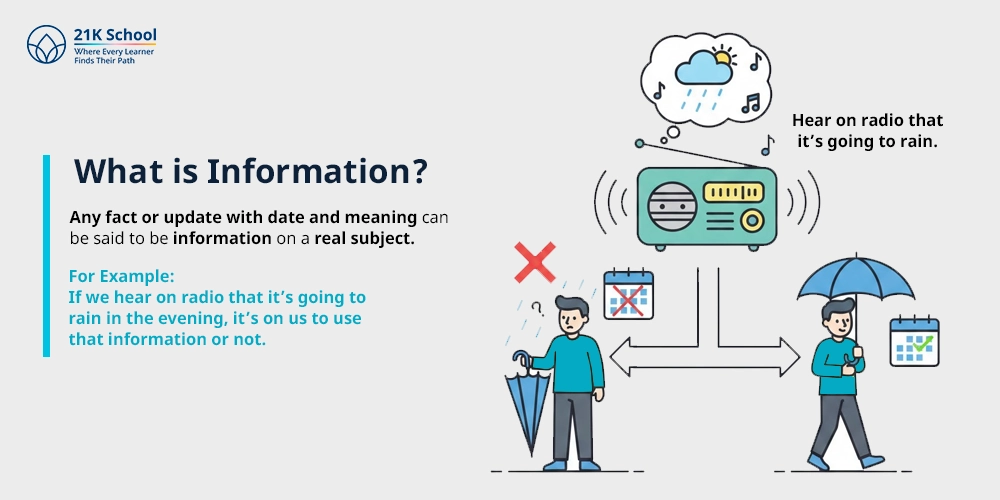
Any fact or update with date and meaning can be said to be information on a real subject.
Unlike data which is raw and unstructured, information gives you the raw material to take actions based on your beliefs and understanding.
For example, if we hear on radio that it’s going to rain in the evening, it’s on us to use that information or not.
1. Characteristics of Information
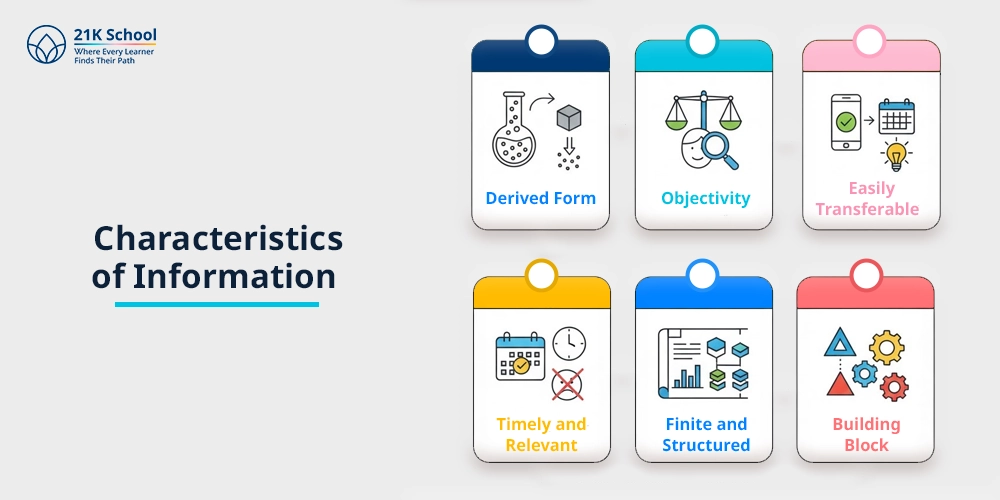
The relevant features of information might include:
- Derived Form: An information is based on raw data (numbers, facts, or symbols) and processed into a form of meaning.
- Objectivity: It tends to be objective without corresponding to any experience.
- Easily Transferable: It is able to be shared, copied and stored in different formats.
- Timely and Relevant: The useful information has to be timely and it has to be pertinent to the situation.
- Finite and Structured: Information is usually confined to certain facts or situations such as a report or statistic.
- Building Block: It is the basis of building understanding and knowledge.
2. Sources of Information
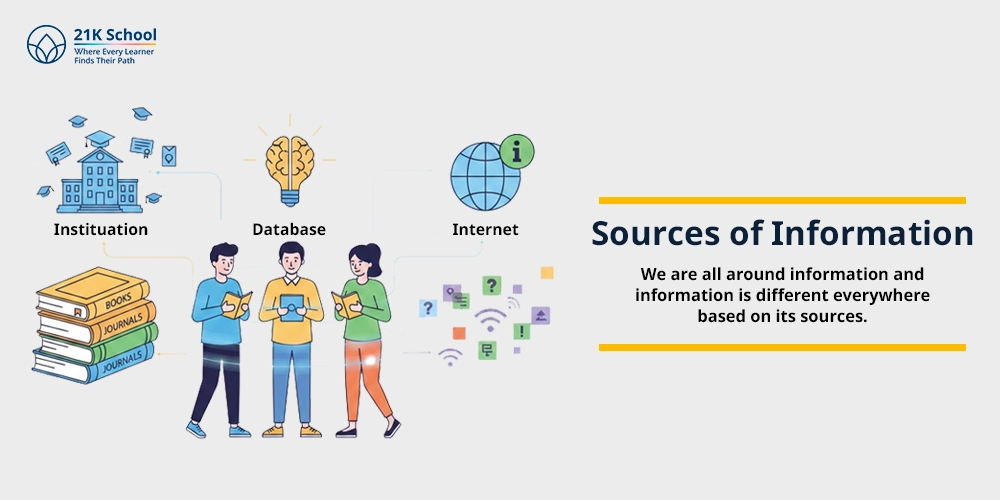
Concisely, we are all around information and information is different everywhere based on its sources. It has an actual value depending on its understanding and application, resulting in knowledge.
Firstly, the books and journals that we read are great ways to get informed.
Your schools and other educational institutions provide the source of academic and structured knowledge.
The internet and databases utilized by almost everyone in present times provide enormous amounts of information which are sometimes unreliable.
If you really want real information you can depend on authorized webpages like wikipedia, and others that provide up-to-date and factual data.
Another least referred source of information for the general public can be surveys and reports that include particular data, obtained to be analyzed.
What is Knowledge?
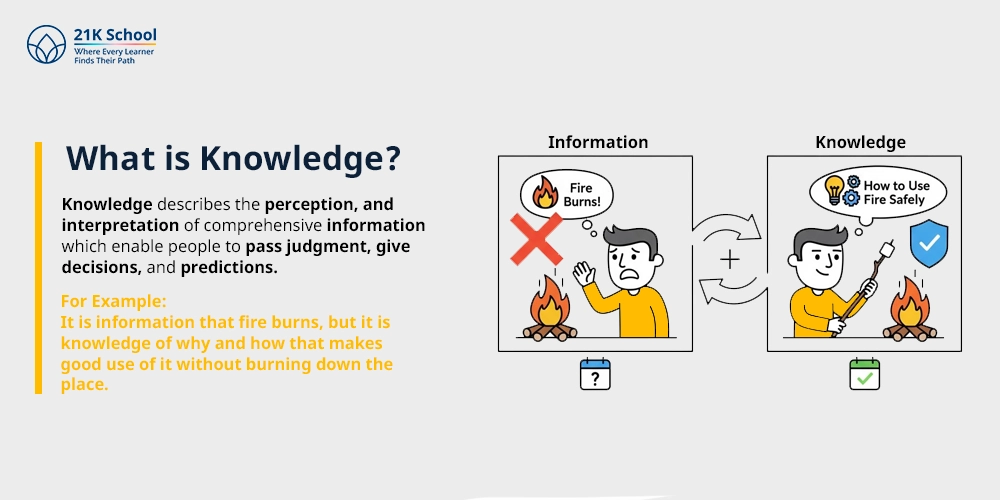
Knowledge describes the perception, and interpretation of comprehensive information which enable people to pass judgment, give decisions, and predictions.
Facts are one thing. Understanding and experience is what makes facts meaningful to us.
As an example, it is information that fire burns, but it is knowledge of why and how that makes good use of it without burning down the place.
Knowledge provides reasoning which would help to critically thinking , innovate, and solve problems.
1. Characteristics of Knowledge
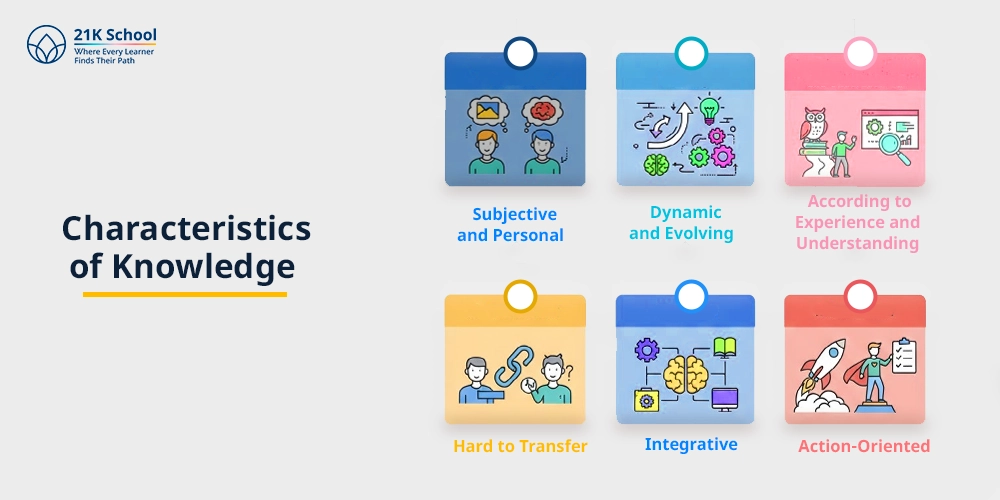
The following features can best describe knowledge:
- Subjective and Personal: The wisdom of any individual is based upon his own perception and experience.
- Dynamic and Evolving: The knowledge is deeper and changes with the course of the time when some new knowledge is formed.
- According to Experience and Understanding: It develops by practicing and reflecting on life’s happenings.
- Hard to Transfer: It cannot be fully expressible by words or text, it may need proper mentorship or practice.
- Integrative: It entails the integration of data, information, intuition and reasoning to coherent understanding.
- Action-Oriented: With the class of knowledge, it is what allows a person to make a decision or even take an action.
2. Types of Knowledge
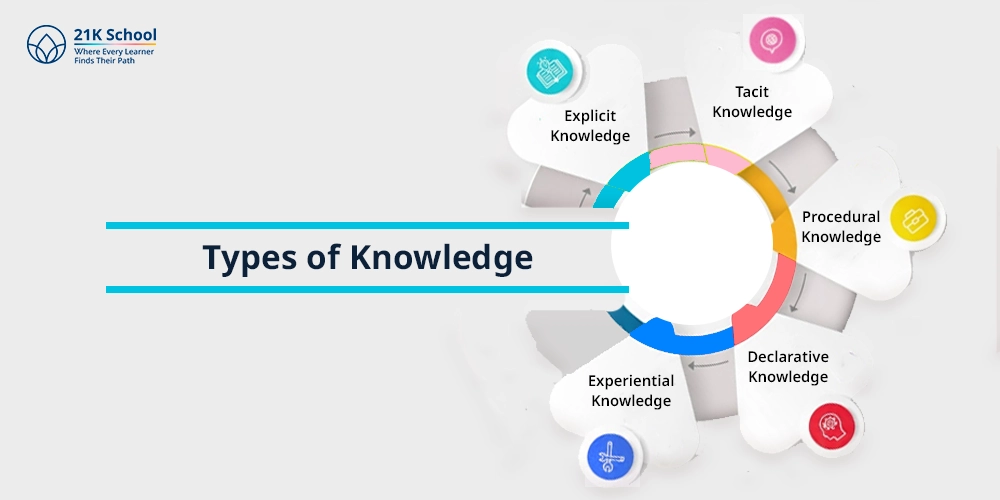
The combination of the forms of knowledge assists people to jump out of memorization into critical use of wisdom.
Knowledge can be classified into the following types- Explicit Knowledge: It is easy to express, record and distribute by the help of available books, references, and websites. Example: Learning a table of contents.
- Tacit Knowledge: It is in accordance with personal experience and intuitive skills of students, which are hard to express or write down.
- Procedural Knowledge: This is the knowledge of being aware of the way to do things like knowing how to write an article.
- Declarative Knowledge: Having knowledge of facts and information on something. When someone asks you the capitals of nations or the law of gravity, you need to dig into your declarative knowledge.
- Experiential Knowledge: The only way to gain experiential learning can be possible through direct experience and practice. Indicatively, as you learn in your failure or success in business or relationships.
Conclusion
There are two different concepts of receiving data named as knowledge and information.
The information may be present without the knowledge. But the knowledge would get its form when the information is exposed to human perception.
Action, innovation, and problem-solving are introduced by knowledge but information alone is limited to awareness only.
And that’s why we need to find and understand the difference between information and knowledge, so that you have a clarity on which information to consume

You may also want to read