

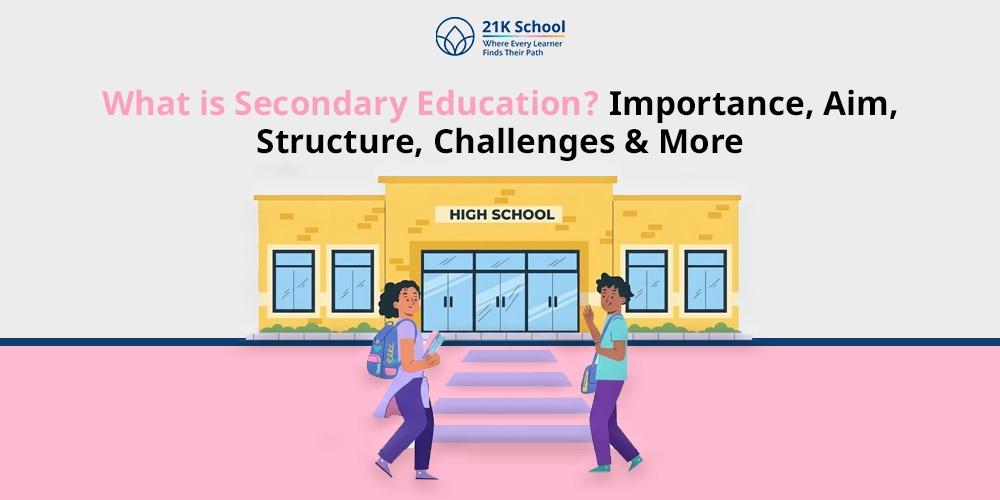
Secondary education is an essential part of a student’s overall educational learning. But still, records suggest that many learners drop out of schools at secondary education level.
Can you tell why? Secondary education acts as a bridge between elementary education and higher education, and equips children with necessary basics of job-related skills.
When parents would know the importance, structure, curriculum, and challenges of secondary education, they might feel confident of admitting their children into high schools.
This article will deeply explore secondary education and inform you about its age range.
Contents
- What is Secondary Education?
- Structure of Secondary Education
- Aims of Secondary Education
- Importance of Secondary Education
- Curriculum and Subjects in Secondary Education
- Age Range in Secondary Education
- Difference Between Primary Education and Secondary Education
- Secondary Education and Career Preparation
- Challenges of Secondary Education
- Conclusion
What is Secondary Education?
Secondary education is the formal education that follows primary or elementary education and precedes higher education.
It is aimed at offering students richer academic content, critical thinking skills, and practical skills that could be useful for future learning and career progression.
The secondary education system in India intends to extend elementary education, where learners grasp the basics of language and mathematics amongst other core subjects.
Secondary education builds understanding of more complex subjects like science, social science and other optional subjects.
It is also at this stage that students mature intellectually, gain problem-solving skills, and become capable of thinking independently.
The curriculum is more rigorous and effective than elementary education.
There are several educational boards that conduct secondary education in India among which the Central Board of Secondary Education (CBSE) stands ahead.
Thousands of schools all over the country follow the CBSE curriculum and are known because of their standardized syllabus and national-level board exams.
State boards and other International boards also offer students secondary education.
After completion of secondary education, the students tend to take board examinations, which tests their knowledge and academic performance.
Such tests tend to affect their enrolment into secondary high disciplines, colleges, and vocational programs.
Structure of Secondary Education
Secondary education follows the following structure, training students as they grow into responsible citizens of the society:
1. Lower Secondary Education
Lower secondary education consists of Classes 9 and 10.
Lower secondary education aims at enhancing the learning of the student on basic academic subjects.
These are taught by teachers to teach analytical skills to students and use their knowledge to solve problems.
Students also start to research other subjects like computer science, environmental studies, and vocational courses.
Through this exposure learners can acquire new interests and skills.
At the end of Class 10, the students tend to take board exams offered by education boards such as CBSE or state boards.
These tests evaluate the general knowledge of the students, and identify if the students are ready to begin their next phase of learning.
2. Upper Secondary Education
The upper secondary education comprises Classes 11 and 12 is commonly known as higher secondary education.
At this level, learners elect a certain academic stream depending on their interests and career aspirations.
The most popular streams are Science, Commerce, and Arts or Humanities.
The streams are specialized in nature and equip students to pursue higher education with professionalism.
As an example, science students can take physics, chemistry, and biology subjects, whereas commerce students can choose economics, accounting, maths, and business studies.
Secondary education also focuses on independent learning, research skills, and critical thinking.
Students also participate in multiple projects, presentations, and other extracurricular activities that enable their overall development.
Class 12 students undertake board exams at the end of Class 12, which plays a huge role in deciding whether they are qualified to study in college or take up professional courses.
Aims of Secondary Education
The main goals of secondary education revolves the points mentioned below:
1. Provide advanced academic knowledge
One of the objectives of Secondary education is to offer more in-depth and advanced knowledge in different subjects.
The curriculum at this level is more intensive and well-focused as compared to elementary level.
Mathematics, science, social studies, and languages offer students more complicated ideas, so the students can have better academic backgrounds that prepare them for higher education.
2. Development of critical thinking skills
Secondary education gives students an opportunity to think, examine the information, and analyze others opinions.
The process aids in the development of the critical thinking skills, which are necessary in the process of solving real issues and a well-informed decision making.
Discussions, assignments, and project-based learning enable students to become independent thinkers and logical during problem-solving.
Personal development and social awareness are also other significant objectives of secondary education. Students are taught social values, respect for diversity, and ethical conduct that ensures culture awareness.
Discussions and community programs involve students in group activities that enable them to acquire teamwork, leadership skills, and communication abilities.
4. Preparing students for higher education
Students who go to secondary schools are trained with the academic requirements needed for college and university admissions. It also influences them to do in-depth study of their career-oriented subjects.
Students are equipped with knowledge and skills for continuing their higher education in their preferred fields by the time they have completed their secondary education.
5. Encourage creativity and innovation
The modern secondary education systems believe in creativity and innovation.
Students are also encouraged to be very creative and have problem-solving skills.
Science projects, art programs, and entrepreneurial workshops aid in unleashing the imaginations of the students and build novel ideas.
Importance of Secondary Education
Secondary education is crucial for many reasons in a student’s life:
1. Expand knowledge and intellectual capacity
Secondary education expands knowledge of the students in various subjects and disciplines.
It promotes curiosity and intellectual pursuit, and assists students in gaining a better perception of the world.
This level of education also enhances research capabilities, analytical thinking, as well as communication skills of students.
2. Economic development
An educated population helps in the economic growth of a country. Secondary education promotes the skills and knowledge needed to start a business or work in corporate future jobs.
Students who attain secondary education have a better chance to acquire higher education or vocational training, which makes students more employable and productive.
3. Social equality and mobility
Secondary education is important in the promotion of social equality.
This assists people with diverse backgrounds in enhancing their social and economic positions through the provision of equal learning opportunities.
Education allows individuals to eliminate poverty and enhance social mobility.
4. Development of responsible citizens
Secondary education aims at making responsible and knowledgeable citizens as well. Students learn about civic duties, democratic rights, ethical guidelines, and environmental sensitivity.
This kind of knowledge allows learners to be actively involved in the society and make their contributions towards the growth of their communities and the country.
Curriculum and Subjects in Secondary Education
In secondary education, the curriculum is designed in such a way that students gain as much academic knowledge and practical skills as possible. This further equips them to take higher education and career-related jobs.
The syllabus is more elaborate at this stage than at primary education, where the students get a chance to investigate subjects more thoroughly.
The secondary education system in India is mostly based on compulsory and optional courses in school.
These topics also strive to understand intellectual skills, critical thinking, and real-world knowledge.
Core Subjects
The central or core subjects that students study during secondary education level are as follows:
- Mathematics: Includes algebra, geometry, statistics, differentiation, and integration.
- Science: Physics, chemistry and biology are the subjects that enable students to learn about principles and application of science in the real world.
- Social Science: Encompasses history, geography, political science, and economics, which make students familiar with society and international events.
- Languages: Students are usually expected to learn two languages including English, Hindi, or any local language.
Additional Subjects
Students are also offered to choose from skill subjects in class 10 and class 12 which comprises information technology, computer science, environmental studies, physical education, fine arts and music, and vocational subjects.
These subjects assist students in being creative, technologically advanced, and physically healthy besides encouraging varied interests.
Age Range in Secondary Education
Secondary education normally caters to students between the ages of 14 to 18 years. But the age bracket may change slightly based on state level or central level education boards.
In India, the students are normally between 14-16 years old when they get into lower secondary education (Classes 9-10), while upper secondary education (Classes 11-12) consists of 16-18 years old learners.
This age bracket is a critical phase of adolescence, during which students experience a dramatic intellectual, emotional, physical, and social growth.
These are the years of education which contributes to their personality development, value-based education, and career aspirations.
Difference Between Primary Education and Secondary Education
Primary education and secondary education are significantly different. The table below shows major distinctions:
| Aspect | Primary Education | Secondary Education |
| Classes | Usually Classes 1-5 | Usually Classes 9-12 |
| Age Group | Around 6-11 years | Around 14-18 years |
| Learning Focus | Basic literacy and numeracy | Advanced academic knowledge |
| Subjects | Basic subjects such as language and maths | Specialized subjects such as science, mathematics, social science, and electives |
| Teaching Style | Activity-based and foundational learning | Analytical and concept-based learning |
| Purpose | Build fundamental education skills | Prepare students for higher education and careers |
Secondary Education and Career Preparation
Secondary education is vital as it prepares students for future careers. At this age, the student starts to explore what they like through strong aspects and future objectives.
Stream selection in higher secondary classes is one of the major components of career preparation in secondary education.
The students usually have three main streams including science, commerce, and arts.
The secondary education also exposes the students to career guidance programs, skills development programs, and co-curricular activities.
These possibilities can assist students develop critical skills such as communication, cooperation, and leadership.
Career readiness can be further improved with the help of internships, vocational education, and project-based learning which expose students to real-world employment.
Challenges of Secondary Education
Besides all the benefits of secondary education, some learners do not complete their secondary education due to the following issues:
1. Limited access to quality education
Students, in particularly the rural and the less affluent parts, do not have access to well-equipped schools, trained teachers, and contemporary learning facilities.
This may impact the quality of education, thus restricting the students’ opportunities.
2. High dropout rates
There are a lot of school dropouts before secondary education completes because of financial strains, family issues, child marriages, or even lack of awareness.
High dropout rates decrease participation in higher education and employment opportunities.
3. Exam-oriented nature of education systems
Secondary education systems emphasize tests and grades as opposed to deeper learning and skills development.
This exam-based education system can reduce the development of critical thinking skills and innovation in school going students.
4. Lack of career guidance
A significant number of students face issues while selecting an accurate academic stream or career path due to lack of adequate career counseling.
The students might make wrong decisions unless they are guided in the right direction.
To overcome these problems, solutions like reforms in education systems, improved infrastructure, qualified teachers, and enhanced career guidance systems are necessary.
Conclusion
Secondary education provides basic academic training to students for higher education at universities and career plans in the future.
It enables students to expand their knowledge that could build the socio-economic status of a country and make them responsible citizens.
Higher and lower secondary education are two stages of secondary levels that consist of classes 11-12 and classes 9-10 respectively.
To grab the best possible career opportunities, students should be encouraged to complete their secondary education in spite of leaving it due to various challenges.

You may also want to read