

Do you know what is the ideal age limit for LKG 2026-27?
The Right to Education Act offers dedicated guidelines for education. However, the age limit for LKG varies from state to state, which typically starts from 3 years.
The Right to Education Act was introduced as a modalities in August 2009 with a main focus on providing free and compulsory education to students between the age group of 6 to 14 years.
The ideal age which most of the schools follow for Lower Kindergarten is between 3 to 4 years and after that children proceed for UKG. However, the age limit for LKG varies for every state and as per the schools policies as well as children’s needs.
According to the RTE Act, 25% of seats should be reserved for socially and economically weak students. Parents who want to admit their child in KG, LKG, UKG, and class 1 can apply online for the admission at RTE official website.
Contents
- What is the RTE Age Limit for LKG 2026-27?
- Why Does the RTE Age Limit for LKG Differ for Different States?
- Guidelines for Admission into LKG under RTE Age Limit
- State-wise RTE Admission 2026-27 Age Limit for LKG
- State-wise RTE Admission 2026-27 Start Date
- Eligibility Criteria for RTE Admission
- RTE Act 2009: A Glance
- Conclusion
What is the RTE Age Limit for LKG 2026-27?
RTE primarily covers elementary education and hence RTE age limit varies for LKG varies state to state and every state and their schools have different admission policies.
However, LKG age typically ranges between 3 years to 4 years and it varies according to different states.
As per the RTE Act every student should receive a free and compulsory education between the age group of 6 to 14. However, to understand the accurate age limit for LKG 2026-27 it is essential for parents to visit the official website of LKG admission.
It is necessary for parents to calculate the process of age limit based on the birth date of children and state wise policies. Admission age calculator is beneficial to understand the accurate age for admission.
For admission to lower pre-primary school the age limit is 5 to 6 however it varies as per the states and age cutoffs.
Why Does the RTE Age Limit for LKG Differ for Different States?
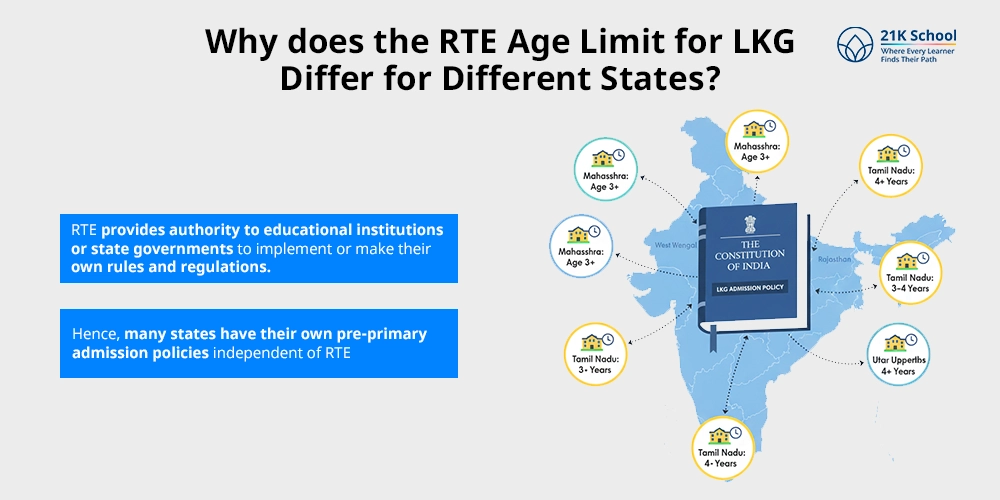
The RTE age limit varies for different states because of flexibility given by RTE Act.
RTE provides authority to educational institutions or state governments to implement or make their own rules and regulations. Hence, many states have their own pre-primary admission policies independent of RTE
However, the RTE Act is a national Act that mandates free education to all between the age group of 6 to 14.
Another reason due to which the age limit differs is because of the state autonomy, which means as per the 42nd Amendment Act of 1976 states that both state and central government are applicable to implement and change educational criterias.
Along with that every state has their own set of rules and policies, due to which states have to set their own RTE admission age limit.
Lets explore the detailed guide on LKG age limit criteria.
Guidelines for Admission into LKG under RTE Age Limit
RTE has introduced some age guidelines related to the admission of children in LKG. As per it, the admission age children can start enrolling in pre-primary in 3 to 6 years, however the age limit varies as per the state policies.
Parents thinking of their child’s admission need to see the RTE admission guidelines. Here are the mentioned guidelines of RTE admission for LKG.
1. Application Timelines
The application time line for LKG admission varies state to state. For one academic year the admission of children usually starts from February and continues till March to May.
However, the admission timeline varies from state to state and school to school. The application process for 2026 can be expected to begin from January 2026 and after final seat allocation lottery based admission will be conducted from the beginning of or end of February.
However, the dates for the application time line will vary. Parents are requested to check the application timeline on the official website of the respective state.
2. Documents Required
Children who are taking admission in LKG under RTE Act, need to submit some essential documents. These depend on the specific state-wise requirements, board requirements, and other school details.
Parents have to check the official RTE website to check which documents are needed.
Parents need to submit scanned copies of all the necessary documents along with original copies for verification. The following are some of the documents that may be needed for LKG admission.
- Birth Certificate Original and Scanned Copy
- Passportsize Photograph of Children (2 Copies)
- Transfer Certificate (If Applicable)
- Aadhar Card of Children (If Applicable)
- Income Details of Parent (based on state’s limitations)
- Caste Certificate (if Applicable)
- Parents ID Proof (Aadhar Card, Passport, Ration Card, Voter ID Card)
- Disability Certificate (If Applicable)
3. Application Process
The application process for RTE admission is mostly the same, however it may slightly differ for different states.
Parents can check the application process for admission of children into LKG by visiting the official website of state RTE policy.
3.1. Select RTE Scheme
Parents can start enrolling their child into LKG under the RTE scheme by selecting the schools available in the area.
Parents can check the list of schools on the official website that follows the RTE scheme for LKG admission.
3.2. Fill the Application Form
For the admission of children parents need to fill out the application form by creating a portal in online mode only.
Now parents can enter all the necessary information about their child such as name, age, gender, caste etc. While filling out the application form parents have to make sure that all the information entered is correct.
3.3. Submit Documents
Now in the next step, parents have to submit scanned copies of the documents in online mode.
They need to submit a child birth certificate, passport size photographs, ID proof of parents, etc. Always check the documents more accurately before submitting.
3.4. Submit the Application Form
Once completed parents have to submit the application form by clicking on the submit button.
Along with online submission parents were also required to submit the application form in the school premises.
3.5. Wait for Lottery-Based Admission
Lottery system of admission is followed in the RTE based education because of limited seats.
If the admission rate is high for the applicable seat then a lottery is conducted. In such scenarios it is important for parents to keep an eye on the official website.
3.6. Admission Confirmation
If a student is selected in the lottery list, parents need to download the allotment letter and visit the allotted school with original documents for verification under deadline.
In the end, complete all the admission formalities mentioned by the school authority for successful admission.
State-wise RTE Admission 2026-27 Age Limit for LKG
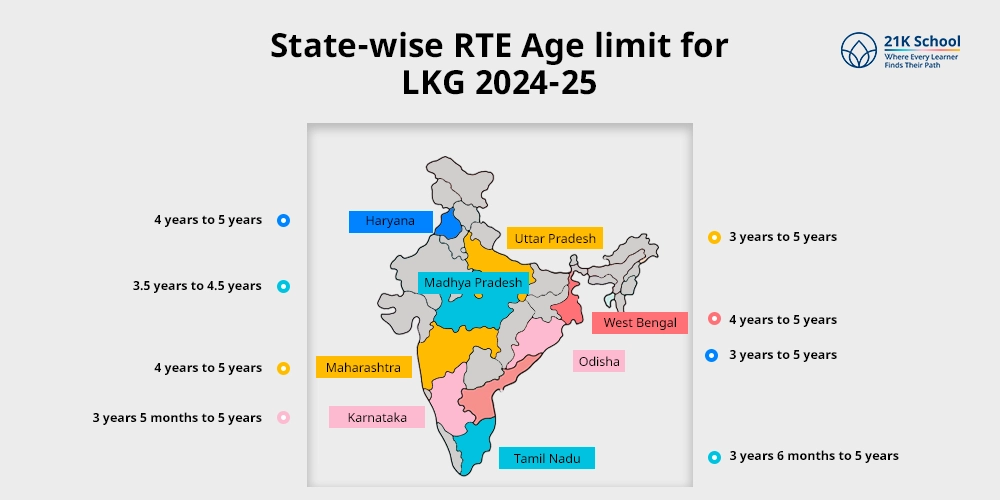
RTE age limit for LKG varies state to state however, the minimum age limit is around 4 years. According to the RTE Act children between the age group 6 to 14 should receive a compulsory and equal education.
The age limit also varies as per the policy of the state governments. Below you can check the state wise age criteria for RTE admission.
| States | RTE Age Limit (Approximate values) |
| West Bengal | 4 years to 5 years |
| Tamil Nadu | 3 years 6 months to 5 years |
| Karnataka | 3 years 5 months to 5 years |
| Maharashtra | 4 years to 5 years |
| Uttar Pradesh | 3 years to 5 years |
| Madhya Pradesh | 3.5 years to 4.5 years |
| Haryana | 4 years to 5 years |
| Odisha | 3 years to 5 years |
| Rajasthan | 3 to 6 years old |
| Andhra Pradesh | 3 to 6 years old |
| Gujarat | at least 3 years old and turn 4 years old before June 1 |
| Uttarakhand | 3 and 6 years old |
| Chhattisgarh | 3 to 5 years old |
State-wise RTE Admission 2026-27 Start Date
The RTE admission start date may vary state to state. To know the exact date, parents and students can visit the RTE official website.
According to the RTE Act each state releases its admission dates. Below you can check the state-wise RTE admission start date 2026:
1. Maharashtra
The Right to Education (RTE) Maharashtra admission for the academic year 2026-27 covers major cities such as (Mumbai, Pune, Marathi) through which children who are from EWS and disadvantaged groups can apply till 10 March 2026.
The given below is table of RTE Maharashtra 25% admission for academic year 2026-27. Go through the important dates of admission:
| Particulars | Dates |
| RTE Admission 2026-27 Start Date Maharashtra | 17 February 2026 |
| Last Date for Application | 10 March 2026 |
| First Lottery Draw Date | April 6, 2026 |
| Final Admission Confirmation | 30 June 2026 |
2. Tamilnadu
The Tamil Nadu RTE admission is about to start for children who are looking forward to taking admission. The notification has already issued The required TN RTE age limit for LKG admission is between 3 years to 4 years.
Here’s a quick overview of RTE Tamil Nadu Admission 2026-27 important dates and how to apply online under the 25% reservation under the Act:
| Particulars | Dates |
| RTE Admission 2026-27 process starts | April 2, 2026 |
| School displaying the number of available seats under the RTE 25% scheme | April 7, 2026 |
| Publication of available seats | April 15, 2026 |
| RTE Tamil Nadu admission application dates | April 20 to May 18, 2026 |
| Documents submission dates | April 22 to May 19, 2026 (before 5 pm) |
| Publication of the eligible and rejected applicant lists | May 20, 2026 |
| Lottery date (if applications exceed seats) | May 22, 2026 |
| Final RTE TN admission process | May 25 to 27, 2026 |
| Admission process ends (schools submitting final admission report) | May 29, 2026 |
3. Karnataka
For the 2026-27 academic year, Karnataka RTE admission is about to start. Individuals must check the official Karnataka education portal for detailed information.
The mentioned data showcasing the RTE Karnataka 2026-27 admission important dates to apply online:
| Particulars | Dates |
| RTE Karnataka 2026-27 online application open date | April 21, 2026 to May 17, 2026 |
| Verification of Application Form Start Date | April 16, 2026 |
| Scrutiny for Special Category Application Forms Start Date | April 16, 2026 |
| Enrollment Begins in Schools Start Date | May 22, 2026 |
4. Rajasthan
The Rajasthan RTE admission applications for the 2026-27 session are expected to be available for children. Visit the official RTE Rajasthan website.
Get a quick overview on the RTE Rajasthan 2026-27 online admission important dates:
| Particulars | Dates |
| RTE Rajasthan 2026-27 online application open date | Last week of March 2026 |
| Last Date for Application | March 10, 2026 |
| First Lottery Draw Date | March 12, 2026 |
5. Andhra Pradesh
The AP RTE (Andhra Pradesh Right to Education) age limit for free admissions into private schools for the 2026-27 academic year. Parents can apply after checking the eligibility.
The RTE Andhra Pradesh admission important dates:
| Particulars | Dates |
| RTE Admission 2026-27 Andhra Pradesh Start and End Date | 17 April 2026 – 28 April 2026 |
| Eligibility of Students List | 16 May 2026 |
| 1st round lottery results | 21 May 2026 |
| 2nd round lottery results | 6 June 2026 |
| Student Admission Last Date | 12 June 2026 |
6. UP
The UP RTE Admission Status 2026 is now active. Parents can apply and check their application status through the official portal. To know more go through the RTE UP admission 2026 online date:
The RTE UP admission important dates: rte up admission 2026 online date:
| Particular | Phase 1 | Phase 2 | Phase 3 |
| Admission Form Dates | 02 Feb – 16 Feb 2026 | 21 Feb – 07 Mar 2026 | 12 Mar – 25 Mar 2026 |
| Last Date for Verification and Locking | February 2 to 16, 2026 | February 21 to March 7, 2026 | March 12 to 25, 2026 |
| Lottery Draw Date | 18 Feb 2026 | 09 Mar 2026 | 27 Mar 2026 |
| Issuing Enrollment Orders | 20 Feb 2026 | 11 Mar 2026 | 29 Mar 2026 |
7. West Bengal
People who are residing near West Bengal can seek the RTE Admission 2026-27 Start Date West Bengal. The given table help you to understand the RTE West Bengal admission important dates:
| Particulars | Dates |
| RTE Admission 2026-27 Start Date West Bengal | 11 Dec 2025 |
| Last Date for Application | 14 Dec 2025 |
| Lottery Draw Date | 21 Dec 2025 |
| Lottery Result Publish Start and Last Date | 23 Dec 2025 – 28 Dec 2025 |
8. Haryana
Under the RTE Act, Haryana reserves 25% seats in private unaided schools for children belonging to Economically Weaker Sections and Disadvantaged Groups.
The below-mentioned table is a quick guide to understand the important dates of RTE Haryana online form 2026-27:
| Particulars | Dates |
| RTE Admission 2026-27 Start Date Haryana | March 31, 2026 |
| Last Date to Apply Online | April 7, 2026 |
| Lottery Result Date | April 9, 2026 |
| Admission Date | April 10-23, 2026 |
9. Gujarat
Gujarat conducts one of the most organised RTE admission processes through its dedicated online portal. Check out some of the crucial details of RTE form online date 2026-27 Gujarat:
| Particulars | Dates |
| RTE Admission 2026-27 Start Date Gujarat | Late February 2026 |
| Last Date to Apply | Last until mid-March 2026 |
| Lottery Result Date | – |
| Admission Date | – |
10. MP
Madhya Pradesh RTE admission cycle follows strict deadlines. It often releases multiple allotment rounds if seats remain vacant
Here are the expected and reported dates for the Right of Children to Free and Compulsory Education Act (RTE) 2026-27 in Madhya Pradesh:
| Particulars | Dates |
| RTE Admission 2026-27 Start Date MP | March 13, 2026 |
| Last Date to Apply | March 28, 2026 |
| Lottery Date | April 2, 2026 |
11. Uttarakhand
Uttarakhand provides 25% reservation in entry-level classes in private schools under RTE. It encourages eligible families to apply under deadline.
Go through expected RTE online registration uttarakhand last date to apply within deadline:
| Particulars | Dates |
| RTE Admission 2026-27 Start Date Uttarakhand | Likely early February 2026 |
| Last Date to Apply | Usually late February to early March 2026. |
| Lottery Result Date | – |
| Admission Date | – |
12. Chhattisgarh
Chhattisgarh follows the RTE admission process with a strong focus on transparency. To apply parents must be aware of important dates.
Find all the important details related to the RTE admission 2026-27 start date of Chhattisgarh:
| Particulars | Dates |
| RTE Admission 2026-27 Start Date Chhattisgarh | February 16, 2026 |
| Last Date to Apply | March 31, 2026 |
| Lottery Result Date | – |
| Admission Date | – |
13. Odisha
Odisha implements RTE admissions through its state-managed online portal. This ensures equal opportunity for eligible children.
The RTE admission date in Odisha will start by 27th March 2026. The details are available on the RTE Odisha and the important dates are as below:
| Particulars | Dates |
| RTE Admission 2026-27 Start Date Odisha | 27 March 2026 |
| Last Date for Application | 10 June 2026 (Extended) |
| First Lottery Draw Date | 24th April 2026 (Revised) |
| Final Admission Confirmation | 10 June 2026 (Extended) |
Understand the Right CBSE Age Limit for LKG Kids.
Eligibility Criteria for RTE Admission
Understanding the eligibility criteria helps in the application process of RTE:
- The age requirement should be between 3 to 6 years for pre-primary (Nursery/LKG) and 6 to 14 years for Class 1 and above.
- Income of EWS families may vary in States. It can be from 1 lakh rupees in Maharashtra to 6 lakh rupees in Gujarat.
- To become eligible for RTE, children must be from disadvantaged groups such as:
- Scheduled Castes (SC)
- Scheduled Tribes (ST)
- Other Backward Classes (OBC), or with special children with disabilities (40% or more disability)
- The child must be a resident of the state where admission is sought.
RTE Act 2009: A Glance
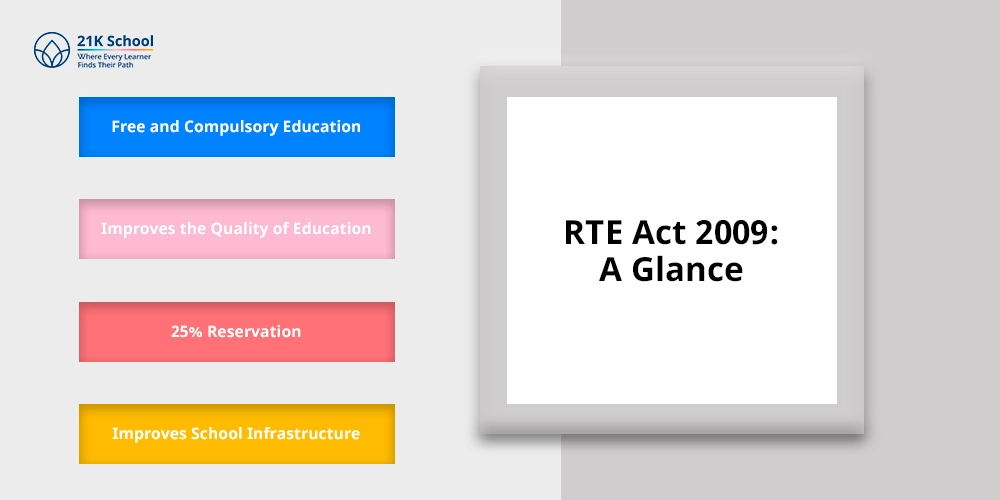
RTE Act was introduced in the year 2009 by the Parliament of India, which states that every student should receive free and compulsory education between the age group of 6 to 14. Later in the year 2010, RTI became a fundamental right of every child.
Under the RTE Act every government school or government approved school has to provide free elementary education to economically poor children.
This Act also provides admission to children who are unable to take admission due to insufficient documents or age criteria.
This Act is also known for prohibiting punishments and capitalised fees. Here you can check some other features of RTI.
1. Free and Compulsory Education
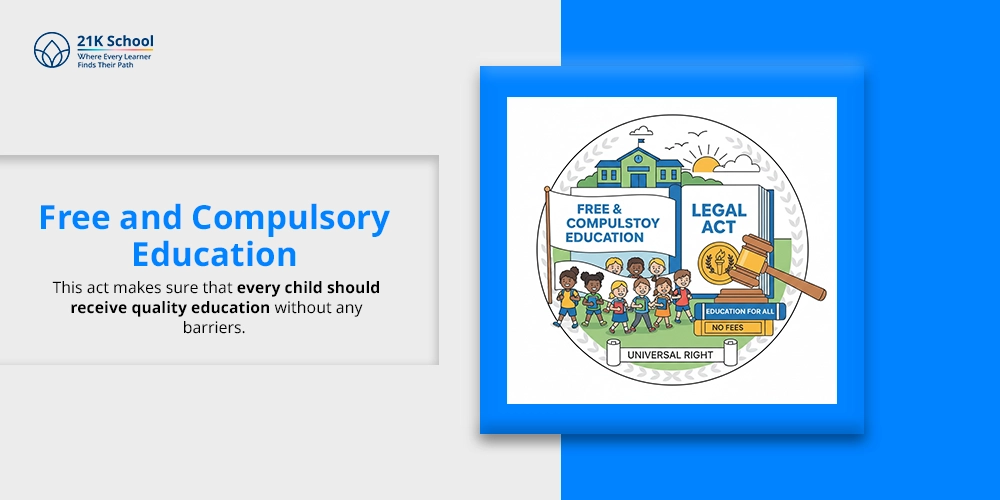
The main aim of the RTE Act is to provide students with free and compulsory education. This act makes sure that every child should receive quality education without any barriers.
This Act focuses on providing extra support to economically weaker students as well as allows schools to follow the same guidelines for admission. Another major aim of this Act is to eliminate the illiteracy rate.
2. Improves the Quality of Education
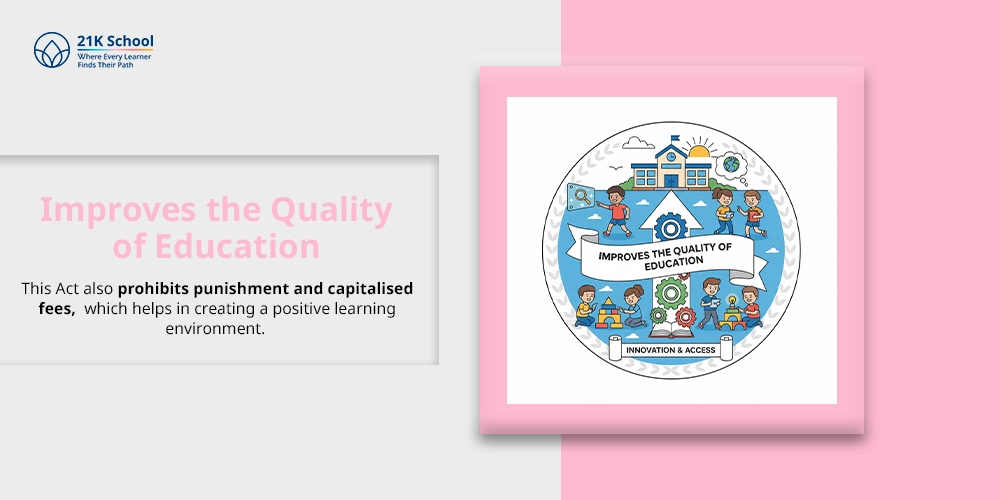
The RTE Act focuses on improving the quality of education by implementing new standards of education and providing extra guidance to students.
This Act also prohibits punishment and capitalised fees, which helps in creating a positive learning environment.
Through providing teachers training as well as improving the educational standards are another objective of RTE.
3. 25% Reservation
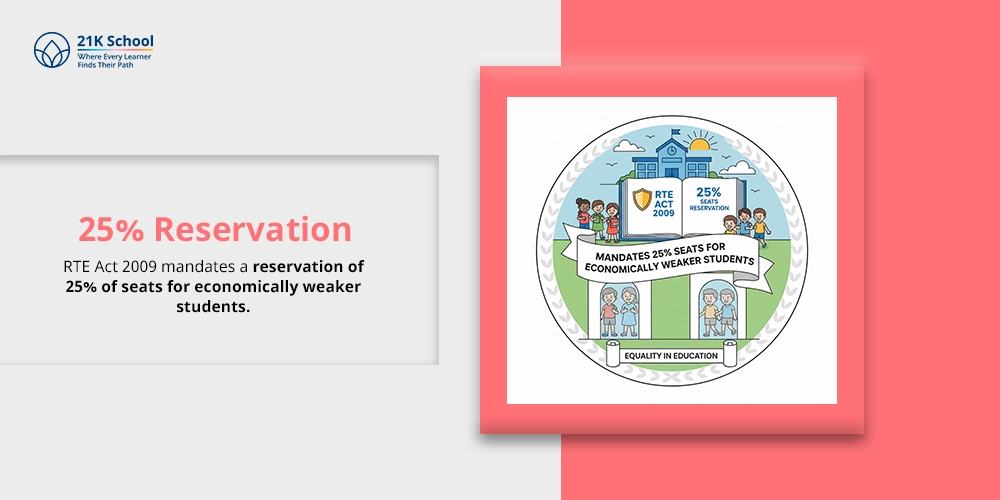
RTE Act 2009 mandates a reservation of 25% of seats for economically weaker students. As per the RTE Act every school where it is private or self financed schools have to keep 25% of seats reserved for poor children.
The main objective of the reservation is to make sure that no student should left behind studies and receive equal learning opportunities.
4. Improves School Infrastructure
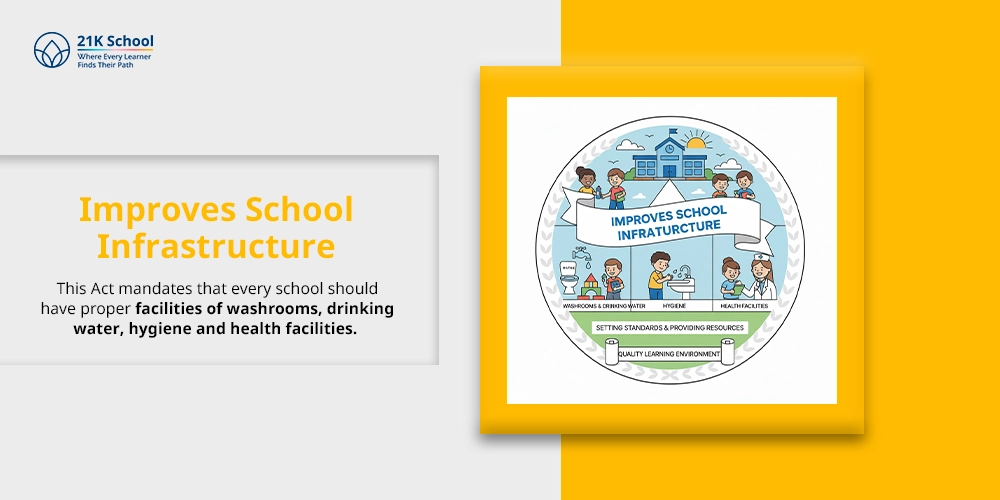
Another significant objective of RTE is to improve the infrastructure of schools by setting standards and providing necessary resources.
This Act mandates that every school should have proper facilities of washrooms, drinking water, hygiene and health facilities.
Conclusion
As per the Right to Education (RTE) Act 2009, 6 to 14 years’ old children have a right to admission for free and compulsory education, which also includes the entitlement of a 25% reservation in seats in private schools for children of economically weaker sections.
Even though the Act primarily concerns elementary education, several states have assimilated the RTE’s stipulations for admissions into LKG as well.
As for the age limit to be eligible for LKG under RTE for 2026-27, the state-wise variation can be noted as: in Karnataka, Maharashtra and Haryana the age is between 4 to5 years, while Tamil Nadu and Uttar Pradesh start admissions from 3 years of age.
The online application process takes place through the state’s RTE portal and usually opens between January and March, although this varies by state.

You may also want to read