

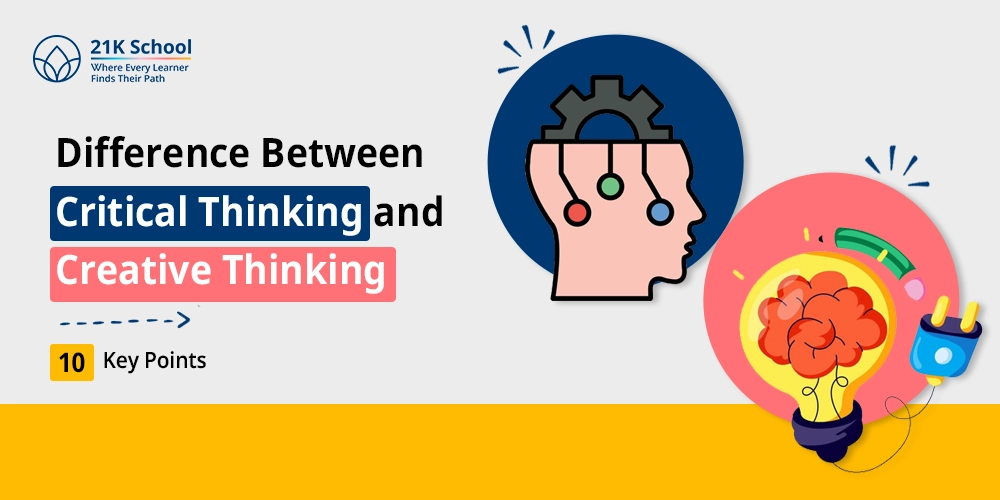
Critical thinking and creative thinking are two important skills a learner must have to improve their abilities both in academic and personal life.
But the question is: Do you really understand the key difference between critical thinking and creative thinking?
This blog will clear all your doubts related to the difference between critical thinking and creative thinking through meaning, examples and 10 key points.
Contents
What is Critical Thinking?
Critical thinking simply means objective analysis and evaluation of a problem or challenge to find a well-supported judgment.
Critical thinking is essential to analyse, evaluate, and make unbiased judgments. It allows individuals to comprehend several issues with facts and information and then draw a conclusion.
To incorporate critical thinking, facilitators and parents can incorporate several activities which are helpful for a child’s mental growth.
Some popular critical thinking activities are:
- Sorting objects
- Reading
- Sudoku challenges
- Decoding riddles
- Maze
- Rhyming game
- Board games
In this way, learners can choose what they like the most. Explore key strategies to foster critical thinking in students.
To understand in depth, let’s take some examples related to critical thinking in children.
Examples of Critical Thinking
It’s time to understand some real-world examples of critical thinking in education :
- Learners use several techniques, logic, and reasoning to resolve mathematical questions.
- Learners use critical thinking skills for research and data analysis to create solutions.
- To ask appropriate questions after the completion of a chapter or topic, critical thinking helps in analysing effectively.
What is Creative Thinking?
Creative thinking simply means the ability to think of unique solutions to particular problems for better outcomes.
Through creative thinking, individuals speculate outside the box, which makes them unique in particular cases.
Creativity doesn’t mean building something new from scratch. It also means improving existing solutions or simplifying the process for better results.
Through creative learning , students can improve several skills, including creative drawing or painting ideas.
Examples of Creative Thinking
- A student designed several creative portfolio ideas to become creative in his photographic field.
- A teacher in the classroom explaining fractions through a pizza slice.
Explore several creative activities for kids especially designed to enhance the artistic or innovative nature of children.
10 Key Differences Between Critical Thinking and Creative Thinking
To understand the key differences between critical thinking and creative thinking, go through the following table and explanation:
| S.No. | Particulars | Critical Thinking | Creative Thinking |
| 1. | Perspective | Analysing existing information | Generating new ideas/solutions |
| 2. | Approach | Objective evaluation | Open-minded exploration |
| 3. | Goal | Identify flaws/biases. | Foster innovation |
| 4. | Focus | Evaluating data and evidence | Exploring novel possibilities |
| 5. | Timeframe | Immediate problem-solving | Solution-oriented creativity |
| 6. | Outcome | Informed decisions | Innovative solutions |
| 7. | Process | Systematic analysis | Divergent thinking |
| 8. | Mindset | Scepticism and objectivity | Open-mindedness |
| 9. | Tools | Logic and reasoning | Imagination and ideation |
| 10. | Application | Problem diagnosis | Novel idea generation |
1. Perspective
Critical Thinking: Critical thinking is essential to analyse and evaluate existing data or information to generate solutions.
Through critical thinking, learners are able to generate effective results by analysing:
- Several facts and arguments
- Seeking evidence
- Understanding different situations
With the help of errors, gaps, and inappropriate circumstances, learners find out the best way to deal with them.
Creative Thinking: The key perspective of this skill is to generate innovative or improvement ideas that can change the results.
Designing a new house from scratch to showcase uniqueness is an ideal example.
2. Approach
Critical Thinking: To find the ideal solution, critical learners often engage in objective evaluation.
They follow steps systematically to avoid wrong or poor decisions. In this way, one can fulfil their goals.
Creative Thinking: Creative thinkers explore with an open-minded approach through which they can focus on end results.
3. Goal
Critical Thinking: The goal of critical thinking is to identify flaws or biases. In this way, learners can avoid wrong or poor decisions.
A critical thinker aims to get accurate and reliable solutions through existing information.
Creative Thinking: The goal of creative thinking is to foster innovation.
Through this, students can find new possibilities, ideas and solutions.
4. Focus
Critical Thinking: Including critical thinking helps learners to focus on data understanding and evaluation. By careful monitoring, individuals can evaluate and obtain data to provide better outcomes.
Creative Thinking: The main focus of creative thinking is different from critical evaluation. Creative thinking makes sure learners seek new possibilities.
This is one of the major differences in critical and creative thinking.
5. Timeframe
Critical Thinking: The timeframe is comparatively short and solution-oriented in critical thinking. It is often used for problems which need immediate solutions.
Creative Thinking: Creative thinking is different from critical thinking. It is future-oriented and focuses on effective and innovative long-term solutions.
6. Outcome
Critical Thinking: The outcome of critical thinking is informed decisions through which learners solve problems accurately.
For example, learners often use various platforms to gather maximum information to make the right decisions.
Creative Thinking: The outcome of creative thinking is innovative solutions which promote uniqueness and freedom to think.
7. Process
Critical Thinking: In critical thinking, learners mainly follow a specific structure. It generally includes:
- Collection of information
- Evaluating evidence
- Looking for several assumptions
- Comparing different alternatives to choose a specific one
- Drawing logical conclusions
Creative Thinking: In creative thinking, learners don’t follow any structure. It relies on divergent thinking.
This means learners are open to thinking of multiple innovative ideas and possibilities.
8. Mindset
Critical Thinking: The mindset of a critical thinker is based on scepticism and objectivity.
Creative Thinking: Open-mindedness comes through creative thinking where individuals understand the challenge of finding something new.
9. Tools
Critical Thinking: Students often look for effective tools to improve their critical abilities, such as logic, evidence, analysis, reasoning, etc.
Through logical reasoning, learners can solve several problems.
Creative Thinking: Some common tools used to motivate creative thinking are:
- Imagination
- Storytelling
- Brainstorming
- Mind mapping
- Experimentation
- Innovation techniques
These are known as imagination-based tools which encourage learners to think in an original and fresh way.
10. Application
Critical Thinking: The application of critical thinking is based on diagnosis. It can be commonly used in several domains including finance, academic research, law, risk management, etc.
Creative Thinking: It is generally applicable in an improvement or innovation environment like business innovation, art and design, education, software, etc.
Conclusion
Both skills are not competitive. Instead, they can go hand in hand where students effectively improve to become successful in their desired fields. In education, both forms of thinking are required to increase the possibility of growth.
As a teacher, one should encourage students to implement several activities to promote critical and creative thinking skills. It’s time to develop both together to increase knowledge.

You may also want to read