

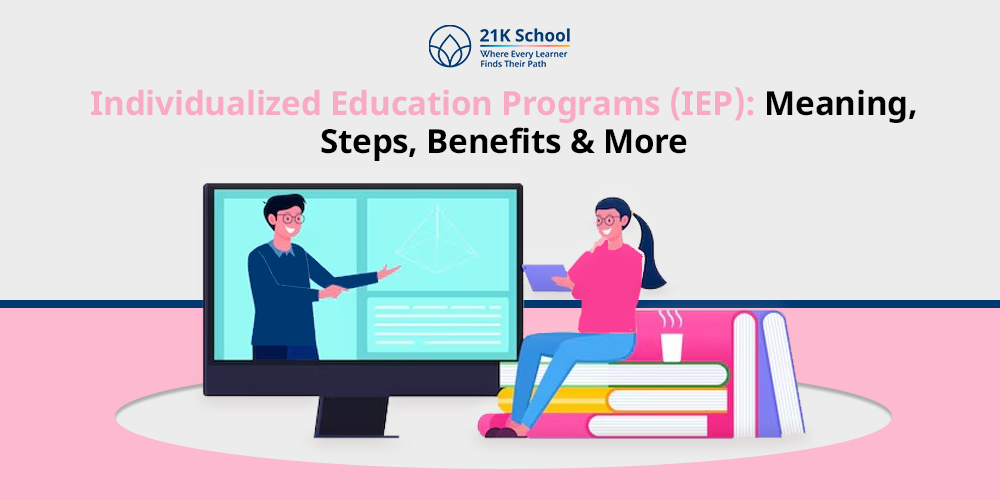
With time, the number of students with disabilities are increasing and to make their personal and professional journey impactful, customised education is essential.
To make learning effective for students with disabilities, Individualized Education Programs are a powerful approach.
Students with Individualized Education Programs receive educational services designed to their needs. Let’s check out everything in detail in the blog.
Contents
- 1 What are Individualized Education Programs?
- 2 History of Individualized Education Programs
- 3 Importance of Individualized Education Program
- 4 Who Needs Individualized Education Programs?
- 5 Individual Education Program for Disabled Children
- 6 Real-Life Examples of Individualized Education Programs
- 7 Individualized Education Programs: 5 Easy Steps
- 8 5 Benefits of Individualized Education Programs
- 9 5 Common Challenges in Implementing Individualized Education Programs
- 10 5 Important Roles of Special Educators in Individualized Education Programs
- 11 Conclusion
What are Individualized Education Programs?
The Individualized Education Program is also popular as IEP. It is an educational program created for special needs children aged 3 to 21.
Through special needs children get extra help and support from their teachers and special educators. It makes learning impactful for students.
In this way, student’s strengths, weaknesses, challenges, and strategies can be measured effectively.
History of Individualized Education Programs
The Individualized Education Program originated in the U.S. with the landmark Education for All Handicapped Children Act (EHA) of 1975 (Public Law 94-142). Major milestones in IEP history includes:
- Pre-1970s
Disabled children were often excluded from public schools or segregated into separate, inadequate settings which impacted them negatively.
- 1973, Rehabilitation Act
It guaranteed civil rights and accommodations for disabled children in schools.
- In 1975, the Education for All Handicapped Children Act (EHA) (P.L. 94-142)
This was an effective step that mandated IEPs. It ensures a Free Appropriate Public Education (FAPE) in the Least Restrictive Environment (LRE).
- 1986, EHA Amendments
Extended services to infants and toddlers with disabilities.
- 1990, Individuals with Disabilities Education Act (IDEA)
Later, IDEA was renamed EHA, focusing on person-first language and rights.
- 1997, IDEA Amendments
Required IEP teams to consider general education curriculum , increasing inclusion efforts.
- 2004, Individuals with Disabilities Education Improvement Act (IDEIA)
Increased accountability and aligned IEPs with No Child Left Behind goals and focused on assessments for eligibility.
Importance of Individualized Education Program
IEP is essential for students with disabilities growth and development. It is important because:
- It helps to identify students strengths, needs, and learning styles to offer customised approaches.
- IEP promotes collaboration and communication to fulfill academic objectives.
- Individualized Education Program instead of academic goals focus on overall development including social, emotional, and behavioral growth.
- IEP offers opportunities to special needs children to support students to reach their full potential.
Who Needs Individualized Education Programs?
Not every child with disabilities is eligible and needs an Individualized Education Program.
That’s why to find out if a learner fits for the program, check out the 14 categories under IDEA, according to the law.
The categories include:
- Autism spectrum disorder
- Deaf-Blindness
- Deafness
- Speech or Language Impairment
- Traumatic Brain Injury
- Emotional Disturbance
- Hearing Impairment
- Intellectual Disability
- Multiple Disabilities
- Orthopedic Impairment
- Other Health Impairment
- Specific Learning Disability like dyslexia , dysgraphia , and dyscalculia
- Visual Impairment
- Developmental Delay (ages 3-9)
The federal regulations define 13 mandatory disability categories for children ages 3 to 21 the 13 disability categories under IDEA. The 14th category “developmental delay” is optional.
Individual Education Program for Disabled Children
Individual Education Program is effective for students with disabilities. It is customised for team members to collaborate with parents to customise plans for a single student’s need.
The approach provides effective teaching strategies for special needs students . In this way, educators and parents on how to manage children with disabilities.
Real-Life Examples of Individualized Education Programs
- Students instead of completing regular assessments break into small parts.
- Teaches implementing inclusive learning in the classroom to support and assist students with disabilities.
- Teachers support students by creating positive learning environments by guiding them how to learn effectively.
Individualized Education Programs: 5 Easy Steps
Individualized Education Programs can be implemented by 5 easy steps:
1. Referral for Evaluation
The first step of Individualized Education Programs is referral for evaluation where schools, teachers or parents request and evaluate whether children have any disabilities.
2. Evaluation and Eligibility
The evaluation is done through a preplanned assessment given to students. Their strengths and weaknesses are effectively measured to customise learning.
Then a group of people analyses and decides if the student qualifies for an IEP under IDEA.
3. IEP Meeting and Development
After confirmation of students eligibility, the team communicates and collaborates to build an Individualized Education Program (IEP) for the children.
The involvement of parents and the school make the process effective for children. Teachers, specialists, therapists, or anyone advocating for the child on a personal level are invited to participate.
4. Implementation
The next step is to implement the plan written with services. Parents also get a copy to understand in-depth.
5. Monitoring and Review
In the end, the team tracks the student’s progress and analyses the growth.
In Individualized Education Programs, a reevaluation must be done at least once every three years unless the parent and LEA agree that a reevaluation is not necessary.
5 Benefits of Individualized Education Programs
Individualized Education Programs are beneficial for special needs students. Some common benefits one must consider are:
1. Personalised Learning Experience
IEP offers students personalised learning experience in which they learn through customised instruction, pace, and content. It is tailored to strengths, needs, interests, and learning style.
2. Improved Academic Performance
With the use of IEPs academic goals, learning strategies, and instructions are designed to improve academic performance.
It allows students to learn concepts effectively and monitor their progress.
3. Better Emotional and Social Development
With academic progress Individualized Education Programs are also beneficial for students emotional and social development.
Here, children learn various skills including self-awareness, self-regulation, resilience etc.
4. Enhanced Student Engagement
Individualized Education Programs help to enhance students engagement towards learning by reducing frustration through appropriate, personalised and position environments.
5 Common Challenges in Implementing Individualized Education Programs
While implementing Individualized Education Programs, individuals often face various challenges related to education. Top 5 common challenges include:
1. Lack of Trained Professionals
While implementing Individualized Education Programs often shortage of trained professionals lead to learning difficulties.
Some common difficulties such as poorly designed or inconsistently implemented IEPs for special needs students.
2. Limited Resources in Schools
One of the common reasons such as limited resources in schools impact negatively on students’ development.
It hinders the delivery of desired resources on time.
3. Large Classroom Sizes
Large classroom sizes are also a challenge faced by teachers while implementing IEP in the classroom.
4. Parental Awareness gaps
Parents play a major role in child learning. But, lack of awareness can impact negatively to implement to address the specific, unique needs of the student.
5. Attitudinal Barriers
Negative attitudes often become a challenge to implement IEP in the classroom.
5 Important Roles of Special Educators in Individualized Education Programs
The roles played by special educators in Individualized Education Programs are diverse. Key roles of special educators in IEPs:
1. Curriculum Redesigning
Special educators modify or redesign curriculum through Individualized Education Programs to make students learning effective and meaningful.
2. Data Collection and Progress Monitoring
Special educators monitor students’ growth and collect data to evaluate progress. This helps them to design curriculum for better learning.
3. Development of Individualized Education Plans (IEPs)
For the development of Individualized Education Plans (IEPs), special educators work on students’ day-to-day activities. They connect with parents, general education teachers, and therapists for better understanding.
4. Enhancing Emotional Well-being and Social Inclusion
IEP supports growth of students with disabilities by enhancing their emotional well-being and social inclusion.
In this way, students become self-confident, collaborative, and work in a team.
5. Collaboration with Teachers and Training
For easy implementation of IEP, special educators collaborate with other teachers and parents to ensure consistency, inclusivity, and holistic development of the children with disabilities.
Conclusion
The guide is a detailed analysis of IEP which showcases the requirement of special needs students educational journey.
The goal of the Individualized Education Program or IEP is to ensure learners get the special services they need. It’s the teachers and parents’ responsibility to implement effectively.
Today, IEP supports and encourages students to achieve educational goals. In this way, every learner with a disability gets an equal opportunity to learn and succeed in life.

You may also want to read