

You would have noticed that education has been very different from what it has been earlier.
This is due to the modernization in education, which involves changed teaching methods , inclusion of technology, classroom infrastructure, and assessment .
The evolved education is more aligned towards personalized learning that centers the needs and capabilities of students.
This article will dive deeper into the concepts of modernization in education. You will also read about the need for this modernization along with its features, aspects, and challenges.
Contents
- 1 What is Modernization in Education?
- 2 Need for Modernization in Education
- 3 4 Key Features of Modernization in Education
- 4 Role of Technology in Modernizing in Education
- 5 4 Modern Teaching Methods for Modernization in Education
- 6 Modernization of Curriculum in Modernization in Education
- 7 Modern Assessment and Evaluation
- 8 Modernization in Education and Teacher’s Role
- 9 5 Impacts of Modernization in Education on Students
- 10 Modernization in Education in India
- 11 Modernization in Education and Inclusive Education
- 12 6 Challenges of Modernization in Education
- 13 Future of Modernization in Education
- 14 Conclusion
What is Modernization in Education?
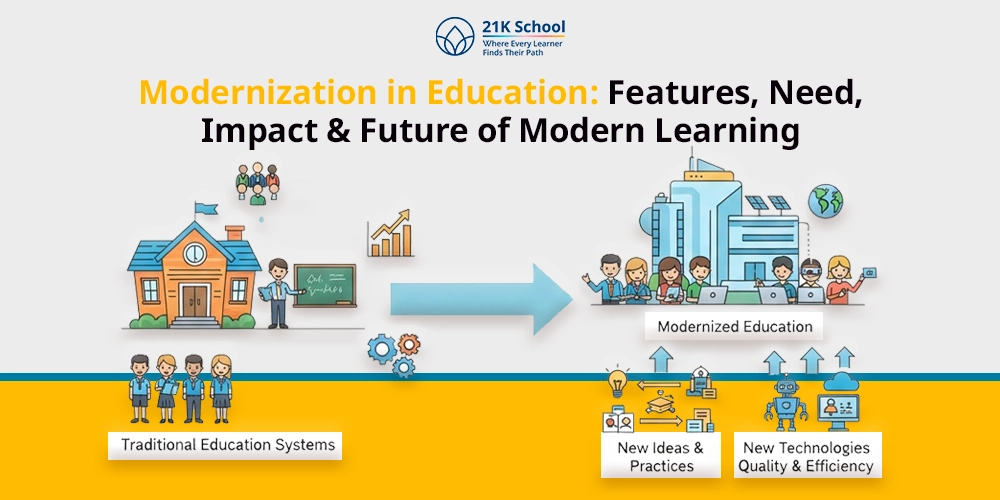
Modernization in education is defined as the advancement of the traditional education systems to suit various social, economic, technological, and cultural requirements in the present society.
It is about acquiring new ideas, practices, and technologies to enhance the quality and efficiency of teaching and learning .
Modernization encourages new and enlightened student-driven techniques, instead of traditional techniques including textbook-based learning.
Essentially, modernization in education focuses on complete growth of students.
This would incorporate intellectual development, emotional intelligence , ethics, creativity, and practical skills.
Contemporary education processes are designed not only to help students achieve academic success, but also to be active members of society.
Consequently, education is evolving to be more than just being a phase of life.
Other forms of structural changes achieved through modernization include changes in curriculum , competency, interdisciplinary education, and inclusive education practices.
It understands the fact that learners possess different needs, learning styles , and abilities, hence aims to promote customized and adaptive learning experiences.
Besides, modernization also incorporates global views, environmental awareness, and digital literacy in learning.
Before moving ahead, learn how to raise environmental awareness among young people .
Need for Modernization in Education
Modernization is required in education due to the significant changes happening in society and technology.
Among the main causes is the rapid shift in technology usage, its access, sharing, and use of information.
The problem with traditional education systems is the lack of effective learning experience, considering that nowadays one can get access to information with one click.
The students have to learn to analyze, evaluate, and apply knowledge instead.
The trend of globalization has further brought high demands like skills in communication, teamwork , cultural sensitivity, and flexibility.
The workplaces of the current days presuppose employing individuals able to work in various teams, think creatively, and solve complicated problems.
Unless education systems keep up with the new changes, there will always be a risk of graduating individuals that were never prepared to face the modern employment environment.
Modernization brings in a teaching approach that fits with the interests and learning abilities of today’s students, thus increasing motivation and learning outcomes.
Social equity and inclusion also provide more reasons for the necessity of modernization.
Along with that, modernization contributes to lifelong learning .
In a fast changing world whereby knowledge and skills are upgrading every other moment, it becomes important that individuals update their competencies.
4 Key Features of Modernization in Education
The most crucial features of modernization would include the following:
1. Shift from teacher-centered to learner-centered learning
Among other serious aspects of modernization in education is the transformation of teacher-centered to learner-centered learning.
Traditional classroom settings ensured that the knowledge was acquired mainly from the teacher and students passively just received it.
In the current education, however, the learners are put in the center of the learning process.
This promotes active participation and cooperative learning among students, making them feel included.
2. Curriculum reform
Another significant characteristic of the modernization in education is the curriculum reformation.
Earlier, curriculums and courses were based on abstract knowledge and strict discipline .
The curricula of today’s world are modernized with skills like critical thinking , problem-solving , communication, digital literacy, and ethical reasoning.
In modern times curricula are designed to be flexible, interdisciplinary, and competency-based with an emphasis on the real world.
3. Technology integration
Technology has been also incorporated lately in modern education which makes it another feature.
Digital tools (computers, tablets, interactive whiteboard and educational software) can be used to teach and learn.
With the use of technology, it is possible to gain access to a wide range of resources, online education , virtual simulations, and teamwork platforms.
Technology helps in personalized learning when well incorporated can enable students to learn at their own speed.
4. Continuous and formative assessment
The contemporary education process focuses on formative and constant evaluation, instead of depending on standardized tests in modernization.
The traditional testing techniques that involved memorization could induce exam-stress and inhibit innovation.
Formative assessment is the continual assessment in the form of quizzes, projects, presentations, discussions, and self-assessment .
Such a strategy makes the feedback right and students can be well-aware of their strengths and weaknesses.
Role of Technology in Modernizing in Education
Technology has largely contributed to modernization in education by the following ways:
1. Increased Accessibility of Education
Digital technologies have increased the accessibility of education as it destroys geographical and social boundaries.
Online learning systems, virtual classes, interactive tools, and learning materials enable students to have access to quality education from anywhere and anytime.
Technology makes the process interesting through interactive and student-friendly learning.
In fact, complicated ideas can be better illustrated by multimedia (videos, animations, etc.) and explained more easily.
The use of virtual and augmented reality tools offers immersion to learning environments, mostly in science and maths-based learning.
2. Fosters Personalized Learning
Another significant contribution of technology is personalized learning.
Adaptive learning systems assess the performance of the students and give them customized content according to the requirements.
This will make learners have the right support and challenges that will enhance learning.
3. Promotes Collaboration and Communication
Collaboration and communication is also facilitated by technology.
Learners are able to collaborate on online projects, engage in online discussions, and share with peers and professionals all over the world.
The result of this international communication is cultural awareness and the ability to work as a team.
4. Aids In Teaching
Technology, in the case of teachers, can be used to plan lessons, evaluate, and develop as a professional.
Data analytics serve to monitor the progress of the students, whereas online training allows teachers to develop the skills through continuous learning .
Altogether, technology is an agent of making education more efficient and innovative.
4 Modern Teaching Methods for Modernization in Education
The ways of teaching has changed over time and now it includes:
1. Project-based learning
Project-based learning is a new teaching method that focuses on learning skills with real-life projects.
Students are not memorizing as they are doing constructive tasks that involve research, problem-solving, and working with others.
Projects give the advantage of dealing with real life problems due to which learning becomes relevant and useful.
It promotes critical thinking and innovation as the students analyse complicated problems and solve them by themselves.
2. Experiential learning
Experience affirms experience which is the principle of experiential learning .
It is a more practical approach that focuses on practical activities and then reflecting on those activities.
Examples are experiments, field trips, internships, role-playing, and simulations.
Experiential learning provides students a good retention and learning method when they get to relate the theoretical lectures with the practicals.
3. Blended learning
Blended learning involves the integration of traditional learning in a physical classroom and online learning.
This approach provides the flexibility and customization feature, giving the students the opportunity to study in the classroom or online.
In blended learning classrooms, teachers can use the classroom time for discussions and interactive experiences, whereas online tools could provide access to powerpoint lectures and assessments.
Blended learning also fosters self-directed learning and digital literacy as it can cater to various learning styles and speeds.
4. Collaborative learning
Collaborative learning aids in teamwork of students to attain common learning objectives.
This approach focuses on collaboration, interaction, and support. Collaborative activities usually include group discussions, peer learning , and online group projects .
By working together, students can learn different points of view. This improves the skills of critical thinking and problem-solving.
Social and interpersonal skills are also developed in the process of collaborative learning which are necessary in the modern workplaces.
Modernization of Curriculum in Modernization in Education
Modernization in education focuses on modernizing the curriculum.
Modern curriculum drops only having subject-based knowledge, and is concerned with life skills, values, and attitudes necessary for excelling in modern day society.
In previous curriculums, studies were usually rigid, congested with material, and test-focused, while emphasizing on memorization.
On the contrary, a modern curriculum is flexible, learner oriented, and outcome-based.
A modernized curriculum is relevant to real-life situations.
Subjects are constructed in such a way that they can help identify theory with practice, so that learners can put their learning to practice.
There is promotion of interdisciplinary learning as students can be informed about the correlation between subjects like science, technology, social studies, and humanities.
In contemporary curricula, the focus also extends to the 21st century skills including critical thinking, creativity, communication skills , collaboration, digital literacy, and problem-solving.
The inclusion of life skills , value education , environmental education , and global citizenship is also increasing to enhance holistic development.
Regular review of curriculum helps in formulation of up-to-date content, corresponding with societal and technological developments.
Modern Assessment and Evaluation
The present assessment and evaluation system has ceased examination-based assessment systems, and has adjusted to more holistic evaluation systems.
Traditional systems were based on final tests that evaluated rote learning usually causing stress and inhibiting creativity.
The contemporary assessment is aimed at measuring knowledge, competencies, growth, and overall child’s development .
The concept of continuous and formative assessment is crucial in the current education system.
The methods used to evaluate the students are projects, presentations, quizzes, portfolios, group work, and classroom participation.
These approaches allow the learners to receive constant feedback, which gives them an understanding of their strengths and weaknesses.
Peer assessment and self-assessment help in reflection of responsibility and critical thinking.
Technology also assists in evaluation by means of online testing, data processing, and immediate responses.
Modernization in Education and Teacher’s Role
The role of teachers in the education system has been modernized in a great way.
Teachers are no longer viewed as sources of information but facilitators, advisors, mentors, and co-learners. This change symbolises the transition of the teacher-centered to the learner-centered education.
Modern teachers create fun learning activities for students so that they engage in inquiry and develop independent learning skills.
They establish inclusive classrooms that embrace diversity as well as cater to the individual learning requirements.
Educational technology is also introduced to learning, therefore teachers utilize the digital tools to provide learning and student-engagement .
In contemporary education, teachers have to continue their professional development .
To be effective, they have to revise their knowledge about subjects, pedagogical skills, and latest technology in education .
Teachers also teach values like empathy , ethical behaviour, and social responsibility to learners.
This is how a teacher plays a vital role in modernization in education to mold the learner in more than just academic spheres.
5 Impacts of Modernization in Education on Students
The shifts in modernization in education have impacted students in many ways.
1. Increased student-engagement
Modernization in education plays an important role in enhancing student involvement, as it helps in making learning interactive and enjoyable.
Students are willing to actively involve in the learning process when applied in learner-centered learning activities and technology.
Interested learners are more inclined to learn and gain deeper knowledge that could be remembered in the long run.
2. Develop real-life skills
Contemporary education focuses on development of real life skills like communication skills, team building, critical thinking skills , flexibility, and problem-solving skills .
Project-based learning, experiential activities, and collaborative tasks impart skills to the students that enable them to prepare for further education, jobs, and day-to-day lives.
3. Access to digital resources
Modernization would enable the students to have access to several digital learning tools in the form of e-books, online lessons, instructional videos, and internet libraries.
Such resources provide self-education and enable students to realize other doubts other than those in the textbooks.
It is also through digital access that equal learning opportunities are encouraged particularly in remote and underserved areas.
4. Global learning opportunities
Online education opens students to learning opportunities at the global level.
International partnerships and virtual classes enable students to communicate with other learners and teachers abroad.
This exposure can improve cultural awareness, global outlooks, and communication competencies, while preparing the students to work in a global world.
5. Personalized learning
Individualized learning is one of the key areas that modernization has added in education.
Flexible teaching modes and adaptive learning materials meet personal needs, interests, and abilities of the learner.
Students are able to study at their pace and get more specific support while becoming more responsible in the learning process.
Modernization in Education in India
Recently the pace of modernization in the education sector of India has increased because of social, economic, and technological developments.
The goal of educational reforms is to enhance quality, accessibility, and relevance at all educational levels.
There have also been changes in teaching, with the adoption of skill-based and competency-based education .
Reforms in curriculum are also shaped through National Education Policy (NEP 2020), focusing on experiences, critical thinking, creativity, and multi-disciplinary learning.
Online education opportunities have improved access to education, particularly in remote regions with digital initiatives, online learning platforms (DIKSHA, SWAYAM, etc.), and virtual classrooms.
Professional development and teacher training programs have been consolidated to work with the current teaching practices.
Modernization in education is also evident in India by ensuring that it aligns with the rest of the world and at the same time maintains the culture.
Modernization in Indian education aims to equip students to be able to grow nationally and compete globally by enhancing inclusion and technology-based learning.
Modernization in Education and Inclusive Education
Inclusion education is a key area of modernization in education.
Its goals are to offer equal learning opportunities to all learners irrespective of ability, gender, socioeconomic background, and cultural differences.
Diversity is met by inclusive education which uses flexibility in studies, adaptive teaching methods, assistive technologies, and supportive learning conditions.
Technology is an important tool that provides facilities like audio-visual aids or screen readers to aid the disabled learner.
Awareness, sensitivity, and positive attitude towards diversity is also encouraged through modernization.
Educators are focused on understanding the needs of learners and establish a comprehensive classroom in which each student feels appreciated and embraced.
6 Challenges of Modernization in Education
While modernization in education sounds so fascinating and appreciable, it has some drawbacks that need your attention:
1. Digital divide
Digital divide is the existing difference in access to technological advancements as well as internet access among the students.
Rich and privileged students can get the advantages of digital tools, but students of the rural background do not have any digital devices or good internet.
This can lead to educational inequality.
The problem of digital divide can be solved with government assistance, improvement of infrastructure, and access to technology at affordable rates.
2. Resistance to change
One of the biggest obstacles to the modernization in education is resistance to change.
The teachers, administrators, parents, and even the students themselves may not be ready to use new instructional techniques, technologies, or assessment systems.
The causes of this resistance are usually fear of the unknown, ignorance, or adherence to the old ways.
To break the resistance, it is necessary to have awareness and training.
3. Lack of training
Contemporary teaching requires teachers to acquire new skills including technological adequacy, new pedagogy, and student-centered learning .
Still, most teachers do not have sufficient training or professional development.
In the absence of necessary training, it would be chaotic to actively use modern tools and methods.
4. Inadequate infrastructure and funding
Modernization in education needs good infrastructure including smart classrooms , effective internet, and digital devices.
There are a lot of schools, particularly in the developing countries, which have limited finances and inadequate facilities.
Limited funds obstructs the implementation of new technologies and methods of teaching, thus slowing down the process of educational reform.
5. Over-reliance on technology
Though technology improves the learning process, over-reliance on technology may inhibit in-person communications, critical thinking, and emotional growth.
Too much use of technology can also result in screen fatigue and lesser hands-on learning activities.
Holistic education requires a balanced mode of utilizing technology with conventional modes of teaching.
6. Violation of ethics and data privacy
The advancements in the utilization of digital platforms pose threats to the privacy of data, cyber security, and ethical issues.
Unless good precautions are taken, students can have their personal information exposed to wrong hands.
Also, plagiarism, abuse of AI tools, and digital misconduct are the problems which question academic integrity.
Powerful ethical codes and data protection policies have become a necessary part of present-day education.
Future of Modernization in Education
Modernization holds a bright and evolving future in the field of education.
It is likely that more personalized and improved learning will be reached with the advancement of technology like artificial intelligence , virtual reality, and adaptive learning systems.
Education will be more flexible, skill-based, and accessible to learners over the geographical borders.
It can be expected that in the future, education systems will be more concerned with lifelong learning, interdisciplinary learning, and competency-based learning.
Institutions and schools will place more and more focus on creativity, innovation, emotional intelligence, and ethical values in addition to academic knowledge.
Instructional technology will also involve teachers as essential contributors in the form of mentors and facilitators with the aid of smart digital tools.
The future of education will also be determined by inclusiveness and sustainability.
The process of modernization will be directed towards reducing the inequalities in education and making sure no learner is left behind.
Through responsible innovation, education can equip future generations to address challenges that affect the global arena and enable them to serve society in a meaningful way.
Conclusion
Modernization in education is an initial step towards global reforms in education based on technological advancements and perception of skills.
Today, learners and teachers are more focused on acquiring real knowledge that can be utilized to either get future jobs in the 21st century or for lifelong learnings.
The teaching curriculum also shows a shift from being teacher-centered to being learner-centered.
The modernization in education still has so much to look forward to as we advance in artificial intelligence, virtual reality, and augmented reality.

You may also want to read